In the winter of 1944, Soviet infantry pushing through the woods around Nova Sakuliki observed something odd. The German soldiers were not pulling back. They were faltering. These were men who had lived through years of bloodshed and shellfire, eastern front veterans tempered by battle, and yet now they were slowing down, scanning the tree lines, refusing to move into open ground.
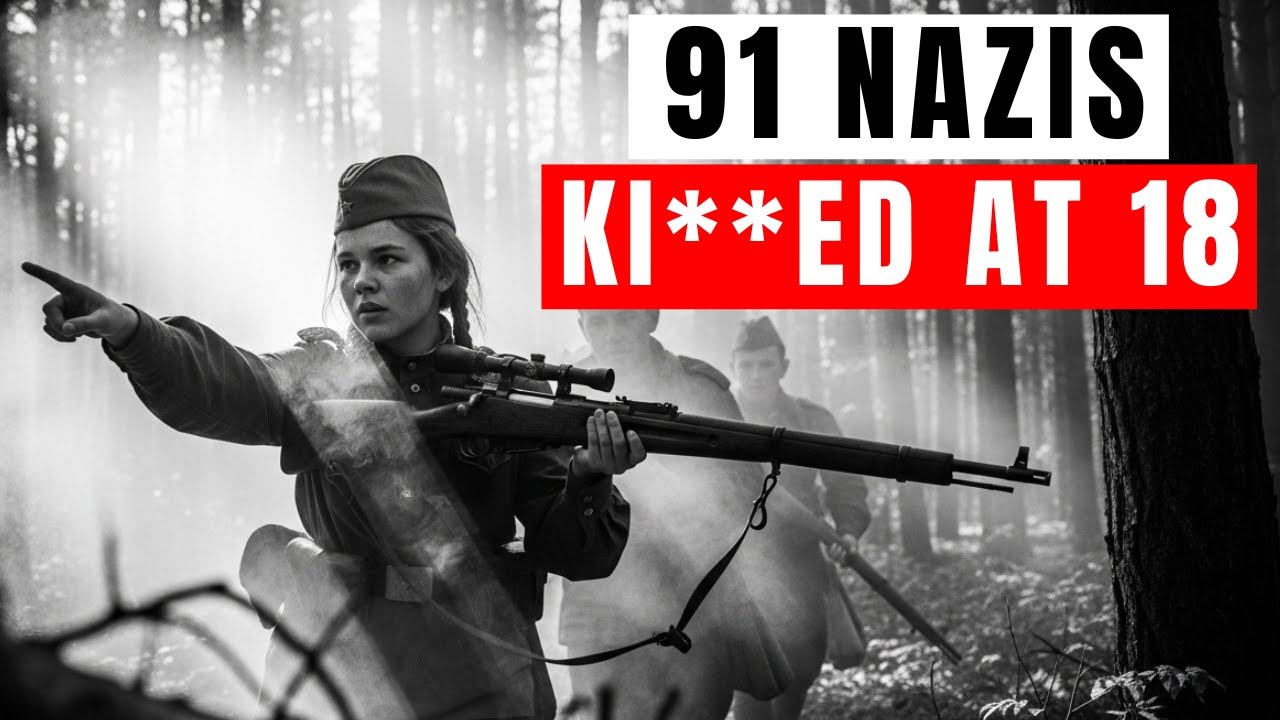
Something had shifted. The shots were coming from positions that made no sense. Single shots, flawless shots, men dropping midstep, mid command, mid breath. Officers murmured that a new sniper had appeared.
But nobody accepted the truth when word of it arrived. The sniper stalking them was not a hardened veteran, not a man steeled by years of fighting, not even an adult. She was 18 years old, small, silent, hardly visible under her winter cloak. Her name was Aliyia Mulakulovva.
And before the war was over, she would become one of the youngest elite snipers of World War II. Her last battle made her a martyr, remembered not for surviving, but for how fiercely she would not retreat. Aliyia was born in 1925 in a remote part of the Kazakh Soviet Socialist Republic. Her early years were shaped not by comfort but by absence.
Orphaned while still young, she passed between relatives before eventually being sent to Leningrad to stay with an uncle. It was there, long before the war, that Aliyia learned endurance. She had lived through hunger even before siege conditions made it legendary. She learned discipline in Soviet schools, where duty to the state was taught not as ideology, but as a means of survival.
When Germany invaded the Soviet Union in 1941, Aliyia was still a teenager. But she did not run. She endured the siege of Leningrad. She watched starvation hollow out whole neighborhoods.
She saw children vanish from classrooms, their desks left empty. She saw grown adults collapse in the streets and learned early that war was not something that arrived all at once. It crept in slowly and never left. When evacuation finally came, Aliyia did not see it as rescue.
She saw it as preparation. By 1942, the Soviet Union was losing soldiers faster than it could train them. Entire divisions were being rebuilt from nothing. The Red Army needed infantry, but it also needed specialists, snipers.
Women were already proving themselves in that role across the eastern front. Patience, discipline, observation—these were traits not taught quickly, but sharpened through necessity. Aliyia volunteered. Not once, not twice, but again and again.
At first, she was turned away. She was too young, too small, too frail. She was told she could serve in support roles—communications, logistics, clerical work. She refused.
Aliyia wrote letters. She argued her case. She trained on her own. She practiced marksmanship at every opportunity.
She learned fieldcraft by watching veterans, memorizing their movements, studying the terrain. In the end, persistence wore down resistance. In 1943, Aliyia was accepted into the Central Women’s Sniper Training School, one of the most demanding and unforgiving programs in the Soviet military. She did not celebrate.
She prepared. Sniper school was not romantic. It was isolation, repetition, and failure. Recruits learned to lie motionless for hours in freezing conditions.
They learned to calculate wind drift without instruments. They learned camouflage, not only visually, but behaviorally. Aliyia struggled at first, not with accuracy, but with endurance. She was smaller than most trainees.
Her body tired faster. The cold hit her severely. But she adapted. She trained longer than required.
She repeated drills after dismissal. She learned to ignore hunger and numbness. Instructors noticed something unusual. Not raw talent, but unshakable focus.
When Aliyia aimed, her hands did not tremble. Her marksmanship improved. She learned to relocate quickly after firing, a critical skill that separates the living sniper from the dead one. She also learned restraint.
Snipers were taught not to fire unless the shot mattered. Aliyia absorbed this lesson completely. By the time she graduated, she was no longer a student. Aliyia was assigned to the 54th Separate Rifle Brigade, operating in some of the most dangerous contested zones of the northwestern front.
This was not static trench warfare. This was forests, marshlands, shifting lines, and brutal infantry clashes at close range. Her first days at the front were quiet. Too quiet.
She observed. She learned enemy patrol patterns. She memorized terrain features. She studied how German soldiers moved when relaxed and how they moved when afraid.
Then came her first confirmed kill. There was no celebration, no announcement, just a quiet note in the log. Aliyia did not hesitate after that. Her confidence grew, not from pride, but from confirmation.
She had proven she could function under real fire. More importantly, she had proven she could kill and remain composed. Veteran soldiers began to notice her presence. Officers assigned her increasingly complex observation tasks.
She was paired with spotters and given independence. By the end of her early missions, Aliyia was no longer considered a trainee. She was considered reliable. And on the eastern front, reliability was everything.
Her early missions were not designed for glory. They were designed to test whether she could survive the rhythm of frontline warfare: long hours of silence broken by sudden violence, the constant threat of artillery, and the psychological weight of knowing that every mistake could be fatal. She was first assigned to observation-heavy sectors, where her primary responsibility was not killing, but watching. She tracked German patrols, counted numbers, noted patterns, identified habitual routes and resting points.
Many snipers failed here, not because they lacked accuracy, but because they lacked patience. Aliyia excelled. Her ability to remain still for hours became legendary even among veterans. She did not fidget.
She did not rush. She waited until the battlefield revealed itself. Only then did she act. Her first confirmed kills came not in dramatic duels, but in controlled, disciplined engagements.
A German soldier stepping out of cover too confidently. A machine gunner exposing himself for a fraction too long. A sentry who believed the forest was empty. Each shot was deliberate.
After every kill, Aliyia relocated immediately, sometimes crawling for long distances through snow and mud to avoid detection. She understood early what many learned too late: a sniper’s survival depended on movement as much as marksmanship. There was no hesitation afterward, no visible shock, no emotional collapse. She recorded the details and prepared for the next mission.
This composure unsettled some of the infantry around her. She was young, quiet, unassuming, but her results were undeniable. Training had taught Aliyia technique. Combat taught her reality.
Battlefield conditions rarely matched theory. Wind shifted unpredictably between trees. Sound carried differently in snow. Smoke and debris obscured vision without warning.
She adapted by simplifying. She reduced unnecessary movement. She shortened engagement windows. She trusted instinct where calculation failed.
Her accuracy did not drop. It improved. Veteran soldiers began requesting her presence during defensive operations, not because of superstition, but because casualties were consistently lower when she was watching key approaches. She was no longer just a sniper.
She was a deterrent. It did not take long for German forces to realize a capable sniper was operating in the area. Patrols changed routes. Movement slowed.
Observation posts were strengthened. German snipers were brought in to hunt the hunter. This was a turning point. Aliyia now operated in contested sniper ground, facing adversaries trained specifically to locate and eliminate her.
The danger grew exponentially, but her concentration grew with it. She started studying enemy snipers—not merely their shots, but their patterns. She learned to predict where they would position themselves, how they would sweep the terrain, how long they would wait before relocating. Her patience turned into a weapon.
Her early sniper duels were not cinematic. They were tense, silent, sometimes dragging on for hours. She learned to read faint disturbances: branches shifted unnaturally, snow packed in ways that betrayed a human presence, shadows that did not belong. When she fired in these encounters, it was decisive.
German snipers started vanishing from sectors she covered. Not always confirmed right away, but enough to shift enemy behavior. By this point, Aliyia was no longer seen as a junior or temporary asset. Commanders trusted her judgment.
Spotters yielded to her instincts. Infantry changed their movements based on her warnings. She received greater autonomy, allowed to select firing positions, to operate independently, to plan extended missions. Her kill count kept climbing steadily.
But more important than numbers was influence. Where Aliyia operated, the battlefield slowed. And slowing the enemy on the eastern front often meant survival. At some point in this phase, Aliyia stopped thinking of herself as someone proving her place.
She belonged. The rifle felt natural. The danger felt familiar. The battlefield, chaotic as it was, made sense in ways civilian life never had.
She was no longer reacting. She was controlling space. And the war had begun to take notice. By the next phase, the battlefield around her had changed.
The Red Army was no longer merely holding ground. It was pushing forward, often blindly, often at enormous cost. Forests that once served as defensive cover became zones of constant advance. Trenches were abandoned and retaken within days.
Positions shifted so quickly that maps were outdated before the ink dried. This kind of warfare demanded more than patience. It demanded aggression. And Aliyia adapted.
Her missions were no longer limited to observation and selective fire. She was now embedded directly with advancing infantry units, tasked with clearing enemy resistance ahead of assaults, suppressing machine gun nests, and eliminating officers before engagements began. This was no longer safe sniper work. This was close, violent, unforgiving combat.
Aliyia began operating forward of main infantry positions, sometimes alone, sometimes with a single spotter. This placed her in extreme danger. If discovered, there would be no backup, no fallback trench, no immediate rescue. But it also placed her where she was most effective.
She identified enemy firing positions before attacks began. She neutralized observers directing artillery. She eliminated machine gun crews moments before they could pin down advancing Soviet troops. Entire assaults succeeded because resistance collapsed before it could organize.
Aliyia’s rifle was shaping the battlefield. Her most intense missions during this period were not measured by distance, but proximity. She engaged targets at ranges far closer than standard sniper doctrine recommended. In dense forests and ruined villages, shots were taken under constant risk of immediate discovery.
Once, after eliminating multiple enemy soldiers in quick succession, she was forced to relocate under fire, crawling through debris while bullets struck the ground around her. Another time, German infantry advanced so closely that Aliyia remained motionless for hours, concealed beneath camouflage, while enemy boots passed within meters. She did not fire. She waited.
When the moment came, she struck decisively. These engagements hardened her. She no longer hesitated between targets. She no longer second-guessed her decisions.
The war had stripped her actions down to instinct and discipline. Something fundamental changed. Earlier she had been careful, almost cautious. Now she was relentless.
She volunteered for the most dangerous assignments. She moved where resistance was strongest. She did not withdraw unless ordered. Her commanders noticed.
So did her comrades. Aliyia began leading by example, not through rank, but through action. Infantry followed routes she cleared. Soldiers advanced with greater confidence, knowing she was ahead.
She was no longer just a sniper. She was an assault enabler. As Soviet forces pressed forward, battles increasingly collapsed into brutal close-quarters fighting. Snipers were no longer guaranteed distance.
Aliyia adapted again. When engagements closed, she fought alongside infantry—rifle, grenades, sheer will. She did not retreat to safer positions. She advanced with the line.
Witnesses later recalled her calm under fire, her refusal to break, even when wounded or exhausted. Her presence stabilized units that might otherwise have faltered. Word of Aliyia spread rapidly within the brigade. Not exaggerated, not mythologized, simply factual.
She was effective. She was fearless. She did not step back. German forces too began responding.
Resistance stiffened in sectors she approached. Enemy fire intensified. Countermeasures increased. She had become a known threat.
This phase marked her final transformation. Aliyia was no longer fighting to prove herself. She was no longer fighting for recognition. She was fighting because retreat was unacceptable, because her unit depended on her, because the mission demanded it, and because somewhere along the way, the war had taken everything else from her.
What remained was purpose. By late 1944, the eastern front had become a chaotic, fluid battlefield. German forces retreating strategically fortified every forest clearing, village, and ridge. The Red Army was advancing relentlessly, but the cost was high.
Casualty numbers mounted with each engagement, and soldiers faced near constant artillery fire, machine gun nests, and concealed enemy positions. Aliyia, now recognized as an exceptionally skilled sniper, was no longer confined to rear observation posts. She moved with the first wave of assaults, her role evolving from sniper to active forward operative. She scouted enemy positions, suppressed machine gun nests, and guided infantry movement, all while under fire.
Where before she had waited and calculated, now she acted swiftly, decisively, and with deadly precision. Her position at the front lines was perilous. Every step could reveal her to the enemy. Every pause might be her last.
Yet she pressed on with the discipline she had cultivated since her first missions. The soldiers around her began to rely not just on her accuracy, but on her instinctive ability to sense danger and assess the battlefield. During this phase, she was embedded in forward operations that required continuous movement. Each day presented a new challenge: an enemy sniper waiting in a ruined barn, machine gun fire from a concealed trench, or the unpredictable chaos of a forested battleground.
She advanced under constant bombardment, crawling through mud, snow, and debris, always maintaining cover, and never exposing herself unnecessarily. Her first action of the day often determined the outcome of an entire infantry movement. She would identify enemy positions, pick targets with extreme precision, and relocate immediately after firing. This mobility kept her alive while keeping the enemy disoriented.
In a particularly memorable clash, a German squad tried to block a Soviet push by setting up interlocking fields of fire across a narrow ridge. Aliyia read the arrangement at once, took out the soldiers holding the formation together, and broke the squad’s coordination before it could do any damage. The infantry drove ahead and the ridge fell into Soviet hands. Wherever she was fighting, the advantage swung toward the Soviets.
Her sharp eye, quick decisions, and fast execution of plans turned her into a natural guide for the infantry. Younger soldiers trailed her movements without thinking, putting their faith in her judgment even in chaotic, deadly situations. She gave no spoken orders. The place she took and the things she did showed the troops how to advance.
On more than one occasion, units reported that having her at the front steadied their advance and cut down needless exposure to danger. Commanders started handing her more freedom, letting her choose her own vantage points and patrol routes. By this point the Germans had grasped how effective she was. Counter-sniper units were sent out with the sole aim of hunting her down.
Every clash turned into a contest of cunning and patience. Aliyia learned to read enemy habits, watching for tiny signs: a snapped branch, a shadow sliding across the snow, a glint in a puddle. Her knack for staying hidden, paired with her deadly accuracy, let her take out threats before they could find her. These duels tried her endurance, frequently pinning her motionless for hours while she waited for the right instant to fire.
From these encounters she gained a deeper grasp of battlefield psychology. She understood when to strike, when to stay frozen, and when to pull back by design—not from fear, but as a deliberate tactic. The strain of forward operations wore on her. Aliyia bore exhaustion, physical wounds, and unrelenting mental pressure.
Sleep came rarely. Food came sparingly. The snow and mud of the eastern front gave no quarter. Each day called on her to perform at her very best with no margin for mistakes.
Still she kept going. Every mission deepened her command of the battlefield, honed her instincts, and hardened her reputation. Her remarkable calm under fire spread confidence across the unit. Forward operations often broke down into savage close-quarters fighting.
Snipers were pushed into places where the lines dissolved: trenches ran into forests, villages turned into killing grounds, and artillery fire blotted out visibility. Aliyia adjusted without missing a beat. She carried grenades and bayonets along with her rifle, ready for sudden run-ins with the enemy. She worked through smoke, snow, and rubble, taking out threats with precision and resolve.
Where she had once watched from a distance, she now fought inside the chaos itself, directly shaping the outcome of whole assaults. Units reported fewer losses and better results in the sectors she covered. Her conduct proved that courage, discipline, and adaptability could make up for age, size, and experience. Word of her spread fast, among Soviet soldiers and German troops alike.
Soldiers spurred by her bravery advanced farther than they otherwise would have. Enemy forces knew she was there, shifting their movements and tactics to steer clear of her sector. This psychological advantage magnified her impact. The battlefield bent wherever she went—not only through her kills, but through the fear she planted and the confidence she stirred.
By early 1944, Aliyia’s brigade was given a vital assault near the fortified village of Kazachika. German forces, alerted to the Soviet advance, had strengthened their trenches, machine gun nests, and sniper posts. Earlier attempts to break through this sector had all failed, leaving it a stubborn and deadly barrier. Commanders understood that this operation could set the momentum for the surrounding campaigns, so success was essential.
Aliyia, by now a seasoned and admired sniper, volunteered for the forward assault. Unlike her earlier assignments, this mission called for more than marksmanship. She would move with the first wave, strike enemy targets head-on, clear the way for advancing infantry, and hold the pressure under the harshest conditions. There would be no fallback positions, no safe distance, and every second carried enormous risk.
Her comrades, already moved by her courage, knew this mission would push her beyond anything they had seen. Yet she kept moving forward, her focus never wavering. The assault opened at dawn. Artillery thundered overhead, smoke drifted over the snow-covered ground, and machine gun fire broke out from every side.
Infantry units moved up carefully, watching for hidden threats. Aliyia went with them, though slightly ahead, her eyes sweeping every shadow, her rifle ready to fire at once. Enemy soldiers tried ambushes from ruins and the edges of the woods. Aliyia picked out each threat with almost flawless accuracy, taking down key targets before they could do serious harm.
Her presence let the infantry advance steadily, holding down casualties and keeping momentum. The battlefield was a swirl of motion, snow, and smoke. Even so, Aliyia moved with quiet precision. During the advance, shrapnel from a nearby artillery blast struck her.
Many soldiers, even hardened veterans, would have dived for cover. She did not. She kept pushing forward, drawing on every bit of strength to hold her position and shield the comrades advancing with her. Her training, discipline, and pure resolve kept her in the fight despite pain and exhaustion.
Close combat could no longer be avoided. German soldiers were now just meters away, and Aliyia fought them directly—firing, shifting position, and when needed, throwing grenades to crush enemy resistance. Her youth no longer mattered. She had become courage made flesh.
Witnesses later spoke of her movements as both calculated and relentless, a force that seemed almost impossible to stop. The attack hit its fiercest point as Aliyia drew near a key enemy trench. German forces, sensing defeat was close, fought with desperation. Machine gun nests opened fire.
Riflemen rose from concealed positions. Counter-sniper teams came after her specifically. Aliyia, wounds and all, kept pressing forward. She took out enemy personnel threatening the assault and went on steering her comrades through action alone.
In one decisive moment, she took on a German officer trying to rally the resistance. Her movements were swift, deliberate, and exact. Tragically, during this engagement, Aliyia was fatally wounded. She fell forward—not away from the fight, but onto the very ground she had risked everything to secure.
Within hours, Soviet forces seized the German position. The mission succeeded, but Aliyia would never see it finished. She was only 18 years old. Her death stunned her unit, yet it also became a deep source of inspiration.
Soldiers who had followed her recalled her fearlessness, discipline, and unwavering commitment. Officers reported that her actions directly shaped the success of the operation, saving countless lives in a sector once thought nearly impossible to take. She was posthumously awarded the title Hero of the Soviet Union, the highest honor for bravery. Military ceremonies, monuments, and commemorations made sure her sacrifice would not be forgotten.
Schools and streets were named in her honor, and her story was written down for future generations. Yet these honors only partly capture the real weight of her life. Aliyia’s legend reaches past medals. It lives in the courage she inspired, the tactical edge she created, and the example she set for soldiers and civilians alike.
Even teenage recruits, troops staring down hopeless odds, and commanders themselves took something from the example she set. She showed that a single resolute person could sway whole engagements, turn the course of operations, and fill others with confidence. Her last stand on the battlefield became a moment that defined not just the Red Army but history itself. Aliyia Mulakulovva did not live through the conflict.
And yet her bravery, her accuracy, and her unshakable resolve made her immortal as one of the most remarkable snipers in history and one of the youngest heroes of World War II.
