She rose from the main table and walked toward the stage. The room had been laughing all night, but now it stopped, because the First Lady of the United States was doing something no one had seen her do before. She was interrupting the President. George W.
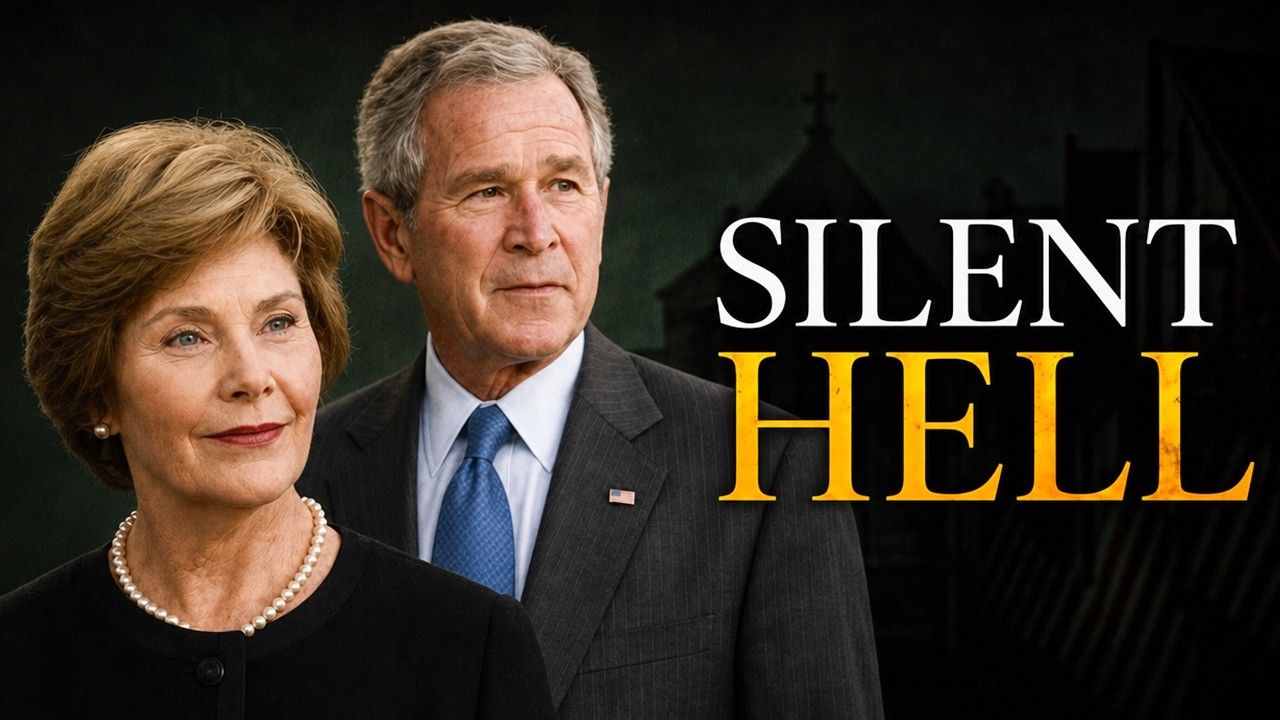
Bush stepped aside. Laura Bush stood in front of the seated president, faced several thousand journalists, and told them that the President of the United States went to bed at nine o’clock, that he was the only person in the administration who could pronounce the word “nuclear,” and that on the night they came together, he had tried to milk a male horse. She called herself a “desperate housewife. ” She said that at thirty-one, the president had never married and spent his time buying a ranch and doing things with cattle that no boy in Midland should ever have tried.
It was the biggest laugh of the night. None of it was spontaneous. The performance had been written with a professional speechwriter named Landon Parvin, who had spent years writing for Republican causes. It had been rehearsed.
It had been approved. It was, in effect, a communications operation disguised as a wife being charming. And the timing of it told the real story. In the spring of 2005, the second-term agenda was collapsing.
Social Security privatization was going nowhere. Casualties in Iraq were climbing. Gallup put the president’s job approval in the mid-forties and falling. His wife’s approval sat in the seventies, higher in some polls that year.
There was exactly one member of that administration whose popularity remained intact, and she had been described as unwilling for twenty-eight years. The quiet had a reason, and the reason was older than the marriage. Long before Laura Bush learned to speak in front of journalists, she had learned what a document could do to a life. On the night of November 6, 1963, seventeen-year-old Laura Welch was driving a Chevrolet on a dark road outside Midland, her friend beside her.
She reached the intersection of State Highway 349 and Farm Road 868. She did not stop. Her car struck a Corvair, and the driver of that Corvair, seventeen-year-old Michael Dutton Douglas, was thrown from the vehicle and killed. He was her classmate.
By various accounts, he was a boy she knew well and liked. No fine was imposed. No charge was filed. The accident report went into a Texas file cabinet and stayed there.
She did not speak of it. Not in high school. Not at Southern Methodist University. Not during the years she taught second graders at Longfellow Elementary in Dallas, nor later at a predominantly Black elementary school in Houston in the early years of desegregation.
Not when she earned her master’s degree in library science from the University of Texas in 1973, nor while working as a school librarian in Austin. Her closest friends in adulthood said they had no idea. Her future husband learned about it during their courtship, and the campaign workers of 1978 knew nothing, because no one asked. She was silent for thirty-seven years.
Then, in May 2000, in the middle of a presidential campaign, a Texas journalist got hold of the report and the story spread everywhere. She issued a brief, careful statement. She did not write about it in depth until her memoir, Spoken from the Heart, appeared in 2010, in which she described losing her faith for a time afterward and admitted she had never contacted the Douglas family. That was her account, given thirty-three years after the wedding, on her own schedule, in her own book, in her own words.
Remember the order of that. Everything she later did with her own story took this shape. There was something else that made her necessary, and this part got buried under the shy librarian veneer. She was the only child of a mother who had suffered one miscarriage after another.
Jenna Welch had endured a stillbirth and multiple miscarriages, and Laura grew up in a small house in Midland where her parents’ emotions were expected to stay contained. Her father, Harold Welch, built houses. The family was comfortable, not wealthy, not politically connected, and entirely local. That last word mattered in 1977.
By the summer of 1977, Laura Welch was thirty, unmarried, living alone in Austin, and, by her own later description, watching her life narrow. She had a career, a small circle, a rent check, and a mother who had started asking questions. She was remarkably unemotional about the period. She was not waiting to be rescued.
But she was aware of the arithmetic. Meanwhile, the eldest son of George Herbert Walker Bush had a problem that no amount of family money could solve. In July 1977, he announced he was running for Congress from Texas’s 19th District. He was thirty-one, unmarried, an Andover graduate, Yale and Harvard Business School alumnus.
He was the son of a sitting CIA director, running in West Texas against opponents who would happily explain to voters that he was a carpetbagger with an Ivy League accent and a famous name. His campaign required one specific thing. Not money. Not staff.
It required a wife from Midland. Jan Donnelly O’Neill had grown up with Laura Welch. Her husband, Joe O’Neill, had grown up with George Bush. In August 1977, they hosted a barbecue in their backyard in Midland with the sole purpose of bringing the two together.
Both later confirmed the arrangement was deliberate. Both left the party early. By multiple accounts, including their own, they talked past midnight. Three months later, on November 5, 1977, they were married at First United Methodist Church in Midland.
About seventy-five guests. No bridesmaids, no best man present. The wedding was arranged quickly because the campaign schedule could not wait. She said her mother-in-law was astonished by the speed.
Everyone was astonished by the speed. This is where most versions of the story go soft, and where the real account is more interesting than either the romance or the cynicism. Both things were true at once. By every surviving account, he was genuinely smitten.
Friends from that period describe a man who talked about her constantly, who had been in long relationships that went nowhere, and who had reached an age in that social world where being unmarried was conspicuous. She, by her own writing, was drawn to a man who was funny, restless, relentlessly present, and entirely different from the men she met in Austin. There is no evidence of cold calculation on either side. And there is no honest way to pretend politics was secondary while looking at the calendar.
He announced in July. He met her in August. In November he married her. He had filed to run in a district where his father’s name carried some weight and his accent carried more.
The marriage was real. It was also the most effective act of the campaign. Then came the condition. She has told this story consistently for decades, in interviews and in writing.
She agreed to marry him on the condition that she would never have to give a political speech. That was the deal, not a joke between them, not a story retrofitted to fit later events. A stated condition of the marriage, told so often it became part of the couple’s official lore. Their honeymoon was the campaign.
They took a brief trip and then spent their first year driving across West Texas, motel to motel, county to county, a period she described with genuine affection and without illusion about what it was. In 1978 in Muleshoe, Texas, population around four thousand, she gave her first political speech. She froze. By her own account, she lost her place, couldn’t find the thread, and finished badly.
She said that afterward, in the car, she reminded him of the promise he had made her. He had already broken it, and they both knew he would keep breaking it, because there was no version of his ambition in which he stayed quiet. That November he lost to Kent Hance, a Democrat who ran hard on exactly the weakness the marriage was supposed to fix: the outsider with the pedigree and the Eastern schooling. So the first year of the marriage delivered a broken promise, a public humiliation on a small stage in a small town, and a defeat.
What it did not deliver was a renegotiation. She never publicly asked for that term back. She simply stopped mentioning it and started getting better. It was a decision, not a temperament.
And the next ten years would test what she had actually signed up for, because the man she married in November 1977 was already drinking in a way his friends noticed, his family noticed, and she married him anyway. The arrangement she married into had rules, and none of them were written. The Bush family was less a family than a franchise with a compound. Summers meant Walker’s Point in Kennebunkport, where the day was built around competition, tennis, horseshoes, speedboats, and a golf game they played at a sprint.
Barbara Bush ran both the social space and the family narrative, and she ran them with a dry intensity that most in-laws would have found instructive. There was a correct way to be a Bush wife. You had children, you held yourself in public, you did not complain to outsiders, and you never gave the press an account that competed with the family’s version. Laura Bush did something in that environment that has been mistaken for passivity for the last forty years.
She refused to compete. When family members shredded each other on the tennis court, she sat on the porch with a book. She did not try to outdo the Bushes. Friends and staff from that period describe the same thing over and over.
She was pleasant. She was careful. She volunteered nothing. Which meant that inside a family obsessed with controlling its own story, she was the only member who never leaked, never overreached, never handed anyone material.
Barbara Bush reportedly liked her almost immediately. Of course she did. Laura was the only daughter-in-law who behaved like a professional. The men around them doubled as staff.
Don Evans and Joe O’Neill were Midland friends who became campaign operatives, then cabinet officials and fundraisers. The oil money that funded the early efforts came from the same dinner invitation phone lists. There was no line between the social life and the political operation, and no neutral ground where she could stand. Her husband’s friends were his employees.
Her house was a campaign asset. Within four years of her wedding, her father-in-law would be vice president. She had married into a family that already owned the story. It would take her twenty years to learn where the pen was kept.
Then there was the drinking. This part of the record is unusually well established, largely because he established it himself. George W. Bush wrote and said publicly that drinking had become a problem, that he drank too much and too often, and that it was turning him into someone he did not want to be.
In Decision Points he described it plainly as a habit that began to compete with everything else in his life. The specific details that survive from the late seventies and early eighties are the kind that get repeated at dinner tables. Club crawls in Midland and later Washington. A well-known incident at a dinner in Maine where, late at night, he asked an elderly friend of his parents what sex was like after fifty.
The 1976 drunk-driving arrest in Kennebunkport, kept buried until five days before the 2000 election. Friends of the couple describe arguments. The famous line from the marriage belongs to that narrow category. She supposedly confronted him and said, “It’s me or Jim Beam.
” The line appears in multiple books, repeated for twenty-five years in profiles. It’s a great line. He has denied that she ever said it, saying repeatedly that she never issued an ultimatum, never nagged him about it, that the decision was his. She has never confirmed the quote either.
What she described was less dramatic and possibly more damaging: after one night of drinking, she asked him whether liquor had ever done one good thing for his life. That account tells you more about the marriage than any ultimatum could. She didn’t threaten. To threaten, you had to have the credible power to leave.
He quit drinking in July 1986, the morning after his fortieth birthday weekend at the Broadmoor Hotel in Colorado Springs, where he and a group of friends had celebrated as usual. He never drank again. Whatever the mechanism, it held for the rest of his life, and by all accounts she was part of it. Understand what the result was, though, for the balance of power.
It did not make her his equal. It made her his infrastructure. By 1986 she had also been through the experience that bound her to that house permanently. The couple could not conceive.
They tried for years. They went to the Gladney Center in Fort Worth, one of Texas’s best-known adoption agencies, and began the paperwork. She wrote about the process, the forms, the waiting, and about conceiving while the adoption application was still active. The pregnancy was risky.
She developed toxemia. In the final weeks she was admitted to Baylor University Medical Center in Dallas. On November 25, 1981, five weeks early, she gave birth by cesarean section to twin daughters. They were named Barbara and Jenna, after their two grandmothers.
She was thirty-four. Her husband was running an oil company that wasn’t profitable. Put the sequence together. Two premature babies delivered by the narrowest margin.
A husband drinking too much. A failing business. A father-in-law who had become vice president of the United States two months earlier. The twins were two months old at the inauguration, and the family had just acquired national visibility.
She was a thirty-four-year-old mother of newborns in a family that had become a political institution. Leaving at that point was no longer an option, and the reason needs to be specified. She had no money of her own. She had quit her school librarian’s job.
Her professional credentials were real, but that income could not sustain the world she was in. Her name now belonged to the family. Her children were named after her mother-in-law. Her social circle consisted of her husband’s paid employees.
And by the mid-eighties, a divorce in Midland would not have been a private matter between two people. It would have been the story of the vice president’s son, and soon after, the story of a family preparing a presidential campaign. There is no evidence she ever seriously moved toward divorce. There is abundant evidence of how expensive it would have been.
But ask the same question from the other direction, because this is where the standard narrative flips. What would he have lost if she left? He was a man with a drinking problem, a stalled business, a famous father, and no record of his own. His entire political viability depended on being known as a reformed, settled Texan with a wife and twins.
Remove her from that picture in 1986, and there is no gubernatorial campaign in 1994. No compassionate conservatism. No candidate at all. The dependence ran both ways.
His was heavier. It took people fifteen years to understand that. The nineties looked like a rehabilitation, and part of it really was. He was sober.
He bought into the Texas Rangers and became a public figure in Dallas on his own terms. In 1994 he ran for governor against Ann Richards, and Laura Bush, the woman who had frozen on the mule-shoe stage, campaigned. Not brilliantly, not yet. But she did it, and she didn’t have to be dragged.
Then in 1996, as First Lady of Texas, she did the thing that changed her position in the marriage more than any speech. She founded the Texas Book Festival. On the surface, that is the least dramatic sentence in the story. A librarian starts a book festival.
Look at what it actually was. An annual event at the State Capitol in Austin that raised money for Texas public libraries. It involved her name, her authors, her board, her donors, her staff. In the first few years it raised over a million dollars.
The people who wrote the checks wrote them to her. For nineteen years, every institution in her life had belonged to her husband or his family. This one did not. It was small.
It was literary. It posed no threat to anyone’s political ambition, and it was hers. She had built a platform that could not be taken away in a bad election. She had learned from the mule-shoe speech, and the lesson was not to get better at speaking.
The lesson was to find a room of her own. By 1999, her husband was running for president, and she had gone from a woman who did not speak in public to a woman with her own donor list. The marriage was stable. The drinking years were a decade behind them.
The twins were teenagers, and the family had a plan. Then, in May 2000, a Texas journalist requested a thirty-seven-year-old accident report from a two-lane intersection outside Midland. The one thing she had kept to herself her entire adult life became campaign property. The story broke in the press in early May 2000.
Michael Dutton Douglas, seventeen, had been killed at the intersection of State Highway 349 and Farm Road 868 on November 6, 1963. The driver of the other car was the woman about to become First Lady of the United States. The way the campaign handled it was instructive. No long statement.
No interview. No tearful appearance. She confirmed the facts briefly, said it was the most horrible thing that had ever happened in her life, and stopped. Surviving members of the Douglas family told journalists they had heard nothing from her.
That news ran too. And then, within about a week, the story died, because there was nothing to push it forward. She had not spoken about the most tragic event of her life for thirty-seven years, and when it finally came into the open, the discipline she had built around it worked exactly as it had always worked. She gave the press the facts and nothing usable.
Three months later, on August 1, 2000, she walked onto the stage of the First Union Center in Philadelphia and delivered the opening-night address at the Republican National Convention. Read that sentence against the situation of 1977. The woman who married him on the promise that she would never give a political speech was given the opening night of the presidential nomination convention, not a cameo on the final night as the wife. Opening night, the slot the party uses to set the emotional frame for everything that follows.
She spoke about literacy, teaching, and her husband. The subject was education. The purpose was to make him safe. The whole story turns on that reclassification.
She was never protected from politics. By 2000 she was the product, and she was better than he was at exactly the places where he was weakest. People worried about him. His temper, that dismissive smirk, his past behavior.
She was the balancer. Both internal polls and public surveys showed the same pattern all year. She moved suburban women. She reassured moderates.
She made the ticket look calm. The Bush operation understood this and used her accordingly. Then September 11, 2001, happened, and her political value shifted from campaign asset to something closer to an instrument of governance. On November 17, 2001, Laura Bush delivered the president’s weekly radio address alone.
No First Lady had ever done that. The subject was the treatment of women and girls under the Taliban, and the address was part of a coordinated push with a State Department report and a White House briefing. It aired on stations across the country. Two days earlier, the administration had wanted a messenger who could talk about Afghan women without sounding like war justification.
The messenger they chose was the librarian. She did it again and again. In the 2004 campaign, she was the most used surrogate for reelection, appearing alone in states where her husband’s presence was a liability. The Gallup numbers from those years are not ambiguous.
Her approval stayed consistently in the high sixties and low seventies, twenty to thirty points above his in the second term. And she never once said anything that produced a bad headline. The real thing is that almost no one noticed while it was happening. Alongside all that public power came an operational change at home, and it began before he became president.
In 1999, the Bush family bought about sixteen hundred acres near Crawford, Texas. The house built on that land between 1999 and 2001 became the Western White House. The physical proof of her influence. The place where he cleared brush in front of cameras for eight years.
The image defined him. She directed its creation. She chose the site. She hired David Heymann, an architect from the University of Texas, and worked with him directly on the design.
Heymann described her as a client who was attentive, precise, and clear about what she wanted. For a family with that kind of resources, the result was deliberately plain. One story, long and low. Local limestone, a metal roof, a cistern system for rainwater, native plantings instead of lawn, deep porches and passive cooling.
It earned architectural praise. In construction terms, it was one of the most environmentally conscious houses any president has ever lived in. Built for a president whose environmental record was under constant attack, the house identified George W. Bush as plainspoken Texas, and it was designed to his wife’s specifications.
His architecture was her self-portrait. She controlled much more, quietly and consistently. She controlled press access, ran a very small operation in the East Wing, nearly eliminated unscripted interviews, allowed no competing leaks, and no staff wars. She controlled her daughters’ visibility, which is why the 2001 incident of two young women caught in Austin with fake IDs never became a rolling national story.
She traveled extensively without him, which served as diplomacy and as distance, and at some point during those eight years she began collecting information. The 2005 Correspondents’ Dinner was that. A wife being charming. A planned deployment of the administration’s most valuable communications asset at the exact moment the president’s numbers were falling.
Written by a professional, delivered by a woman standing over a seated president. He was the punchline. The president got the coverage. It was the best press week the White House had that spring.
She was not the reluctant figure in that room. She was the one doing the work. So what was this marriage, finally? Not a fraud.
And this needs to be careful, because the record does not support the fairy tale any more than it supports the cynical version. There is no credible evidence of infidelity on either side. No separate residences. No separation.
No written arrangement. Forty-eight years later they are still together. Their affection appears genuine and has consistently appeared genuine. Their daughters describe parents who liked each other.
What the record supports is that alongside the affection, they ran an institution. He held the office. She held the asset of reputation. And by the second term, she had taken possession of more of that asset than he had.
She knew exactly what she had been allowed to spend. Which brings the story to the part that is usually recorded as a mistake. In January 2001, a few days before the inauguration, she said at an event that she did not think Roe v. Wade should be overturned.
That is not a mistake. She was the incoming First Lady of an anti-abortion administration, opposing its policy on national television in inauguration week. She later expressed discomfort with embryonic stem cell research. She said publicly how difficult the death penalty was for her.
Each time, the White House accepted it, because there was no logic in fighting a woman who polled thirty points above the president. Then in May 2010, sixteen months after leaving Washington, she sat down with Larry King and said she supported same-sex marriage, that she believed it would happen, and that she had discussed it with her husband. Same-sex marriage had been the major social issue of his 2004 reelection. His campaign had supported a federal constitutional amendment defining marriage as between a man and a woman.
State ballot measures on the issue had driven turnout. In Ohio, the state that decided the election. Whatever her private views in those years, she said nothing publicly while the office was contested, and she said it plainly when it no longer was. That is not a change of mind on camera.
That is sequencing. The book came four months later. Spoken from the Heart. Scribner, May 2010, four hundred pages.
For the first time she wrote in detail about the 1963 accident. The intersection. The loss of faith. The fact that she had never contacted the Douglas family.
The fact that she and her husband discussed it and then largely did not. She wrote about the fertility years, the Gladney papers, the toxemia. She wrote about the drinking in her own restrained language but did not confirm the Jim Beam line that had been attributed to her for twenty-five years. She wrote about the physical reality of 1977 and the mule shoe.
Every version of this marriage now in circulation flows through that book. The portraits by Kessler, by Anderson, by Felix, the profiles, the memoirs, all have to contend with her account, and none of them has replaced it. She waited thirty-three years and then set the terms for all of it. She kept setting them.
She became co-chair of the George W. Bush Presidential Center at Southern Methodist University, which opened on April 25, 2013, and which houses her papers and her women’s initiative in the same building. She runs programs there under her own name. Barbara Bush, who had controlled the family narrative for half a century, died in 2018.
Laura Bush is now the family’s sanctioned narrator, and she got there by outlasting everyone and by not writing anything until she decided to look back at that correspondents’ dinner again. For twenty years, that clip has been shown as the moment America first learned the First Lady was funny. A wife taking the microphone, teasing her husband, humanizing him, the president laughing in his chair while the room erupted. It is charming, and that is exactly why it worked so well, and exactly why it told you nothing.
What you were actually watching was a live broadcast of the accounting of a marriage. The woman who in 1977 made a vow never to speak in public stood on the stage of the most powerful press gathering in the country, delivering a prepared performance, doing a job the president could no longer do as well, at the exact moment his political capital was running out. She sat. She didn’t sit.
He got the presidency. She got the record. The love story was real. It was also the most functional thing the two of them ever built.
And the decision about how it would be remembered was hers.






