In October 1778, deep in Shawnee country, a man painted black from head to toe sat waiting to die. His face was so swollen from beatings that his own mother would not have recognized him. The Shawnee had stripped him, tied him to a post, and the council had voted with a war club—strike it on the ground, and the prisoner dies. The club had struck the ground more times than it had been passed along.
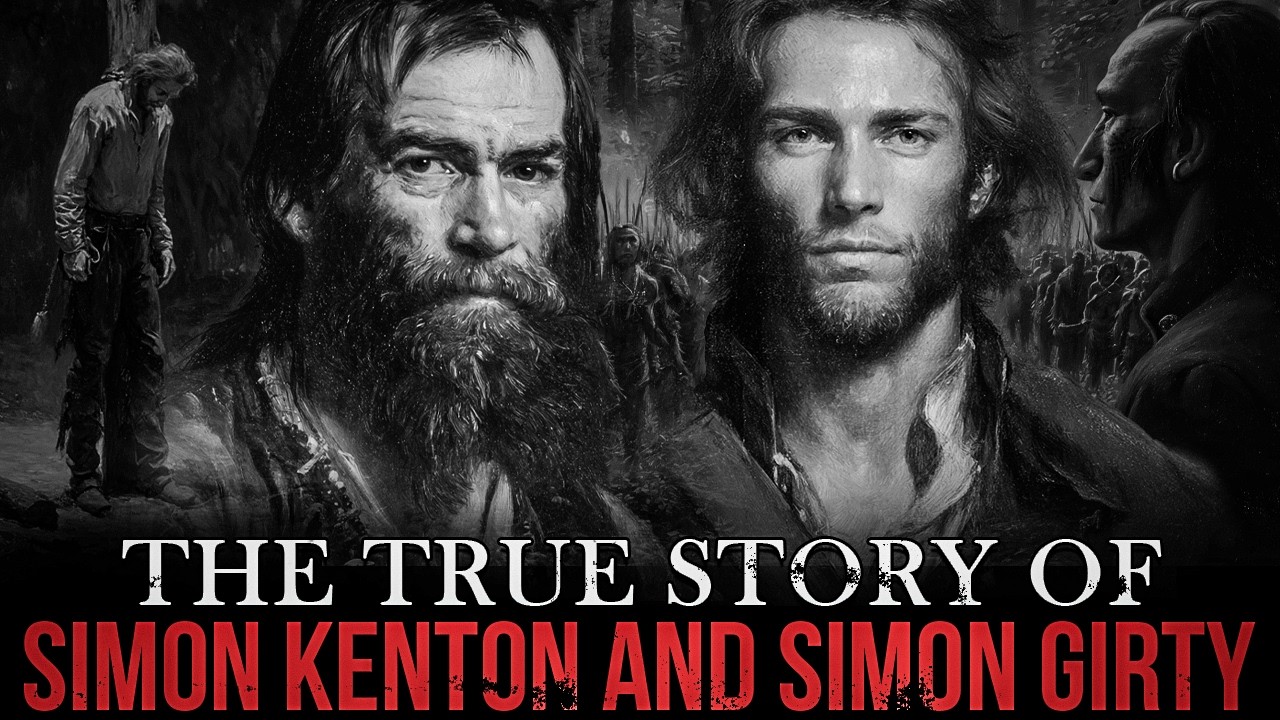
The sentence was death by burning at the stake, and the execution was set for any moment now. Simon Kenton had been a scout for the American cause, a man who had once saved Daniel Boone’s life. Now he was twenty-three years old, broken, and waiting to be burned alive in a village called Wapatomica. He did not know that the man who had just been ordered to translate his interrogation was someone he had known for years.
He did not know that this man, another Simon, would soon fall into his arms and cry like a child. The story of how the two Simons came to that moment begins more than two decades earlier, in the summer of 1756, when an eleven-year-old boy named Simon Girty watched his stepfather burn to death. Simon Girty was born in 1741 in Pennsylvania, to an Irish father who died when Simon was young. His mother remarried a man named John Turner, and the family settled near the frontier.
When the French and Indian War swept through the region, the family sought protection at a fort in Pennsylvania. The fort fell. The victors tied John Turner to a post and tortured him to death while his family watched. Then they took Simon, his brothers, and his mother prisoner.
The captors separated the family. Simon was given to the Seneca. What followed was the gauntlet—two lines of warriors, each wielding clubs and sticks, and a boy forced to run between them. He survived.
He was adopted into the tribe, and instead of dreaming of escape, he dove headfirst into that world. An old Seneca leader named Guyasuta became his mentor. Simon learned the Seneca language, then Delaware, then Shawnee, then Wyandot, and more. By his early twenties, he spoke eleven Indian languages fluently.
When he returned to white society—sources differ on whether it was 1758 or 1764—he was no longer the boy who had been taken captive. He had one foot in each world. On the other side of the mountains, another Simon was growing up. Simon Kenton was born in 1755 in Virginia, a tall, strong boy who at sixteen made what he thought was the worst mistake of his life.
He was in love with a girl named Ellen Cumins, but she chose another man. Whether it happened right after the wedding or months later, the result was the same: Simon grabbed the groom by his long hair, tied it to a tree branch to hold him in place, and beat him until the man spit blood and passed out. Kenton believed he had killed the man. In Virginia in those days, that meant the gallows.
So he changed his name to Simon Butler, fled to the mountains, and spent thirteen years thinking he was wanted for murder. He would not learn until 1784 that the man had survived. In those thirteen years, he became a hunter and a scout, a man who could read the forest better than his own tracks. In 1774, during Lord Dunmore’s War—a conflict few remember now—the two Simons met at Fort Pitt.
Girty was working as an interpreter. Kenton was recruited as a scout. They became fast friends, two men who knew the forest, spoke with the Indians, and understood that the line between civilization and savagery was thinner than city folks liked to admit. They fought together, camped together, became brothers.
Then came the American Revolution, and everything fell apart. When the war began, Girty took an oath to the Americans. He served for a time as a recruiter and received a lieutenant’s commission. But something was wrong.
Some said the officers treated him poorly. Others said he was arrested on suspicion of being a loyalist, and even after he was cleared, they kept looking at him sideways. The truth, as far as it can be known, runs deeper. Girty looked at the war and saw what it really was: Americans hungry for land—land the Indians occupied.
He had lived with those people, buried friends, learned their languages, understood their culture. He knew that if the Americans won, it would be the end of all that. So one night in March 1778, Girty and a handful of other men left Pittsburgh and headed straight for Detroit, where the British still held control. They arrived in April, and the British deputy governor hired Girty as an interpreter.
Back in Pittsburgh, the Americans indicted him for treason, convicted him without him even being present, and put an $800 reward on his head—a fortune in those days. Simon Girty had become an enemy. But he had not betrayed the Indians. He had betrayed the Americans to stay with the Indians.
For him, it was a matter of principle, of loyalty to the people who had raised him as a boy. History called it treason. Girty called it choosing a side. Meanwhile, Simon Kenton kept fighting for the Americans.
In 1775, he saved Daniel Boone’s life during an attack, shooting a Shawnee warrior who was about to kill Boone. Boone never forgot. The two Simons were now on opposite sides of a war, but the friendship was still there, tucked away, waiting. Six months after Girty’s desertion, Kenton was going to desperately need the friend who had become an enemy.
In the fall of 1778, Kenton decided to steal horses from the Shawnee. It was not the smartest decision. He and two companions went to spy on a village near where Xenia, Ohio, is today. They saw seven horses grazing and thought it would be easy.
It wasn’t. They managed to grab the horses, but when they tried to cross the Ohio River to escape, the wind hit so hard they had to turn back. Instead of running while they could, they waited for the wind to die down. The Shawnee came after them.
Kenton and the others split up. Kenton heard a shout and, instead of running the other way, went to see what it was. He found three Shawnee on horseback, raised his rifle, and pulled the trigger—but the powder was wet. Just a flash.
The Shawnee jumped on him. One of Kenton’s companions tried to help and was killed. The Shawnee came back with the bloody scalp and shook it in Kenton’s face. They tied him between two stakes and beat him with rods until his body was raw.
That was just the beginning. They took Kenton to their village, a three-day journey. Every night they tied him spread-eagle on the ground. During the day, they put him on a wild horse with no saddle, tied with ropes, and let the beast loose through the woods.
Branches hit Kenton’s face, and he couldn’t protect himself. When they reached the village, they tied him to a post. About 150 people came, dancing around him for three hours, beating, shouting. Then they made him run the gauntlet—two lines of Shawnee, each holding whatever they wanted to hit him with.
Kenton saw two men with butcher knives and thought: If I don’t get out of this line now, I’m going to die here. He broke through the line and ran. Hundreds of Shawnee ran after him. At the edge of the village, someone threw a blanket over him and knocked him to the ground.
Kenton was so broken he couldn’t even resist. The council gathered and voted using a war club: pass it to the next person, the prisoner lives; strike it on the ground, it means death. Kenton didn’t speak Algonquin, but the sound of that war club hitting dirt was clear. Death was winning over life.
The sentence was death by burning at the stake. They decided to make a spectacle of it and took him to another village. On the way, another council voted to kill him. In another place, they beat him so badly that when they left him alone, he tried to escape—ran almost two miles before getting caught again.
As punishment, some young Shawnee dragged him through a creek, pushing his head in the mud until he nearly suffocated. When they reached the final destination, a place called Wapatomica, they painted Kenton completely black. That was the sign. The execution was set.
A council gathered, and some British agents showed up. Among them were two brothers, Simon and James Girty. Some prisoners were also there, but they were taken away soon after. Simon Girty was there to translate.
He put a blanket on the ground and told Kenton to sit. When Kenton didn’t move—he was so hurt he barely understood what they were saying—Girty grabbed him by the arms and forced him to sit. He started interrogating. Where do you live?
Kentucky. How many men there? Don’t know. What’s your name?
Simon Butler. Girty stopped. He looked again at the man painted black, his face so swollen it was hard to recognize any features. And something clicked.
Girty threw himself into Kenton’s arms and started crying. One of the accounts that survived uses these words: “His dear and esteemed friend. ” Another says Girty “cried like a child and said he regretted taking sides against his countrymen, that he was good to Kenton. ” And there is a phrase that still sticks: “When we see our fellow men every day, we don’t care about them.
But it’s different when we find a man alone in the forest—in the wild and lonesome forest. ”
Girty turned to the council and gave a speech. He said he had never spoken for an American before and never would again. But he begged them to spare Kenton’s life.
He reminded the Shawnee that he had never asked for anything in return for his service. The council agreed. They gave Kenton to Girty for twenty days. Girty took care of Kenton, gave him food, clothes, and medicine from his own supplies.
They traveled from village to village while the wounds healed. It looked like it was going to have a happy ending. Then a Shawnee war party came back from an attack. They had been defeated, humiliated—and defeated warriors need to take it out on someone.
A messenger arrived and summoned Girty and Kenton to the council. The messenger shook Girty’s hand but refused Kenton’s. Not a good sign. The council reinstated the death sentence.
Girty tried to argue again. It didn’t work. So he changed strategy. Back then, the British had a post where they paid Indian allies.
Girty said, “Why don’t you take him to the British? They’ll pay a good reward. ” Greed beat revenge, and the council agreed. On the way, Girty still had to convince other people.
A Mingo leader named Logan—a man who had every reason in the world to hate white people, since his entire family had been massacred—looked at Kenton and decided the man didn’t deserve to die. He helped Girty negotiate. In the end, a French Canadian officer offered $100 in tobacco and rum in exchange for Kenton, saying he would return the prisoner later. It was a lie.
But the Shawnee believed it. They took Kenton to Detroit. The British interrogated him but got nothing important. They gave him freedom to move around the city, just couldn’t leave.
Kenton stayed there for six months. In June 1779, with help from a woman who bought supplies and hid weapons in her garden, Kenton and two other prisoners escaped. It took thirty days of hunger and danger, but they reached Louisville. Simon Kenton was alive, and he owed that to Simon Girty.
Four years later, Girty would be present at a scene that would define him forever—and not the way he wanted. In May 1782, an American colonel named William Crawford led an expedition against Indian villages on the Sandusky River with nearly 500 men. The idea was to attack the settlements and force the Indians to retreat. It didn’t work out.
The Delaware and Wyandot were waiting. There were two days of battle on a wooded hill. On the second day, Girty approached the American lines asking to negotiate, asking Crawford to surrender. Crawford refused.
When Indian reinforcements arrived that afternoon, Crawford decided to retreat. The retreat turned to chaos. The Indians detected the movement and attacked. Many Americans were killed or captured during the flight.
Crawford was one of them. The Delaware decided to execute him. The reason: three months earlier, American militiamen had massacred a group of peaceful Delaware, including women and children, at a Moravian village called Gnadenhutten. The Delaware wanted revenge, and Crawford—even though he hadn’t participated in that massacre—was going to pay for it.
They decided to burn Crawford alive. Girty was there. He translated the trial. When Crawford asked to meet with him, Girty went.
Crawford begged for help, offered military information in exchange for ransom. Girty promised to do what he could, even suggested Crawford try to escape the next morning, said he would leave a horse ready. But Crawford was too weak, couldn’t do it. They took him to a clearing west of the village, tied him to a post, fired charges of gunpowder at his body, cut off his ears, applied burning sticks to his bare skin, threw hot coals at his feet.
Crawford passed out and was scalped, and died shortly after. During the torture, Crawford screamed for Girty to end his suffering, asked him to shoot him, end it. And here the stories completely diverge. The first account comes from a surgeon who witnessed it all.
His report was edited by a man who hated Girty. According to this version, when Crawford screamed, Girty mockingly told the colonel he had no weapon, then turned to an Indian standing behind him, laughed heartily, and by all his gestures seemed to delight in the horrible scene. The second account comes from Girty’s daughter. Decades later, she was interviewed by the historian Lyman Draper.
She said her father explained that nobody had permission to interfere once the torture started, and that her father had tried everything to save Crawford. The third account comes from a woman named Elizabeth Turner. She had been captured by the Wyandot and witnessed the execution. She said Girty offered his horse, his rifle, even the servant he had—everything as ransom.
But they told him Crawford would only be spared if Girty took his place. And she said Girty cried while Crawford died. The British officer who received the report wrote: “Crawford died a hero, never changed his countenance, though they scalped him alive and then put hot ashes on his head, despite every means having been attempted by an Indian officer present to save his life. ”
So what’s the truth?
History chose the version it wanted—the first one, the mocking and the laughter. And from then on, Simon Girty stopped being a man and became a symbol. The white renegade, the savage, the monster. In newspapers, in books, in stories told around fires, Girty became the frontier demon.
One biographer even wrote that the screams and groans of helpless women and children while being massacred were music to his soul. On the other side, Simon Kenton kept being a hero—the man who had survived three weeks of torture, the brave scout, Daniel Boone’s loyal friend. In the years that followed, the two Simons stayed on opposite sides of the war. Simon Kenton became a legend.
He kept serving as a scout, explored territories in Ohio, claimed lands. In 1810, he moved to Urbana and was promoted to brigadier general of the state militia. During the War of 1812, when the great Shawnee chief Tecumseh was killed at the Battle of the Thames, they asked Kenton to identify the body. And here’s one last twist that shows the kind of man Kenton was.
He lied. He identified another dead warrior as Tecumseh. Why? Because he knew that if he identified the right body, the soldiers would hack it up to take pieces as souvenirs.
Even after everything—the torture, the years of war, nearly being burned alive—Kenton still had enough respect for the enemy to spare the body from a final humiliation. Kenton died in 1836 at eighty-one years old and was buried with honor. They called him a pioneer hero, and he was. On the other side of the frontier, Simon Girty was living a very different story.
In August 1782, he had been present at the Battle of Blue Licks. It was a terrible ambush. The Americans lost seventy-seven men that day. Among the dead were Israel Boone, Daniel’s son, and Thomas Boone, his brother.
Daniel Boone never forgave—and he didn’t forget that Simon Girty was there. But the worst defeat Girty helped inflict was in November 1791, in a battle that doesn’t get the attention it deserves. They call it the Battle of the Wabash, or St. Clair’s Defeat.
It was one of the worst military defeats the United States ever suffered. A general named St. Clair led a poorly prepared army into Indian territory. They camped on the banks of the Wabash River without building proper fortifications.
At dawn, they were attacked by more than a thousand warriors: Shawnee, Miami, Delaware, Wyandot, and others. Girty led the Wyandot contingent. It was a massacre. Six hundred thirty American soldiers killed.
Women and children accompanying the army were killed or captured. The camp was completely destroyed. Girty received three captured artillery pieces as a reward—and had to bury them because he had no way to transport them. For many Americans, that sealed his image.
He wasn’t just the man who supposedly laughed while Crawford died. He was the military leader massacring American troops. Yet there are also other accounts: of Girty saving an eighteen-year-old boy the Wyandot planned to burn alive, convincing them to spare the boy and trade him for ransom; of women and children captured during raids, Girty doing what he could to protect them. How do you reconcile these two pictures?
The warrior who fights in massacres and the man who saves lives when he can. The answer is you don’t reconcile them. You just accept that people are complex, that war is dirty, that loyalty has a price. In 1794 came the last great battle, Fallen Timbers.
It was a crushing defeat for the Indian peoples. General Wayne had trained a professional army, and they swept through the warriors. Girty, who had received orders not to participate directly, could only watch as everything fell apart. The warriors fled in panic toward a nearby British fort, thinking they’d find refuge.
But when they got there, the gate was locked. The British had abandoned them. A year later, in 1795, the Indian leaders signed a treaty giving up almost everything. The war was over, and they had lost.
Girty retired from the Indian department that same year and went to live on land the British had given him on the Canadian side of the Detroit River. He had married a young woman named Catherine—a girl he had rescued from a Shawnee village years before. They had children. Girty tried to farm the land, but he was never good at it.
He hired men to do the work, and he drank a lot. Remember that head wound from years before, when a drunk Mohawk leader attacked him with a sword? Girty never really recovered. He suffered from dizziness and constant pain.
In 1800, he broke his leg in a fall. In 1809, he started losing his vision. By the time the War of 1812 broke out, he was a blind and lame old man. One of his sons, Thomas, joined the militia during that war.
In a battle in August 1812, Thomas rescued a wounded officer, contracted a fever, and died days later. Simon Girty buried his son and kept living—blind, lame, old. He died on February 18, 1818, at seventy-seven years old, and was buried with military honors on his own farm. The British remembered his service, even if the Americans had made him a demon.
Two Simons. One buried as a hero, the other demonized for generations. And yet, on that day in October 1778, when one of them was painted black, waiting to die in a wild and lonesome forest, it was the other who fell into his arms and cried. It was Girty who risked his reputation, negotiated, bribed, did everything to save his friend’s life.
History decided Girty was a villain. For more than a century, writers called him renegade, white savage, monster. But when you dig deep, you find Girty’s daughter saying her father cried during Crawford’s death. You find records of prisoners he saved.
You find a British officer writing that every means were attempted to save Crawford. You find Elizabeth Turner saying Girty offered everything—horse, rifle, even his own freedom—to ransom the man. And you find Kenton saying Girty cried like a child and regretted it, that he was good to him. The truth, as always, is somewhere in the middle.
When a man painted black heard someone crying for him, it was the supposed demon doing the crying. And sometimes, in a wild and lonesome forest, that’s what matters.






