The order came down the mountain with the water: a log had jammed crosswise in the flume, and behind it a hundred more were backing up fast. Crewmen grabbed their peaveys and waded into the freezing rush, prying at the tangle while the pressure built. They knew what a jam meant. One stuck log could burst a seam, snap a support, or send the whole channel washing out in a matter of minutes.
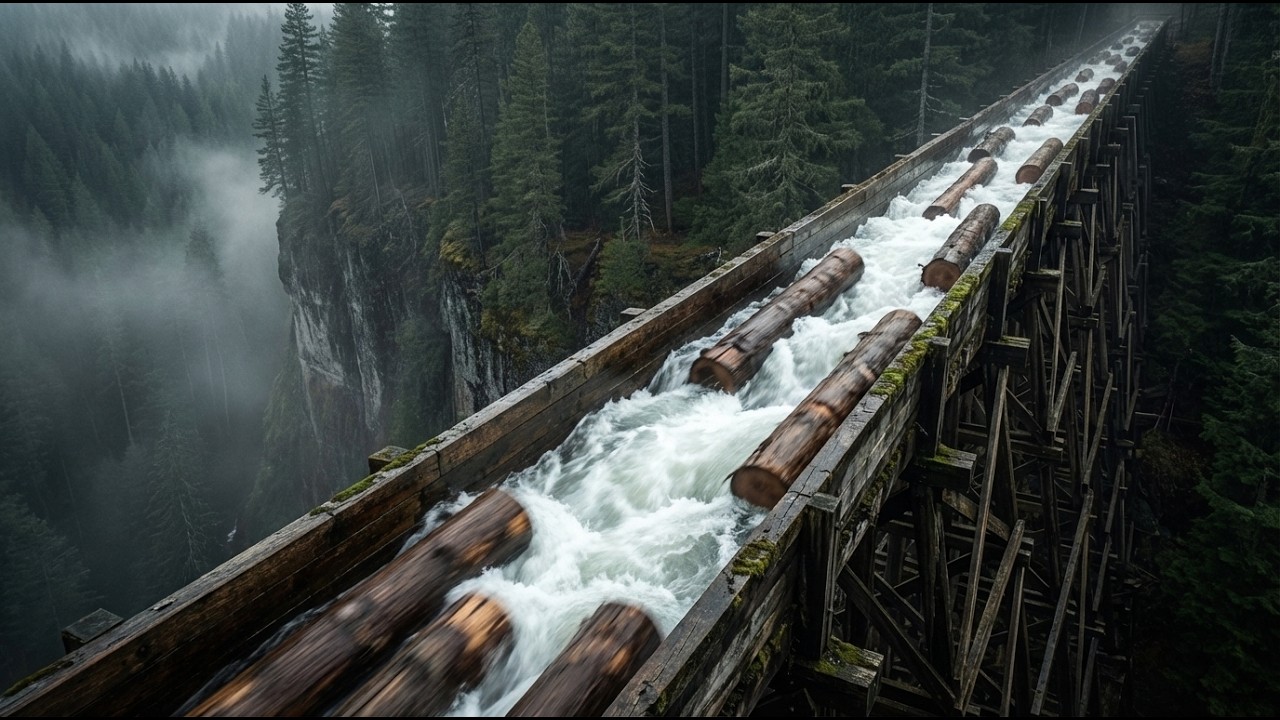
They had seen it happen before, and they would see it again. In the 1880s, America built rivers in the sky. Wooden troughs, some stretching more than fifty miles, carried millions of board feet of timber down the Sierra Nevada and the Rocky Mountains on nothing but water and gravity, outpacing trains at a fraction of the cost. These flumes crossed hundred-foot ravines on hand-built trestles, hugged sheer cliff faces, and were constructed entirely from the same material they carried.
It sounded nearly impossible, but the real question was not just how they were engineered. It was what drove a nation to attempt something this audacious in the first place. That story began with a hunger for lumber so extreme it was reshaping the continent. By the late 1800s, America’s demand for timber was relentless.
Railroads cut across the country, each mile demanding thousands of oak and pine ties, bridge timbers, and car frames. The Union Pacific and the Central Pacific alone consumed an estimated 30 million board feet of lumber every year just to keep their tracks running. In cities like Chicago, San Francisco, and Denver, swelling populations fueled a construction boom that devoured nearly 40 percent of the nation’s timber output for framing, flooring, and finish work. After the Chicago fire of 1871 destroyed miles of wooden buildings, the scramble to rebuild pushed demand for Douglas fir and fire-resistant studs even higher.
Mining towns in Nevada, Colorado, and Montana burned through wood for shaft supports, headframes, and ore chutes. Company records from the era show contracts for 5 to 8 million board feet annually, with orders spiking whenever silver or copper prices surged. Shipyards on both coasts, especially in San Francisco and Portland, relied on West Coast fir and hemlock for hulls and decks, importing 2 to 3 million board feet each year to keep up with the growing merchant and naval fleets. All that timber came from the vast belts of the Sierra Nevada, the Pacific Northwest, and the Rocky Mountains.
In the Sierra, companies like Union Lumber and San Joaquin Lumber cut 6 million board feet a year at their peak, feeding San Francisco’s endless appetite for construction lumber. In the Pacific Northwest, giants like Weyerhaeuser and Herman Brothers shipped up to 25 million board feet annually, logs floating down rivers or stacked at mill yards near deep-water ports. Even the Rockies, with their rugged slopes and scattered mining claims, managed 4 million board feet a year, mostly ponderosa pine and lodgepole for local mines. As the easiest timber vanished near rivers and rails, loggers faced steeper, more remote forests.
The old methods, horses, oxen, and sleds, could not keep pace. The need for faster, more efficient timber haulage became urgent, setting the stage for new solutions. The forests that fed the boom were anything but accessible. Dense belts of Douglas fir, ponderosa pine, and western hemlock stretched across the Sierra Nevada, the Pacific Northwest, and the rugged Rocky Mountains.
These were not gentle woodlands beside broad rivers or city roads. The richest stands grew high on mountain slopes, tucked between granite ridges and deep canyons, sometimes at elevations above 5,000 feet. In the Sierra Nevada, the best ponderosa pine grew on the western slopes, while Douglas fir dominated the steeper, cooler ridges. The Pacific Northwest boasted vast tracts of fir and hemlock, some trees shooting up more than 200 feet tall, thriving in the rain-soaked foothills of Washington and Oregon.
The Rockies supplied ponderosa and lodgepole pine, but the terrain was even more fractured, with narrow valleys, sudden cliffs, and snow that lingered well into spring. Getting to these trees was only half the battle. Once felled, logs had to be moved out of forests that were miles from the nearest rail line or navigable river. In the early days, teams of horses or oxen dragged timber over rough trails inch by inch, sometimes using sleds on packed snow in winter.
Where the ground was too steep or broken, loggers built temporary wooden roads or tried rolling logs downhill, risking splintered wood and runaway timbers. River drives worked in the Midwest, but out west, many mountain streams were too small, too rocky, or too dry for floating logs. The geography itself set strict limits on how much wood could reach the growing cities and railroads below. The isolation of these forests pushed engineers and lumbermen to look for new ways to move timber.
The challenge was not just distance, it was the relentless pull of gravity, the constant threat of landslides, and the sheer remoteness of the supply. These realities narrowed the options and set the stage for a bold solution: harnessing gravity itself to build wooden flumes that could carry logs for miles down the mountainsides. The next step was figuring out how to make such a system work on ground that gave no easy path, across terrain that seemed determined to keep its trees out of reach. Dragging logs out of mountain forests tested every method known to nineteenth-century lumbermen.
Teams of horses and oxen, the backbone of early logging, could barely budge massive Douglas fir or ponderosa pine over the rocky, uneven ground. Each animal could haul only a few logs at a time, and every trip meant hours of backbreaking labor for both beast and driver. In winter, sleds offered a brief advantage, gliding over snow-packed trails, but as soon as the thaw came those same paths turned to mud, stalling operations for weeks. Even when the snow held, steep grades and sudden drop-offs made sledding a gamble, with runaway loads crashing down slopes or vanishing into ravines.
Temporary rail spurs promised speed, but building tracks through dense timber and across broken terrain cost a fortune. Narrow-gauge lines, like those in the Sierra Nevada, required constant rebuilding as logging moved deeper into the forest. Laying rails meant clearing land, hauling in steel, and paying for locomotives, expenses that only the largest companies could bear. When the timber ran out in one patch, the rails had to be torn up and moved, burning through time and money.
In the Rockies, short rail lines often ran just a season or two before being abandoned, leaving twisted rails rusting in the brush. River drives worked wonders in the Midwest, where wide, gentle streams could float thousands of logs to distant mills. But the mountain west told a different story. Streams in the Sierra and Cascades ran too shallow or too wild, choked with boulders and snags.
Spring floods might carry logs for a few miles, but summer droughts left channels bone dry. Many western forests sat miles from any navigable water at all, making river transport a non-starter. Even when a stream could be used, log jams were a constant threat. One wrong turn and an entire season’s harvest could pile up in a tangled mess.
Each of these methods had its limits: high costs, seasonal shutdowns, dangerous grades, and the sheer unpredictability of mountain weather. The gap between the timber up high and the markets down below kept growing wider. By the 1880s, with demand for lumber at an all-time high and the best stands now deep in the back country, it was clear that old solutions could not keep up. The time had come for a new kind of engineering.
It would harness the very force that made mountain logging so difficult: gravity itself. A mountain log flume began with a V-shaped channel, crafted from timber chosen for its strength and resistance to rot. In the Pacific Northwest, Douglas fir was the wood of choice, prized for its rapid growth and durability against water and weather. In the Sierra Nevada, ponderosa pine was favored, while western hemlock filled gaps where it grew thick.
Each plank was selected for soundness, often milled on site, then shaped to nest tightly against its neighbors. This careful fitting was more than tradition, it was necessity. Any gap meant wasted water, and wasted water meant stranded logs. The V profile of the channel was no accident.
With side walls pitched between 30 and 45 degrees, the shape kept logs riding the center, letting water rush fast enough to keep timber moving, but not so fast it battered the wood against the sides. Planks were fastened to a skeleton of heavy wooden ribs, each rib cut and joined by hand. No two ribs were quite identical, as the flume twisted to follow the mountain’s natural lines. At every joint, workers pressed strips of canvas or thin metal, then sealed the seams with hot pine pitch.
The scent of pitch hung over the camps, sticky and sweet, as crews worked into dusk, racing the next storm. Pitch was only part of the solution. On long or exposed stretches, builders sometimes lined the channel with copper sheathing or asphalt-soaked canvas, especially where the flume crossed open valleys or ran high on trestles. Every inch had to be watertight.
Even small leaks could drain the flow, strand logs, or rot the supports below. Nails and bolts were chosen with care. Iron rusted quickly, so carpenters used galvanized fasteners, sometimes driving them at angles to clamp the wood tight. Joinery was a quiet art.
Where two planks met, the seam was often beveled or shiplapped, not just butted. This let water pressure squeeze the boards tighter, forcing pitch into every crevice. In places where the flume bent sharply around a ridge or hugged a cliff, carpenters cut compound angles by hand, adjusting ribs as needed to keep the channel true. Each day, a lead carpenter walked the flume, tapping joints and listening for hollow knocks, a sign of a missed seal or a warped board.
Despite rough tools and rugged terrain, the finished channel was a marvel of fit and finish. Water poured in at the top, gliding down the V-shaped trough in a smooth, glassy sheet, carrying logs for miles. Without tight joinery and careful sealing, even the best engineering could not keep water in or timber moving. Every rib, every plank, every bead of pitch was a craftsman’s answer to the mountain’s challenge: how to turn raw wood and gravity into a working highway.
Survey engineers faced a problem that ran nearly fifty miles: how to move thousands of tons of timber down a mountain using only water and gravity, without smashing logs or destroying the flume itself. Their solution began with numbers, not wood. Every route started with careful field surveys. Teams hauled heavy tripods and steel chains up steep ridges, measuring each rise and dip by hand.
They mapped every contour, searching for a path that would keep the water moving just fast enough, never too slow, never too wild. The calculations were precise. For a flume to carry logs over such distances, the channel had to drop at a steady grade, typically about 0. 35 percent, or just 18 feet for every mile traveled.
Too steep and logs would barrel ahead, splintering at the bends. Too gentle and the water would stall, leaving timber stranded. Using the Manning equation, engineers set the target velocity at around 6 feet per second. That was fast enough to keep a 1,000-pound log afloat and moving, but slow enough to avoid chaos at every curve.
Over fifty miles, this meant a total elevation drop of roughly 900 feet, a number that matched the mountain profiles near places like Kings River and Madera. But slope was only the start. The channel itself had to be wide and deep enough for both water and timber. Most flumes ran with a cross-section of about 4 feet wide and 5 feet deep, giving a flow area of nearly 20 square feet.
With logs and water rushing together, the system demanded a flow rate of at least 120 cubic feet per second, about the volume of a lively mountain creek. Historical records from the Lake Coeur d’Alene diversion dam show that engineers guaranteed up to 150 cubic feet per second in dry months, building a margin for drought and heavy timber loads. Friction was a constant enemy. The roughness of wet wood, the seams between planks, and the bends in the flume all threatened to slow the water or trap logs.
To account for this, surveyors factored in a roughness coefficient of about 0. 05, a value drawn from government hydraulic tests on wooden channels. Every calculation accounted for the drag of pine pitch, the swelling of boards, and the debris that would inevitably collect in the trough. Speed control was just as crucial as water flow.
On long, straight runs, logs could accelerate dangerously. To keep things in check, engineers installed wooden baffles every couple of hundred feet. Each baffle worked like a brake, forcing water to tumble and bleed off energy before the next drop. Where the grade steepened, check gates could be lowered into the flow, pooling water and slowing the logs behind.
These simple devices, baffles, gates, and even splash pools, turned raw gravity into a controlled, predictable force. Survey notes from the Madera and Kings River projects are filled with these details: slope tables, flowcharts, and lists of every baffle and gate. The numbers justified the risk and expense. With the right calculations, a wooden trough could carry logs for miles, crossing ravines and hugging cliffs, never losing momentum.
The math proved that even in the wildest terrain, water and gravity, when harnessed with care, could move a forest to market. Ravines and cliffs cut straight across the path of every long flume. Where the mountain dropped away, carpenters met the challenge head-on, building timber trestles that seemed to float in midair. Some of these wooden bridges soared 60 feet above the ground, taller than a six-story building, spanning canyons that would have stopped any wagon, sled, or early rail line cold.
The work started with raw logs felled nearby, stripped and squared with axes and pit saws. Each upright post, called a bent, was set deep into the ground or anchored to exposed rock. Crews lifted these heavy frames upright using block and tackle, then braced them with diagonal timbers, locking the whole structure together like a giant wooden puzzle. The joinery was more than brute force.
Mortises and tenons, carpenter’s joints, were cut by hand to fit tight, holding firm against gravity, water, and the weight of thousands of passing logs. Every cap beam had to sit perfectly level to keep the flume above true. Planks for the trough were hoisted up by rope, then bolted down atop the trestle, sealed with pitch to keep every drop of water inside. The tallest documented trestles, like the Madera High Bridge at 62 feet and the Kings River Upper Crossing at just under 60 feet, pushed the limits of what could be done with hand tools and local timber.
The sight of a flume threading the air was enough to draw crowds of onlookers and newspapermen. Bridge gangs worked fast, sometimes raising a bent every hour. But the job was never easy and often dangerous. A sudden storm could wash out fresh footings or send a whole span tumbling.
In winter, ice coated the sills, and every hammer blow echoed down the canyon. The pride of these crews ran deep. Letters home described the work as dangerous but thrilling, and one carpenter wrote that they were building a road in the sky. Their skill made the entire flume system possible, proving that with the right wood, the right hands, and a bit of calculated risk, even the wildest landscape could be bridged.
The trestles were not just structures; they were the backbone of America’s gravity-powered timber highways. Flume camps clung to the mountainsides, clusters of rough shacks and canvas tents perched above the rush of water. Life here revolved around the endless demands of the flume. At first light, flume tenders set out along narrow catwalks, patrolling miles of channel.
Their job was constant: listen for the hollow thump of a loose plank, watch for leaks that could drain the flow, and scan for the first sign of a jam. One log stuck crosswise could back up a hundred more, turning a smooth run into chaos. Clearing jams meant wading into freezing water, prying with six-foot peaveys, and sometimes risking a fall into the chute itself. Winters brought their own hazards.
Snow drifted deep against the trestles, ice glazed the boards, and every step became a gamble. Crews chopped ice with axes and shoveled snow from the trough, knowing a frozen section could stop the entire operation. The work was relentless. Flume tenders rotated through twelve-hour shifts, day and night, often in teams of two or three.
Company records from the Kings River and Madera flumes show twenty to thirty men assigned to every ten miles of channel, enough to keep the water moving, but never enough to make it easy. Camps were isolated, sometimes a full day’s walk from the nearest town. Mail came once a week, if the trails were clear. Supplies arrived by mule or sled in winter.
The cookhouse was the camp’s heart. Each night, the cook, often the highest-paid man on site, served beans, salt pork, and coffee strong enough to float an axe. Oral histories recall cooks boiling 300 pounds of beans at a time, feeding men whose hunger matched the mountain air. Evenings brought a short break.
Crews gathered by lantern light, swapping stories, mending boots, writing letters home, or whittling scraps of pine. But rest was always brief. At any hour, the whistle might sound: a jam, a shifted trestle, or a storm upstream. Accidents were common.
A slip on a frosty catwalk, a falling log, a sudden burst of water. Yet pride ran deep. Letters from the era describe men who saw themselves as guardians of a moving forest, shepherding millions of board feet down from the high country to the waiting mills below. Gravity flumes emerged as a practical answer to the challenges of moving timber through rugged terrain.
But their real advantage was economic. In the 1880s, constructing a mile of flume cost between $300 and $500, with timber sourced directly from the surrounding forest and labor drawn from logging camps already on site. By contrast, even the most basic narrow-gauge rail line demanded $1,200 to $1,500 per mile, while standard-gauge track, requiring heavier rails, extensive grading, and sometimes bridges or tunnels, could easily exceed $2,500 per mile, especially in mountainous country. The numbers left little room for debate.
Flumes allowed companies to stretch their capital further and reach deeper into the woods. Operating costs told a similar story. Flumes harnessed water and gravity, moving logs with minimal human intervention. Once the channel was sealed and the flow established, a small crew could oversee the passage of thousands of logs each day.
The expense to move 1,000 board feet of timber by flume hovered around 2 cents, covering water rights, repairs, and the men who kept the trough clear. Railroads, on the other hand, faced ongoing costs for fuel, larger crews, and constant track maintenance. Hauling the same volume by rail could be four to six times as expensive. And every log had to be loaded and unloaded by hand.
Speed offered another edge. Logs dropped into a flume at sunrise could arrive at a mill or railhead by midday, traveling at three to six miles per hour without interruption. Trains, bound by schedules and the need to load, haul, and return, moved in fits and starts. During peak harvest, a single flume could deliver 30 to 40 percent more timber than a comparable rail spur, keeping mills supplied while others waited for the next train.
In the Sierra Nevada and the Pacific Northwest, the scale of these investments was justified. The Sanger flume stretched 30 miles across canyons and ridges, built from local pine. The Madera Lumber flume, nearly 19 miles long, fed the Southern Pacific railyard without a locomotive in sight. For these companies, every dollar saved on transport meant faster returns and more timber to market.
Gravity-powered log flumes reached their greatest scale in the Sierra Nevada, where two legendary lines set the standard for what was possible. The Kings River flume, built in 1888, stretched nearly 30 miles from the high country down to the Sanger depot, snaking through ravines and across more than 300 trestles. At its peak, this flume delivered 12 million board feet in just 4 months, feeding a sawmill that supplied much of California’s Central Valley. Not far away, the Madera Lumber flume opened in 1902, running about 19 miles from the timber belt to the railhead at Madera.
Company records show it moved close to 200,000 board feet a month, with sections reinforced by concrete and lined with redwood planks to withstand the pounding water and constant wear. Both flumes followed the contours of the Sierra, dropping hundreds of feet in elevation and crossing terrain that would have stopped a wagon or train. The channels twisted around granite outcrops, soared over valleys on timber bridges, and threaded through dense stands of ponderosa pine and Douglas fir. Surveyors plotted every curve by hand, balancing the grade to keep logs moving without letting them barrel out of control.
Each mile was a test of calculation and carpentry, from the first plank at the inlet to the last splash at the mill pond. These were not isolated experiments. The Kings River and Madera flumes became icons of American engineering, their names appearing in trade journals and company ledgers across the West. While some reports later exaggerated their length, sometimes claiming fifty miles or more, the documented main lines of thirty miles and nineteen miles still put them among the longest timber flumes ever built.
Their scale and ambition proved that with enough wood, water, and ingenuity, even the wildest mountain country could be conquered by gravity alone. Every mile of log flume was a gamble against disaster, even with careful engineering. The system ran on a knife’s edge. When a log jammed in the channel, the pressure behind it could build in minutes.
Crews scrambled to break up blockages with long peaveys, but sometimes the force of pent-up water and timber would burst a seam or snap a support. In 1893, a sudden flood on the Nacimiento flume tore out a 200-foot section overnight. Workers plunged into icy water, racing to plug the breach before the entire run drained away. Collisions were a constant threat.
If the grade steepened unexpectedly, logs could accelerate to dangerous speeds. A 1,000-pound pine barreling around a curve might slam into the sidewalls, splintering wood and sending shards flying. In places where trestles soared 60 feet above a canyon, a single runaway log could break through the trough, raining debris onto the rocks below. Bends and branches magnified the risk.
Too sharp a turn and the water’s force would fling timber sideways, threatening both the structure and anyone unlucky enough to be nearby. Floods were not the only danger. Heavy rains or spring melts could overwhelm the flume’s capacity, sending water surging over the sides and eroding the very supports that held it up. A breach meant more than a repair bill.
It could strand miles of timber, shut down the mill, and leave a crew isolated until the damage was fixed. Fires posed another hazard. A stray ember from a camp stove or a lightning strike could ignite dry pitch, racing along the wooden trough and reducing months of work to ash in hours. For the men who worked the flumes, every shift brought new risk.
Slippery catwalks, sudden leaks, and the ever-present threat of collapse made safety a matter of vigilance and luck. Company records detail accidents, falls from trestles, crushed limbs, near drownings, and the relentless toll these dangers took on crews. The very speed and efficiency that made the flumes so valuable also made them unforgiving. Any failure, mechanical or human, could cost not just timber, but lives.
Water was the lifeblood of every gravity flume, but it came with a hidden price. Each mile of channel demanded a steady flow, often over 120 cubic feet per second, just to keep logs moving. In dry summers, operators scrambled to secure enough water, sometimes outbidding farmers or mining companies for rights. Ledgers from the early 1900s show annual water fees for the Kings River and Madera flumes rising sharply, sometimes exceeding $2,000 a year.
When drought hit or snowmelt ran thin, entire operations slowed to a crawl, with timber piling up in the woods and crews left waiting for the next rain. The cost of keeping the flumes themselves in working order only grew with time. Wooden troughs, battered by water and weather, needed constant repair. Company records from the Sanger operation list trestle repairs at $5,000 a year, with labor costs adding another $1,500 each month just to keep men on patrol clearing jams and patching leaks.
Every two years, miles of planking had to be replaced, sometimes entire sections rebuilt after a fire or flood. Fires in 1917 and 1933 wiped out large stretches of both the Kings River and Madera flumes, forcing costly rebuilds or, in some cases, permanent shutdown. Even as revenues fell, expenses never let up. Water rights, repairs, and payroll drained profits, turning once-profitable flumes into money pits.
Railroads and trucks began to rewrite the rules of timber transport in the early twentieth century. Railroads and locomotives grew more powerful and reliable, even though they had once been limited by steep grades and the cost of laying track. Narrow-gauge lines pushed deeper into the mountains, crossing terrain that had once belonged only to the flumes. Unlike water-driven channels, these rails could operate year-round, unfazed by drought, winter freeze, or the seasonal flow of mountain streams.
Trains hauled logs in all weather, day or night, and could return uphill with supplies, equipment, or fresh crews. Where a flume needed a constant source of water and a careful balance of slope, a locomotive simply burned fuel and kept moving. By the 1920s, trucks added a new dimension. Early logging trucks, fitted with chain drives and solid rubber tires, rumbled over rough mountain roads, carrying timber straight from the cutting site to the mill or railhead.
These machines did not depend on gravity or the path of a stream. They could climb, turn, and detour as needed. Motorized transport broke the old boundaries, reaching stands of fir and pine that flumes could never touch. Companies no longer had to build miles of wooden trough or wait for the snow to melt.
Instead, they invested in roads and vehicles, knowing that trucks could be used for other cargo when the timber ran out. The shift was more than mechanical. Railroads and trucks promised speed, flexibility, and the ability to keep working through dry spells or winter storms. As the technology improved and the cost of engines dropped, the economic edge of gravity flumes faded.
The same forces that once made flumes a marvel, simple materials, local labor, and clever use of water, were now outmatched by steel rails and internal combustion. The era of wooden water highways was giving way to the age of iron and rubber, marking a turning point in the story of American logging. The numbers tell the story. What began as a clever, low-cost answer to a mountain-sized problem became a burden few companies could bear.
By the time trucks and trains reached the high country, the old wooden flumes were already falling silent, left behind by the very progress they helped build. Today, the remains of flumes like Kings River and Madera quietly mark a moment when American ingenuity turned mountains into machines. Their apparent simplicity masked staggering calculations, relentless labor, and real risk, solving a crisis that fueled an entire nation’s growth.






