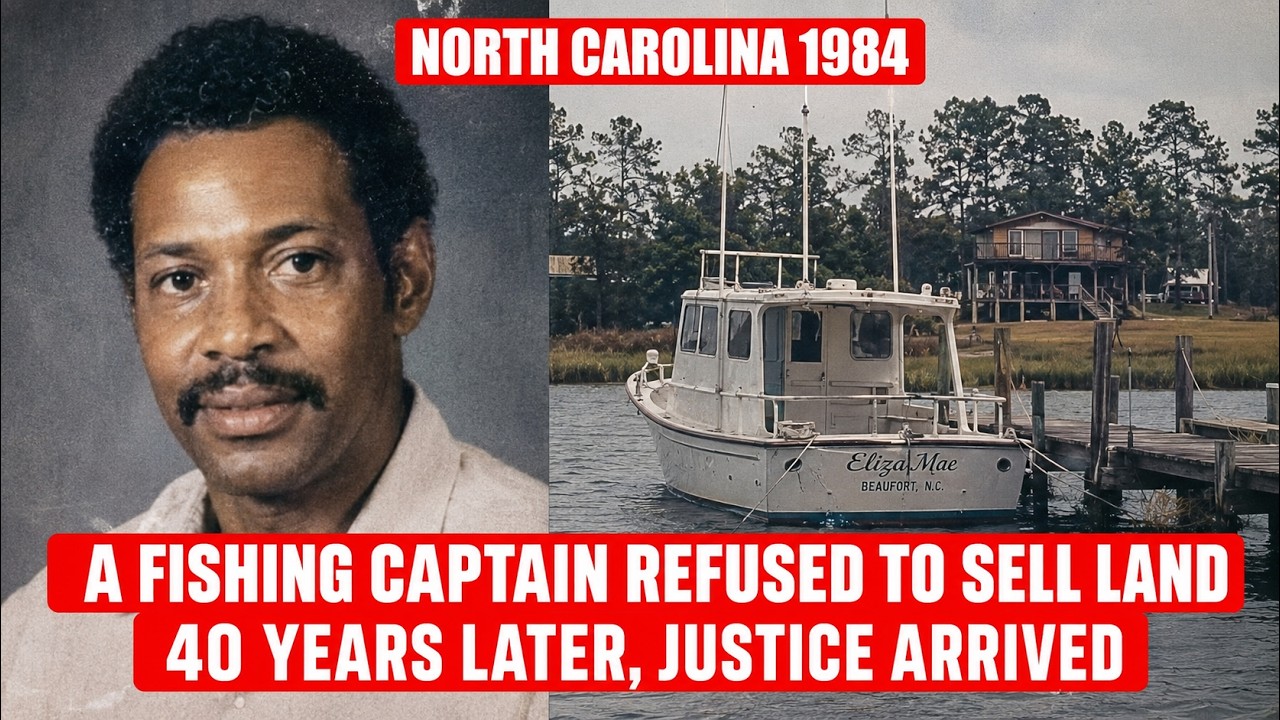
In October 1984, a fishing boat captain in Carteret County, North Carolina was found dead on the deck of his own charter boat after refusing to sell 14 acres of waterfront land that his family had owned for 63 years. Authorities concluded it was a robbery. His wallet was missing. The investigation lasted 11 days and produced no arrest.
His daughter spent the next 40 years becoming the kind of person who could prove they were wrong. And in 2021, a historian at a university in Greenville, North Carolina pulled a deed from a county registry that had been sitting in plain sight for 37 years. A document so carefully forged that it had fooled every eye that passed over it until hers. What she found in the paper stock and the ink and the spacing of a notary stamp that was 2 mm off from every other stamp in that registry would crack open a case that the county had filed away as solved by misfortune and would put a name to a man who had spent 40 years sitting at the head of public meetings and cutting ribbons and telling the people of Carteret County he was one of them.
He was. That was the whole of the problem. James Earl Pridgen had been born in Beaufort, North Carolina in 1926. The third child of a man named Ezra Pridgen who had come back from the First World War with his body intact and a specific and clear-eyed understanding of what he intended to do with the years he had been given.
Ezra Pridgen had saved. He had worked the oyster beds and the crab pots and he had put money aside in the particular disciplined way of a man who understands that opportunity does not announce itself twice. And in 1921, when a parcel of 14 acres on Core Sound came available through an estate sale, he had purchased it. The land was not much to look at.
Low, brackish, cordgrass, and live oak. The kind of coastal terrain that in 1921, nobody had assigned particular value to beyond what it produced from the water. Ezra Pridgen had not bought it for what it was then. He had bought it because it was his family’s, free and clear, and that was a different kind of value entirely.
Jimmy Pridgen grew up on that land. He swam in Core Sound from the age of five. He learned to read the tides the way other children learned to read the clock. When he came back from Korea in 1953, he did not leave Beaufort again.
He bought a second-hand boat, had it repaired and repainted at a yard in Morehead City, and named it after his mother, Eliza May, who had died the previous winter. He ran charter fishing trips out of the Beaufort waterfront, red drum, flounder, bluefish, speckled trout for 22 years, building a clientele that came from as far as Raleigh and Charlotte to fish with a captain who knew Core Sound the way only a man raised on it can know it. He was 58 years old in 1984. He had three children, nine grandchildren, and a mooring at his own dock on the 14-acre parcel that Ezra Pridgen had bought in 1921 for $640.
At People’s Chapel Baptist Church in Beaufort, Jimmy Pridgen served as a deacon for 19 years. He was the man people called when the church roof needed negotiating with a contractor. When a family in the congregation was behind on a bill and needed it handled quietly. When the youth group needed transportation to a county fair and he had the truck to do it.
He was known across Carteret County in the way that people of genuine substance are known. Not because he sought visibility, but because his presence in any situation made the situation more manageable. A white shrimper who had fished alongside him for 15 years told an investigator years after his death that Jimmy Pridgen was the most decent man he had known in 40 years of working the sound. He said it without qualification, which in 1984 Carteret County was itself a statement of some specificity.
The land had been wanted by others for a decade before Jimmy died. The Core Sound waterfront was changing. Vacation development was moving down the Crystal Coast in the early 1980s. Marinas and rental cottages and the particular architecture of leisure that follows money to the water.
A development consortium incorporated in Raleigh had identified the Pridgen parcel in 1975 as the final piece of a planned marina complex on the sound. They had made three offers. Jimmy had refused all three. His refusal was not dramatic or protracted.
He simply said no. In the way a man says no to something he has already fully considered and settled within himself. The land was his family’s. That was the whole of the answer.
The consortium’s third and final offer in August 1984 was for a sum that Jimmy’s daughter Celestine would later describe as insultingly reasonable. Enough to mean something. Not enough to mean what the land meant. Jimmy said no on a Tuesday.
He was dead 6 weeks later. His youngest daughter, Celestine, was 19 in October 1984 and was enrolled at North Carolina Central University in Durham studying business administration. She was home for fall break the weekend her father was found. She had spoken to him by phone the Thursday before about nothing in particular.
He had asked about her coursework. She had asked if the red drum were running. They had talked for 20 minutes about ordinary things. She would say for the rest of her life that the last thing he said to her was that the weather was going to turn and he needed to get the boat winterized before it did.
He sounded like himself. He always sounded like himself. The Eliza May was moored at Jimmy Pridgen’s private dock on the morning of October 23rd, 1984 when a neighboring property owner, walking his dogs at first light, noticed that the boat’s stern light was still burning. He went to the dock.
He found Jimmy Pridgen on the deck where he had been since some time the previous evening. The neighbor ran back to his house and called the Carteret County Sheriff’s Department. Deputy Ronnie Hughes was first on the scene. He was 26 years old, 3 years with the department.
He noted the body, noted the position near the stern on the deck, and noted that Jimmy Pridgen’s wallet was not in his trouser pocket. He radioed the detail about the wallet within the first 15 minutes. That detail, the missing wallet, became the frame through which everything that followed was interpreted. Robbery gone wrong.
A boat captain known to carry cash from charter trips targeted on the water at his own dock on an evening when the dock was unlit and the road above it was quiet. It made a kind of sense. It was the kind of sense that closes a file. The SBI was called in to assist.
Two agents worked the case alongside the county sheriff’s investigators for 11 days. They canvassed the waterfront. They interviewed other boat owners, dock workers, regular charter clients. They found no witnesses, no physical evidence of a robbery in progress, no one who had seen a stranger near the dock.
The cause of death was a single blow to the head consistent with a heavy blunt instrument that was never recovered. The SBI concluded the case had insufficient evidence to support charges and returned it to the county. Sheriff Dale Macon filed it as an open investigation with no active leads. By the spring of 1985, it was functionally closed.
The land dispute was mentioned to the investigators once by Celestine, who drove back from Durham the week of her father’s death and sat across from Deputy Hughes at the county sheriff’s office and told him about the consortium, the three offers, the final refusal in August. She was 19 years old, 3 weeks from her father’s funeral, sitting in a county office in a county where her family had owned land for 63 years and where she was being told that the most likely explanation for her father’s death was an opportunistic robbery. She told Hughes about the consortium. He wrote down, “Daughter reports prior land dispute, development company, Raleigh.
” He did not follow it up. The consortium was not contacted. The deed records were not examined. Gerald Foss, who had served as Carteret County Register of Deeds since 1979, was not interviewed.
His name did not appear in the investigation file. In the spring of 1985, the North Carolina NAACP submitted a formal complaint to the state attorney general’s office, arguing that the investigation into Jimmy Pridgen’s death had been inadequate, and that the inadequacy reflected a pattern of indifference to crimes against black residents of Carteret County. The complaint was received. It was acknowledged.
It was filed. The investigation was not reopened. Gerald Foss attended Jimmy Pridgen’s funeral at People’s Chapel Baptist. He signed the condolence book.
He spoke briefly to Celestine’s mother, offering his sympathies. He was in that room, the man who kept the county’s records, a position of some dignity and considerable trust. He had, by that point, already prepared the forged deed transfer documents that would have conveyed the Pridgen parcel to a shell company affiliated with the consortium, contingent on proof of clear title following Jimmy’s death. The documents were stored in a personal filing cabinet in his home office.
When the consortium collapsed in 1987, following a separate legal dispute with a different property owner, Foss had believed, had assumed with the confidence of a man who controls the records, that the documents would never need to surface. He had not destroyed them. He would spend the next 37 years understanding that this had been a mistake, slowly, the way a man understands something he cannot afford to fully acknowledge. Celestine Pridgen Moore did not go back to North Carolina Central after her father’s death.
She went back to Beaufort. She grieved, and then she enrolled at Pitt Community College and studied paralegal studies, and she was not subtle when anyone asked about why. She said her father had been murdered over 14 acres of land and nobody had looked at the land. She said it in 1985, in 1990, in 1995.
She built a file, a physical file, then a digital one, then both, containing the consortium’s incorporation documents, the three offer letters her father had kept in his desk drawer, the property records for every parcel the consortium had acquired or attempted to acquire on Core Sound between 1975 and 1987, and every document she could obtain related to the deed history of her family’s land. She was not a lawyer. She was not an investigator. She was a paralegal who understood documents, who understood what a chain of title was supposed to look like, and what it looked like when something had been done to it.
In 2019, she submitted the file to the North Carolina SBI’s Cold Case Unit with a cover letter that was four pages long and included a list of specific document anomalies she had identified in the Pridgen parcel’s deed history, cross-referenced against the county registry’s own index. The Cold Case Unit received the file. They assigned it for review. The review was placed in a queue because cold case units work through queues and because a 1984 homicide with no biological evidence and a 35-year-old file is not by the internal arithmetic of resource allocation an urgent case.
The file sat in the queue for 2 years. Jimmy Pridgen’s family kept the Eliza May at the dock. They had made this decision collectively in the winter after Jimmy’s death. Without extensive discussion, it was simply understood that the boat was part of what he had left and that leaving it out of the water would be a form of concession they were not prepared to make.
Celestine’s brother ran it for a season of charters. Then it sat. Then a nephew learned to maintain it. The registration was renewed every year.
It sat in the water at the private dock on the 14-acre parcel on Core Sound for 40 years. Gerald Foss was reelected register of deeds in 1988, in 1992, and in 1996. He ran for Carteret County Commissioner in 1998 and won. He served three terms.
He retired from public life in 2010 attended by a small ceremony at the county administration building at which he was thanked for 31 years of service to Carteret County. He sat in his retirement with the particular comfort of a man who has decided that the thing he is not thinking about has ceased to exist. He was wrong. It had simply been waiting for the right pair of eyes.
And to what a historian found in a deed registry in 2021. Dr. Anita Broadnax was an assistant professor of history at East Carolina University in Greenville. And she had been building a database of black land ownership in coastal North Carolina since 2018.
A project tracing the acquisition, retention, and in many cases forced loss of black-owned waterfront property from reconstruction through the late 20th century. The Pridgen parcel was in her database. In the spring of 2021, working through Carteret County’s historical deed records, she pulled the conveyance documents for the 14-acre parcel on Core Sound and began cross-referencing them against her database’s timeline. The document that stopped her was dated October 31st, 1984, 8 days after Jimmy Pridgen was found on the deck of the Eliza May.
It was a deed transfer conveying the Pridgen parcel to a shell company called Coastal Sound Properties LLC, signed with a signature purporting to be James Earl Pridgen’s and notarized by Gerald R. Foss in his capacity as register of deeds. Broadnax read it twice. Then, she pulled every other document notarized by Gerald Foss in the county registry between 1979 and 1996.
The notary stamp on the October 1984 document was 2 mm narrower than every other stamp in the set. The ink was a slightly different composition. The paper stock, which she identified through texture and light transmission characteristics, was inconsistent with the county’s standard supply of the period. She photographed everything.
She called the North Carolina State Archives. An archivist at the State Archives confirmed her findings. A forensic document examiner brought in by the SBI confirmed them further. The October 1984 deed transfer was a forgery executed on paper stock not used by Carteret County with a counterfeit notary stamp.
Bearing a signature that did not match Jimmy Pridgen’s authenticated signature on file from a 1979 mortgage document, the SBI’s cold case unit cross-referenced the finding against Celestine Pridgen Moore’s 2019 submission, which had flagged the same document as anomalous, though Celestine had not had the forensic capacity to specify why. Low copy number DNA analysis of the document surface recovered a partial profile consistent with handling. Consistent, the forensic laboratory confirmed, with Gerald Foss, whose DNA was on the national database following a minor medical procedure that had included genetic screening through a hospital system linked to the federal registry. The SBI did not contact Celestine Pridgen Moore before the arrest.
They contacted her the morning after. The agent who called her said, “Miss Pridgen Moore, I need to tell you that we arrested a man last night in connection with your father’s death. ” She said, “Was it about the land? ” The agent said, “It was about the land.
” There was a pause. She said, “My father knew. He always knew it was about the land. ” The agent did not know what to say to that.
There was nothing to add to it. Gerald Foss was arrested at his home in Beaufort on the evening of March 14th, 2024. He was 76 years old. He had been retired for 14 years.
He came to the door in a cardigan, his wife behind him in the hallway, and when the lead SBI agent identified herself and stated the charge, murder in the first degree, James Earl Pridgen, October 1984, Foss looked at her with an expression that the agent would later describe as less like surprise than like the end of a very long wait. He said, “All right. ” He said it quietly, without inflection. He did not ask about the evidence.
He did not ask about the warrant. He said, “All right,” and turned back to his wife and told her to call their son, and then he walked out onto the porch and let the agent place the cuffs. In Beaufort, the arrest did not arrive. It detonated.
Gerald Foss was not a peripheral figure. He had been register of deeds for 17 years. He had been county commissioner for 12. His wife had run the county fair bake competition for a decade.
His name was in the county record books in the most literal possible sense. It was on the documents. It was in the indices. It was stamped on thousands of legitimate conveyances that real families had trusted him to execute correctly.
The people who had known him longest found themselves doing the same sick audit that every community does when a trusted figure is exposed, going back through memory, looking for the moment they should have seen it, finding nothing. One former county clerk said she had worked alongside Foss for 11 years and that he had been, in her experience, meticulous and fair. She said it the way people say things they can no longer afford to mean the same way. Celestine Pridgen Moore drove to Beaufort from her home in New Bern the morning after the arrest.
She went to the dock. She stood on the deck of the Eliza May, which the family had kept in the water for 40 years, and she looked out at Core Sound, where the cordgrass was turning gold in the March light, and where the tide was doing what tides do, regardless of what men have done on shore. And she stood there for a long time. She did not say anything that she reported to anyone.
Some things are said to the water. Gerald Foss was tried in Carteret County Superior Court in the autumn of 2024. The prosecution presented the forged deed, the forensic document analysis, the DNA evidence, the consortium records, the three offer letters Jimmy had kept in his desk drawer, and the contents of Celestine’s 40-year file, which was entered into evidence as a body of supporting documentation that the prosecution described, correctly, as the work of a person who had understood from the beginning what the investigation had failed to see. Foss’s defense argued that the DNA evidence from a document handled 40 years ago was insufficiently reliable, that the document forgery, while conceded, did not establish that Foss had committed murder, and that the link between the forged deed and the crime was circumstantial.
The jury deliberated for 9 hours. They convicted on all counts. Gerald Foss was sentenced to prison. He was 76 years old.
He had kept the county’s records for 17 years. He had attended Jimmy Pridgen’s funeral and signed the condolence book and told Celestine’s mother he was sorry for her loss. And then he had gone home and left a forged deed in a filing cabinet and spent the next 40 years running on the assumption that records only matter if someone looks at them. A historian looked.
Jimmy Pridgen was 58 years old. He learned to read the tides from the time he was 5 years old. He named his boat after his mother. He was the man the congregation called when something needed handling and he handled it without drawing attention to himself because substance is not the same thing as performance and he understood the difference.
He refused to sell 14 acres of land that his grandfather had bought in 1921 for $640 and he refused it because the land was his family’s and that was the whole of the answer. And someone decided that the answer was not acceptable. He was found on the deck of the Eliza May on the morning of October 23rd, 1984 and a deputy wrote down a detail about a missing wallet and the frame went on and the file went in a drawer and a forged deed sat in the county registry for 37 years under the name of the man who had forged it. Celestine Pridgen Moore spent 40 years building a file.
She had been 19 and 3 weeks from her father’s funeral when she first told an investigator to look at the land. She was 60 when a historian she had never met pulled the same document she had flagged in 2019 and confirmed through the width of a notary stamp and the composition of an ink that her father had been right about everything. The file she had built, the offer letters, the incorporation documents, the deed anomalies, the cross-referenced indices, was entered into evidence in a Carteret County courtroom in 2024 and helped convict the man who had signed the condolence book at her father’s funeral. The Eliza May is still in the water.
The registration is current. The land on Core Sound, the 14 acres that Ezra Pridgen bought in 1921, still belongs to the Pridgen family because the forged deed was never recorded as valid and because Celestine spent 40 years making sure the chain of title held. That is what the land means. That is what keeping the boat in the water means.
That is what 40 years of a file in a box means. There are questions this case insists on. The NAACP filed a formal complaint in 1985 arguing the investigation was inadequate and racially motivated in its indifference. That complaint was received, acknowledged, and filed without result.
The case sat for 40 years. What does it mean that the break came not from law enforcement, but from a university historian working on a project about black land loss in coastal North Carolina? And what does that say about where the investigative pressure in these cases actually originates? Celestine flagged the deed anomaly in her 2019 submission to the SBI two years before Dr.
Broadnax found it independently. The cold case unit had the file in a queue. If Broadnax hadn’t pulled that deed when she did, how much longer? And Gerald Foss said all right at the door when he was arrested.
No surprise, no denial. Just two words that suggested he had been waiting for this. What does a man think about for 40 years when he is living with something like this? And does thinking about it constitute its own form of punishment?
Or is that too generous? Jimmy Pridgen’s family kept the boat in the water for 40 years. They renewed the registration every year. They kept the land.
That is not a small thing. That is a form of answer that does not require a verdict to be true. If you believe that a deed in a county registry and a historian’s eye and 40 years of a daughter’s file can outlast the man who thought he had buried all three, subscribe so you don’t miss the next case. More solved cold cases are in the description below.
Thank you for watching.






