On the 30th of April 1555, London’s bells rang for hours and bonfires burned in the streets, all to celebrate the birth of a healthy prince. There was no prince. There had never been a child at all. Most people know Mary Tudor as Bloody Mary, the queen who sent nearly three hundred people to the stake.
But the cruelest thing in her reign wasn’t the fires. It was happening inside her own body. Mary Tudor was born on the 18th of February 1516 at the Palace of Placentia in Greenwich. She was the only child of Henry VIII and Catherine of Aragon to live past infancy.
Her mother had been pregnant at least six times—six pregnancies, one surviving daughter. The rest were miscarriages, stillbirths, and babies who died within weeks. Mary grew up inside the wreckage of that record. Before she could read, she understood the arithmetic that ruled her family.
A queen’s body was a political instrument. A womb that failed was a national emergency. And her mother’s failure was about to cost her everything. For a while, Mary was the most valuable child in England.
Henry displayed her to ambassadors like a trophy. He betrothed her on paper to a French prince, then to the Holy Roman Emperor. In 1525, aged nine, she was sent to Ludlow with her own household, treated as Princess of Wales in everything but the formal paperwork. She was small, serious, and severely shortsighted—badly enough that ambassadors were still remarking on it thirty years later.
To read, she had to bring the page almost to her face. To recognize a man across a room, she had to lean in and fix him with a hard, narrow stare that foreign envoys found deeply unnerving. They wrote about the glare. None of them understood they were describing a defect in her eyes rather than her character.
And that same defect would come back at the end of her life in a far more frightening form. She had everything. Within eight years, she was a servant in her baby sister’s nursery. In 1533, her parents’ marriage was declared invalid.
Mary, aged seventeen, went from princess to bastard in a single legal stroke. Her household was dissolved. Her title was stripped. She was sent to Hatfield to wait on the infant Elizabeth, and she was forbidden to see her mother—not once, not for a visit, not even a letter that wasn’t intercepted.
Her body reacted first. The Imperial ambassador reported over and over that Mary was ill: headaches, sleeplessness, crushing depression, and reportedly menstrual problems severe enough that her physicians were consulted from abroad. She was a teenager whose periods had already become unreliable. Nobody at the time thought that was worth recording as anything except a nuisance.
Catherine of Aragon died at Kimbolton on the 7th of January 1536. Mary was refused permission to go to her. She lost her mother without a goodbye, in a house she wasn’t allowed to leave. Five months later, broken and isolated, she signed.
She put her name to a document acknowledging her father as head of the church, her parents’ marriage unlawful, and herself illegitimate. She was welcomed back to court within weeks. She was never made legitimate again. And that one unresolved word—bastard—would still be hanging over her twenty-two years later, on the morning she had to name an heir.
In 1544, Henry restored her to the line of succession by act of parliament, behind Edward and behind any future legitimate children. He restored her place. He did not restore her legitimacy. She was legally a bastard who might inherit England.
Henry died on the 28th of January 1547, aged fifty-five. His nine-year-old son became Edward VI, and the boy’s Protestant council came for the one thing Mary had left. They ordered her to give up the mass. She refused.
She wrote to her cousin, the Emperor Charles V. And in 1550, imperial ships were reportedly waiting off the Essex coast to smuggle her out of the country. She hesitated. She stayed.
Three years later, that hesitation handed her a kingdom. Edward VI died on the 6th of July 1553, aged fifteen, having signed his half-sisters out of the succession in favor of his cousin Jane Grey. Jane was proclaimed queen in London. Mary, who had been dismissed as a sick, stubborn spinster for two decades, did the single most decisive thing anyone in her family did that century.
She ran for East Anglia, raised her standard at Framlingham, and dared the country to choose. The country chose her. Jane’s regime collapsed in nine days. On the 19th of July 1553, Mary was proclaimed queen in London, and on the 1st of October she was crowned at Westminster Abbey—the first woman ever crowned Queen Regnant of England, at thirty-seven years old.
She had taken a throne with almost no bloodshed. Every drop of blood in this story was still ahead of her. Because thirty-seven was late. She needed a husband and she needed a son, and she needed both immediately.
Her closest advisor in those months was Simon Renard, the Imperial ambassador—the Whisperer, a man whose job was to make Spanish interests sound like Mary’s own thoughts. He pushed for a Spanish marriage. He also pushed, according to his own dispatches, for the execution of her cousin Jane Grey, who was already a prisoner and already harmless. Then came Wyatt’s rebellion.
In January 1554, thousands of Kentish rebels marched on London specifically to stop the Spanish marriage. Mary faced them down in a speech at the Guildhall, and the rising broke apart. But it gave the Whisperer his argument. Jane Grey was executed on the 12th of February 1554.
She was sixteen or seventeen—her exact birth date isn’t certain. Elizabeth was taken to the Tower on the 18th of March, then moved to house arrest at Woodstock. Mary had just imprisoned the sister she would eventually be forced to crown. She married Philip of Spain at Winchester Cathedral on the 25th of July 1554, two days after meeting him for the first time.
She was thirty-eight. He was twenty-seven. The marriage treaty was drafted with brutal English clarity. Philip got the title of king and almost none of the power.
And England was not to be dragged into Spanish wars. She fell for him almost at once. He reportedly felt nothing of the kind, and made little effort to pretend otherwise in private. When he was away, she sat up writing to him late into the night, letter after letter, in a hand that got worse as the candles burned down.
There is no evidence he wrote back with anything like the same heat. Then in September 1554, her body gave her the one thing she wanted more than his affection. Her periods stopped. Her abdomen began to swell.
Her breasts changed. Within weeks, she reported feeling the child move. Her physicians examined the signs and agreed. On the 27th of November 1554, the Privy Council wrote formally to the bishop of London that the Queen was conceived and quick of child, and ordered thanksgiving services across the capital.
The bells rang for that, too. Everything now depended on a baby arriving in the spring. And that winter, Parliament revived the medieval heresy statutes. The first Protestant went to the stake at Smithfield on the 4th of February 1555.
By the end of the reign, at least 280 people had been burned alive—56 of them women, with around thirty more dying in prison awaiting the same fate. It was not a private hobby. It was a judicial machine run through the church courts and the Privy Council, most heavily in London and Canterbury. Some historians argue Mary genuinely believed she was saving those souls, and that the caricature of personal sadism is a later Protestant invention.
The bodies are documented either way. So is the timing. She was purifying her kingdom for the arrival of a Catholic heir. And every fire she lit was, in her own mind, a gift being prepared for a child.
In April 1555, she entered formal confinement at Hampton Court. The preparations were extraordinary. A carved cradle, elaborate baby linens, wet nurses, rockers, and nursery staff hired, housed, and paid. Letters announcing the birth were written out in advance and left with blank spaces—space for the sex of the child, space for the hour, space for the date.
All anyone had to do was fill them in. The expected month came. Nothing happened. The physicians recalculated and produced a new due date.
That one passed as well. By the end of May, they had moved it twice, and the ambassadors crawling around Hampton Court had begun writing home in a very different tone. In early August 1555, without any announcement at all, Mary left Hampton Court for Oatlands. The nursery staff were quietly dismissed.
The cradle was taken away. Almost eleven months had passed since the first rumors of the pregnancy. The Venetian ambassador, Giovanni Michieli, had already written the sentence that finished her reputation across Europe. The whole thing, he said, would end in wind.
There was never a public correction. There was never an official explanation. The greatest humiliation of her life was handled by simply never mentioning it again. Philip left for the Low Countries weeks later, in late August 1555.
He stayed away for eighteen months. The fires didn’t stop. On the 21st of March 1556, Thomas Cranmer—the archbishop who had annulled her mother’s marriage and declared Mary a bastard—was burned at Oxford. He had recanted repeatedly under pressure and was meant to repeat it publicly.
Instead, he withdrew every recantation at the stake and put his writing hand into the flames first. He was Mary’s most personal enemy on earth, and his death handed Protestant England its most powerful martyr in a single afternoon. Philip finally came back in March 1557. Not for her, but to pull England into his war with France—exactly what her own marriage treaty had been written to prevent.
He got what he came for and sailed away again in July. In January 1558, England lost Calais. It had been English for 211 years. The famous line about Calais being found written on her heart appears only in later retellings.
It is not recorded as anything she actually said. What is recorded is that she lost the last English foothold in France, and that her husband’s war had cost it. And by then, her body had started lying to her a second time. The signs returned in late 1557 after Philip’s departure—the missed periods, the swelling, the certainty.
In December and January, she had Cardinal Pole write to Philip with the news. On the 21st of January 1558, Philip replied expressing his joy. In March, she drafted her will in language that assumed a living child—a child who would need a regent because the mother might not survive the birth. By the summer of 1558, the court had quietly accepted that there would be no baby.
For the second time in three years, nobody said so out loud. From August 1558, Mary was visibly seriously ill. The pattern recorded by those around her was fever that came and went, deepening weakness, severe headaches, and failing sight. Though the exact progression has been reconstructed from later summaries rather than a day-by-day medical record, the shortsighted queen who had to hold documents against her face was now, by most accounts, close to blind.
And she was not the only one. An influenza epidemic was moving through England that autumn, filling parish burial registers in London and the counties. Members of her own household were dying. On the 28th of October 1558, she added a codicil to her will.
It admitted, in careful legal language, that there was no heir of her body. The crown would pass to her next successor by law. She never wrote Elizabeth’s name. Everyone knew whose name it was.
In early November, she sent her lady-in-waiting, Jane Dormer, to Hatfield with jewels and two requests for Elizabeth: keep the Catholic faith, and pay the Queen’s debts. That account comes from a biography written decades later by Dormer’s own chaplain, so the exact wording deserves caution. The outcome doesn’t. Mary Tudor, who had spent twenty-five years refusing to accept Elizabeth as legitimate, spent her last strength arranging Elizabeth’s inheritance.
On the morning of the 17th of November 1558, sometime between roughly five and seven o’clock, mass was said in her bedchamber at St. James’s Palace. She was awake for it. She made the responses.
Then she lost consciousness and died. She was forty-two years and nine months old, and she had reigned five years and three months. Later that same day, Cardinal Reginald Pole—her kinsman, her archbishop, her partner in the entire Catholic restoration—died of the same fever in his own bed at Lambeth. The regime was erased in a single twenty-four-hour sweep.
Philip was in the Low Countries. He learned of her death afterwards and wrote to his sister that he felt reasonable regret. That was the eulogy. Two words.
And he was already negotiating for Elizabeth’s hand within months. Mary was buried at Westminster Abbey on the 14th of December 1558. Now back to the 30th of April 1555, the morning the bells rang. Mary had been sealed in her confinement chamber at Hampton Court for weeks, in the dark, hot, shuttered conditions royal childbirth demanded.
Somewhere in London that morning, a false report escaped that the queen had been delivered of a healthy son. Nobody has ever identified who started it. It didn’t matter. The city had been primed for months by official thanksgivings, and it detonated.
Bells rang across the parishes. Bonfires were lit. Tables were carried into the streets and strangers ate together. And the news reportedly reached the continent before anyone could chase it down and correct it.
And the whole time, the queen those people were toasting was lying in a sealed room, still pregnant, still waiting, being told by her physicians that they had simply miscalculated the date. So what was actually inside her? The signs were real. They were recorded by hostile ambassadors who had every political reason to call her a fraud.
And even they described the swollen abdomen and the changes to her body as genuine. Then, over the following weeks, it receded. The swelling went down. The body that had counterfeited a pregnancy quietly dismantled the evidence.
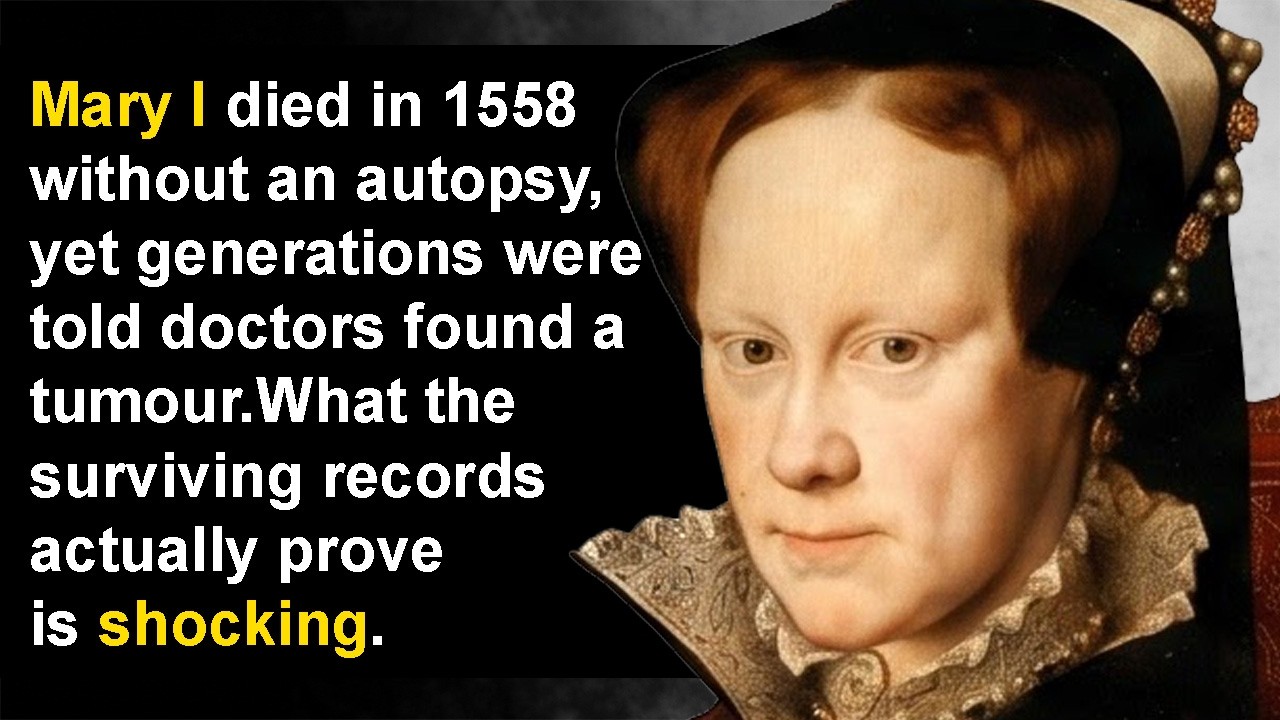
Here is the part that popular history gets wrong. There is no autopsy. No postmortem was performed on Mary Tudor, and no surviving record identifies a tumor, an ovarian mass, or any other lesion. The famous story that embalmers found a growth inside her rests on nothing.
No primary source records it. The tumor everyone repeats was never found because nobody ever looked. What exists instead is a hypothesis. In 1987 and again in 2000, two medical writers proposed in academic journals that Mary suffered from a tumor of the pituitary gland—a prolactinoma.
It would account for the whole cluster: periods that stopped for years, lactation, abdominal swelling, crushing headaches, deepening depression, and vision that failed as the growth pressed on the optic nerve. It is a genuinely elegant explanation. It is also completely unprovable. There has been no exhumation, no tissue, no DNA study, and no contemporary physician’s notes that diagnose anything.
We’ll likely never know what her body was actually doing. What can be said is what she believed. She died convinced she had been chosen to restore the true faith to England, and that God had answered her twice with the physical, unmistakable signs of a son—and taken him back both times. In her will, Mary asked that her mother’s body be brought from Peterborough to lie beside her.
It never was. She lies in Westminster Abbey with no child, no husband, and no mother. And in 1603, the coffin of Elizabeth—the bastardized sister she imprisoned and could not disinherit—was lowered into the vault directly on top of her.






