In the great hall of the Red Fort in Delhi, on the night of January 6, 1903, thousands of aristocrats and diplomats fell into absolute silence. Every flickering candle in the Diwan-i-Khas seemed trained on a single figure. Mary Curzon, the Vicereine of India, moved slowly through the room in a gown of champagne silk embroidered with gold thread and thousands of iridescent beetle wings. The dress weighed ten pounds, pressing down on a body already exhausted by fever, heat, and years of imperial duty.
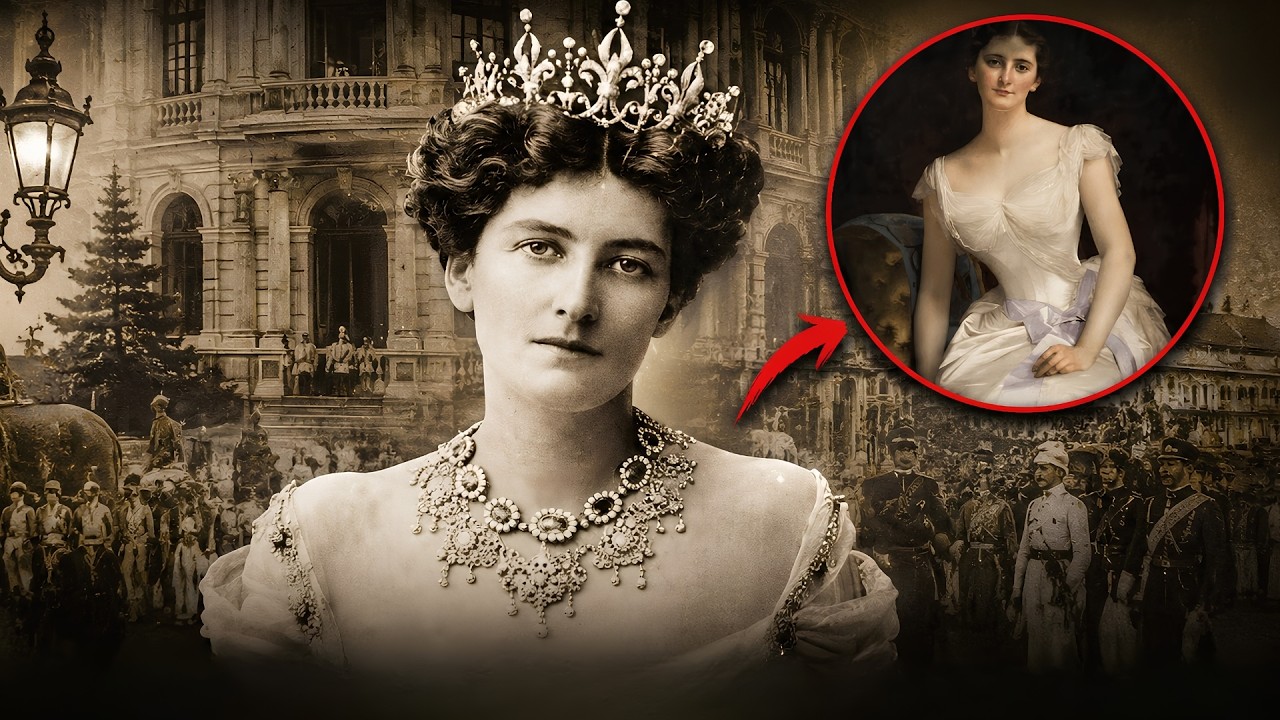
Diamonds from her Bouchéron tiara caught the candlelight as she held the room with perfect composure. Standing in a dark corner, her husband George Curzon watched with cold satisfaction. He saw a living masterpiece of empire. No one in that hall recognized the truth: beneath the silk, a failing body was paying a price none of them could see.
Mary Leiter was born in Chicago on May 27, 1870, into a fortune built with astonishing speed. Her father had partnered with Marshall Field years before the great Chicago fire, and after the city rebuilt, his wealth expanded further. Newspapers and property ledgers calculated his holdings in the tens of millions of dollars. But Mary was not born into the inherited silk of European dynasties.
Her foundation came from trade, real estate, and the hard instincts of a rapidly rising America. Washington completed the lesson Chicago had started. In the capital, money mattered, but manners decided who stayed in the room after introductions ended. Mary grew up in a lavish mansion on Massachusetts Avenue and moved in the same official social world as Frances Folsom Cleveland.
She watched hostesses, diplomats, and political wives treat conversation as a form of ranking, and she absorbed the method quickly. For her deeply ambitious mother, however, raw capital was never the destination. Money was merely an instrument. It had to purchase something more permanent: historical recognition.
The American elite understood that true aristocratic authority could not be built from scratch in a single generation. It had to be acquired across the ocean. Mary carried herself with unusual physical confidence. Tall for her era and hard to ignore, she moved through crowded ballrooms with slow, deliberate calm, often lowering her eyelashes and listening rather than competing for attention.
The established elite expected a newly wealthy American girl to be loud, to flaunt heavy jewelry, and to beg for social validation. Mary executed the opposite strategy. Her restraint made her harder to read, and in rooms where every family measured every other, mystery worked better than display. The Chicago Tribune praised her “engaging sympathy” and noted her distinct lack of aggressive self-confidence.
She shattered the stereotype of the new money American heiress. During the late nineteenth century, the global elite operated on a ruthless transactional formula. America possessed bottomless bank accounts; Europe retained ancient aristocratic titles. Mary’s mother crossed the bourgeois French nobility off her target list and demanded the highest echelon of power.
Carefully arranged invitations to British royal gatherings sat on a vanity table. Mary did not stumble into the old world as a desperate social climber. She executed a flawless curtsy before the prince and princess of Wales in London, officially signaling her arrival. Millions in financial ammunition bought the introduction, but she held her ground using her own dignity, wit, and diplomatic instincts.
The notoriously snobbish London aristocracy initially tried to ignore her, then bowed to her presence. Around 1890, Mary encountered George Nathaniel Curzon. He was thirty-one, with cold eyes and an ambition large enough to swallow the world. Beneath his perfectly tailored suits, a rigid steel corset clamped his curved spine, forcing him to stand painfully straight.
He had crossed the deserts of Persia, penetrated the borders of Afghanistan, and written heavy books on geopolitics. His arrogance was so legendary that Oxford students mocked him in verse. Yet his towering public greatness was maintained only by hiding extreme bodily torment every single day. Mary did not fall in love with an easy man.
Hundreds of private letters passed between them over two years of courtship. At formal dinners, she neutralized the frozen atmospheres Curzon generated with his endless arrogance and lack of empathy. She did not purchase him with her father’s wealth. She won him through steadiness, intelligence, and emotional discipline, providing the warmth his austere chambers lacked and mending the political relationships his sharp tongue severed.
It took Curzon two full years to recognize her as the vital missing component of his political trajectory. They became engaged in 1893. On April 22, 1895, the twenty-four-year-old bride flashed a triumphant smile across the front pages of the international press before a Washington church altar. Behind the headlines lay a prenuptial agreement.
A decisive signature transferred an enormous fortune from America to England, erasing the groom’s debts and paving a golden road for his future power. The public framed the union as a modern Cinderella story, but as biographer Nigel Nicolson later pointed out, this was a specific fairy tale where Cinderella’s father happened to be worth twenty million dollars. Mary had secured the most brilliant sought-after man in Britain. But the tragedy of her impending life began on this exact day.
What Curzon craved next was the highest imperial office he could reach. On January 6, 1899, the vessel carrying the newly appointed viceroy dropped anchor in Bombay harbor. Mary stood on deck, twenty-eight years old and pregnant with her first child. The moment the iron doors swung open, a suffocating wave of tropical heat struck her face.
Blinding dust swirled through air heavy with spice, salt, and dry earth. Beneath a blazing sun, a deafening roar of human voices rose from the docks. Mary was not merely accompanying her husband to a distant outpost. She was being dropped into the nerve center of the British Empire.
The title of Vicereine transformed her into the visible consort of imperial authority in India, ruling over a subcontinent of three hundred million subjects. The role was public before it was personal. Every procession, greeting, and review turned her body into part of the state itself. As the royal train moved toward Calcutta, hundreds of thousands of eyes turned toward the foreign woman inside it.
The colonial elite waited for the wealthy American heiress to commit a catastrophic social error. Mary refused to grant them that satisfaction. Seated in an open-top state carriage, her posture remained perfectly straight, her gaze sweeping across a crowd of over one hundred thousand people lining the streets. Newspapers described her as the most beautiful memsahib in Asia.
An Indian poet welcomed her in court verse. But this public triumph carried a cruel trap. To the empire, Mary was no longer an independent human being with private vulnerabilities. She had been turned into a polished symbol.
An imperial symbol was denied the human right to be weak. She could not show fatigue. She could not admit physical distress. Behind the closed doors of the palace, far from the state dinners, she faced a relentless schedule of official labor.
Her silk shoes were often caked in mud as she walked miles to inspect hospitals, rural dispensaries, and schools. She managed budgets to expand medical education and professional training for Indian women. She collaborated with local weavers, incorporating their embroidery techniques into her own court dresses, forcing the fashion houses of Paris and London to recognize indigenous artistry. Yet her kindness softened the public face of colonial rule without changing its structure.
She had become one of the empire’s most visible faces. That structure was already driving its weight into her failing body. In 1903, seeking to celebrate the coronation of King Edward VII, Curzon orchestrated an event without historical precedent: the Delhi Durbar. Thousands of elephants draped in gold ornaments and jewels moved across the plains.
Dozens of ruling princes appeared before an enormous crowd under the Delhi sun. The spectacle was the undistorted reflection of Curzon’s psychology, his grandiosity, his obsession with microscopic control, his hunger to project ultimate authority. To anchor the center of the stage, he required a flawless leading lady. Mary was positioned to become the ultimate symbol of imperial dominance.
To meet the demands of the pageant, Mary collaborated to design a garment that pushed beyond contemporary fashion. Indian artisans in the Kishan Chand workshop in Delhi worked long hours, driving thousands of needles through heavy champagne-colored silk, executing the ancient art of zardozi embroidery with genuine gold and silver thread. At the center of the peacock feather motifs were iridescent beetle wing cases, the elytra of the jewel beetle, radiating a haunting blue-green light. The finished panels were shipped to Paris, where the House of Worth completed the assembly.
The garment weighed ten pounds. It strained the body wearing it. The night of the Durbar marked the zenith of Mary’s authority, the most radiant moment of her tragically brief existence. But the physical price extracted by that single night of supremacy triggered an agonizing slide into dark, isolated rooms.
After the Durbar, her headaches became severe and persistent. Thick velvet curtains were drawn shut in the Calcutta palace. The only sound in her bedroom was the shallow breathing of a woman confined to her mattress for weeks at a time. The scorching climate and a diplomatic schedule offering no accommodation for weakness had finally cornered her.
In 1903, she was repeatedly bedridden. She refused to complain. Educated from childhood to believe that silent endurance was the ultimate feminine virtue, she clenched her teeth and maintained silence, terrified that her failing health might obstruct her husband’s ascent. The couple’s only escape was a secluded retreat high upon the windy slopes of Mashobra.
There, the formal shells of their public life loosened. They reverted to a quiet intimacy, whispering their private nicknames, Kinky and Papy, to one another. Curzon allowed his punishing steel corset to be temporarily loosened. The historical record confirms that he truly loved her.
When her health forced her to return to England alone, he wrote to her repeatedly, admitting that he felt adrift without her. But his love never became strong enough to slow his ambition. He needed her to maintain his balance, and he refused to stop using her. By 1904, Mary’s private letters stated her premonition that returning to India would be a terrible mistake.
Despite her warnings and her deteriorating condition, Curzon bullied his way into securing an unprecedented second term as viceroy, prioritizing his own legacy over the survival of the woman he claimed to cherish above everything else. Her fears proved justified on English soil just before they were due to return east. In autumn 1904, at Walmer Castle in Kent, medical specialists gathered as blood soaked through the bed linens following a severe maternity complication. Mary’s temperature plummeted.
She was rushed into emergency surgery, but a massive infection spread through her weakened system. She narrowly escaped death, but permanently lost her prior physical health. Yet colonial duty and Curzon’s ambition dragged her shattered body back to the eastern furnace. By then, imperial politics was shifting against him.
Curzon had waged a vicious public bureaucratic war with Lord Kitchener, the ruthless commander-in-chief of the Indian army, over administrative control of the colonial military. Curzon presented precise arguments that were correct on paper, but he had alienated his allies. In August 1905, Prime Minister Arthur Balfour and the government in London sided with Kitchener. Curzon was stripped of his governing authority and compelled to resign.
His humiliation was broadcast across the empire. On November 18, 1905, the steam ship carrying the disgraced former viceroy departed India. The docks were empty. No honor guards stood attention.
No brass bands played. Curzon stood rigidly on the deck, muttering a line from his farewell speech, claiming he had written his name there and that the letters were a living joy. Mary had lost something harder to recover than office: her health and six vital years of youth, spent supporting him. They sailed back toward the grim fog of London.
The polluted air offered her no chance of recovery. The summer of 1906 descended upon London with oppressive heat. Inside her quiet bedroom at Carlton House Terrace, at forty minutes past five on July 18, the steady ticking of the pendulum clock gave way to permanent silence. The death certificate listed heart failure, described as the sequel of a serious illness two years earlier.
It was the end point of damage her body had carried for years, the final consequence of six relentless years inside imperial life. Mary died at age thirty-six. Curzon collapsed beside her deathbed. He commissioned sketches and plans for a memorial in white marble.
The effigy with closed eyes lay inside the ancient chapel at Kedleston Hall. The historical record demands acknowledgment of a complex truth: he loved her with genuine, agonizing intensity, and dedicated seven years to constructing her memorial tomb. Yet within less than a year after the funeral, he initiated a new romantic relationship. He remarried and later became foreign secretary, helping reshape global borders.
In 1923, he came close to becoming prime minister. He was granted nineteen additional years to build his legacy. Society allowed the widower to continue a life of power and consequence. Mary lost that privilege forever.
She was frozen in white marble and sealed into a rural chapel. Her death left three young daughters suffocating under their father’s shadow. Little Alexandra was still a child when her mother died. Years later, the daughters were forced to sign legal documents and battle in court to secure their inheritance from their American grandfather, a fortune their own father had deliberately locked away.
When Mary vanished, no one remained to soften Curzon’s brutal tendencies. He restricted his children’s lives and wealth through psychological control. Irene, Cynthia, and Alexandra were cast into a scandal-ridden British society without a maternal compass. Cynthia would later marry Oswald Mosley and die at age thirty-four.
More than a century later, the dress remains behind thick glass at Kedleston Hall, still standing intact. The champagne silk has yellowed. The heavy gold threads have tarnished black. Yet those thousands of beetle wings continue to cast a cold, brilliant light.
History carved the proud viceroy’s name deeply into enduring marble. But for the woman who sacrificed her youth and body to illuminate his path, the empire preserved almost nothing. What remained was a collection of lifeless insect wings.






