Before the headlines branded her a traitor, before the seven husbands, the starvation diets, and the billion-dollar inheritance, Barbara Hutton was a lonely child in a gilded cage. She was born in New York on November 14, 1912, the only daughter of Edna Woolworth and Franklin Hutton. Her mother died when Barbara was just four years old, a tragedy so shrouded that the family kept it hidden for years. But the little girl found her.
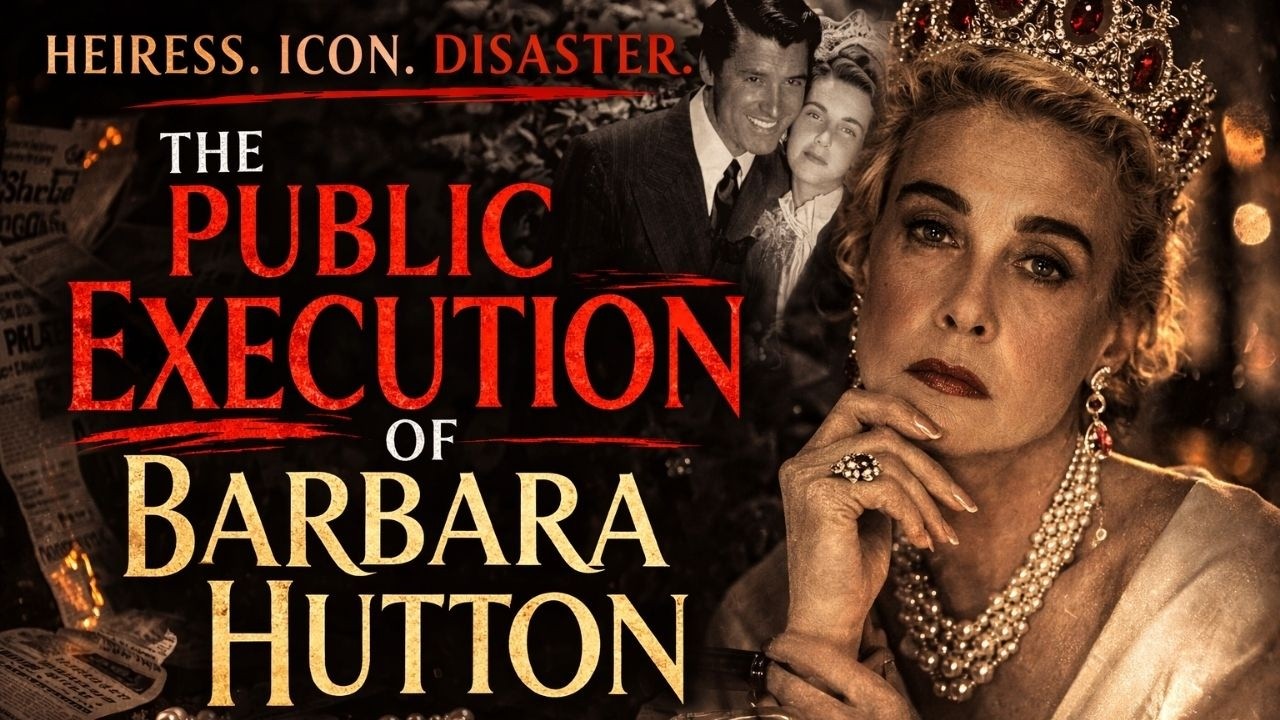
Barbara was raised by governesses, shuffled between palaces, and starved for affection. The press stalked her childhood, and the public watched not with wonder but with anticipation, waiting for her fall. At her debutante ball, flown-in orchids, champagne, and an orchestra brought from Europe created the most expensive coming-out party of the season. While America starved during the Great Depression, she danced in diamonds.
Public opinion turned viciously against her. She was called vulgar, unpatriotic, a corrupting symbol of everything wrong with the rich. Strangers spat at her in the street, jeered her, and threw stones at her car. When she used her fortune to support Britain’s war effort, she was branded a warmonger and a traitor.
Her life became a blur of parties and hollow marriages that collapsed in scandal. She woke up in hotel rooms she didn’t remember checking into. She married seven times; three husbands were princes, and one she bought outright with money. She gave diamonds to hotel staff, rode elephants to parties, and slept beside legends like Cary Grant and James Dean.
She fought custody battles across continents, always hoping to win love as easily as she won attention. But the money drained away, the tabloids closed in, and the parties turned cruel. Friends vanished into scandal, addiction, and death. She faded quietly, surviving on brutal diets, sleeping pills, champagne for breakfast, and vodka to sleep.
Her weight plummeted and her accounts dried up while vultures circled. Still, she kept playing her role, painted with perfume and powder, utterly alone. Her fortune came from her grandfather, Frank Winfield Woolworth, whose five-and-dime stores lined nearly every main street in America. Barbara’s father was a rising Wall Street broker, and her mother, Edna, was the ethereal second daughter of the Woolworth empire.
The marriage of her parents was a mismatch of temperaments. Edna was shy and reclusive; Franklin was restless, heavy-drinking, and unfaithful. Their union collapsed publicly when photographs of Franklin dancing with a young Swedish actress appeared in the New York Sun. Edna stopped trying to save the marriage.
On the evening of May 2, 1917, she dressed in her finest gown, strung pearls around her neck, and closed her door. The newspapers reported that a maid had found her body. In truth, it was four-year-old Barbara who discovered her mother. No autopsy was performed.
The coroner claimed mastitis, which didn’t match the facts. Most believed Edna had taken her own life, and that the Woolworth family had paid to bury the truth. Barbara was sent to live with her grandparents at Winfield Hall, a white marble mansion of sixty rooms. The house was divided by historical periods, from Louis XIV to Marie Antoinette, with each bedroom door bearing a plaque in gilded letters.
Her grandfather, Frank Woolworth, once a titan whose stores spanned continents, had become paranoid and reclusive, playing his pipe organ for hours until the walls seemed to shake. Barbara’s grandmother, Jenny, sat all day in a rocking chair, mute and unresponsive. The meals were silent. Barbara learned early the meaning of being surrounded by everything and touched by nothing.
When her grandmother died in 1924, the estate was divided. At eleven years old, Barbara received more than twenty-six million dollars, making her one of the richest children in the world. She wasn’t yet a teenager, but she belonged to no one. Her mother was dead, her father was elsewhere, and her guardians were servants.
At sixteen, she fell for a tennis coach named Peter Story, a man of twenty-six who treated her with tenderness she had never known. The affair was brief and devastating. By seventeen, she had stolen a sailboat and drifted fifteen miles out to sea before the coast guard intercepted her. Her father covered it up and hired a bodyguard to watch her; within a week she was sleeping with him.
When her father found out, he was disgusted and replaced the guard with a married chauffeur, adding the man’s wife to the household staff. Her formal debut came in three acts, culminating in a ball at the Ritz-Carlton on December 21, 1930. One thousand guests, four orchestras, two hundred waiters, ten thousand roses, and twenty thousand white violets. Maurice Chevalier greeted guests as Santa Claus, and party favors were velvet boxes containing unmounted jewels.
Even then, Barbara noticed how people looked at her, not with affection but with calculation. She began calling herself the Princess of Plague. She said she only had to look at a respectable man and he would run in the opposite direction. The following year, she was presented at the British court.
The Prince of Wales danced with her, but she described him as buoyant, drunk, and strangely unserious. The press painted her as a reckless heiress trying to buy a title. She was already entangled with Prince Alexis Mdivani, a Russian exile from Georgia whose aristocratic claims were mostly invented. He divorced his American wife while she was pregnant, and Barbara’s family tried to stop the marriage.
At nineteen, she petitioned the court to be declared legally of age. It was granted. They married in Paris on June 20, 1933, in a civil ceremony, followed by a religious service in a Russian Orthodox cathedral. Eight thousand people crowded the streets outside.
At the altar, Barbara stepped on the ceremonial carpet a second before Alexis. The priest had explained that whoever stepped first would rule the marriage. She gave him a yacht, pearl shirt buttons, polo ponies, and then a second set of polo ponies, because she had learned his first wife had given him the same. He gave her a jade necklace paid for from her own money.
The marriage crumbled quickly. On the train to Lake Como, he told her she was too fat. She weighed 148 pounds and was five foot four. By morning she had begun what she called her Gandhi diet: three cups of coffee a day, cigarettes, and no food.
He spent her money, caroused, and was arrested in nightclubs. When she finally asked for a divorce, her father hired investigators to check the new suitor, Count Kurt Reventlow. They found a Danish aristocrat with a dairy farm, a private railway, and thousands of acres. Her father advised her to take her time.
But hours after her divorce from Alexis was finalized, she married Reventlow anyway. The marriage was a disaster. He demanded she renounce her American citizenship to save taxes for their son, Lance, born in 1936. The press erupted with accusations of treason.
He grew controlling, then violent. In Paris, he took her to a secret club where children were exploited on a stage, and that night, inside their suite, he assaulted her. She fled to London and pressed charges. A judge muttered that he had known men who killed their wives for far less.
But she dropped the charges, saying she didn’t want a scandal, she wanted peace. By 1939, war was gathering over Europe. Barbara had given up her American citizenship, but a British court refused to release her young son to her. She fled to America with her mother’s pearls and a fortune, arriving in New York on October 22 to a storm of contempt.
Protesters gathered outside her hotel. Stones hit her limousine. A woman threatened to throw acid in her face. She received a hundred threatening and hateful letters every day.
The city had decided she was a dollar princess who danced while others starved. She fought back with money and spectacle. She lent her yacht to the British navy, sponsored fifteen families, gave ten ambulances to the Red Cross, and fifty thousand dollars to the British war relief fund. Headlines softened.
She was called as American as apple pie. In July 1942, she married Cary Grant at Lake Arrowhead. He signed away any claim to her fortune. For a time, she was happy.
But she had already begun taking pills, first to sleep, then to calm down. Grant, famously frugal, began counting bottles of Coca-Cola and clipping buttons from discarded shirts. She retreated into secret rituals, painting days with colors and speaking in code. They slept in separate rooms and lived behind a wall of silence.
Their divorce came quietly. By 1946, she fled to Morocco, buying a white palace and filling it with silk and crystal. She gave grand parties and secretly donated thousands to feed the poor. But nothing filled the emptiness.
She married Igor Troubetzkoy, then Porfirio Rubirosa, a Dominican diplomat who demanded two million dollars paid on the wedding day. She agreed. The marriage lasted seven weeks. Her son Lance grew distant.
He married at nineteen; she didn’t attend. He died in a plane crash on July 4, 1972, when a friend lost control of a small aircraft. Barbara refused to believe it. She screamed, collapsed, and raged.
She admitted she had been a bad mother. Her fortune had been drained for years by her own lawyer, Graham Madison, who owned five houses and two Rolls-Royces while she accumulated debt. By the late 1970s, she was confined to a hotel bed, refusing to rise, begging for men to sit with her for a thousand dollars a night. Her meals were Coca-Cola and cigarettes.
She was convinced she was being watched, that her lawyer was plotting against her. On March 26, 1979, she was admitted to Cedars-Sinai hospital with cardiomyopathy. She refused IVs and pulled needles from her arms. On May 11, 1979, at 5:10 in the evening, Barbara Hutton died at the age of sixty-six.
Her funeral took place in the Woodlawn Cemetery in the Bronx. Ten people attended. There was no priest. She had once said she didn’t want a man she had never met droning over her grave.
One poem was read. She was buried beside her mother, and beside Lance. Barbara Hutton had spent a lifetime chasing something that would never stay.
In the end, when nothing was left, she slipped quietly into the silence she had feared all along.






