The blow came out of the darkness without warning. Sandra Rivet had reached the bottom of the basement stairs at 46 Lower Belgrave Street, a tray of empty teacups in her hands, when the lead pipe swung. There was no shout, no challenge, no moment to turn. The first strike caught her on the head and she collapsed, the cups shattering on the linoleum.
The man did not stop. He kept swinging until the only sounds in the kitchen were his own ragged breathing and the ticking of the clock. Then he began folding her body into a canvas mail sack. A few minutes later, upstairs in the first-floor drawing room, Veronica Lucan looked at the clock.
Ten minutes had passed, perhaps fifteen. Making tea did not take this long. The silence from the basement was absolute. She called out for Sandra.
Nothing. She stood, walked to the top of the stairs, and called again. Still nothing. She began to descend into the gloom, a small woman in a dress and heels, moving toward the dark that had just swallowed the young nanny.
She sensed movement before she saw it. A shadow detached itself from the deeper shadows. The pipe caught her on the forehead, splitting the skin and sending blood into her eyes. Veronica screamed, a raw primal sound, and fell back, dazed but conscious.
The adrenaline of survival flooded through her. She realized, with a horror that defied sanity, that she was being murdered in her own home. The shadow lunged again. “Shut up,” a voice hissed.
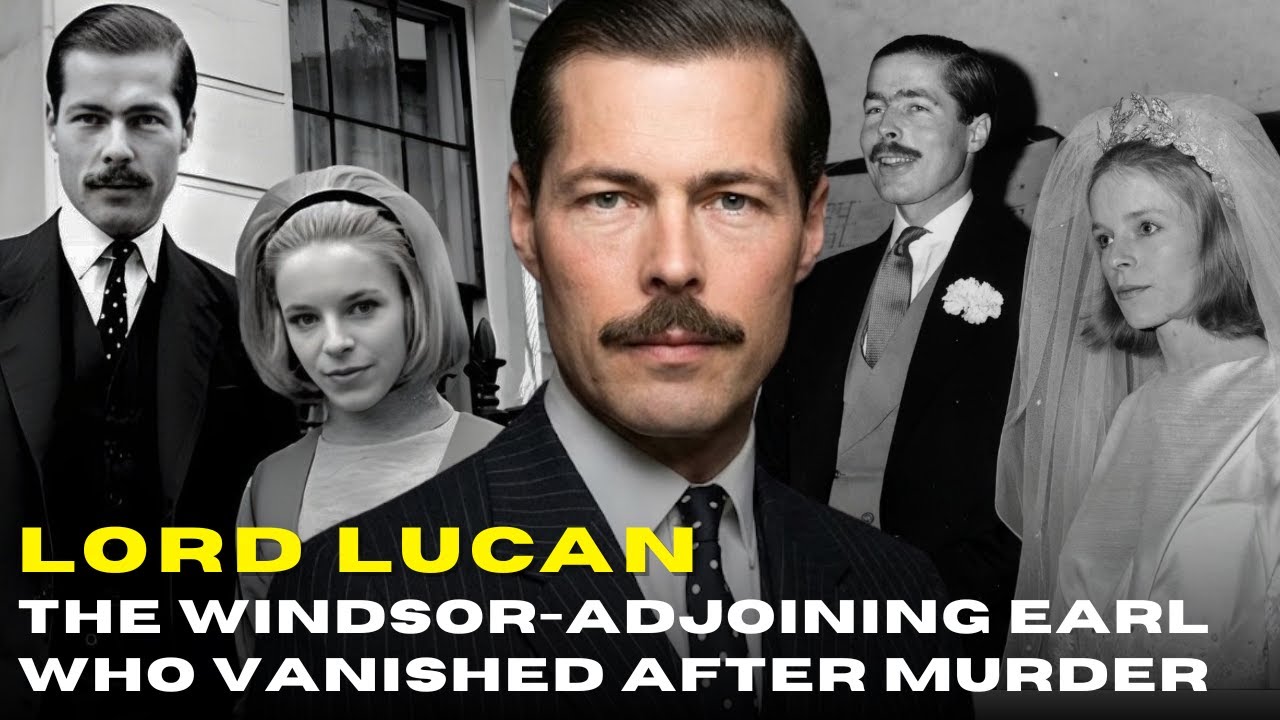
It was the voice of her husband. Richard John Bingham, the seventh Earl of Lucan, had come home to kill his wife. The man who stood in that dark basement was not a stranger to violence. Born in 1934 into one of the oldest families of the Anglo-Irish aristocracy, he had been raised with an absolute conviction that his will was law and his lineage placed him beyond the reach of consequence.
He was a gambler by nature, a man of rigid habit, known to his circle as “Lucky Lucan” for his improbable runs at the backgammon table. His marriage to Veronica, a beautiful young woman he had swept into his world in 1963, had curdled over the years into a bitter war over money, custody, and control. The courts had refused to bow to him. A divorce settlement had stripped him of his fortune and his children.
In his mind, he had been wronged, and he had decided to restore the natural order by eliminating the source of his ruin. For weeks he had planned it. On the morning of November 7, 1974, he made phone calls, organizing his affairs with a strange detached finality. He lunched at the Clermont Club but did not linger.
He borrowed a dirty, nondescript Ford Corsair from his friend Michael Stoop, claiming his own Mercedes — as recognizable in Belgravia as a bus — had battery trouble. In the boot he placed a heavy canvas sack and a length of lead piping wrapped in tape. The tape was for grip. A smooth lead pipe becomes slippery when wet with blood.
It was the thinking of a pragmatic man, not a maniac. That evening, darkness swallowed London in the damp grey of an autumn Thursday. At 46 Lower Belgrave Street, the atmosphere was heavy with the static of a family under siege. The household was run by Veronica and the 29-year-old nanny, Sandra Rivet, a young woman with a son she had given up for adoption years earlier, a boyfriend named John Hankins who drove a cab, and a fondness for spending Thursday nights out with him.
That night she was tired. The tension of the household had taken its toll. She decided, on a fatal and tragic whim, to stay home instead. Around 8:55 p.
m. , the most British of impulses set the tragedy in motion. Sandra said she would go downstairs and make tea. “Would you?
Thank you,” Veronica replied. Those were likely the last words Sandra Rivet ever heard. She gathered the cups, walked out of the drawing room, and began the descent into the basement, which was unusually dark. The light that was usually left on had been extinguished.
She was just a silhouette to the predator waiting in the corner. Lucan had let himself in with the key he had sworn to the courts he had lost. He stood in the shadows, breathing shallowly, the pipe heavy in his gloved hand. He was waiting for a woman of a certain height, a certain build — the mother of his children.
But in the gloom, shapes are deceptive. Sandra Rivet was roughly the same height as Veronica, and she had short hair. He struck the wrong woman, and he did not stop striking until he had bludgeoned her to death. Upstairs, Veronica fought for her life.
In the desperate close-quarters struggle, sliding on the blood-slicked floor, she managed to get her hand between his legs and twist with every ounce of strength she possessed. Lucan gasped. The pain broke his frenzy. He pulled back, panting.
The violence stopped as abruptly as it had begun. “John,” she gasped. “Don’t hurt me. ”
“I’m not going to hurt you,” he muttered, the pipe still in his hand.
They stood in the dark for a moment, two ghosts in a ruined marriage. Veronica knew she could not outrun him. She had to outthink him. She asked where Sandra was.
“She’s dead,” he said flatly, as if commenting on the weather. “I’ve killed her. She’s in the sack. ”
She did not scream.
She knew that if she screamed again, she would join Sandra in a sack. She switched tactics. “I can help you,” she whispered. “We can work this out.
But I need to clean my face. I’m bleeding. ”
Lucan hesitated. The adrenaline was fading, leaving him confused.
The plan had gone wrong. He had killed the wrong woman, and the right woman was standing in front of him offering to help. His gambler’s mind could not calculate the odds of this new scenario quickly enough. “All right,” he said.
“Go upstairs. ”
They walked up the carpeted stairs together, the murderer and his victim, into the ground-floor cloakroom. Veronica looked in the mirror. Her face was a mask of crimson, the cuts deep.
She said she would get a towel from the bedroom. Lucan stood in the doorway, the pipe still in his hand, watching her. She knew this was the only chance she would ever get. If she let him think, if she let him regain his composure, he would finish the job.
She moved toward the bathroom, saying she would wet a towel, and then, seizing the brief moment of separation, she bolted. She ran for the front door with the desperation of a hunted animal, her blood-slicked fingers fumbling with the brass latch. The door gave way. The cold night air hit her face.
She burst out onto Lower Belgrave Street and ran toward the lights of the Plumber’s Arms pub on the corner, screaming, “Murder! Murder! He’s murdering me. ”
Inside the pub, the regulars were nursing their pints in the warm, smoky atmosphere.
The door crashed open. A woman stood there, her clothes torn, her face a mask of blood. “Help me,” she shrieked, collapsing onto the floor. “My children.
Save my children. He’s in the house. ”
Back at number 46, Lucan stood in the hallway. He heard the door slam.
He heard the screams fading down the street. He knew, with the cold certainty of a man who has bet everything on red and watched the ball land on black, that it was over. He did not chase her. There was no point.
He did not go upstairs to check on his children sleeping in their beds. He did not pack a bag. He simply turned, walked out the front door, climbed into the Ford Corsair, and pulled away from the curb, driving slowly and calmly past the pub where his wife was being tended to by shocked strangers, into the night, a man who had ceased to be an earl and had become a phantom. The drive from Belgravia to the sleepy town of Uckfield in East Sussex is roughly 42 miles.
On a normal night it takes perhaps an hour. In a battered Ford Corsair with a sluggish engine, it took longer. Lucan drove south, leaving behind the wailing sirens, the blood-soaked basement, and the wife screaming in the pub. He drove into the black silent countryside, a strange and terrifying composure settling over him as he began to construct the narrative that would protect his legacy.
He began to build the lie. At approximately 11:30 p. m. , the car pulled into the driveway of a large comfortable house called The Grants, the home of Ian and Susan Maxwell-Scott, old friends from the high society set.
Ian was away, but Susan was home. She answered the door to find Lord Lucan standing there, disheveled, his hair uncharacteristically messy, with a wet patch on his trousers, likely blood he had tried to sponge off. His manner was startlingly normal. “Hello, Susan,” he said.
“I’m in a terrible mess. ”
She invited him in. She did not know that a murder had taken place in London or that every police officer in the capital was looking for the man standing in her hallway. She saw a friend in distress.
She led him into the drawing room, lit the fire, and poured him a scotch and water. Lucan sat down, took a drink, and with the calmness of a man recounting a minor traffic accident, told her the story he had concocted during the drive. He claimed he had been walking past 46 Lower Belgrave Street, glanced through the basement window, seen a man attacking Veronica, let himself in with his key, rushed down the stairs, and scared the intruder off. He admitted he had slipped in a pool of blood, that Veronica was injured, and that she had then hysterically started screaming that he had done it.
Realizing he would be framed, he had panicked and fled. It was a preposterous story, reliant on impossible coincidences. Susan Maxwell-Scott listened. She was a woman of her class and generation, conditioned to trust the word of a peer of the realm.
She offered sympathy. Lucan knew the story would not hold up in court, but he was not telling it to convince a jury. He was telling it to convince his world. After the story was told, he asked for pen and paper.
He sat at a small writing desk in the Maxwell-Scotts’ drawing room, the fire crackling, and wrote letters explaining his version of events, including one addressed to his brother-in-law, Bill Shand Kidd. These documents would become the most chilling artifacts of the entire affair. In the first letter, he repeated the intruder lie, then let the mask of the hero slip and the cold pragmatist emerge. “The circumstantial evidence against me is strong in that V says it was me,” he wrote.
“V has demonstrated her hatred for me in the past and would do anything to see me accused. ” Then he wrote the sentence that has haunted investigators for fifty years: “I will lie doggo for a while. ”
Lie doggo. An old-fashioned public school phrase meaning to hide, to stay quiet, to go to ground.
The most disturbing aspect of the letters was what was missing. There was no mention of Sandra Rivet. He had bludgeoned a young woman to death hours earlier and stuffed her body into a sack, yet in his final correspondence she did not warrant a single word of regret, pity, or even acknowledgement. To Lucan, she was not a human being.
She was merely a prop in the tragedy of his own life. In the second letter, the financial reality of his ruin bled onto the page. He wrote about the sale of the family silver at Christie’s, gave instructions on which creditors to pay, and asked Shand Kidd to look after the children and ensure they were raised with the right values. “When they finish with my wife,” he wrote, “I will be condemned.
” He was not afraid of justice. He was afraid of judgment. He finished writing in the early hours of Friday, November 8th. He sealed the envelopes and stood.
Susan Maxwell-Scott asked what he intended to do. “I must get back,” he said vaguely. “I must sort things out. ” He walked out into the cold night, climbed back into the Ford Corsair, and drove down the driveway.
She watched his tail lights disappear into the darkness. She was the last credible witness to see Richard John Bingham alive. He drove south again, toward the coast, toward Newhaven, a ferry port offering a gateway to France. At some point in the early hours, the Ford Corsair pulled into Norman Road.
Lucan parked, turned off the engine, and sat for a moment. In the boot lay the bloodstained lead pipe. The interior was smeared with evidence. He left the car unlocked.
What happened next is the void into which a thousand theories have been poured. Did he walk to the ferry terminal and board a boat to France on a false passport provided by his powerful friends? The Clermont set had the means. Did he walk to a nearby private airfield where a light aircraft waited to spirit him to Africa?
Or did he do the one thing his code of honor dictated? The most plausible and bleakest theory is that he walked toward the harbor. The English Channel is cold and unforgiving in November, the currents around Newhaven strong. If he realized that the lie doggo strategy was a fantasy, that the shame of a trial, the stripping of his dignity, was inevitable, he may have decided to take the gentleman’s way out.
No body was ever found. No piece of clothing washed up on shore. He simply ceased to exist. Back in London, the police burst into 46 Lower Belgrave Street.
They found the body of Sandra Rivet in the sack, the blood, and the children upstairs, unharmed but sleeping in a house of horror. The investigation, led by Detective Chief Superintendent Roy Ranson, soon hit a wall of upper-class indifference. When the detectives interviewed Lucan’s friends — Aspinall, Goldsmith, Shand Kidd — they were met with arrogance and obstruction. “He’s an Earl,” one friend reportedly told a detective.
“You can’t just treat him like a common criminal. ” They did not seem horrified by the murder of the nanny. They seemed annoyed by the mess. They repeated the intruder story even though they must have known it was a lie.
They held private meetings at the Clermont Club, strategizing, pooling resources. Were they planning his escape or managing the PR damage? The police were outmaneuvered, used to dealing with street thugs, not men who played backgammon with MPs and dined with royalty. By the time they issued a warrant for Lucan’s arrest, he had been gone for days.
The Ford Corsair was found abandoned in Newhaven, but the man himself was gone. The trail was freezing cold. John Aspinall, the zoo owner with a philosophy that fetishized the predatory strength of the elite, became the ringleader of the defense. He openly told the press that if Lucan had come to him, he would have helped him.
“If a close friend of yours comes to you and he’s in a mess, you help him,” he said. “You don’t hand him over to the police. That’s the morality of the betrayal. ” The police suspected a fund of money had been raised to aid Lucan’s flight.
There were rumors of private planes chartered to France, safe houses in the Scottish Highlands, contacts in the South American Junta. But rumors are not evidence, and the Clermont set was careful to leave none. In June 1975, seven months after the murder, an inquest was held at the Westminster Coroner’s Court. The courtroom was packed with the world’s press.
Veronica, the Dowager Countess of Lucan, took the stand. For years her husband had told the world she was mad. Now she stood before it, the scars of his attack still visible on her forehead, and told her story quietly, describing the darkness of the basement, the blow to the head, the fight for her life, and the terrifying realization that the man trying to kill her was her husband. She was composed, lucid, and devastatingly credible.
The inquest jury returned a swift verdict that made legal history: murder by Lord Lucan. Naming a member of the aristocracy directly in a murder verdict was historically striking. In the eyes of the law, the mystery was solved. But a verdict cannot handcuff a ghost.
The sightings began in earnest, turning Lucan into a recurring modern myth. A hiker claimed to see him on a mountain in Colombia. A tourist spotted him in a bar in Mozambique. He was reported to be living as a monk in India, a sheep farmer in New Zealand, a waiter in San Francisco.
The Metropolitan Police were forced to investigate thousands of leads across five continents. One of the most persistent theories centered on Africa, where Lucan had spent time in his youth and where his friends had deep connections. Detectives flew to Cape Town, chased leads in Botswana, found men who looked like him, tall, mustached, distant — but never the man himself. Aspinall fueled the Gothic speculation by quipping darkly that the best way to get rid of a body was to feed it to his tigers.
It was likely a sick joke designed to taunt the police. But it added a layer of horror to the mystery. While the world played a parlor game of Where’s the Earl, a very real tragedy continued to unfold in London. The true victim of the Clermont set’s protection racket was not the police.
It was Veronica Lucan. The tribe that protected her husband turned its collective fury on her. In their warped logic, she was the architect of the tragedy. If she hadn’t been so difficult, if she hadn’t fought for custody, poor John wouldn’t have been forced to snap.
She was ostracized. Friends stopped calling. Invitations dried up. The press, initially sympathetic, turned on her, portraying her as cold, odd, reclusive.
In 1982, in a cruel twist of irony, custody of her children was transferred to Bill Shand Kidd, the very man Lucan had written his letters to. He had asked him to ensure the children were raised with the right values — values that evidently included the belief that their mother was a monster. Veronica was left alone in the house on Lower Belgrave Street, the house where the murder had happened, surrounded by the ghosts of that Thursday night. She became a recluse, rarely leaving the property, living out a long silent sentence for a crime she did not commit.
The legend of Lucky Lucan grew more absurd with every year. In 2003, a book claimed he was living in Goa, India, under the name Barry Halpin, a banjo-playing hippie known as “Jungle Barry. ” The British press went into a frenzy. Photos were analyzed, facial recognition experts hired.
It turned out to be exactly what it looked like: a banjo-playing hippie from St. Helens who happened to have a mustache. But the fact that the story made front-page news nearly thirty years after the murder proved the enduring power of the Lucan brand. He had become a symbol of the ultimate escape, the idea that if you are rich enough and connected enough, you can literally get away with murder.
As the 21st century dawned, the wall of silence began to crack. The men of the Clermont set began to die. Aspinall and Goldsmith passed away, and the fear they inspired evaporated. A secretary who worked for Aspinall came forward to say she had been instructed to book flights for Lucan’s children to travel to Africa to meet their father in the late 1970s, a trip abruptly cancelled.
A former detective revealed that police knew Lucan had made a call to a friend hours after the murder, a call never officially logged. The investigation was cold, but the file was never closed. For the family of Sandra Rivet, the speculation was a constant reopening of the wound. Her son, Neil Berriman, who had been given up for adoption and only learned of his true identity years later, began his own quest for justice.
He did not care about the Earl or the glamour. He wanted to know where the man who killed his mother was hiding. As the 40th anniversary of the murder approached, the Lucan family wanted closure. They wanted the title to pass to the son, George Bingham, and they needed a death certificate.
That requires a presumption of death, and in the case of Lord Lucan, presumption is a dangerous thing. On a gray morning in February 2016, inside the High Court in London, the ghost of Lord Lucan was finally officially laid to rest. There was no coffin, no body, no tears — just a battle of paperwork fought between two middle-aged men bound together by the violence of a night forty-two years earlier. On one side stood George Bingham, who believed his father was long dead, likely a suicide in the Channel hours after the murder.
On the other stood Neil Berriman, who believed with fierce conviction that Lucan had escaped and lived a life of luxury in Africa. The judge, Mrs. Justice Asplin, had no choice. There had been no proof of life for four decades.
Under the presumption of death act, she issued her ruling: Richard John Bingham was presumed dead. Outside the court, the new eighth Earl spoke to the cameras. “Our family has no idea how our father met his own end,” he said, his voice measured. “Whether he did so at his own hand or by the hand of others remains a mystery.
” For Neil Berriman and for the obsession of the British public, a piece of paper changed nothing. You cannot legislate a legend out of existence. The true tragedy of the Lucan affair is not the mystery of the Earl. It is the slow, silent destruction of the countess.
Veronica had survived the lead pipe, but she did not survive the peace. For over forty years she had lived in the house on Lower Belgrave Street, refusing to be driven out, an act of stubborn, perhaps masochistic defiance. She was estranged from her children, estranged from her sister. The high society that had once toasted her beauty had completely ostracized her.
In 2017, a year after her husband was legally declared dead, police forced entry into the house after concerns that she had not been seen for days. They found her dead. Fearing a loss of independence amid declining health, she had taken a quantity of pills and alcohol and lain down to die alone in the house that had been her prison for half a century. She was the one who had told the truth.
She was the one who had fought back. Yet she died alone, labeled mad to the end by the very people who protected her attacker. In her final television interview, given months before her death, she said she believed her husband had escaped, that he had watched her from afar. “I don’t know if he is dead,” she said.
“I never knew. ”
Since the death certificate was issued, periodic claims have surfaced alleging Lucan may have lived abroad, including Australia, but none have been proven and police have not confirmed them. The trail went cold again. Fifty years have passed.
The Clermont Club is gone, turned into a different luxury venue. The main players — Aspinall, Goldsmith, Shand Kidd, Veronica, Sandra — are all dead. The Ford Corsair was crushed into scrap metal decades ago. But somewhere, perhaps in the deep silt of the English Channel, or perhaps in an unmarked grave under an African acacia tree, the truth lies buried.
Richard John Bingham, the seventh Earl of Lucan, committed what some called the perfect crime, not because he was clever, but because he was protected. He bet his life on the silence of his friends, and for fifty years that bet has paid out. The water at Newhaven is dark and deep, and it keeps its secrets well.
The man who walked into the night simply never came back.






