Fidel Castro ruled Cuba for nearly half a century while keeping one of the most carefully guarded private lives of any modern head of state. The world knew his speeches, his uniform, and his image, but not his children. Some were raised in privilege, others in secrecy. Some lived quietly inside the Cuban system.
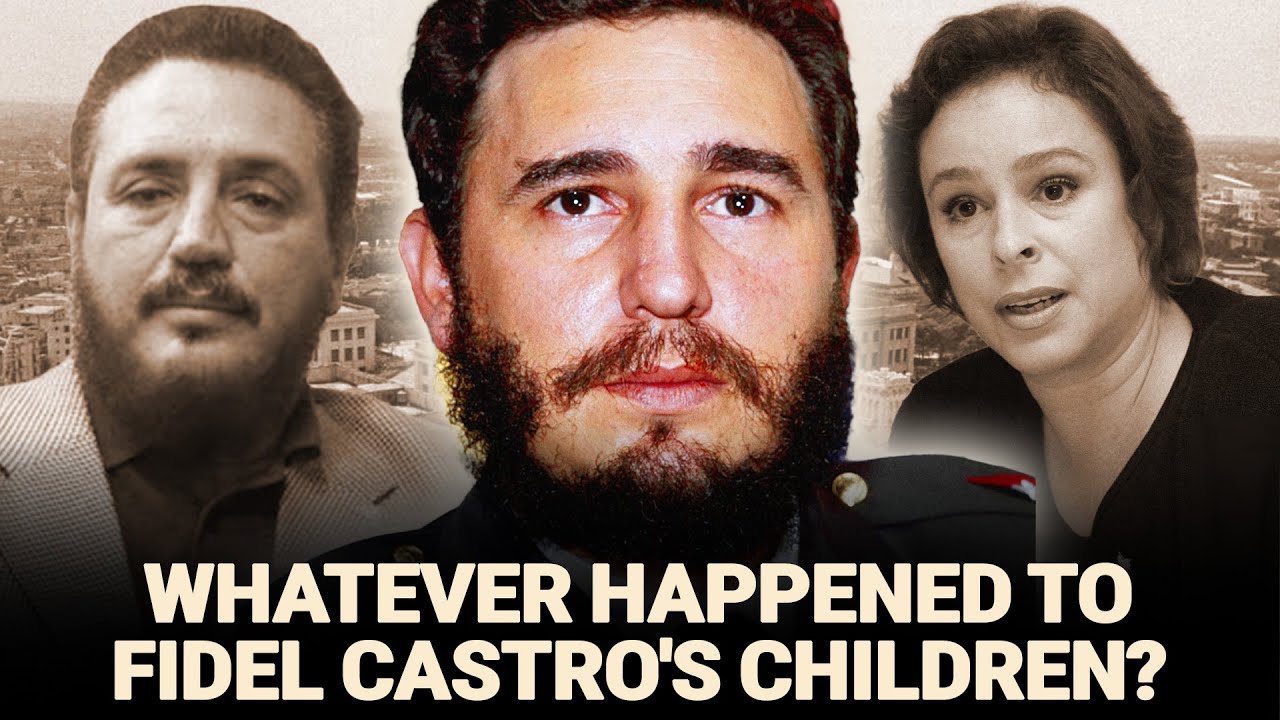
Others rejected it entirely. A few became public figures in their own right. Others left barely a trace in the historical record. The first of those children, Fidel Ángel Castro Díaz-Balart, was born on September 1, 1949, in Havana.
His mother, Mirta Díaz-Balart, came from a prominent Cuban political family with ties to the established elite. His father was then a young law student with political ambitions but no power. The marriage between Fidel Castro and Mirta Díaz-Balart, which had taken place in October 1948, united two families from different social strata. The Díaz-Balarts represented wealth and political influence, while the Castros were landowners from Oriente province with less standing in Havana circles.
Fidélito, as he would be known throughout his life, was born into relative comfort. His early months were spent in a Havana apartment far removed from the revolutionary activities that would soon dominate his father’s life. The marriage deteriorated rapidly, and by 1954, when Fidélito was five, his parents had separated. The divorce was finalized in 1955, and custody arrangements became contentious.
Mirta Díaz-Balart initially retained custody of her son, but the situation became complicated by political developments. Following Fidel Castro’s release from prison in 1955, after the failed Moncada barracks attack of 1953, he left Cuba for Mexico to organize his revolutionary movement. In 1956, Mirta Díaz-Balart discovered her son had been taken to Mexico without her consent. The incident became public and required diplomatic intervention.
Eventually, Fidélito was returned to his mother’s care. After the revolution succeeded in 1959, custody shifted again, and he went to live with his father in Cuba, while his mother eventually left for Spain and later the United States. Throughout the 1960s, Fidélito was the only child Fidel Castro publicly acknowledged. In the 1960s, he was sent to the Soviet Union for his education, attending primary and secondary schools in Moscow.
He remained there for approximately fifteen years, completing advanced studies at Moscow State University and earning a degree in nuclear physics, followed by a doctorate in the same field. His professional identity became rooted in science rather than politics. After completing his education, Fidélito returned to Cuba in the mid-1970s and was appointed to positions within the country’s scientific establishment. In 1980, he became head of Cuba’s atomic energy commission, overseeing the development of nuclear research and Cuba’s planned nuclear power facilities.
Cuba had begun construction of a nuclear power plant at Juraguá with Soviet assistance, and Fidélito’s role placed him at the center of the project. However, the plant was never completed. Construction halted in 1992 after the collapse of the Soviet Union and the end of Russian financial support. Fidélito held the position until 1992, when he was dismissed amid reported disagreements over the direction of Cuba’s nuclear program and management decisions.
He never again held a position of equivalent prominence, though he continued to work as a scientific consultant and taught at the University of Havana. Fidélito married María Victoria Barreiras, a fellow scientist, and the couple had three children. His family life was conducted with relative privacy. After his dismissal, his relationship with his father appeared strained, though details remained private.
On February 1, 2018, at the age of 68, Fidel Ángel Castro Díaz-Balart died in Havana. Cuban state media announced that he had taken his own life following a period of deep depression and treatment for the condition. His funeral was private, attended by family members. Another child, Francisca Pupo, was reportedly born in 1953, during the period after Fidel Castro’s separation from Mirta Díaz-Balart and before his imprisonment following the Moncada attack.
Unlike Fidélito, Francisca was not publicly acknowledged during Fidel Castro’s lifetime in any official capacity. Her existence became known primarily through investigative reporting and accounts compiled after Castro’s death. Her childhood appears to have been spent outside the benefits that came with acknowledged connection to the Castro family. There are no educational records, no interviews, no memoirs, and no documented evidence of any relationship between Francisca Pupo and Fidel Castro.
Whether she knew her father’s identity during childhood or learned it later remains unclear. Whether she married, had children, or pursued any particular career cannot be established from available sources. Her life represents the extreme end of privacy among Castro’s children, so complete that even basic biographical facts remain unknown. Alina Fernández-Revuelta was born on March 19, 1956, in Havana.
Her mother was Natalia “Nacha” Revuelta, a woman from Havana’s upper middle class who had been involved in supporting the revolutionary movement. At the time of Alina’s birth, Nacha Revuelta was married to another man, Orlando Fernández, and for legal and social reasons, Alina was given his surname. Her biological father’s identity was not publicly disclosed. Fidel Castro was in Mexico organizing the expedition that would return to Cuba aboard the yacht Granma later that year.
Alina was raised primarily by her mother in Havana. She learned that Fidel Castro was her biological father when she was approximately ten years old, and the revelation transformed her understanding of her own identity. Her relationship with Castro during her youth involved occasional visits, which she has described as brief and formal, lacking the warmth of a traditional father-daughter relationship. She attended the University of Havana, married young, and had a daughter, Alina Fernández, in the mid-1970s.
The marriage did not last. During the 1970s and 1980s, Alina worked in various capacities within Cuba’s cultural sphere, including modeling, and lived embedded in Cuban society. In 1993, she left Cuba under dramatic circumstances, disguising herself with a wig and false identification documents and traveling to Spain on a tourist visa. Once outside Cuba, she requested asylum in the United States.
Her departure was not authorized by Cuban authorities and represented a definitive break with her father and the Cuban government. She arrived in the United States in December 1993 and settled in Miami, joining the large Cuban exile community there. After arriving in the United States, Alina established herself as a writer and public speaker. She published her memoir, “Castro’s Daughter: An Exile’s Memoir of Cuba,” in 1997, which detailed her childhood, her relationship with her father, and her reasons for leaving Cuba.
She gave interviews to major media outlets and became a sought-after commentator on Cuban affairs. She described her father as absent, cold, and authoritarian in personal relationships as well as governance, and stated that they had no contact after her departure. When Fidel Castro died in November 2016, Alina gave media interviews expressing complex emotions but did not travel to Cuba for any funeral or memorial services. Beginning in the 1960s, Fidel Castro entered into a long-term relationship with Dalia Soto del Valle, a former teacher from the central Cuban town of Trinidad.
They never married in any official capacity made public, but the relationship produced five sons, all raised largely outside public view and kept secret for decades. The household they shared was located in Havana in a residential compound that provided security and privacy. The five sons, Alexis, Alex, Alejandro, Antonio, and Ángel, grew up within this protected environment. They were raised with privileges unavailable to ordinary Cubans, including access to imported goods, private education, and recreational facilities.
However, these privileges came with the constraint of secrecy. The children were reportedly educated by private tutors or in special schools attended by children of other high-ranking officials. Of the five brothers, Alex became the most publicly known through his work as a photographer for Cubadebate, a Cuban state media outlet. His work included photojournalism and official photography documenting events involving Cuban leadership, including his uncle Raúl Castro after he assumed the presidency.
After Castro’s death in 2016, Alex was photographed at the funeral and memorial services standing with other family members. Alejandro pursued roles within Cuba’s government and security apparatus, rising to the rank of colonel in Cuba’s military and intelligence services. His positions reportedly included work in counterintelligence and involvement in Cuba’s security relationship with other countries. He was also reported to have been involved in discussions related to the normalization of relations between Cuba and the United States during the Obama administration.
Antonio, born in 1974, pursued higher education in medicine, specializing in orthopedics and sports medicine. He became the most publicly visible of all the sons born to Dalia Soto del Valle, working as a physician for Cuba’s national baseball team and other athletic programs and traveling internationally with Cuban sports delegations. Ángel, the youngest, is the least documented of the five, with no confirmed photographs, no reports of education or career, and no public appearances identified. Beyond these children, there have been reports of additional offspring attributed to Fidel Castro, including Abel Castro Vera, reportedly born in 1983, and children named Ciro and Jorge Ángel, mentioned in some biographical accounts.
Verification is limited or absent, and the lack of documentation raises questions about the accuracy of reports claiming their existence. The children of Fidel Castro fall into distinct categories based on their visibility and integration into his life. Fidélito, born before the revolution to Castro’s only legal wife, was publicly acknowledged and held official positions. Alina, though not publicly claimed, eventually revealed her identity and broke with her father entirely.
The five sons born to Dalia Soto del Valle lived for decades in secrecy, their existence known to few outside Cuba’s inner circles. Other reported children lived entirely outside the structures of acknowledgement and support. When Castro died in November 2016, no son inherited his position. His brother Raúl had already assumed the presidency in 2008, and succession proceeded through institutional and party channels rather than family lineage.
The obscurity of Castro’s children served the revolution’s official ideology. Power was supposed to belong to the system, not to a family. Yet the lives of these children also reveal the personal costs of such arrangements, distance, secrecy, and the weight of their father’s presence shaping every aspect of their existence. Some, like Alina, rejected it entirely.
Others, like Fidélito, pursued careers that ended in disappointment. Still others remain unknown, their lives unrecorded.






