The English Channel had become a graveyard of steel and flesh before the sun even rose on June 6th, 1944. Twenty-four thousand airborne soldiers had already vanished into the darkness over France. Now, in the half-light before dawn, the first assault craft churned toward a coastline fortified with more explosives per square mile than any stretch of earth in human history. And in the lead boat of the entire Fourth Infantry Division, a fifty-six-year-old man with a wooden cane and a shattered knee was about to commit an act that military textbooks said should have gotten him killed.
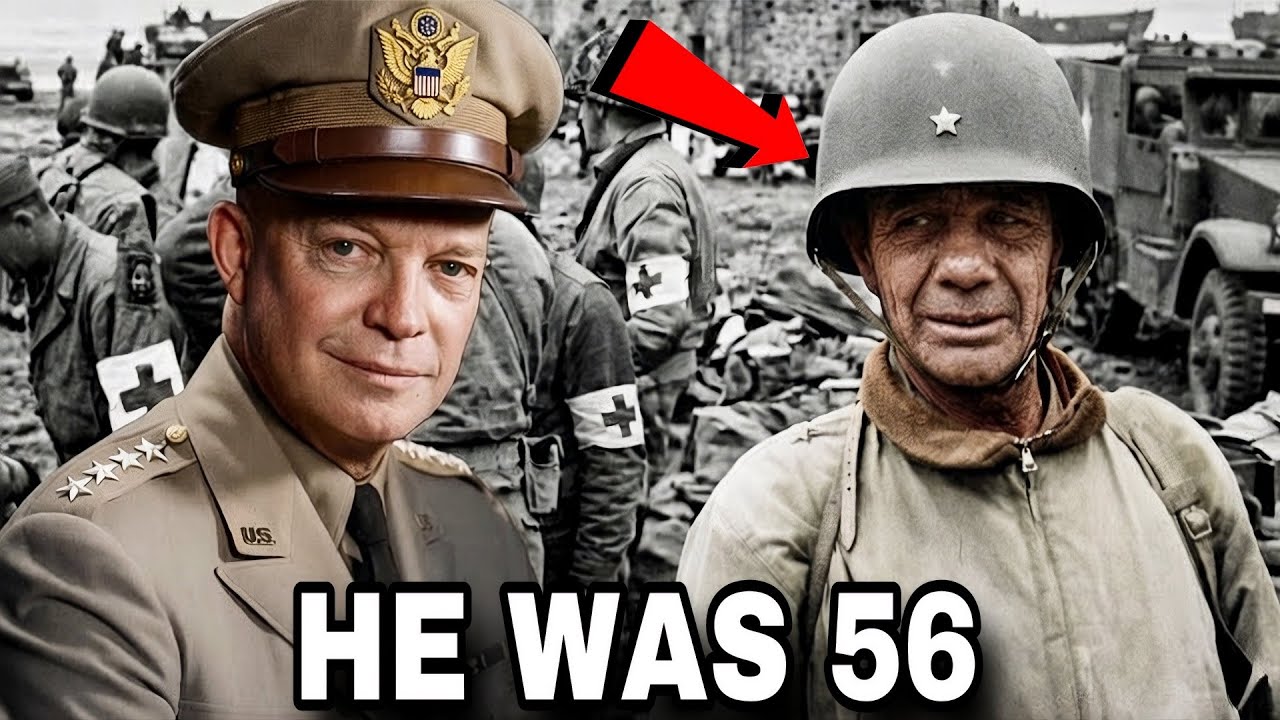
His name was Brigadier General Theodore Roosevelt, Jr. What happened next would force General Dwight Eisenhower to say something about a single officer that he never said about any other man in the entire war. Before dawn on June 5th, while the invasion fleet still churned through unprecedented gale-force winds, Eisenhower had already written Roosevelt’s eulogy. The Supreme Commander of Operation Overlord had sat down and composed words for a funeral because he was absolutely certain this man would be dead within twenty-four hours.
Roosevelt was not supposed to be there. Every regulation in the United States Army’s command structure said he should have been in England, sipping coffee from a metal cup, waiting for radio reports. But Roosevelt had done something that infuriated his superiors, then won their respect, then terrified them. He had insisted on landing with the first wave.
His commanding officer, Major General Raymond Barton, said no twice. Verbal requests were denied flatly. Barton pointed to the arthritis that had swollen Roosevelt’s hands and feet. He pointed to the cane.
He pointed to the bullet wound from the First World War that had never fully healed. He pointed to the fact that Roosevelt was the oldest man in the entire division, and that the average life expectancy for a first wave officer on Utah Beach was measured in minutes. Roosevelt listened to every objection. Then he submitted a written request.
No verbatim transcript of that conversation survives, but every account agrees on the essence of what he said. He told Barton, and the message traveled up to Eisenhower himself, that the men landing on Utah Beach had never seen combat. They were going to hit sand under machine gun fire with artillery shells dropping around them. They needed to see a face.
Not a face on a poster, not a name in a letter—a real face attached to a real rank, walking beside them through the bullets. Roosevelt argued that his physical condition did not matter, because leadership was not about running faster than the enemy. Leadership was about being seen when everything else was invisible. Eisenhower understood something that morning that most staff officers never grasped.
Sometimes the most valuable asset on a battlefield is not a weapon. It is a symbol. The invasion plan for Utah Beach was elegant on paper. The Fourth Infantry Division would land at a specific grid coordinate designated as Tare Green and Uncle Red.
Three hours of naval bombardment would soften the defenses. Engineers would blow gaps in the underwater obstacles. The first wave would secure the causeways leading inland, and within six hours the beachhead would be firmly established. That was the plan.
But war does not care about plans. The English Channel had other ideas. A tidal current running faster than any pre-invasion calculation predicted caught the landing craft and pushed them south—not a little south, but two thousand yards, nearly a mile and a half from where they were supposed to be. When the ramp dropped and Roosevelt stepped into the surf, the water was cold enough to stop a younger man’s heart.
He was carrying a pistol in one hand and his cane in the other. The German defenders on the bluffs above had not yet realized the invasion was happening, because the naval bombardment was still falling further north. That gave Roosevelt approximately thirty seconds of relative quiet before the machine guns opened up. He used those thirty seconds to look around and realize something that would have broken a less experienced commander.
There were no landmarks. No causeways. No recognizable terrain features. He was not on the beach he was supposed to be on.
Here was the moment where the entire invasion of Utah Beach hung in the balance. A lesser commander would have frozen. A by-the-book officer would have tried to reorient, to march his men two thousand yards north through enemy territory to reach the intended landing zone. That would have taken hours.
Those hours would have given the German 91st Infantry Division time to rush reinforcements to the exact spot where the Americans were supposed to be. The casualties would have been catastrophic. But Roosevelt did not freeze, and he did not panic. According to multiple eyewitness accounts, he looked at the terrain, assessed the German defensive positions, and made a declaration that has become the stuff of military legend.
The words were recorded by multiple soldiers who heard them: “We’ll start the war right here. ”
He was not asking permission. He was not consulting a manual. He was not radioing back to the fleet for instructions.
He was making a command decision in real time, under fire, based on nothing but his own experience and his own eyes. And that decision changed everything. Because the beach where they had landed—the wrong beach—was actually less heavily defended than the intended objective. The Germans had concentrated their fortifications to the north, expecting the main assault there.
Roosevelt had stumbled onto the weak point of the entire Utah Beach defensive sector, simply because the English Channel had pushed him there. But recognizing an opportunity and exploiting it are two different things. Roosevelt could have pointed inland and told his men to advance. Instead, he did something that no officer of his rank had ever done on any amphibious assault in history.
He walked back and forth across the beach, under direct fire, and personally directed every company as it landed. He would lead one group across the seawall, establish them in a defensive position, then return to the beach to find another group pinned down. He would lead that group forward, then return again. He repeated this action multiple times throughout the morning.
Consider the physical toll of what he was doing. This was a man who needed a cane to walk on flat ground. The beach was uneven sand mixed with shingle and mud. The seawall was several feet high.
Behind the seawall was open ground crisscrossed by drainage ditches and hedgerows. Through all of that, under machine gun fire and mortar shells, Roosevelt moved like a man half his age. Not because his body could handle it, but because his will refused to break. One soldier who watched him that morning later said that seeing the general limp past while bullets kicked up sand around his feet made every other fear seem small.
The tactical impact of Roosevelt’s leadership can be measured in numbers that tell a shocking story. Of the 21,000 troops who landed at Utah Beach on June 6th, only 197 were killed. That is a casualty rate of less than one percent. Compare that to Omaha Beach, where the casualty rate approached ten percent.
Compare it to the British landing at Gold Beach, where losses were significantly higher. Utah Beach was supposed to be a bloody fight. The German 709th Infantry Division had spent two years fortifying that coastline. But because Roosevelt made the decision to accept the wrong beach, and because he personally led the assault, the Fourth Infantry Division rolled up the German defenses from the flank instead of attacking them head-on.
The question military historians have debated for eighty years is whether another officer would have made the same decision. The answer is probably not. Most commanders, faced with a navigation error of nearly two miles, would have attempted to correct the mistake. They would have radioed back to the fleet, requested clarification, and waited for orders.
Those minutes of waiting would have given German artillery spotters time to find their range. The first waves would have been slaughtered on the sand while senior officers debated what to do. Roosevelt did not debate. He acted.
By late morning, the situation on Utah Beach had transformed from potential disaster to operational success. The Fourth Infantry Division had pushed more than a mile inland. They had captured the coastal villages that were supposed to be their first day objectives. They had linked up with airborne forces from the 82nd and 101st Airborne Divisions who had dropped behind enemy lines hours earlier.
And Roosevelt, still walking with his cane, still moving from unit to unit, was on his third or fourth trip back to the beach to bring more men forward. When the command staff who had remained in England finally arrived on the beach that afternoon, they expected chaos. They expected to find senior officers dead or wounded. They expected to have to piece together what had happened from fragmented radio reports.
Instead, they found Roosevelt standing calmly on the sand, leaning on his cane, with a complete operational report ready for them. He had organized the beach. He had marked the landing zones. He had established the supply dumps.
He had done the job of a full division staff while also leading the assault. The men who served under Roosevelt that day never forgot what they witnessed. One soldier from the 8th Infantry Regiment later wrote that seeing the general limp past while everyone else was crawling for cover made him feel ashamed of his own fear. Another said that Roosevelt’s complete unconcern for his own safety was the most powerful leadership lesson he ever received.
These were not professional soldiers writing propaganda. These were farm boys and factory workers who had been drafted and trained and thrown into the greatest amphibious assault in history. They needed someone to show them that courage was possible. Roosevelt showed them.
Consider what did not happen. In the alternate reality where Roosevelt follows protocol, where he radios back to the fleet and waits for instructions, the first wave of the Fourth Infantry Division spends thirty crucial minutes pinned down on the wrong beach. German artillery observers use those thirty minutes to adjust their fire. The second wave lands directly into a killing zone.
The third wave piles up behind them. By noon, Utah Beach looks like Omaha Beach. By nightfall, the surviving American forces have barely established a foothold. The entire right flank of the Normandy invasion collapses.
The German 91st Infantry Division counterattacks through the gap. That is the catastrophe that did not happen, because one man made one decision in one moment. Roosevelt’s story does not end on the beach. It ends thirty-six days later, in a farmhouse in Normandy, with a heart that finally gave out under the weight of everything it had carried.
July 12th, 1944. The Allies had broken out of the beachhead. Roosevelt had been promoted to assistant division commander of the 90th Infantry Division, a unit that had struggled in the early weeks of the campaign and needed his steadying presence. He had been sleeping in a Jeep, eating cold rations, and walking miles every day with that cane.
One month of combat at age fifty-six, and his body simply could not sustain it. The news of his death hit the Fourth Infantry Division like a physical blow. These were men who had watched him limp across Utah Beach while bullets snapped past his ears. They had followed him over the seawall and through the hedgerows.
They had believed, because he made them believe, that the invasion would succeed. And now he was gone—not by German bullet or artillery shell, but by the simple failure of a heart that had beaten too hard for too long. Roosevelt was buried initially in a temporary cemetery at Sainte-Mère-Église, the town that had been liberated by paratroopers in the first hours of D-Day. Later, his family requested that his remains be moved to the Normandy American Cemetery overlooking Omaha Beach.
Today he rests there among nearly ten thousand other American soldiers. But here is the detail that haunts military historians. Roosevelt never received the promotion that everyone believed was coming. He died as a Brigadier General.
One star. While less capable officers who never heard a shot fired in anger received their second and third stars, Roosevelt remained where he was. Promotion is a political game, and Roosevelt had never played it. He had asked to land on the beach when he could have stayed safe.
He had walked through machine gun fire when he could have directed from behind. He had made decisions in seconds when other officers needed hours. Those are not the actions of a man who cared about stars on his collar. General Dwight Eisenhower, when he learned the full story of what had happened on Utah Beach, rendered a verdict that has never been challenged by any subsequent historian.
He said that Roosevelt alone made the beach a success. Not the naval bombardment. Not the air support. Not the engineers or the paratroopers.
Roosevelt alone. Those are extraordinary words from a man who commanded millions. Eisenhower never said that about any other officer in any other battle of the entire war. The supreme commander of Operation Overlord, the man responsible for the largest amphibious invasion in history, looked at the results and concluded that one individual had made the difference between success and failure.
A misconception has persisted for decades. Many people assume that Roosevelt received the Medal of Honor immediately after D-Day. He did not. The award was approved posthumously, nearly three months after his death, and it was not without controversy.
Some officers argued that his actions, while heroic, did not meet the strict criteria for the nation’s highest military decoration, because he was a general officer, and generals were expected to lead. That argument was rejected by the review board, but the delay meant that Roosevelt never knew he had received the Medal of Honor. He died thinking that his service had been noted, but not elevated. The Medal of Honor citation, when it finally came through, described Roosevelt’s actions in language worth reading carefully.
It said he showed gallantry and intrepidity at the risk of his life above and beyond the call of duty. It mentioned that he repeatedly led groups from the beach over the seawall. It noted that his calm and unfaltering leadership under fire inspired the troops. But the citation left out the most remarkable detail of all.
It did not mention his age. It did not mention the cane. It did not mention the arthritis or the World War I bullet that had shattered his knee. The official record simply said that a brigadier general landed with the first wave and led the assault.
The rest was left for history to discover. The question every leadership course in the United States military has grappled with since 1944 is why Roosevelt did it. He was fifty-six years old. He had already served as Assistant Secretary of the Navy, Governor of Puerto Rico, and Governor-General of the Philippines.
He had nothing left to prove. His father had been President of the United States. His name alone guaranteed him a place in the history books. No one would have questioned him if he had remained in England.
No one would have called him a coward. He could have lived out the war in comfort and returned home to a hero’s welcome based on his name alone. But he did not stay. He went.
The answer, according to the men who served under him, was simple. Roosevelt believed that rank was a burden, not a privilege. He believed that the men who carried rifles deserved to see the men who gave orders carrying the same risks. He believed that a general who asked soldiers to die for a cause should be willing to die for that cause himself.
Those beliefs cost him his life. His heart attack on July 12th was almost certainly exacerbated by the physical stress of the Normandy campaign. The cold water. The sleepless nights.
The endless walking on a damaged knee. The constant pressure of command under fire. His body paid the price for his principles. There is another layer to this story that rarely gets told.
Roosevelt was not just any general. He was the son of a president who had charged up San Juan Hill. He had grown up in the shadow of American heroism, measured constantly against a father who had won the Medal of Honor and the White House. Some men crushed by that weight would have retreated into comfortable mediocrity.
Roosevelt did the opposite. He spent his entire life trying to earn a legacy that he already possessed by birth. And on June 6th, 1944, on a beach in Normandy, under machine gun fire and artillery shells, he finally succeeded. He stepped out of his father’s shadow forever.
The tactical lessons from Utah Beach have been studied by every military academy in the world. Decentralized command. Initiative at the point of attack. The importance of leadership by example.
But the human lesson is simpler and harder to teach. Roosevelt succeeded because he was present. He was there. He did not direct the battle from a command ship with a map and a radio.
He stood in the surf. He climbed the seawall. He walked through the bullets. And because he was there, his men followed.
One month after D-Day, the Fourth Infantry Division held a memorial service for their general. They had captured their objectives. They had broken through the German defenses. They had done everything he had asked them to do, but they did it without him.
The man who had limped ashore first was gone. Soldiers who had watched him walk through fire stood in formation and remembered what he had shown them. Courage was not the absence of fear. Courage was doing the job anyway.
Theodore Roosevelt, Jr. rests today in the Normandy American Cemetery, overlooking the beach where he made his stand. His grave is marked with a simple white cross, identical to the thousands around him. No special monument.
No larger marker. Just his name, his rank, and the date of his death. But visitors to the cemetery notice something about that grave. There are almost always flowers there, even when no official ceremony is scheduled.
Veterans leave them. Families leave them. Complete strangers leave them. Because somehow, eighty years later, people still understand what Roosevelt understood on that June morning.
Some debts cannot be repaid. They can only be remembered. Eisenhower’s words about Roosevelt have echoed through the decades because they capture something essential about war and leadership. One man made a beach successful.
Not the plan. Not the firepower. Not the numbers. One man with a cane and a pistol and a knee that should have kept him home stood on the sand and decided that the war would start right there.
And because he decided, the war started. And because the war started, the Allies won. And because the Allies won, the world changed.
All of that traces back to one moment, one decision, one man who refused to stay safe.






