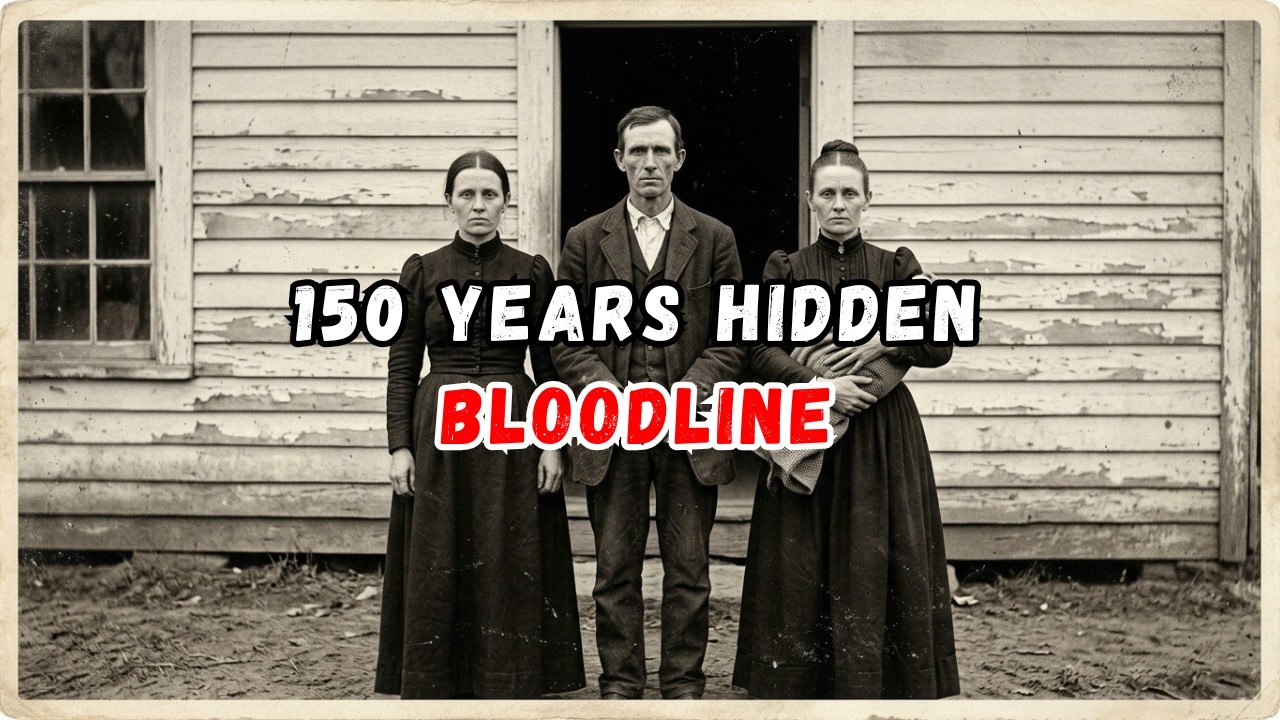
Sometime around 1820, a young French orphan by the name of Martin Fugate wandered into the hills of eastern Kentucky and settled beside a narrow, winding stream known as Troublesome Creek. Few places in the eastern United States were as cut off as this, and the families who put down roots there tended to remain for generations, wedding their neighbors simply because there was no one else within reach. Martin built his life there, took a local woman named Elizabeth Smith as his wife—fair-skinned and red-haired, by all accounts—and slipped into the quiet routines of the valley. Yet both Martin and Elizabeth carried something unseen in their blood: a single defective copy of a recessive gene.
On its own, that gene did nothing at all. Martin was not blue. Elizabeth was not blue. Only when a child drew two broken copies, one from each parent, did the gene stir to life.
Out in the wider world, the chance that two carriers would ever meet was almost nothing. Along Troublesome Creek, that chance had suddenly become very real. Martin and Elizabeth had seven children, and four arrived in the world blue—a deep, saturated blue that covered their lips and showed beneath their fingernails. They were not ill.
They were not dying. They grew up sturdy, farmed the land, married, and lived long lives, and the blue passed down the family line for 150 years. For generation after generation, the blue people of Troublesome Creek stayed healthy. The color neither shortened their lives nor brought them pain.
What did bring them pain was the gaze of the outside world. Itinerant preachers flinched. Peddlers crossed themselves. Outsiders who caught sight of a blue face in a cabin doorway carried tales back down the mountain, each retelling more distorted than the last, until the lowlanders talked about the blue people as though they belonged to legend.
The families learned to shield themselves with silence. They kept the blue children nearby, kept them back up the hollow, and whenever strangers appeared, the blue ones stayed away from the door. The secret remained hidden, the blue kept arriving, and no one capable of explaining it ever came close enough to try. Then, in 1958, the blue walked out of the hollows on its own two feet.
A Fugate woman turned up at a rural health clinic in the Kentucky hills—not on account of her color, but for some everyday complaint. The nurse on duty, Ruth Pendergrass, caught sight of her and froze. The woman was blue, not faintly so, but the color of a glacier lake, blue like the waters of Lake Louise in Canada. Pendergrass took it for granted that the woman was dying, that her blood could no longer carry oxygen.
Yet the woman was calm and healthy, and the blue had nothing to do with why she had come. Pendergrass recorded what she saw and spoke of it to others. The story traveled through the small circle of rural Kentucky medicine, handed from nurse to nurse and doctor to doctor, largely written off as a mountain tall tale. Still, it eventually reached a young hematologist at the University of Kentucky Medical Center named Dr.
Madison Cawein the Third. Cawein did not take it for a tall tale. He thought of hemoglobin. Somewhere in the medical literature was a rare, little-known condition that could turn a person blue while leaving them otherwise entirely well.
To come upon an entire family with it—six generations of it—in a single isolated Kentucky county seemed impossible. Cawein resolved to go and look for himself. In the early 1960s, he drove the winding mountain roads toward Hazard, Kentucky, carrying a theory hardly anyone believed. The Fugates and their kin had every reason to distrust yet another outsider asking about the blue.
Outsiders had brought them nothing but stares and whispers. Cawein had to be patient, had to win their trust little by little, but he was different. He did not shrink back. He looked at a blue face and saw a patient, not a monster.
He traced the family tree backward through census records, county marriages, births, and deaths, and found every blue person named and documented, all the way back to Martin Fugate and Elizabeth Smith in 1820. He drew their blood, ran his tests, and the diagnosis came out exact. The condition was methemoglobinemia. Hemoglobin ferries oxygen through the blood, and the iron at the heart of each molecule binds that oxygen and gives blood its red color.
But iron can slip into a slightly altered state, and once it does, it can no longer carry oxygen. Hemoglobin in that altered state is called methemoglobin, and it is dark, brownish-blue. Everyone produces a small amount of methemoglobin all the time, and the body has an enzyme that converts it back. The blue people of Troublesome Creek had inherited two broken copies of the gene that built that enzyme, one from each parent.
Their repair crew was understaffed, so methemoglobin built up in their blood, staining their skin a permanent blue. They were not starved of oxygen. They still had enough working hemoglobin to live full, vigorous lives. They were simply blue.
Cawein also knew how to fix it. There was a compound that could do the work of the missing enzyme, a chemical shortcut that would convert methemoglobin back to normal hemoglobin. That compound was a dye called methylene blue, an ordinary medical dye used in laboratories and hospitals. The cure for the blue people was itself blue.
Cawein went back up the creek with his syringe. He asked the family to trust him, to roll up a sleeve and let him inject a stranger’s dye into their veins. The injection went in, and within minutes, the blue began to leave. The methemoglobin broke down, the blood ran red again, and across skin that had been blue since birth, the color changed in real time.
Pink rose up from underneath, and for the first time, the blue people saw themselves the way the world saw everyone else. Cawein could not give them a permanent cure, because the missing enzyme was written into their genes. But he left them tablets of methylene blue they could take by mouth, a workaround that allowed them to hold the color at bay, to choose what shade they walked through the world. There was one small price: the body cleared the dye through urine, which turned a brilliant blue.
The color did not vanish entirely, it simply moved somewhere more private. Cawein published his findings in the mid-1960s in the Archives of Internal Medicine, laying out the entire chain of the story, the isolated creek, the recessive gene, the concentration through generations, the methemoglobin, the methylene blue. It became a nearly perfect illustration of recessive inheritance, a textbook case come to life. But the gene was still out there, still capable of surfacing when two carriers happened to marry.
In 1975, it surfaced one last documented time. In a hospital nursery in Hazard, Kentucky, a young woman gave birth to a boy who came out blue. The nurses checked his oxygen, checked his heart, found nothing wrong, but prepared for the worst, talking of transfusions and airlifts, because a baby this blue should have been dying. Then the boy’s grandmother spoke up.
She was an older mountain woman, calm and in no hurry, and she addressed the room: “It runs in the family. There have been blue people in our family for a long time. It is nothing new.” The boy was given the name Benjamin Stacy, and they called him Benji.
He came down the family tree in a direct line from Martin Fugate and Elizabeth Smith, and he was healthy. As he grew, the deep blue faded, easing and drawing back the way it had for many of his ancestors. By the time he was a boy, he looked like any other child in the county, except at certain moments, when he was cold or angry or had exerted himself, a faint blue would rise again in his lips and fingertips, a ghost of the creek showing through. Benji Stacy grew up and lived an ordinary life.
He was the last documented blue descendant of Martin Fugate, the last child of Troublesome Creek born the color of deep water. The gene has not disappeared. It is still out there, folded into the blood of an unknown number of descendants scattered far beyond the creek, waiting for a coincidence that grows less likely every year. But the isolation that made the blue people is gone.
The roads came, the hollows opened, the families married outward, and the tight closed circle that had concentrated the gene for six generations finally broke apart. The blue people of Troublesome Creek were not a legend. The census counted them, the county filed their marriages, the university kept their medical files, and the newspapers wrote them up as the strange true thing they were. The real darkness of the story was never in their blood.
They were healthy, strong people who lived long lives and raised families. The only thing wrong with them was a color, and a color harms no one. Their suffering came from the flinch of strangers, the whispers, the instinct to look at a person who is different and decide that different must mean cursed or wrong. The methylene blue could wash the color from their skin in minutes, but the shame took 150 years and a doctor’s kindness to lift.
The creek is still there, still running narrow and twisting through the crowded green hills, and somewhere in the blood of its scattered descendants, the old passenger still rides, quiet, patient, and blue.
