
The Architecture of Accountability: Why “Guilty” is Now a Permanent Presidential Record
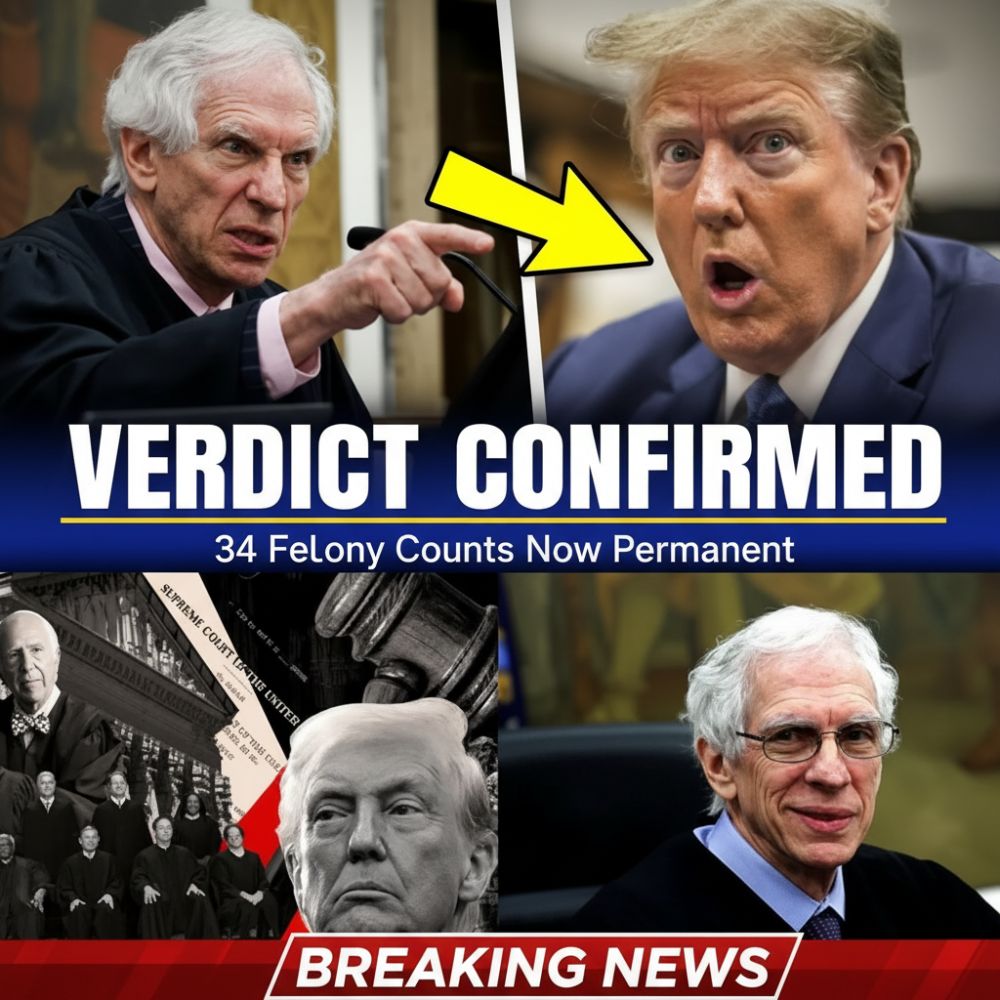
In the humid air of lower Manhattan, the silence that followed the word “Guilty” didn’t just end a trial; it punctuated two and a half centuries of American constitutional theory. 34 felony counts. 12 jurors. One former President.
On July 11, 2026, the Supreme Court of the United States—an institution that has spent much of the last two years grappling with the limits of executive power—delivered the final, crushing blow to the Trump legal strategy. By denying the President-elect’s bid to stay his criminal sentence, a 5-justice majority, including Chief Justice Roberts and Justice Barrett, confirmed a reality Donald Trump has spent his life trying to outrun: The law does not have an “Elite” setting.
As the 34 counts of falsifying business records are officially entered into his permanent record, the nation is forced to look into a mirror. The trial was never just about a reimbursement to Michael Cohen or a nondisclosure agreement with Stormy Daniels. It was a stress test for the American judiciary—and the system just held its ground.
1. The 4:20 Verdict: 34 Rounds of Reality
The end came with a speed that rattled the global media pen. At 4:20 p.m. Eastern time, after only a few days of deliberation, the jury returned. The foreperson did not hesitate. Thirty-four times, the word “Guilty” echoed through the courtroom.
These weren’t mere misdemeanors. These were Class E felonies, the result of a coordinated effort to cover up a separate crime—the illegal influencing of an election. The prosecution’s case, led by District Attorney Alvin Bragg, successfully mapped the “Money Trail” from the Trump Organization’s controller, Jeffrey McConney, through Allen Weisselberg, and directly into the hands of Michael Cohen.
The Mechanics of the Conviction:
The Crime: Falsifying business records in the first degree (New York Penal Law § 175.10).
The Intent: To conceal the “hush money” payments that circumvented federal election laws.
The Checkbook: 11 checks, nine of which were reportedly signed by Donald Trump inside the White House.
For the jury, the lack of a formal “retainer agreement” with Michael Cohen was the smoking gun. In the world of high-stakes accounting, you don’t pay a lawyer $35,000 a month for “legal services” without a contract—unless that money is actually a reimbursement for an off-the-books payoff.
2. “I Am Above the Law”: The Courtroom Removal
Perhaps the most visceral moment in American legal history occurred during the final proceedings. Reports from inside the courtroom describe an unprecedented scene: Donald Trump, a man accustomed to being the ultimate authority in every room he occupies, standing up mid-proceeding to scream at Judge Juan Merchan.
The quote being attributed to him by multiple witnesses is as blunt as it is terrifying: “I am above the law.”
If the accounts of his forced removal by court officers are confirmed, it represents the final collapse of the “Presidential Dignity” defense. Trump has spent years treating gag orders as suggestions and fines as business expenses. But when a judge says “Remove him,” the power dynamic shifts from the political to the procedural. It was the physical manifestation of the Supreme Court’s earlier ruling: the President is a citizen, and the citizen must sit down.
3. The SCOTUS Rejection: No Special Treatment
The Supreme Court’s denial of a stay was the most significant moment of the week. Trump’s legal team argued that as a “President-elect,” the dignity of the office—and the logistics of the upcoming inauguration—should shield him from the “indignity” of a criminal sentence.
The Court’s answer was a resounding “No.” This rejection confirms a vital constitutional principle: Status does not grant immunity. By letting the sentencing proceed, the Supreme Court signaled that the “convicted felon” label is now a permanent part of the executive branch’s history. Every future bail hearing, every future international negotiation, and every future legal proceeding will now have to account for 34 felony convictions.
4. The 95% Democrat Defense: A System vs. A Story
Throughout the trial, Trump’s primary defense was a narrative of victimhood. He argued that the Manhattan jury was a “rigged” pool of “95% Democrats” in an “unfair area.”
However, the legal reality of jury selection—voir dire—tells a different story. In any criminal trial, both the prosecution and the defense have the opportunity to strike jurors who show bias. The 12 men and women who convicted Donald Trump were vetted by his own lawyers.
By attacking the jury, Trump wasn’t just attacking a political party; he was attacking the only institution in the world that is truly “peers” to the defendant. The system keeps saying, “No, it is not rigged.” The verdict is the proof.
5. The Institutional Fracture: What Happens Next?
With sentencing scheduled for July 11—just days before the Republican National Convention—the United States enters a “Strategic Void.” We are now in a world where a major party nominee is a convicted felon under threat of jail time.
Judge Merchan has stated that while he has no desire to put a former President in jail, his primary job is to “protect the integrity of the justice system.” The conflict is now existential:
The Judiciary’s Goal: To prove that no one is above the law.
The Executive’s View: That the office itself is the law.
Conclusion: The Permanent Record
Donald Trump has argued that his “sacrifice” is for the Constitution. But the Constitution is what convicted him. The 34 counts are not a political talking point; they are a judicial fact.
Whether he yells it in a courtroom or posts it on social media, the belief that the President is above the law has officially met the “Check and Balance” of a New York jury. The courts have been extraordinary patient, allowing for every appeal and every delay tactic. But as of today, March 17, 2026, the patience has run out.
The system has spoken. The voice of the jury is the only one that remains.