On October 4, 1991, the last worker at the Schwinn factory in Greenville, Mississippi, clocked out after building the final bicycle. He shut off his station, turned off the lights, and locked the door. After 96 years of continuous American manufacturing, Schwinn no longer produced bicycles in the United States. The building still stands today, set back from Highway 82, surrounded by overgrown grass and cracked pavement, a faded sign near the entrance bearing a name that once meant something to millions of American families.
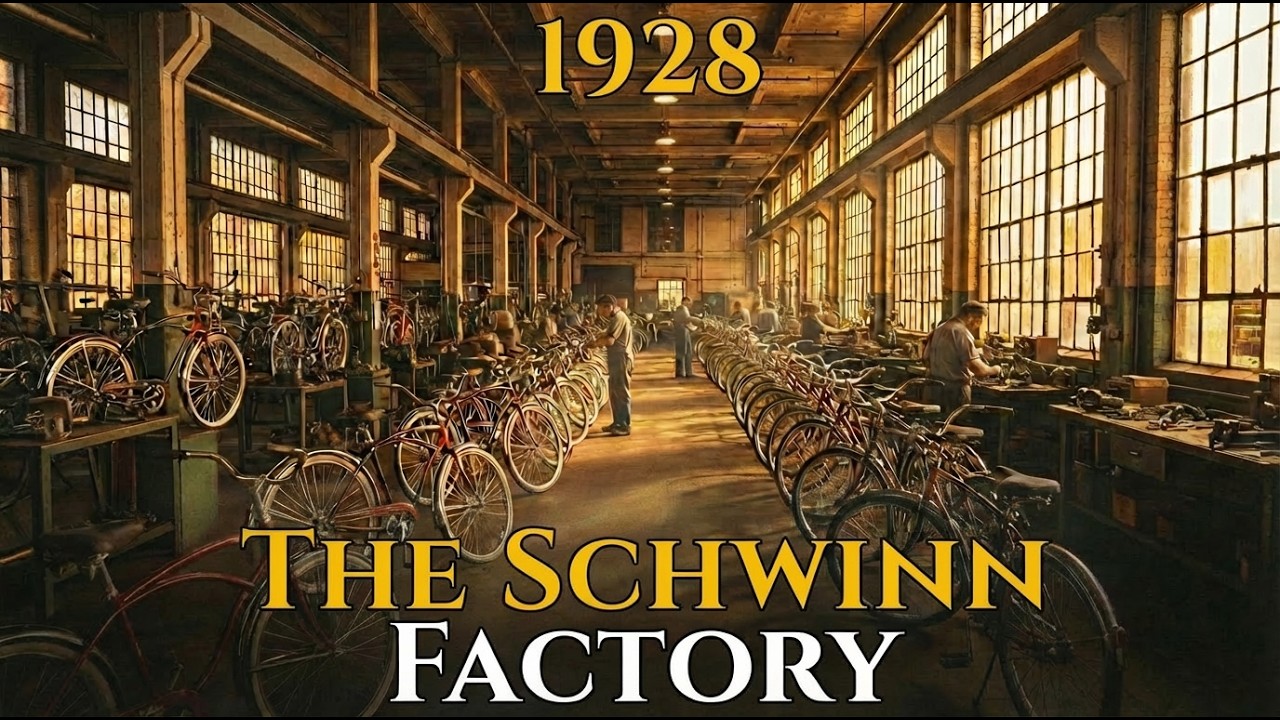
The story that led to that silence began more than a century earlier in Chicago. Ignaz Schwinn arrived there in 1891, a 31-year-old trained machinist and bicycle engineer who had spent the previous decade working in German factories. He came without money or connections, but with experience and a belief that the American bicycle market was wide open. He was right.
The 1890s were the height of bicycle mania in the United States, with hundreds of small manufacturers opening shops and producing bikes as fast as they could assemble them. It was chaotic, competitive, and unsustainable. In 1895, Schwinn partnered with a Chicago meatpacking financier named Adolf Arnold. They formed Arnold, Schwinn & Company in a modest factory space on the city’s northwest side.
From the beginning, Schwinn focused on quality over volume. While competitors cut corners to increase production, he insisted on precision welding, careful frame geometry, and component testing. He was building a reputation that would outlast the inevitable market collapse. That collapse came quickly.
By 1900, bicycle sales in the United States had dropped by nearly 25 percent. The automobile was becoming a legitimate form of transportation and was killing the bicycle boom. Hundreds of manufacturers went bankrupt, and entire city blocks of bicycle factories in Chicago shut down. Schwinn not only survived, he used the crisis.
While competitors liquidated, he acquired their machinery, patents, and tooling at prices that made sense only because so many others were desperate to escape. By 1908, he had bought out Arnold entirely. The Schwinn factory on Kildare Avenue in Chicago grew over the following decades into one of the most advanced bicycle manufacturing facilities in America. It was a sprawling industrial complex that by the 1960s covered multiple city blocks and employed 1,800 workers across three shifts, operating 24 hours a day.
At peak capacity, Schwinn produced over a million bicycles per year. One out of every four bikes sold in the United States carried the Schwinn name. Quality control bordered on obsessive. Every frame was inspected, every weld tested, components that didn’t meet standards were rejected even if it slowed production.
This approach made business sense because Schwinn had built a distribution network that depended entirely on reputation. In the early 1950s, Frank Schwinn, Ignaz’s son, who had taken over leadership, made a decision that defined the company’s business model for the next three decades. He stopped selling to department stores. Most manufacturers at the time sold wholesale to large retailers like Sears and Montgomery Ward, which rebranded the bikes under their own house labels.
Frank saw a problem with that system: when your product sits on a shelf next to cheaper alternatives, you lose control over pricing, presentation, and customer experience. So Schwinn built a network of independent bicycle dealers across the country, dedicated bike shops that carried Schwinn as their primary and often exclusive brand. In exchange, dealers received protected territory and factory support. The strategy worked remarkably well for a long time.
In the early 1960s, kids in Southern California started modifying their bicycles, installing smaller wheels, banana seats, and high-rise handlebars, imitating the custom chopper motorcycles they saw older brothers building. Al Fritz, Schwinn’s director of research and development, saw the movement during a trip to California and understood immediately that this wasn’t a local fad. He pitched the idea to management, which was skeptical. But Fritz persisted, and Frank Schwinn approved a limited test run.
In 1963, the Schwinn Stingray entered the market with a short frame, high handlebars, and a banana seat. Between 1963 and 1968, Schwinn sold nearly 2 million Stingrays, the bestselling model in company history and one that defined what a children’s bicycle looked like for an entire generation. For a decade, the Stingray drove Schwinn’s profitability. But markets don’t stay stable, and by the early 1970s, the American bicycle industry was beginning to change in ways Schwinn was slow to recognize.
The 1970s brought new kinds of riders. Adults wanted lightweight road bikes, European-style bicycles with thin tires, drop handlebars, and multiple gears, weighing half what traditional American cruisers weighed. Schwinn produced some lightweight models, but they were compromises. The company continued prioritizing its signature heavy-frame cruisers.
Meanwhile, companies like Raleigh and Peugeot were importing European bikes, and Trek Bicycle Corporation, founded in Wisconsin in 1976, focused exclusively on lightweight, high-quality road bikes for affluent customers, building a market Schwinn had largely ignored. The second missed opportunity was more dramatic. In the mid-1970s, kids in Southern California started racing modified Stingrays on dirt tracks, a sport that became known as BMX. In 1975, Mongoose was founded specifically to build bikes for BMX racing, followed by GT Bicycles and Diamondback.
Schwinn looked at BMX and saw liability, worrying about injuries, lawsuits, and damage to its family-friendly brand image. The company stayed out of the market entirely. Then in 1974, something else happened that should have been a warning. A man named Gary Fisher took an old 1937 Schwinn Excelsior, one of the heavy, durable cruisers from the company’s earlier era, and modified it with multiple gears, knobby tires, and better brakes.
He rode it down fire trails in the mountains of Marin County, California, at high speed, inventing the mountain bike. Fisher brought his creation to Schwinn and showed it to their engineers, who dismissed it as absurd. A few years later, Mike Sinyard’s company, Specialized, began importing mountain bike components from Japan. In 1982, Specialized released the StumpJumper, the first mass-produced mountain bike.
It was an immediate success, and within five years, mountain biking went from a fringe activity to a mainstream sport. Schwinn finally entered the market in 1983 with a model called the Sierra, but by then Specialized, Trek, and others had been dominating the category for years. Schwinn was late, reactive, and playing catch-up in a market it could have owned. By 1980, the Chicago factory was in crisis.
The building itself was nearly 80 years old, parts of it structurally unsound, the machinery outdated, and fire hazards throughout. The factory floor couldn’t produce the lightweight frames the market now demanded. Then the union went on strike, with workers demanding better pay, safer conditions, and investment in the facility. The Schwinn family was done with Chicago.
In 1981, they announced plans to build a new factory in Greenville, Mississippi. The strategy seemed logical. Mississippi was a right-to-work state, unions would have no power, the state offered tax incentives, and labor costs were lower. The factory would be modern and capable of producing high-quality American-made bicycles.
But there were problems nobody seemed to consider carefully. Greenville is in the Mississippi Delta, 75 miles from the nearest interstate highway. There wasn’t a deep pool of experienced metal workers or welders, so Schwinn had to train workers from scratch. The supply chain was complicated and expensive: components manufactured in Asia were shipped to West Coast ports, trucked across the country, then transported down to rural Mississippi.
In June 1983, Schwinn closed the Chicago factory. 1,800 workers received termination notices. The last bicycle built in Chicago rolled off the line, was tagged, and shipped out. 88 years of continuous manufacturing in the city ended.
Everything depended on Greenville working exactly as planned. The Greenville factory never turned a profit, not once during its entire operational life. The bikes produced there weren’t significantly better than the imports Schwinn was already buying from manufacturers in Taiwan and China, and in some cases they were worse. Mississippi wages were lower than Chicago wages, but they were still 5 to 15 times higher than what workers made in Taiwan or China.
Schwinn was paying American labor rates to produce bikes that had to compete on price with Asian imports. By the late 1980s, the financial reality was undeniable: the factory was losing money every day it operated. By 1988, Giant Manufacturing in Taiwan was producing 82 percent of Schwinn’s bicycles. Schwinn had become almost entirely dependent on a single foreign supplier that was also launching its own branded bicycles and competing directly with Schwinn in the American market.
Schwinn owed Giant and other Asian manufacturers massive amounts for bikes already produced and shipped, and those manufacturers were demanding cash on delivery. Sales were collapsing. Market share had dropped from 25 percent to 5 percent. Warehouses were filled with unsold inventory.
In August 1991, Greenville was closed. 240 workers received 60-day notices. On October 4, 1991, the last worker built the final bicycle and locked the door. By 1992, Schwinn’s debt had reached $82 million, with losses of $50 million over the previous three years.
On October 7, 1992, Schwinn filed for Chapter 11 bankruptcy protection. 97 years as a family-owned business ended. The company that had survived the bicycle bubble burst of 1900, the Great Depression, and two world wars was insolvent. In January 1993, investor Sam Zell purchased Schwinn out of bankruptcy for $40 million.
He attempted to rebuild the company, but the damage was too extensive. In 2001, Schwinn filed for bankruptcy a second time. The company was eventually sold to Pacific Cycle, later acquired by Dorel Industries of Canada, and in 2021 sold to Pon Holdings, a Dutch conglomerate. Today, Schwinn bicycles are manufactured in China and sold primarily through big-box retailers like Walmart and Target.
The brand still exists, but it’s a name applied to mass-market bikes with no connection to the company Ignaz Schwinn built in 1895. The Chicago factory at Kildare Avenue was demolished in the 1990s, the site now a residential development. The Greenville factory still stands, structurally sound, but with broken windows, chained doors, and a faded for-sale sign. Schwinn had been dominant for so long that it became difficult to imagine not being dominant.
BMX looked like a fad because Schwinn had seen fads before. Mountain biking looked ridiculous because it didn’t fit how bicycles had always been used. Each individual decision seemed defensible at the time, but collectively they represented a failure to recognize that the market itself was fundamentally changing.
The silent factory in Greenville stands as evidence that reputation alone doesn’t protect you, that being right for decades doesn’t guarantee being right forever, and that the market rewards current value, not historical contribution.






