The barn doors were still chained when the fire took the sky, but no one inside could say who had bound them. The master sat upright in the char of the house for seven nights afterward, his sockets glowing like embers that refused to die, and the villagers learned that looking too long meant your own eyes would never close again. The story they told to explain it all began long before the fire, in the years when the plantation was still whole and the name Esther was never written in any ledger. Her name appeared nowhere in the master’s books.
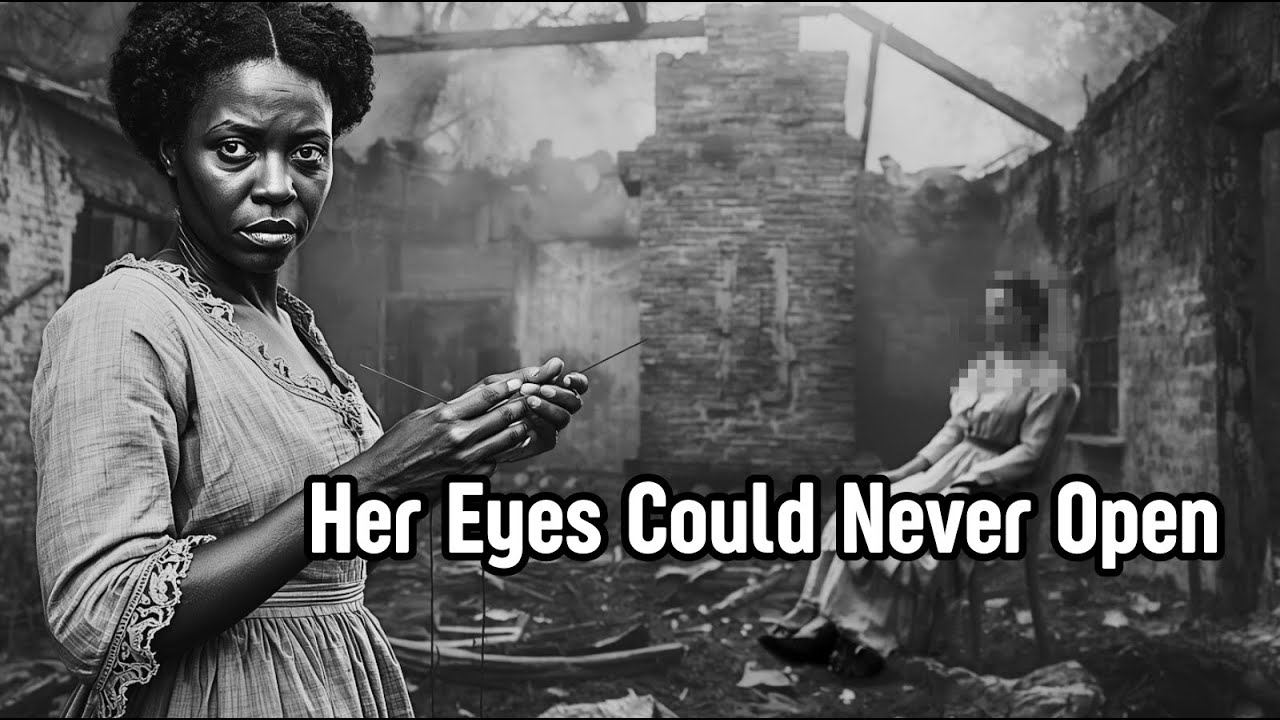
The ledgers were precise in ink and cruelty, recording bodies as numbers, souls as property, hands as tools, but throughout all those pages the name Esther did not appear. Yet the land remembered it. The ground hummed with the syllables at night, low and warning, as if the earth itself was trying to tell those who walked above it who had been buried there. They said she carried silence the way others carried scars, and that silence was never empty.
It pressed, it bruised, it choked the tongue. Those who spoke her name felt their mouths tighten, their teeth grit, their lips go numb until the syllables left like blood rather than breath. The old women said she was born beneath a blood moon, and her first cry was no louder than a moth’s wings beating against a lantern. Even then the fire dimmed, as though unwilling to contest her breath.
In the quarters, the stories were not told in full. Mothers hushed their children when questions reached their lips, for the telling itself carried danger, as though Esther’s life was less a tale and more a curse being summoned. Some swore she was touched by something older than scripture, that in the hour of lashes she did not bleed, that in the nights of hunger she did not starve, that her shadow walked half a step behind her, slow and deliberate, waiting for her to stop so it might take her place. The overseer once bound her wrists to the post and raised the whip, grinning through yellow teeth, but when the lash cracked, it fell limp in his hand as though the leather itself had refused.
His arm trembled until the bone snapped like glass, dangling useless from his shoulder. From then on no man touched her, no woman dared to look too long, yet every shadow in that place bent toward her, not in worship, not in fear, but in inevitability. An old man in the dark once rasped, “Do not say her name. Names are thread, and thread binds what you call.
” His eyes glazed, his lips dry as if sewn by unseen hands, and when he died that night, they swore his mouth had no tongue at all. Still the whispers grew, because silence itself was unbearable. Esther became a legend stitched into the marrow of those who lived and those who died, not written, not inked, but carried like a splinter beneath the skin. The house and the fields remembered her step, and those who pass near the ruin today say they see her, not as flesh, not as bone, but as a shadow stitched into the air, head bowed, hands folded, lips moving without sound.
If you follow the movement close, the words grow clearer, not a prayer, not a curse, but a sewing song, slow and steady, the kind sung to keep rhythm while mending cloth. Only what she sews now is darker, the needle lost, the thread invisible, and yet the air pulls tight, the world itself puckering like fabric beneath her hands. On the night the needle first appeared, the air was thick and swollen, humming as if the fields themselves held their breath. The torches in the yard flickered and spat, and the whip cracked, but never struck, for in Esther’s hand glimmered a blackened sliver, a needle that moved like it chose its own path.
An old woman with white cataract eyes fixed on her from the corner of the quarters and whispered, “Thread follows needle. Needle follows night. ” The children heard the chant, and though they did not understand, they rocked in rhythm to it, heads bowed, lips trembling, as if the words had already bound them. Esther’s hand did not shake.
Her fingers pinched a thread dark and wet, too thick to be spun from flax, too warm to be from any loom. And when the needle pierced the first strip of cloth, the sound was not of fabric tearing but of skin surrendering, of breath halting in a throat. They said the overseer’s eyes bulged when she lifted the cloth so neatly, so cruelly, that his lips would never part again, the stitches clean and perfect but slick with a wetness that was not his saliva. Yet that was only the beginning.
The needle did not sleep. It hummed in her palm, tugged against her fingers, urging her hand toward every mouth that laughed, every eye that dared not close, every throat that commanded others to silence. Someone whispered in the dark that it sang, and indeed it did, a faint metallic hymn rising each time it was lifted, falling into silence only when driven through flesh. They tried to bless it once.
The priest laid the needle upon the altar, murmured prayers, sprinkled holy water that hissed and boiled on its surface until he drew back his hand blistered. The water blackened, and the cross above the altar cracked in two. From then on, no man of faith dared touch it. It belonged to Esther, and Esther belonged to the night.
The slaves who lived in the shadow of that house often woke to find her sewing, but not by firelight, not with lamp or candle. The needle itself glowed faint, fevered red as a coal at the edge of dying flame, casting shadows that did not match the bodies they belonged to, shadows stitched together at the edges, shadows that moved as though tethered to one another by unseen thread. When she stitched, the world grew quiet. The crickets silenced, the owls stilled, even the wind paused at the seams of the trees, as if waiting to see what she would bind next.
The masters whispered too late of what they had done, that their cruelty had called her forth, that their hunger for obedience had birthed a seamstress whose needle could unmake their world. But it was not fear that bound them. It was the needle. They could not close their eyes.
In the morning they found the master seated upright in his chair, his eyes wide, pinned open by stitches finer than spider silk, staring eternally into the ashes of the hearth, the needle still warm in Esther’s hand. His eyes had grown red as lantern glass, but still they would not close. The lids trembled, the lashes quivered, but the stitches pulled them wide, a cruel crown of thread gleaming faintly in the firelight, and each hour of staring only deepened the madness that crawled behind his gaze. He begged for sleep, but sleep would not come, not when the stitches refused him, not when the fire itself seemed to demand his sight as tribute.
The other servants told the story in whispers, how Esther moved silent through the house that night, her bare feet stirring no sound on the wooden floor, how the needle guided her hand, tugging at her wrist like a thing alive, and how she bent low over the master’s face, the thread slick and black between her fingers, piercing flesh as gently as one might hem a garment. He had screamed when the first stitch pulled taut, a thin cry high and ragged, but it faltered as the needle passed again and again, looping his eyelids, pulling the flesh back, pinning them open until the orb of his eye bulged forward, wet, gleaming, raw. “Look,” Esther whispered, her voice little more than the hiss of breath. “You will look until the fire takes you whole.
”
The house itself seemed to listen. The rafters moaned, the shutters clattered though no wind pressed them, and the portraits on the walls seemed to bend forward, their painted eyes glistening as though sharing in his curse. He sat in the great chair before the hearth, bound not with rope but with terror, the thread in his skin pulling tighter each time he struggled until every twitch widened the wound. Every blinkless moment filled his sockets with dust, with ash, with the memory of flame.
His prayers faltered, breaking into groans, the Lord’s name catching on his tongue as though the stitches had wound his throat as well. He wept, but the tears ran unchecked, rolling down into the stitches where they stung, pooling into the blackened thread until it shone like veins of oil. Those who saw him swore he did not only watch the fire but something within it, shapes moving in the flames, faces without mouths, eyes that blinked in perfect unison, all staring back at him. The longer he gazed, the more the fire bent to his vision, the flames rising and twisting into forms that mocked his features, as though the hearth itself had swallowed him and was chewing on his soul before the body had even cooled.
By the third night his voice was gone, only a rasp remained, a ragged scraping of air that begged without words. Esther did not answer. She moved like shadow through the halls, and when the servants listened, they swore she was humming that same sewing song, a lullaby for the damned. The master’s children hid their faces.
The mistress clawed at her rosary until the beads split and scattered across the floor. But no prayer could undo the stitches, for the thread was not twine, not cotton, but something older, blacker, wet as blood, strong as oath. At dawn his eyes no longer blinked at all. The sockets dry, cracked, bleeding, but still the stitches held them wide, forcing him to witness the birth of something only he could see in the flames.
A child hiding in the corner whispered, “Do you see it? Do you see what he sees? ” But no one answered, for the fire was burning strange that night, blue at its heart, white at its tips, and in its dance were not flames but figures, tall, silent, reaching, their arms stitched together, their mouths sewn closed, their eyes wide and burning. The master’s body convulsed, but his eyes did not move, and as his head lolled against the chair, the fire flared one final time, casting his shadow long across the wall.
Only it was not his shadow at all, but Esther’s, needle in hand, stitching, stitching, forever working, never finished. At dawn, when the fire had cooled to ash, the servants found not one voice in the house willing to speak. Their lips parted, their throats strained, yet no sound emerged, as though every tongue had been sewn in the night by an invisible hand. The night did not begin with silence, but with the groaning of beams and the restless shift of air, as though the barn itself were a living thing breathing in dread.
Those who bore witness lost their voices one by one, until the barn was filled with mouths moving in silence, a choir sewn shut. The first to fall mute was the boy who had followed his father out into the hayfields, his laughter once loud enough to stir crows from the fence posts, now reduced to a clutching throat and frantic eyes. He had been whispering a hymn, only to discover the words would not climb out. They had knotted themselves like thread wound too tightly to release.
Then the women followed, their mouths still shaping curses, prayers, bargains to any god that would listen, but no sound emerged, only the ripple of lips against teeth, as though the barn walls drank everything whole. The elders tried to speak commands to steady the trembling younger ones, but their tongues faltered, not from age but from a force that plucked sound away like wool sheared from a lamb, leaving their mouths open, quivering, empty. The silence itself began to pulse, a thick weight pressing on the chest, heavier than the scent of straw, heavier than the musk of sweat, heavier even than the copper tang that had begun to spread unseen across the wooden floor. The master, proud, arrogant, trembling behind the mask of command, clutched at his throat as though his voice had been stolen mid-order.
His lips flapped open, mouthing syllables of rage that no longer carried, his words falling apart in the air, dying before birth. The overseer hissed beside him, “Speak, man,” yet even his whisper came out mangled, eaten by the thick and dark, his jaw moving soundlessly, his eyes widening in disbelief. The barn doors rattled but did not yield, the chains outside holding them firm, and the flames of the lanterns bent strangely, refusing to cast shadows where they ought, pooling instead against the rafters where swaying shapes had begun to appear. They were not bodies at first, only impressions, the outline of mouths straining open, hanging like masks in the gloom, each one an oval wound, each one dripping thread that shimmered faintly like wet silk.
Then the shapes deepened, became faces, pale, sagging, slack, each lip sewn closed with a stitch too thick, a stitch not meant for cloth but for punishment. The witnesses below staggered back, pressing against one another, their voiceless lips still moving in wild desperation, like a choir rehearsing a song in silence. The master clawed at his own lips, as if to prove his mouth still belonged to him, yet the skin split under his nails and blood ran down his chin in dark rivulets. No sound came forth.
His eyes bulged in horror, and in that bulge he recognized it: the barn had become an altar, and he and his kin the sacrifice. One of the younger women tried to scream, but only a strangled hiss pushed from her nose, her mouth a mere opening without use. The rafters swayed again, the faces leaned closer, mouths sewn shut, yet they were not silent. A hum began to stir, low and guttural, like bees swarming in an empty skull, a vibration felt in the ribs before heard in the ears.
The hum grew, weaving into a dreadful harmony, a song without words, a hymn without blessing, the song of those denied voice yet still forced to sing. The witnesses, mouths gaping uselessly, felt the urge to join, their lips shaping notes that never left them, the sounds stolen and woven into the choir above, their very breath pulled from their lungs to strengthen the song. One by one they collapsed to their knees, swaying as though strings had been tied to their heads and tugged by unseen hands. The master thrashed against it, his body refusing the pull, but his eyes betrayed the terror of one who knows resistance is only a delay, not a salvation.
The overseer reached for the lantern to smash it, to end the barn in fire, but his hand froze midway, every tendon locking as if bound by thread. His mouth worked furiously, yet no sound came, his face contorted until his lips tore at the corners, blood running black under the wavering light. The song climbed higher, still wordless, still heavy, and the rafters seemed to bow inward, drawn down by the weight of the choir, the faces swaying, mouths sewn, eyes weeping thin streams of wax and tears. The barn walls creaked, the floorboards groaned, the air itself quivered like skin pricked by needles.
And in the midst of that suffocating silence, the final cruelty revealed itself, for each of the living began to see their own reflection in the rafters above, their own faces stitched, their own lips sealed, their own eyes rolling upward into darkness, until the choir was no longer the dead alone but the living too, caught between breath and burial. The master sank to his knees, eyes wild, lips trembling with words that would never escape, his body shaking as if the song was sewing him from the inside out. Then the lantern flame died without smoke, plunging the barn into a silence so total it seemed to erase time itself, but the faces still glowed faintly above, swaying like drowned things, and their song, though wordless, still shook the beams, as though the barn itself was now singing, holding every throat in its belly, waiting to take more. The first flame was not born in the straw, nor in the oil-soaked timbers, but in the breath of something older, something waiting for centuries to speak in tongues of fire.
The blaze spread like a scripture rewritten in smoke, and the heavens themselves seemed to blister under its verses. It began with a single crack, a sound too sharp, too alive, the kind of sound that made every living thing in the fields pause, as if the night itself had been pierced. Then the crack grew teeth, splitting beam after beam, until the barn groaned like a dying animal. The flame did not crawl.
It leapt. It sang. It devoured. Its voice louder than a hundred choirs sewn shut, louder than the silence that had smothered the night only moments before, louder even than the thoughts of those who watched helpless, unable to breathe, unable to pray.
The rafters were already a flame, and the faces stitched in silence seemed to writhe within it, their wax and eyes melting into rivulets, their mouths sewn forever stretching into grotesque smiles as the fire licked the threads, snapping them one by one, each snap like the pluck of a violin string played too tight. Still no cry came, for the fire ate sound as greedily as it ate timber. The witnesses fell back, pressed against the locked doors, their bodies rattling against the chains that held them captive, and though their lips moved in wild, frantic harmony, the silence remained until the fire itself began to roar with their stolen voices. The fire sang now, a hymn of heat, its verses a scripture no priest would dare to read, the words blistering across the sky in smoke that coiled like serpents around the stars.
The master stumbled forward, face glistening with sweat and blood, mouth torn but still voiceless. He raised his arms as though commanding the fire to obey him, but the flames bent away from him in mockery. “Open the doors,” his lips formed, but only the fire spoke, only the fire answered, licking the walls in red tongues, spitting sparks that fell like curses into the straw at their feet. The overseer struck the chains with his fists until his skin split, but the iron drank his blows without flinching, the soundless thud of flesh against metal swallowed whole.
The fire climbed, swallowing beams, swallowing air, swallowing heaven itself. The sky outside turned red, not from the sun, not from the moon, but from the scripture of the blaze, its letters vast, stretching across clouds like wounds, the constellations themselves swallowed, their cold light erased, rewritten in ash. One of the women whispered, though her whisper was not heard, only seen, her lips curling the words, her eyes glazed with horror, for she smelled not wood, nor hay, nor tar, but flesh, faint, distant, but rising. The rafters gave way one by one, and the choir fell with them, faces still sewn, mouths still working, yet no scream, no moan, no plea, only the silence of their descent into flame, their features blistering as they landed, their mouths bursting into blackened holes that swallowed the fire itself.
The witnesses crumpled, some clutching their throats, others clawing at the doors, the chains, the dirt floor beneath them, as if earth itself would open and deliver them from the furnace. But earth did not answer. The master’s eyes rolled back, his mouth trembling, his tongue swollen and dark, his voice forever gone, and yet his lips still formed one word, over and over, a prayer without breath, a curse without sound: mercy. The fire gave none.
The blaze leapt higher still, its spine cracking against the heavens, splitting the stars like glass, sparks falling from the wounds as though the firmament itself was bleeding. The barn was no longer wood, no longer stone, no longer a place. It had become a mouth, open, infinite, its tongue of flame licking the very dome of the sky, eating the stars one by one. The people inside sank lower, faces bathed in red glow, lips still moving soundlessly, still joining the choir that now had no rafters, no beams, only flame.
The overseer at last tore free a beam, wielding it like a weapon, striking the doors until splinters embedded in his arms, blood running freely, but the doors did not yield. Then the heavens answered, a low rumble, not thunder, not storm, but something deeper, older, as though the fire had awakened a hunger above it. The clouds split open, not with rain but with light, blinding, searing, white as bone left in the sun, and for a moment the fire looked small beneath it. Yet the fire did not die.
It stretched upward, merging with the light, feeding it, and together they wove a scripture no eye could bear to read, lines of flame and light burning across the firmament, rewriting the night itself. The master fell to his knees, arms raised, lips still moving in soundless prayer, eyes wide with the reflection of a sky now burning not with stars but with words written in fire. Then the chains on the barn doors began to glow, not red but white, their links melting as though the fire outside had touched them too. The doors shuddered, their wood blistering, their hinges shrieking without sound.
The doors were opening, but not outward, not into the fields, not into safety. They were opening upward, into the scripture itself, into the fire that ate the sky. It was not the fire that haunted the survivors afterward, nor the ashes that scattered like dark snow across the fields, but the sound that came after: the slow, deliberate clink of chains in the grass, always at midnight, never before. Long after the house was gone, the fields empty save for skeletal chimneys and the charred ribs of beams, the sound persisted, metallic, measured, cruel, drifting through the scorched cotton rows like the footsteps of something dragging eternity behind it.
The living swore they saw nothing, yet they walked faster when the hour came, clutching their children to their breasts, whispering prayers that turned to ash in their throats. Old men spat tobacco into the dirt and said it wasn’t no ghost, it was the land remembering, but even they would not stay in the fields when the bells told midnight. The sound was too exact, too heavy, the scrape of iron against bone, the ring of links drawn taut and then loosened again, as if unseen hands strained at them, as if wrists and ankles still burned where iron once bit. Sometimes, only sometimes, the links did not sound alone.
Sometimes there was a groan so faint it could be mistaken for the sigh of wind, but sharper, wetter, like a throat raw from centuries of silence pressing through its wound. Children who dared each other to listen swore the chains grew louder if you stood still, that the sound crept closer with every breath you took, and when you turned to flee, the first step always sank into earth too soft, as though graves had opened beneath the cotton roots. Esther’s name was whispered in those nights, never allowed, never full, just a hiss of consonants, unfinished, as if the fire had stolen the last syllable. Those who tried to say it whole found their jaws stiffening, their tongues pressing against their teeth as though sewn there.
A preacher stayed past midnight once, standing in the blackened rows with his lantern raised, calling on Christ to bind the devil and silence his works. But when the hour came, the lantern flickered, the flame thinned, and the chains answered him in rhythm, circling him unseen, one ring, then another, then another, tightening like a snare, until he dropped to his knees and begged for mercy in a voice that cracked like a child’s. When dawn came, they found his lantern smothered in the dirt, the glass cracked from within, the handle bent into a twisted loop, and his hat lying far from where he had fled. The preacher himself was gone, leaving only a shallow groove in the soil, the kind that iron drags make when pulled by many hands.
The field workers learned not to name him after that, not even in whispers, for every time his memory stirred, the chains grew restless, ringing faster and sharper, as though delighted to be remembered, as though hungry for another voice to claim. Those who plowed the earth spoke of tools breaking too often, handles splintering without cause, blades bending against roots that had not been there a moment before, roots that rang when struck, roots that were no wood at all but rusted chain buried deep, woven through the soil like veins. Sometimes when a man cut too deep into that hidden lattice, blood welled up, not from his skin, not from the ground itself, but from the iron, thick, black, slow, the kind that smokes when it touches the air. The oldest among them whispered that Esther had bound him, sewed his eyes to the fire, sewed his voice to silence, and bound his soul to the earth link by link.
But when they spoke, they never looked at the fields, never looked at the sky, never even looked at one another. They stared at the ground beneath their feet, as though afraid the chains would hear. On the seventh year of the fire, when the ashes had long sunk into soil and new growth struggled to rise, the chains grew louder, so loud that even the deaf felt them rattling in their bones, tugging at their teeth, shaking the nails loose from door frames and shutters as though the whole world were bound in the links. Then the sound stopped, not faded, not drifted into distance, but stopped all at once, leaving the night hollow, leaving the silence unbearable, leaving hearts hammering in the echo of what had been.
The villagers pressed their palms to their ears, desperate for the clinking to return, because silence meant something worse. Silence meant the chains no longer lay in the fields. Silence meant the chains were moving elsewhere. As the moon split the sky, white and pitiless, the first door hinges shrieked open in the village though no hand touched them, the first lock rattled in its cradle though no key turned it, and the first baby cried out though no one had stirred the air.
The chains were no longer in the fields. They were in the homes. And somewhere, deep in the cotton rows where no cotton grew, a single thread of blackened twine lay coiled on the dirt, pulsing faintly, as though waiting to stitch again. They said the fire consumed him, but the truth was far worse, for the fire did not finish its meal.
It left him there, half devoured, a husk smoldering in the ashes, his sockets glowing as if the blaze itself had nested inside his skull. His sockets glowed in the embers for seven nights, and anyone who looked too long found their own eyes refusing to close. It began the very next morning, when the ash was still rising in soft veils from the fields, drifting like black snow into the mouths of children, into the cracked lips of the weary, into the wells where water turned bitter overnight. In the heart of that ruin he still sat upright, his body crumbling but unmoving, his head tilted just so, as though watching, always watching.
The villagers would not approach at first, believing him nothing more than char and shadow, but curiosity gnawed at them, for the glow did not fade, not by day, not by night, not even under the weight of storms that rolled in heavy with thunder and rain. The embers that lived inside him were not natural flame. They pulsed, steady like a heartbeat, sometimes dimming, sometimes flaring, as though responding to the breaths of those who drew near. The first man who dared to look upon him claimed it was not empty sockets he saw but something vast, something deeper than skull and bone, a hollow so dark it bent the air around it.
When he staggered away, face pale, voice gone, he whispered that the master’s gaze had crawled into him, that it sat now behind his own eyes. That night his wife woke screaming, shaking him by the shoulders, begging him to sleep, but his lids did not close, no matter how hard she pressed her fingers against them. No matter how raw his eyes became from the endless staring, he remained fixed wide, unblinking until dawn, when blood finally seeped from the corners, streaking down his cheeks like tears. By the third night others had fallen to the same curse, each one guilty of staring too long into the glow, each one robbed of sleep, their eyes glassy, their bodies trembling with exhaustion, their tongues heavy with silence.
They gathered in the church, the air thick with the smell of wax and fear, and the preacher raised his voice above the storm outside, crying, “Turn away! Do not look upon him! The fire belongs to the devil himself. ” But even as he spoke, his gaze drifted toward the windows, toward the blackened ruin where the master still sat, and when he faltered mid-prayer, the congregation knew he too had looked too long, for his eyes shone in the candlelight, reflecting the glow from across the fields, twin mirrors of that hollow fire.
The mothers clutched their children close, whispering hymns that cracked like dry wood, while the men crossed themselves, though their hands trembled. On the fifth night the watchers began to speak, not in words of their own but in murmurs that belonged to him, their lips shaping syllables that no language claimed, their throats working in rhythm to the pulse of the embers, until the sound filled the village like a swarm of flies, droning, constant, gnawing at the bones of every living soul who heard it. One woman cried, “Stop your mouths! ” striking her husband as he whispered in his sleep, but his lips would not still, the words pouring out unbidden even as he bled from biting his own tongue.
The old ones said this was no haunting, no restless spirit, but a bargain left unfinished, that the fire had promised him eternity so long as he kept watch, so long as he gathered eyes to join his own, and that each villager who fell sleepless fed him, filling the sockets with borrowed sight. By the seventh night the village was a hollow of its own, houses lit with the white eyes of the cursed, faces gaunt, lips cracked, all staring endlessly toward the fields, toward the ruin where the master sat glowing still, his jaw slack, his skull burned bare, yet his presence heavier than any living man’s. On the stroke of midnight the watchers rose as one. No bell had tolled, no call was given, but their bodies lifted from beds and benches, their feet dragging, their eyes unblinking, walking into the fields through the ash, into the skeleton of the house that had burned, drawn to the hollow light like moths, drawn to the sockets that demanded more.
The children cried after their parents, tugging at skirts, clutching at sleeves, but no one turned, no one answered, and the children themselves soon fell silent, for they too began to sway, their tiny eyes widening, glassing over, and one by one their hands slipped free of their siblings’ grip. Only one girl remained awake, small and trembling, hidden beneath the pew of the ruined chapel, and she pressed her palms to her eyes so tightly that blood vessels burst, red trickles staining her cheeks. Yet she did not look, she did not follow. She watched through her fingers as the others gathered around him, kneeling in the ash, faces tilted toward his, eyes glowing faintly with the reflection, mouths opening in unison.
Yet no sound came, only the pulse, only the steady beat of ember light. Then the master’s head turned, not swiftly, not with the snap of bone, but with the grinding creak of charred wood bending in the wind, his jaw yawning wider, wider until the glow poured from it, spilling onto their faces, burning into their eyes, branding them with his hollow watch. The girl screamed, but no sound left her throat, for the fire swallowed it whole. As she stumbled back into the chapel, the crucifix above the altar split, falling face first into the dirt, its carved eyes gouged out, its sockets hollow, glowing faintly.
When she looked again toward the fields, the master was gone, but the villagers remained, their sockets smoking, their lids torn open by unseen stitches, their gaze locked forever on the heavens, as though waiting for a fire yet to fall. The fields never healed. No matter how many seasons passed, no matter how many new owners forced hands into the soil, the row where she walked remained barren, dry as a salted wound. They called her Esther, though her true name was older, whispered only among the enslaved, carved into hushed prayer and night-sung lament.
Her shadow clung to the cotton rows long after her body was taken, long after the ropes had frayed away. No blade of grass grew where she had stumbled, no stalk of cotton dared to flower in the furrow that bore her last footsteps, and so a strip of earth cut through the plantation like a scar that refused to close. At dusk the silence there grew unnatural. Birds would not dip low, and even the insects hushed, as if waiting for something to rise, as if fearing a rhythm older than wind.
The elders said she was still moving, her shape swaying in the place where no harvest came, her arms crooked as though forever reaching, fingers twitching as if tugging a thread that no mortal hand could sever. When the moonlight spilled over the fields, sharp as a blade’s edge, some swore they saw her trailing between the empty rows, her figure taller than memory, thinner than hunger, her eyes two hollows, her mouth forever parting as if to speak yet never releasing sound. The overseers mocked the stories at first, laughed with teeth yellowed by whiskey, but laughter grew brittle when the first of them returned from the fields with threads tangled in his lashes, his lips sewn into silence with no needle, no spool, no explanation. He clawed until his mouth bled open, tearing skin, but the stitches healed in the pattern of a woman’s hand.
They began to whisper then, whisper to one another and whisper to the land, that Esther had not forgiven, that she had found a way to keep stitching even after fire had devoured her body. In the quarters mothers warned children not to wander into the bare row, not even in daylight, for once a child followed the shifting shadow there, and when she was found again she was carrying a piece of old muslin cloth, woven not with cotton but with strands of her own hair, plucked out until her scalp gleamed raw. Some claimed the cloth smelt of smoke and char, as though it carried the heat of Esther’s last breath. Others said it bore patterns, crooked diamonds and spirals that no seamstress alive could have cut.
The master tried to order the barren strip plowed under, cursed it as wasted land, but every man sent into that furrow returned pale, silent, and unwilling to touch food or drink. One muttered, voice cracked like old wood, “Something moves there. Not above the ground, but beneath it, her thread pulling in the soil like roots. ”
Still the harvest went on around the wound, bales bundled high, wagons heavy, yet all the wealth seemed lighter, cursed, for no cotton from that plantation sold without whispers of Esther stitched into its fibers.
The women in town began to refuse dresses sewn from that cloth, saying that when the candlelight hit just so, you could see her hands in the fabric reaching outward. At night the sound came soft at first, then closer, the delicate pull of thread through skin, the sigh of a needle sliding home, always in threes: stitch, pull, knot, stitch, pull, knot, a rhythm as old as grief. Those who dared to watch too long swore they saw her figure bent between the rows, hands working tirelessly, stitching at the very air, fingertips glistening red though no wound was seen. She did not look at them, not directly, but her shadow did, a long black reach that stretched wider than the body it belonged to, sliding toward them across the earth, coiling around their feet until they could not move.
The whisper would come not from her mouth but from the empty rows themselves: “Do you wish to be sewn shut? Do you wish to be part of the cloth? ” One man answered, half mad from drink, swollen with cruelty, and the next morning he was found tangled in the fence, his skin embroidered with looping thread, as though Esther had sewn him into the world itself. No scissors could cut him free, no flame could burn the thread, for it was not made of cotton nor wool but something darker, something that hummed when touched, like the string of an instrument that played only for the dead.
From then on no one dared to speak her name aloud after dark. They called her only the seamstress in the rows, though in their hearts they knew she was Esther still. The cotton stood tall and white and trembling, but the barren strip remained untouched, the hollow path of a woman who walked even after fire, even after rope, even after silence. On certain nights, when the moon burned its brightest and the wind hissed low through the branches, they swore they could see her at the end of the row, head bent, lips half open, as if humming a lullaby no ear should hear, and if one watched too long, their own fingers began to twitch, curling, pinching, pulling, as though something deep inside them remembered the needle too.
One evening the overseer’s daughter followed the sound of humming into the fields, the lantern swinging low in her grip, her white dress brushing the barren earth. When the sun rose, the lantern was found broken, the flame gone cold, the dress gone too. But in the empty row a new strip of cloth lay folded neatly, stitched with threads of pale blonde hair, still warm to the touch, and above it the shadow swayed, moving as though Esther herself was looking for the next stitch. They say the chapel rotted from the inside long before its walls gave way, that something had crept into the prayers whispered there, and when the stones finally sank into moss, the ruin felt less like a collapse and more like a confession.
Yet the Bible remained. It sat on the altar even when the roof fell in, even when rain and rot chewed the pews to splinters, its pages swollen with damp, its spine cracked and trembling, as though every verse within it resisted closing. No wind dared turn the leaves, yet sometimes the book shifted open by itself, as if drawn toward a certain passage. In its pages, pressed like a relic and curse alike, lay the needle, rusted, yes, but wet, as though it had only just pierced flesh.
The townsfolk did not speak of it by daylight, but at night, when the bells of memory tolled across the fields, the whispers returned. Some swore the needle had belonged to Esther, the seamstress who stitched shadows in the cotton rows. Others claimed it had passed through generations of suffering women, each leaving behind a thread, each binding something invisible in the margins of the holy text. The overseer’s widow once tried to remove it, lifting the Bible with a trembling hand, but when she pulled the needle free, her own lips sealed together, sewn without touch, stitched by nothing her eye could see.
Her screams rattled in her throat until she clawed herself bloody, collapsing with the open Bible still glowing faint in her grip. Since then no hand has dared to pluck it out. It rests lodged between verses of blood and judgment, the ink around it smeared and blackened as though the letters had tried to swallow it whole, yet failed. Children dared each other to peer inside the ruin, though they never crossed the threshold.
They said you could see the Bible glowing faintly at dusk, pulsing like a heartbeat, the needle catching the last light of day, a thin glisten of red like a single tear. Sometimes a voice would follow them out, soft as moth wings brushing their ears: “What will you sew? Whose name will you bind? ” The chapel doors hung crooked on their hinges, though no one remembered when they last opened them.
The walls bore carvings that had not been there when sermons still filled the air, scratches of figures bent double, mouths open in silent hymns, eyes sewn shut with shallow X’s. A traveling preacher once entered, bold in faith, claiming he would cleanse the ruin. His shouts rang into the rafters until they faltered, stammered, broke. The congregation gathered outside waited for him to return.
Instead, when they finally forced themselves in, the Bible was open again, but a second needle lay pressed within the pages, shining wet as the first. The preacher was gone. From that day they said the Bible was choosing. It had begun as a book of salvation, but something darker had written itself in the spaces between lines, something older than ink, binding prayers into curses, turning blessings into traps.
At night the pages would whisper if you listened close, threads of voices caught between paper, muttering names of those long dead, begging not for forgiveness but to be remembered, to be sewn into the fabric of the living. The ruin became a place no one tended yet everyone feared. Grass refused to grow in its shadow. The bell that once hung above the chapel, cracked and useless, still rang at midnight when no wind stirred, just once, a toll that carried across the fields, making cattle groan and children whimper in their sleep.
After the toll came the sound of a thread pulling through skin. The elders warned the young, “Do not answer it. Do not pray there. Do not read from that book, for once you see the needle, it will follow you home.
” Yet stories spread of those who dared. A man from the town, drunk with arrogance, crept into the chapel by moonlight. His wife woke hours later to find him sitting upright in bed, the family Bible open on his lap, his eyes sewn shut with thin black threads. The needle was gone from the chapel that night.
When they returned it, pressing it back into the ruin’s Bible, the stitches in his flesh loosened and fell away, but the scars never healed, thin ridges spelling out words across his eyelids that no one dared to read aloud. The ruin waits still. The book waits, open, patient, heavy with damp pages and darker promises. Each year another name seems written in the margins, not in ink but in thread, tiny letters stitched so fine they almost vanish into the paper, but when seen they cannot be unseen: a seamstress’s name, a preacher’s name, a child’s name, and always at the edge of the cloth, a place left empty, as if waiting for the next.
Now they say the needle has begun to glisten more often, not only at dusk but even beneath a noon sun, damp and shining as though freshly used. The ruin feels less abandoned, more like a loom waiting for hands to return. And the Bible lies open, the needle glimmering inside, patient, rusted, wet, as if eager for the reader’s skin.






