The intake ledgers of that ward in upstate New York were written in careful copperplate hand, the sort of penmanship taught in another century, when a doctor’s records were meant to be legible to anyone who might one day need to read them. The entries spanned nearly fourteen years, from the winter of 1871 to the early months of 1885, and they listed the names of forty-three patients admitted under the care of a single physician. What made those records disturbing was not the names themselves. It was the column beside them, the one labeled discharge date, which for thirty-one of those forty-three patients was left entirely blank.
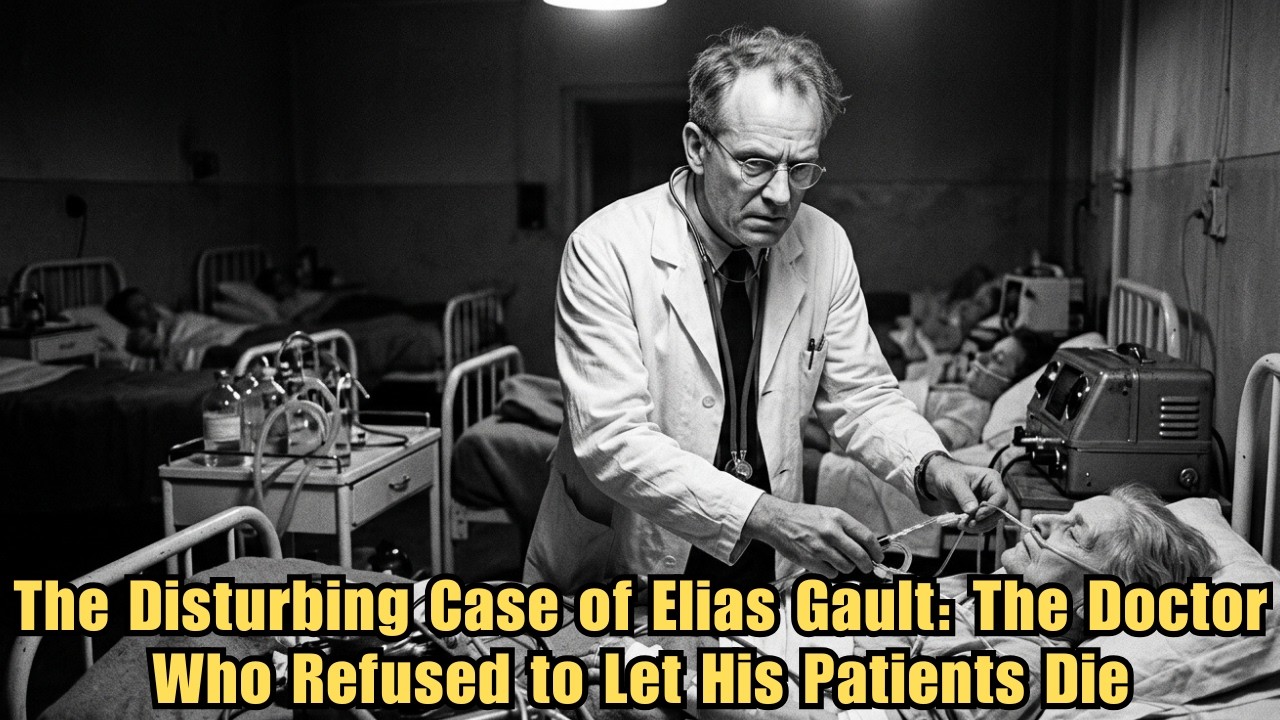
Not marked deceased. Not transferred. Not escaped. Simply blank.
For decades, those ledgers sat in the basement of a former county building, unread and uncataloged, bundled beneath the papers of a man whose medical license had been surrendered quietly, without public hearing, in the spring of 1885. His name was Dr. Elias Gault. And if you had asked anyone in the village of Harwick Hollow in those years what kind of doctor he was, they would have told you, without hesitation, that he was the finest physician in the county, a man of extraordinary gifts, a man devoted above all else to keeping his patients alive.
They were right about that last part. The hamlet of Harwick Hollow sat at the bottom of a narrow glacial valley about forty miles northeast of Albany, pressed between the Helderberg Escarpment to the west and a dense stand of old-growth hemlock forest to the east. It was not a prosperous place. It had never been prosperous.
The farms that climbed the valley’s lower slopes produced enough rye and potatoes to keep families fed through the long winters, but not enough surplus to attract the kind of commerce that might have brought a proper town into being. There was a mill, an inn, a general store, a Methodist church of pale clapboard that needed painting, and, by 1868, a single-room medical office attached to the rear of the Gault house on Fallow Creek Road. The county seat was in Coxsackie, nearly two hours by road when the weather cooperated, which it seldom did between November and April. Before Elias Gault arrived in the autumn of 1866, the nearest physician had been an elderly man named Dr.
Prentiss Halverson, who traveled a circuit between four villages and was known as much for his fondness for bourbon whiskey as for his medical acumen. When Halverson died of a stroke while fording a creek in the spring of 1866, the valley was left with no medical care whatsoever, and the town council, such as it was, being three farmers and the mill owner, had quietly begun to despair of attracting anyone qualified to replace him. Elias Gault was thirty-two years old when he arrived. He came from Albany, where he had completed his formal training at Albany Medical College and then spent two years working in the wards of Albany City Hospital.
His colleagues there would later describe him as methodical, precise, and unusually patient. A man who took careful notes and revised them carefully. A man who never seemed to tire of a difficult case when other physicians had already begun to speak of hopeless situations. In 1864, he had published a single paper in the American Journal of Medical Sciences on the subject of respiratory complications in patients recovering from typhoid fever.
The paper was not remarkable. What was remarkable was its tone: clinical, almost cold, as though the suffering of the patients it described were variables in an arithmetic problem rather than experiences being endured by living people. Nobody in Harwick Hollow read medical journals. What they saw was a tall, angular man with careful dark eyes and very clean hands.
Gault, who arrived on a Tuesday with a leather trunk full of instruments and reference texts, rented the house on Fallow Creek Road from the widow Tilda Mosgrove and opened his office within the week. He charged modest fees. He made house calls in all weather. He did not drink.
He attended the Methodist Church on Sundays without apparent devotion, but without apparent reluctance. He was polite to everyone and familiar with no one. Within a year, he was the most trusted man in the valley. There was reason for that trust.
In his first winter, a diphtheria outbreak moved through the farms along the eastern ridge and killed six children before Gault contained it. He did this by isolating the sick, enforcing quarantine with a firmness that irritated several farmers who could not afford to be kept from their livestock, and administering treatments, some drawn from European literature that had not yet reached standard American practice, that appeared to slow the disease’s progression in at least three cases where death had seemed inevitable. The children who survived became a kind of testament. Their parents spoke of Gault with a reverence that the Methodist minister found slightly uncomfortable.
By the early 1870s, the valley’s population had grown modestly, not through prosperity, but through the arrival of two dozen German immigrant families who had come to work the limestone quarry that opened on the escarpment in 1869. These families brought with them their own ailments: industrial injuries from the quarry work, the chronic respiratory complaints that came from breathing stone dust, and, among the older men, the accumulated damage of decades of hard labor in worse conditions than anything Harwick Hollow offered. They also brought a cultural deference to educated professionals that sat comfortably alongside the valley’s existing respect for Gault’s abilities. It was for these quarry workers, and for the valley’s poorest farming families, that Gault proposed the ward.
He came to the town council in the winter of 1870 with a proposal written in the same precise hand that filled his patient ledgers. The valley, he argued, needed a facility for the care of patients whose conditions required sustained attention, not the kind of attention that a family with a farm to run and other children to feed could provide, but the continuous professional attention that only a dedicated medical environment could offer. He had already identified a building for the purpose: the old Renner farmhouse at the end of the hollow, which had stood empty since the Renner family departed for Ohio in 1868, and whose owner, a man in Albany who had inherited it without interest, was willing to lease it for a modest annual sum. The council approved the proposal with some hesitation.
One member, a farmer named Cornelius Vander, raised the question of oversight. Who would inspect the facility? Who would ensure that its operations met the standards of the county medical board? Gault answered patiently that he would maintain full records and submit them to the county medical officer annually, as required by law.
The facility would not be a formal hospital, he explained, but a private care home operating under his license, which relieved it of certain regulatory burdens while still ensuring professional standards. Vander was not entirely satisfied, but the other council members were, and the motion passed three to one. Work began on the Renner farmhouse in the spring of 1871. By November of that year, the ward, as it came to be called, though it had no official name, was ready to receive its first patients.
The first patient admitted was a quarry worker named August Brenner, forty-seven years old, a native of Baden-Württemberg who had been in the valley for two years and whose lungs Gault determined had been severely compromised by stone dust. Brenner’s breathing had worsened through the autumn to the point where he could no longer work, and his wife, Marta, had exhausted herself trying to nurse him while also managing their four children and the small kitchen garden that supplemented their income. When Gault suggested that August might benefit from the care of the ward, consistent monitoring, proper ventilation, a diet calibrated to his specific condition, Marta Brenner agreed with the relief of a woman who had been carrying a weight she could not put down. She visited the following Sunday.
The farmhouse had been transformed into something clean and orderly, with four beds in the main room and two in a smaller chamber off the kitchen that Gault had extended with a lean-to addition. There were linen curtains on the windows, a wood stove that kept the air warm and dry, and a smell that Marta associated with a hospital she had glimpsed in Baden as a girl: carbolic, metallic, precise. Elias Gault met her at the door in his white coat and showed her to August’s bed. August was sitting up, breathing more easily than he had in months.
He held Marta’s hand and told her the food was good. The doctor checked on him twice a day, and he was sleeping through the nights for the first time since summer. Marta Brenner went home reassured. She came back the following Sunday and the Sunday after that.
On the third Sunday in January of 1872, she arrived to find that August had been moved to the smaller chamber off the kitchen. Gault explained that the main room was being used for a patient who required more intensive care, and that August’s situation had stabilized sufficiently that he could be moved without any risk to his treatment. He said this gently and clearly, with the unhurried manner that people in the valley had come to associate with absolute competence. Marta nodded and went to see her husband.
She noticed that the door to the small chamber had a new bolt on the outside. She did not say anything about the bolt that day. She told herself it was for privacy, or for preventing drafts, or for some other sensible medical reason she did not have the expertise to understand. But the bolt stayed in her mind the way an unexpected sound stays in the ear long after it has passed.
When she returned the following week, a woman she did not recognize answered the front door and told her that the doctor was not in, and that visiting hours on Sundays had been changed to two hours in the afternoon beginning at two o’clock. Marta had arrived at half past one. And so she waited in the cold for thirty minutes, then was admitted and taken to see August, who was sitting in the same position as the week before, in the same chair, with a blanket over his knees. He said he was feeling well.
His voice was flat in a way that Marta could not quite identify. When she asked him whether he wanted to come home now that his breathing had improved, he said the doctor thought it was too soon. When she asked him what the doctor had said exactly, he paused for a moment, a pause she would remember for the rest of her life, and said he couldn’t quite recall. Outside, walking back through the snow along the hollow road, Marta Brenner tried to understand what was bothering her.
Her husband was alive. His breathing was better. The facility was clean and orderly and under the care of a physician everyone respected. She had no evidence of anything wrong.
Only the bolt, and the pause, and the flatness in his voice, and the feeling, which she could not justify and could not dismiss, that her husband was being held in that house the way a specimen is held in a jar: preserved, and still, and entirely in someone else’s keeping. She did not know, as she walked home through the late January cold, that she had just had the last real conversation with August Brenner that she would ever have. He remained in the ward for six more years. The valley moved on as valleys do.
The quarry expanded. Three of the German families bought farmland and began to put down roots deep enough to feel permanent. A second general store opened. The Methodist Church got its fresh coat of paint.
Elias Gault’s ward received, over the following years, a slow and steady stream of patients. Some sent by Gault himself after house calls, some arriving through referrals from neighboring communities that had begun to hear of the facility. One or two brought in carriages by relatives from as far as Albany who had been told by someone who knew someone that Gault could manage conditions other physicians had given up on. The ward expanded.
By 1875, Gault had added a full second story to the Renner farmhouse and enclosed the lean-to into a proper wing. A woman named Theodora Kepler, who had trained as a nurse at a hospital in Utica and come to Harwick Hollow to care for an aging aunt, was hired as the ward’s only regular staff besides Gault himself. Kepler was efficient and quiet, and told anyone who asked that the work was satisfying and that Dr. Gault was an exceptional physician.
She said this without warmth, in the same careful, uninflected way that Gault himself spoke about nearly everything. Among the families whose relatives had been admitted to the ward, there was a layer of unease that grew slowly, the way ice grows on a still pond. You can’t see it happening, but one morning you step on what you thought was water and find it solid beneath your boot. Marta Brenner was not the only wife or daughter or son who had noticed something they could not name.
Carl Fritsch, whose father Otto had been admitted in the spring of 1873 for a severe infection of the lower leg following a quarry accident, found that his father’s improvement, which Gault reported regularly and in detail, never seemed to translate into any actual prospect of discharge. Each time Carl asked when his father might come home, Gault would describe another complication, another phase of treatment that needed to run its course, another risk of relapse that it would be irresponsible to ignore. The explanations were always plausible. They were always delivered in the same calm, methodical voice, and they always ended with Carl Fritsch walking back down the hollow road feeling vaguely foolish for having asked.
There was also the question of the records. When a patient died in the ward, and some did die, the very old, the very ill, those whose conditions had progressed too far even for Gault’s treatments to arrest, Gault filed death certificates with the county as required, and these were duly recorded in Coxsackie. But the certificates were filed in batches, sometimes months after the actual death, and the causes listed were invariably the patient’s original presenting condition: lung disease, septic infection, heart failure. No county medical officer had ever visited the ward to inspect its records or its conditions.
This was not, in itself, suspicious. County medical oversight in rural New York in the 1870s was, in practice, nearly nonexistent. But it meant that Gault’s intake logs and his discharge records, the ones with the blank column, existed only in his own files in the farmhouse at the end of the hollow. In the summer of 1876, a circuit preacher named Absalom Crane came through Harwick Hollow on his annual tour of the valley communities.
Crane was not a remarkable man in most respects, but he was observant, and he had been through the valley in each of the previous six years. He noticed things that changed and things that didn’t. He noticed that the old Renner farmhouse was considerably larger than it had been on his last visit. He noticed that there were more chimneys now, and that the curtains in what appeared to be upper-story windows were always drawn.
He noticed that when he asked at the inn that evening about the facility at the end of the hollow, the innkeeper, a blunt-spoken man named Peter Schiller, paused before answering in a way that struck Crane as deliberate. “It’s the doctor’s place,” Schiller said finally. “Gault’s ward. ”
“And it does good work?
” Crane asked. Schiller looked at him steadily. “People go in,” he said. Crane waited.
“And they don’t often come back out,” Schiller said, then turned away to wipe down the bar, and did not say anything more on the subject. Crane sat with his supper and thought about what Schiller had said. He thought about it for the rest of his circuit, and when he returned to Albany in the fall, he mentioned it almost as an afterthought over dinner with a colleague, to a man named James Aldgate, who was a reporter for the Albany Evening Journal and who collected unusual observations the way other men collected stamps. Aldgate wrote nothing about it immediately, but he kept the name Elias Gault, Harwick Hollow, and he began quietly, and without hurry, to make inquiries.
It took James Aldgate the better part of two years to assemble enough information to feel that he was looking at something real rather than a collection of disconnected complaints and rumors. He was a careful reporter, careful enough that he had learned through painful experience the difference between a story and a grievance, and the consequences of mistaking one for the other. So he gathered slowly. He obtained, through the county clerk’s office in Coxsackie, the death certificates that Gault had filed between 1871 and 1878.
There were eleven of them. He compared them against the intake records he had been able to partially reconstruct through interviews with families of admitted patients. The math was troubling. He could identify through those interviews at least twenty-eight individuals who had been admitted to the ward during that period.
Eleven had death certificates. He could find no record of any of the remaining seventeen being discharged. He traveled to Harwick Hollow in the autumn of 1878 and spent four days at the inn, having conversations with everyone willing to talk to him, which was fewer people than he had hoped. Peter Schiller, who had first planted the seed two years earlier through the circuit preacher’s account, spoke with him at length, though always in the back room of the inn and always after ensuring that no one else was nearby.
What Schiller told him was not dramatic. It was a series of small, ordinary observations that together formed a picture Aldgate found deeply unsettling. Schiller had seen patients in the ward’s yard in the warmer months, sitting in chairs or walking slowly near the garden that Kepler kept on the south side of the building. He had spoken once with a man he recognized as Emil Vorst, a farmer from the northern end of the valley who had been admitted two years earlier for a severe winter illness that had nearly killed him.
Vorst had recovered. Anyone could see that by looking at him. He was walking on his own, speaking coherently, and showed no obvious signs of serious illness. Schiller had asked him when he was going home, and Vorst had looked at him with an expression that Schiller could only describe as carefully blank, and said that the doctor had not determined that it was safe yet.
Then Kepler had come around the side of the building, and Vorst had looked away, and the conversation had ended. That expression, carefully blank, was the phrase that lodged in Aldgate’s mind. He had heard some version of it from Marta Brenner, who still visited her husband August every Sunday four years after his admission, even though August no longer seemed to recognize her with any consistency. He had heard it from Carl Fritsch, who had not been permitted to see his father Otto in over a year, Gault having explained that the elder Fritsch was in a delicate phase of treatment requiring complete rest and minimal stimulation.
He had heard it from a woman named Louisa Tanner, whose mother had been admitted in 1874 and who had received three months later a death certificate listing the cause as cardiac failure, though Louisa’s mother, when last Louisa had seen her, had been ambulatory, cogent, and in no apparent distress. Aldgate was a journalist, not a physician, and he knew the limits of his expertise. But he had covered the Albany City Hospital for two years and knew something about medical practice. What he was hearing suggested a pattern he could not explain through incompetence alone.
Incompetence loses patients. It does not keep them. He requested an interview with Gault. Gault agreed, which surprised him.
They met in the ward’s front room on a cold Thursday in November. The room was precisely as clean and orderly as everyone had described: whitewashed walls, scrubbed floorboards, linen curtains letting in the flat, gray November light, a faint smell of carbolic acid that was not unpleasant. Gault sat across from Aldgate with his hands folded on his knees and answered every question in his careful, unhurried voice. The death certificates were accurate.
The cases Aldgate had asked about were too sensitive to discuss specifically, as patient confidentiality was a professional obligation he took seriously. The facility’s records were available to the county medical officer upon request. He had nothing to hide, and resented the implication that he might. Aldgate asked, as gently as he could, about the patients who appeared to have recovered but had not been discharged.
Gault looked at him for a moment. Then he said, “Recovery is not the same as cure, Mr. Aldgate. A man who stops coughing may still be contagious.
A woman whose fever breaks may relapse without warning. The premature discharge of a patient whose condition I have not fully resolved is, in my professional judgment, a greater cruelty than keeping them a little longer than their family might prefer. I have seen what happens when people go home too soon. I have seen them die in beds their children sleep in.
I have seen whole families consumed by illnesses that proper isolation would have ended. What I do here is not comfortable, but it is correct. ”
It was a perfectly reasonable answer. It was the kind of answer that could not be argued with, because it was grounded in genuine medical logic and framed in terms of patient welfare.
Aldgate left the ward that afternoon without having found a single thing he could point to and say, this is wrong. He had only the feeling, persistent, cold, specific, that he had just been managed very skillfully by a man who had a great deal of practice at it. He returned to Albany and began writing the only kind of story he could actually write: not an accusation, but a question. The article appeared in the Albany Evening Journal on the fourteenth of February 1879.
It was careful, measured, and deeply unsettling to anyone who read it closely. Aldgate did not accuse Gault of any crime. He described the ward’s operations, the families’ concerns, the gap between admissions and recorded discharges, and he posed a series of questions addressed nominally to the county medical board about the oversight of private care facilities in rural counties. He named no patients, cited no specific cases, and at no point made any allegation that could not be supported by documented fact.
It was, in every legal and journalistic sense, an exemplary piece of cautious reporting. It was also, within the valley of Harwick Hollow, received as a declaration of war. Gault’s supporters, and there were many, because he had been the valley’s physician for thirteen years and had in that time genuinely saved lives that would otherwise have been lost, were furious. The town council held a meeting at which Cornelius Vander, now older and somewhat softened toward Gault, moved that the council send a letter to the journal expressing its confidence in the doctor’s character and the facility’s operations.
The motion passed unanimously. The minister preached a sermon the following Sunday about the sin of slander. Three of the German families whose members were not patients at the ward circulated a document signed by forty-two residents vouching for Gault’s professional conduct. Marta Brenner did not sign it.
Neither did Carl Fritsch. And there were four or five others, quieter, less willing to draw attention, who also did not sign, and who in the weeks that followed the article’s publication found themselves the subjects of a kind of social pressure that was not quite ostracism but had much the same practical effect. The valley had decided what it believed, and it believed in Elias Gault. Those who did not were an uncomfortable presence in a community that had organized itself around his competence for over a decade.
But Aldgate’s article had also been read in Albany, where it reached the desk of the state medical board’s administrative secretary, a man named Horace Delacroix, who was methodical in his own way and who took seriously his obligation to follow up on credible complaints about licensed practitioners. Delacroix wrote to Gault requesting a formal submission of patient records for the preceding five years. The letter was politely worded and framed as routine administrative procedure. It arrived at the Gault house on Fallow Creek Road in the third week of February.
What happened next is documented only indirectly. A farmhand named Silas Prout, who occasionally helped with deliveries along the hollow road, later told Aldgate that he had seen, on the night of February twenty-third, a considerable amount of smoke coming from the chimney of the ward’s new stone outbuilding, the one that had been added to the property in 1876 and that appeared to serve as a storage facility for the ward’s records and supplies. It was, Prout said, more smoke than a heating fire would produce. It was the kind of smoke that comes from paper.
Three weeks later, Gault submitted to the state medical board a set of records that covered only the years from 1876 to 1879, and that showed for that period nineteen patient admissions and nineteen corresponding discharges or death certificates. The records were clean, legible, and internally consistent. Delacroix reviewed them, noted no immediate irregularities, and filed them. For the moment, the inquiry stopped.
But something else had begun. Among the families who had read Aldgate’s article, and who recognized themselves in the questions it asked without naming them, there was a slow crystallization of purpose. They had been isolated from one another, each family managing its own uncertainty, its own carefully reasonable explanations, its own reluctance to seem ungrateful to the man who had, after all, kept their relative alive. But the article had shown them that they were not alone, that other people were asking the same questions, that the questions themselves were not unreasonable.
Marta Brenner wrote a letter to James Aldgate. So did Carl Fritsch. So eventually did a woman named Hedwig Ross, whose brother Conrad had been admitted in 1874, and who had stopped receiving any communication from the ward in 1877, when Gault informed her by post that Conrad’s condition had deteriorated beyond the point where visits could be permitted. Conrad Ross would have been forty-one years old in 1879.
His death certificate, which Gault had not yet filed, did not exist. In the spring of 1879, Aldgate traveled back to Harwick Hollow with the letters in his coat pocket and a considerably clearer sense of what he was dealing with. This time he did not request a meeting with Gault. He went directly to the ward and asked to see the patients.
Kepler met him at the door. She was polite and immovable. The ward was not open for unannounced visits. The doctor was not in.
She would convey his request. Aldgate asked specifically to see August Brenner. Kepler said that Mr. Brenner’s care requirements did not permit unannounced visits.
Aldgate asked to see Conrad Ross. Kepler’s expression did not change, but something behind her eyes shifted in a way that Aldgate noticed and filed away. She said she was not aware of a patient by that name. Aldgate said that Conrad Ross had been admitted to this facility in July of 1874 and had not been reported discharged or deceased.
Kepler said she could not discuss individual patient cases. She said it with perfect composure. Then she closed the door. Standing on the steps of the former Renner farmhouse in the mild April light, listening to the sound of the bolt being drawn on the other side of that door, James Aldgate understood, with a clarity that moved through him like cold water, that he was not looking at a story about negligence.
The investigation that followed was not swift, and it was not clean. And it did not produce the kind of dramatic single revelation that makes for a satisfying story. What it produced was a slow accumulation of pressure, legal, medical, and journalistic, that eventually made Elias Gault’s situation untenable in a way that all his careful management could not address. It began with Marta Brenner.
In May of 1879, she retained a lawyer, a young man in Coxsackie named DeWitt C. Hollis, who had read Aldgate’s article and who agreed at a reduced fee to pursue a formal petition to the county court for access to her husband. The petition argued that Marta, as August Brenner’s wife, had a legal right to information about his condition and to make decisions regarding his care. It was a straightforward legal argument, and Hollis made it well.
The county judge, a cautious man named Orville Strang, who was aware of Gault’s standing in the community and disinclined to create controversy, nevertheless signed the order in June because he could find no legal basis for refusing it. Gault’s response, submitted through his own lawyer in Albany, was to present August Brenner’s condition as one of severe mental deterioration. The result, he claimed, of the original lung disease’s impact on August’s neurological function. He submitted a medical report in his own hand describing a man who was no longer capable of self-directed action or coherent communication, and who required continuous institutional care for his own safety and the safety of others.
He argued that Marta Brenner’s visits, far from benefiting August, were causing him distress that set back his treatment. Judge Strang appointed a neutral physician from Albany, a man named Dr. Francis Cleary, to evaluate August Brenner’s condition and report to the court. Cleary visited the ward on a Tuesday morning in August of 1879.
He was accompanied by a county constable, which Gault had not been informed would be the case, and which Kepler, meeting them at the door, had no legal basis to refuse. Gault himself was not present. He was at his office on Fallow Creek Road. Kepler led them through the ward with the careful composure of someone who had rehearsed this, or something like it, many times.
What Cleary found in the main room of the ward were three patients, all elderly, all in beds, all in states of apparent sedation. He examined them briefly and noted in his records the smell he associated with laudanum, the tincture of opium that was in the 1870s legal, widely available, and routinely misused. He noted that the patients’ muscle tone suggested long-term immobility, and that one of the three, a woman he could not identify, as no names were displayed, showed signs of pressure sores consistent with months or years of being confined to bed. He asked Kepler to show him the remaining patients.
Kepler said that the other rooms were in use and could not be disrupted. The constable said that the court order covered the entire facility. Kepler said she would need to consult with Dr. Gault.
The constable said that was not an option currently available to her, and stepped past her into the hallway. The second and third rooms held two patients each, in similar conditions to those in the main room. The small chamber off the kitchen, the one with the bolt on the outside, held one patient. Cleary estimated the man’s age at approximately fifty, which matched August Brenner’s age in 1879.
The man was awake, in a chair by the window, and he looked at Cleary when Cleary entered the room with the slow, slightly unfocused attention of someone who had been in a chemically dampened state for a long time. Cleary asked him his name. The man said, after a pause, that his name was August. Cleary asked him what month it was.
August looked out the window at the summer light, then back at Cleary, and said he didn’t know. Cleary asked him if he wanted to go home. August was quiet for a long time. Then he said, slowly and with evident difficulty, “I don’t think the doctor wants me to.
”
That sentence, six words, spoken by a man who appeared physically recovered from a respiratory illness that had been his original reason for admission eight years earlier, was the center of Francis Cleary’s report to the court. The report concluded that August Brenner showed no signs of active disease requiring institutional care, that his cognitive impairment appeared consistent with prolonged administration of sedative compounds rather than neurological disease, and that his retention in the facility was, in Cleary’s professional opinion, medically unwarranted. The report also noted carefully that the ward’s population appeared to consist primarily of patients who had, by all physical evidence, recovered from their presenting conditions, and who were being maintained in a state of pharmacological compliance that prevented them from exercising or expressing any desire to leave. Gault was called before the state medical board in October of 1879.
He came prepared with records, citations, and a detailed defense of his treatment protocols. He argued that Cleary’s observations were those of a general practitioner unfamiliar with the specific complexities of long-term chronic care. He argued that the medications he used were standard components of any responsible treatment regimen for patients with the profiles his ward served. He argued that Marta Brenner’s petition was the product of a misunderstanding about the nature of her husband’s condition, amplified by irresponsible journalism.
He was persuasive. He had always been persuasive. And the board in 1879 was not equipped to act decisively on what it had, which was a pattern of suspicious evidence rather than a single clear crime. But they kept watching.
And in the watching, more came out. Hedwig Ross finally demanded a formal accounting of her brother Conrad. Gault filed a death certificate in December of 1879 listing the cause as pneumonia and the date of death as September of the previous year. Hedwig, with Hollis’s help, then petitioned for access to the burial records.
The cemetery on the hollow road had no record of Conrad Ross. Gault explained that Conrad had been interred on the ward’s property, which he owned, at the family’s request. A request Hedwig stated for the record had never been made by any member of the family, because no member of the family had been informed of Conrad’s death until fifteen months after it had allegedly occurred. An inquiry into the ward’s property found, in the spring of 1880, evidence of a small enclosed area on the north side of the building that appeared to have been used as a burial site.
It contained the remains of at least four individuals. Three were eventually identified through the painstaking work of matching physical characteristics against intake records: Conrad Ross, a quarry worker named Philip Austin, and a woman from a neighboring valley whose family had been told she was discharged in 1875. The fourth was never identified. Gault maintained through the entire process that the burials had been with the family’s knowledge and consent, that the deaths had been from natural causes consistent with the patients’ conditions, and that the delay in filing documentation was an administrative failure, not a deliberate concealment.
He was asked, repeatedly and in several different legal forums, to explain the blank discharge column. He said it was a clerical system he had since revised. He said it was an artifact of his record-keeping method. He said it meant nothing.
The board could not prove that it meant anything definitive. But they could, and in the spring of 1885 they did, determine that his practice of administering sedative compounds to patients without documented medical justification, his failure to maintain adequate death records, and his pattern of obstructing legitimate family access to patients constituted sufficient grounds for the surrender of his license. The proceeding was administrative rather than criminal. There was no trial.
There was no jury. There was a closed hearing, a formal agreement, and Elias Gault’s signature on a document stating that he would cease medical practice in the state of New York immediately and permanently. He left Harwick Hollow that spring. He went somewhere west.
There were accounts, years later, that placed him in Pennsylvania, then Ohio, then further still, always in counties where his name had not preceded him. The ward on the Renner farmhouse property was emptied, and its remaining patients, six of them, including August Brenner, were returned to their families or, in two cases where there was no family to receive them, transferred to the county almshouse. August Brenner came home to Martha in April of 1885. He had been in the ward for thirteen years.
He was sixty years old, and he walked with the careful uncertainty of someone relearning a skill. He had no specific memory of the years between roughly 1875 and 1885. They existed for him as a kind of gray absence, punctuated by occasional impressions of a window, a chair, the smell of carbolic and laudanum, Kepler’s footsteps in the hallway. He lived for another four years.
He died in his own bed in the fall of 1889, with Martha beside him. His death certificate, filed by the county physician, listed the cause as heart failure. It was accurate. The question that James Aldgate spent the last years of his career trying to answer was not whether Elias Gault had done something wrong.
The evidence for that was sufficient, even if it had never been sufficient for a criminal conviction. The question that kept him awake, that he returned to in his notes and in the long, careful essays he published in the years after the ward was closed, was a simpler and more terrible one. Why? Not why in the abstract, not what was wrong with a man who could do this, but why specifically, mechanically, in terms of Gault’s own stated beliefs.
Because Gault had, on multiple occasions, explained himself not as an admission of wrongdoing, but as a defense of a philosophy. The prolonged administration of sedatives, he argued, was a legitimate tool for managing patients whose conditions made them difficult to treat through conventional means. The extended stays were a necessary consequence of taking recovery seriously, of refusing to discharge patients before he was certain, completely certain, that they would not relapse, would not spread disease, would not return to him worse than when they had arrived. He spoke of it as a form of care that families were too emotional, too impatient, too medically uninformed to appreciate.
Aldgate believed, in the end, that this was not entirely a lie. He believed that somewhere inside the system Gault had built at Harwick Hollow was a genuine medical conviction: that if he could simply control all the variables, if he could maintain his patients in a state of perfect managed stability, if he could prevent the unpredictable intrusions of the outside world and the patient’s own choices and the chaos of ordinary life, he could achieve outcomes that ordinary medicine could not. He believed that what Gault called keeping his patients alive too long was in Gault’s own framework not a perversion of care, but its highest expression. What made Gault dangerous was not that he was indifferent to his patients.
It was that he cared about them in a way that had no room for their autonomy, their relationships, their own experience of their existence. They were cases to be managed, not people to be returned to their lives. And the institution he built, clean, orderly, plausible at every level, and wrapped in the impenetrable authority of medical expertise, was perfectly designed to prevent anyone from challenging that framework until the damage was already done. Theodora Kepler left Harwick Hollow the same week Gault did.
She was never called before any legal body, because the investigators determined that she had followed physician’s instructions throughout and could not be held accountable for what those instructions had produced. Whether she had known at any point that what she was participating in was wrong, whether she had pushed that knowledge down or rationalized it or simply decided that the physician’s authority superseded her own judgment, is a question no one can definitively answer. She never gave an account of her time at the ward. She disappeared into another life somewhere.
Another name, perhaps. She left no record of herself that anyone has found. The Renner farmhouse stood empty for several years after the ward was closed. It was eventually purchased by a family from Albany who used it as a summer residence and who reportedly knew nothing of its history.
By the early twentieth century, it had been substantially renovated. By mid-century, the original structure was barely visible beneath the additions. Eventually, like so many buildings and valleys that time slowly abandons, it fell into disrepair, then into the kind of ruin that becomes indistinguishable from the landscape, and then into the ground. The intake ledgers, the ones with the blank discharge column, were preserved in a county record storage facility that changed hands several times over the following decades.
They were cataloged incorrectly, marked as a general hospital register from a now-defunct facility, and filed under a heading no one was likely to search. They sat there for nearly a century, undisturbed. Forty-three names and thirty-one blanks, waiting for someone who knew what they were looking at. When they were finally examined in the course of a local historical society’s survey of county medical records, the archivist who opened the ledger noted in her report that the handwriting in the discharge column was very clean, that it showed no sign of correction or revision, that whoever had maintained these records had always intended from the beginning to leave those spaces empty.
She did not know what to make of that. She wrote it down accurately and moved on to the next box. Some questions, it turns out, are answered not by revelations, but by the slow, patient accumulation of things that cannot be explained away. The blank column.
The bolt on the outside of the door. The careful smoke from the outbuilding chimney on a February night. The six words of a man who had been kept alive, carefully, methodically, professionally kept alive for eight years past any medical necessity, sitting in a chair by a window with the summer light coming in, saying that he didn’t think the doctor wanted him to go home.






