Some men carry a story the way other men carry a wound. They walk around it. They dress carefully to hide it. And when a stranger comes to the door, they take a long time answering, because a wound has to be arranged before anyone can see it and not flinch.
The man I am about to tell you about carried his for seventy-one years. He was ninety-five when he finally told it, and he told it once. The house sat on a dry rise above the Santa Cruz River, three miles south of Nogales, Arizona. Cinder block walls painted the color of a morning dove, a tin roof gone brown from thirty summers of desert weather.
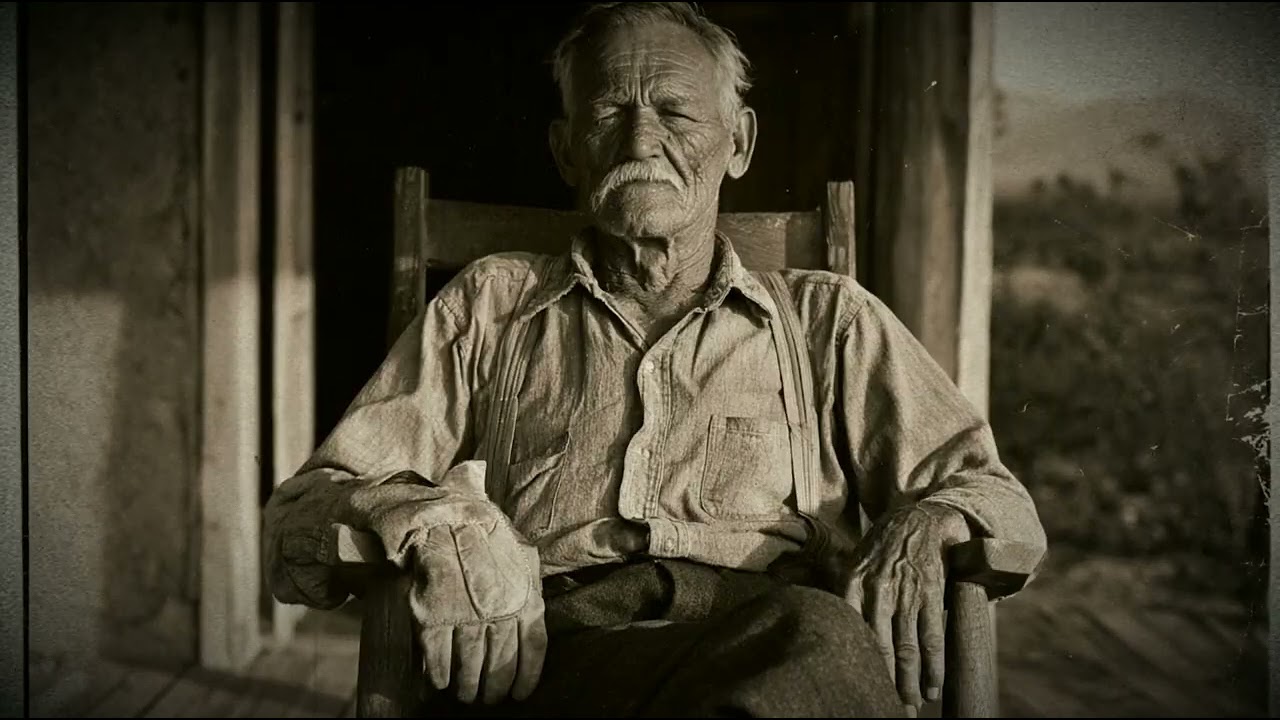
There was a rocking chair on the porch, and in the chair, when I drove up that morning, sat the man I had come to see. He was ninety-five years old. His name was Absalom Kettering. A woman from the county nursing service had told me about him.
She had been visiting him twice a week for two years, since his sister passed. One afternoon he had asked her, out of nowhere, whether she thought a man could go to his grave with something and be forgiven for keeping it. She had said she thought so. She had said she believed God took a man’s silences the same way he took his prayers.
He had shaken his head then, and said, “I do not think it works that way for what I am carrying. ”
That was how I ended up on that porch in the middle of July 1960, a tape recorder in a canvas bag, a notebook, and a very old man who took a long time to look at me because his eyes had gone milky at the edges and needed a moment to find a new shape. When he did find me, he said in a voice that was smaller than his body, “You are the one who wants to hear about the canyon. ” I said I was.
He said, “Sit down. ” And I sat. Absalom Kettering was born in Tucson in the Arizona territory in the summer of 1865. His father was a wheelwright from Pennsylvania who had followed the war west and never gone home.
His mother was a Sonoran woman from a family that had lived in the same valley below the Baboquivari peaks for six generations. She spoke Spanish and English and a little Tohono O’odham, and she taught all three to her son, along with something else that would matter later: the habit of listening when the land asks a person to be quiet. By the age of twenty-two, Kettering was a civilian scout attached to the 10th Cavalry, stationed out of Fort Huachuca. He was not a soldier.
He was a man on a horse, paid a modest wage to ride ahead of soldiers and to know what the country was going to do before the country did it. He was quiet. He was patient. He was good at the work.
In the summer of 1889, he was twenty-four years old. That was the summer of the canyon. You have to understand something about that border in those years. The line drawn on a piece of paper in Washington did not mean very much on the ground.
Men went back and forth across it as if it were the shadow of a fence. Cattle went across it. Silver went across it. Trouble went across it.
Under an agreement signed in 1882 between the United States and Mexico, patrols on either side were permitted to cross in pursuit of raiders. Officially, there were rules. Unofficially, out there among the ridges of the Sierra Madre, there were only the rules a captain made up as he went. That July, a small band of raiders had struck a ranch outside the town of Patagonia.
They had taken horses. They had taken silver. They had left one of the ranch hands dead, wrapped in a blanket, laid out at the door of the main house with his hat on his chest. That last detail — the hat, arranged carefully — was the part that troubled Captain Osgood Merryweather more than any of the others.
It was the part that made him say, when he ordered the patrol out, “This is not the usual thing. ”
The patrol was small: five soldiers, a civilian scout, a local guide. Kettering was the scout. The soldiers were four Buffalo Soldiers of the 10th Cavalry, commanded by Sergeant Wharton Blazedell, a slow, careful man from Kentucky with a beard the color of wet ash and hands so large they seemed to belong to a bigger person than the one he was.
Under him rode Corporal Emmitt Doss, a man of about thirty who had come up from Louisiana and had a soft, slightly whistling voice from a jaw that had been broken at a place called Beecher Island. Private Vernon Radlaw, twenty-three, freckled across the bridge of his nose, quiet, homesick, always writing letters to a sister in St. Louis. And Trooper Callum Isby, an Irishman from New York, forty and going gray, who never talked about how he came to be there and who read a small leather-bound Bible each night by the fire without moving his lips.
The guide was a man named Donaciano Talamantes. Donaciano was Opata, from a village east of Bacuachi in Sonora. He was somewhere between sixty and seventy years old — no one, including him, knew exactly. He had guided American and Mexican patrols across those mountains for thirty years.
He had a face the color and texture of old saddle leather, and eyes the color of riverbed stones, and he wore on a thin cord around his neck a small carved thing that Kettering never got a good look at and never asked about, because Donaciano did not invite that kind of question. Those seven men left Fort Huachuca on the morning of the 12th of July, 1889. Six days later, only two of them were still alive. I want to slow down there for a moment, because if you are already leaning in a little, I want to ask you something before I take you into what happened.
I want you to tell me whether you have ever been in a place that felt wrong. Not haunted. Not scary. Just wrong.
The way a room feels wrong when the pictures have all been rehung an inch off from where they were. A place where nothing was happening, but something was watching what was not happening. Because Kettering used almost exactly those words on that porch seventy-one years later. He said it was not that anything was wrong.
It was that nothing was wrong. And it should have been. The trail south of the border led through the low grass country first — flat, dry, dotted with mesquite and yucca, the ground crackling under the horses’ feet. They followed the raiders’ sign for two days without seeing anything unusual.
The tracks were clean. Eight horses, one wounded, two with heavier loads, moving southeast toward the Sierra. Donaciano rode at the front. Kettering rode second.
The soldiers came behind in a loose column, rifles across their thighs, canteens knocking against the saddle horns in a soft, regular rhythm that a man learns to stop hearing after the first hour and only remembers later, as a sound the land made. On the second afternoon, they came into the town of Mineral de Ánimas. I need to tell you about that town. Mineral de Ánimas had been, twenty years earlier, a silver camp of perhaps two thousand souls.
The vein had been rich for a while. There had been a hotel and two cantinas and a small stone church and a Chinese laundryman and a woman from Zacatecas who ran a boarding house that had, according to the stories, been the cleanest place between the border and Hermosillo. Then the vein had thinned and thinned, and then it had ended, as veins do, in a wall of rotten quartz that gave up nothing. The town had gone with it.
By the summer of 1889, Mineral de Ánimas had perhaps forty people in it. Most of them were old. A few had come back after the mine died because there was nowhere else to go. A handful worked a little placer gold in the arroyos when the rains came.
The rest waited. They waited for the town to finish. The patrol rode in from the north up a road that had once been wide enough for freight wagons and was now barely wide enough for two horses abreast. The buildings on either side stood roofless.
The doorways were dark and empty. In one of them, a very thin dog watched them pass without lifting its head off its paws. In another, an old woman in a black shawl sat on a low stool, grinding something in a stone bowl, and did not look up. The church still stood.
It was small, whitewashed once, gray now. There was a wooden cross at the peak of the roof that had lost most of its paint. Beside the church, a small adobe that had been the priest’s house. The priest came out to meet them.
He was a man of perhaps fifty, short and stocky, dressed in a dusty black cassock that had been patched at the elbows. His hair was thin and white on the sides and gone on top. His eyes were very dark and very tired, and they did not miss anything. His name was Padre Anselmo Vergara.
He greeted them in Spanish. Kettering translated for Blazedell. Blazedell explained politely that they were following a party of raiders that had struck a ranch in the Arizona territory and that they believed the tracks led south. Padre Anselmo listened.
He nodded. He did not interrupt. When Blazedell was finished, Padre Anselmo said in Spanish to Kettering, “How far south? ” Kettering said, “Into the Sierra.
” Padre Anselmo was quiet for a long moment. Then he said, “Where in the Sierra? ” Kettering pointed generally southeast toward the ridges that stood dark against the afternoon. Padre Anselmo closed his eyes.
He said, still in Spanish, and quietly, “Do not go past the second ranch. ”
Kettering said, “Padre? ”
Padre Anselmo said, “There is a second ranch two days south. A man named Ochoa lived there with his wife.
If they are still there, they will feed you. Speak to them gently. They have lost animals. They have lost a hand who worked for them.
Do not go past that ranch. If your tracks lead past that ranch, let them go. Turn your horses. Come back.
Say your captain lost the trail. He will not be pleased, but he will be alive to be displeased. ”
Kettering translated partially. Blazedell asked what the Padre thought was south of the ranch.
Kettering asked the Padre. Padre Anselmo looked at Blazedell for the first time since the conversation had begun. His eyes stayed on Blazedell’s face for a long time. Then he said in careful English, slow and heavily accented, “I do not know, sir.
I have been a priest in this town for twenty-two years. I have buried men who died of the fever, of the drink, of the mine, of the knife, of the horse. I have seen what men do to each other in this country. I know what that looks like.
What is south of the second ranch, I do not know. I only know that in twenty-two years I have baptized every child, married every couple, and buried every dead person in this parish — except for the men who went south past that ranch. Those men I did not bury, because those men did not come back to be buried. ”
He said nine of them in twenty-two years.
Some soldiers, some vaqueros, one American in 1879 who was hunting mountain lions. “I did not bury any of them. I said nine masses. That is all I could do.
”
Blazedell was quiet. Then Blazedell said gently, in the way he had of being gentle with old men and horses, “Padre, we appreciate the warning, but we have our orders. ”
Padre Anselmo nodded slowly. He did not seem surprised.
He said in Spanish to Kettering, “Tell your sergeant I understand. Tell him also that I will say a mass tomorrow morning for seven souls. If in a week no one has come to correct me, I will say another one for seven bodies. ” Kettering did not translate that.
They watered the horses at the well behind the church. Padre Anselmo brought them beans and tortillas from his own kitchen and refused any payment. As they were mounting to leave, he came to Kettering’s stirrup and put a hand on the boy’s knee — because Kettering at twenty-four was still a boy to him — and said in Spanish, very softly, “You have the look of your mother’s family. Are you from Baboquivari?
” Kettering said, “My mother was. ” Padre Anselmo said, “Then you were raised to listen. Listen to the guide. When the old man says stop, stop.
Whatever the sergeant says, stop. If you cannot make the others stop, at least stop yourself. Do you understand me? ” Kettering said, “Yes, Padre.
” Padre Anselmo said, “Go with God, son, and with more than God if you can. ”
They rode out of Mineral de Ánimas in the last hour of the afternoon. Kettering looked back once at the top of the rise, and Padre Anselmo was still standing in front of his church in his patched black cassock, watching them. He was watching them the way a man watches a coffin being carried out of a house.
On the third day they came into the foothills. The country changed. It stood up on its hind legs. Great red cliffs rose on either side of them, cut through by dry washes and old riverbeds.
The air smelled of hot stone and creosote, and once, faintly, of woodsmoke that no one could find the source of. Kettering scanned the ridges. He saw nothing. Donaciano did the same.
Donaciano also saw nothing, but Donaciano was quieter about it, in a way that made Kettering look at him twice. On the afternoon of the third day, they came to a ranch. It was small — three low adobe buildings, a corral, a well. It had been abandoned.
Not recently, not long ago. The doors stood open. The corral was empty except for a scatter of dry bones inside it, arranged in a way that Kettering at first took to be the natural work of scavengers. He dismounted and walked into the corral and stood over the bones and looked at them for a long time.
Then he called for Donaciano. Donaciano came in through the gate and stood beside him and said nothing. The bones were cattle. Four full skeletons.
The skulls were laid in a line, all facing the same direction — east. The ribs were stacked, longest at the bottom, smallest at the top. The leg bones were arranged in each case in a square around the skull, four sides joined at the corners. There was no meat left on them.
There was no smell. The bones were clean and dry and pale and old, and the arrangement of them was too careful to be an accident, and too strange to be a joke. Donaciano looked at the bones. He looked at the ranch buildings.
He looked at the eastern ridge above them, where the sun was starting to slide down behind a broken skyline of stone. He said in Spanish, “We should not sleep here. ”
Sergeant Blazedell wanted to. There was water in the well.
There was shade in the buildings. The horses were tired. Blazedell was not a fool, but he was a practical man, and to him a set of arranged bones was a curiosity, not a warning. Donaciano shook his head once and would not say anything more.
They slept there. Nothing happened that night. That was the part, Kettering said, that he remembered most clearly seventy-one years later. Not a sound.
Not a howl. Not a wind. The horses did not shy. The fire did not gutter.
Nothing happened. And when he woke in the gray hour before dawn, he lay on his blanket, looking up at the ceiling of the adobe, and he thought: something did happen, and I do not know what. They rode out at first light. By midday they had climbed high enough to look down on the country they had come through, and it looked from that height like a great yellow-brown sea, and the ranch was already invisible in the folds of it, and Kettering felt, for reasons he could not name, relief.
He looked over at Donaciano, who was riding a few paces ahead of him, and Donaciano did not turn but said in Spanish, quietly enough that only Kettering heard him, “Do not look back at it again. ” Kettering did not look back. They found the second ranch late that afternoon. This one was inhabited — or had been until very recently.
There were fresh coals in the fire pit outside the main building. A pot half full of beans, cool but not cold. A door standing open with a shirt half tucked into a laundry basket. Two milk cows in the corral, alive, unmilked, complaining.
And by the water trough, three dogs — large brown dogs of the kind Sonorans kept for guarding. All three dead. Not one mark on them. Not one drop of blood.
Their necks were unnaturally straight. Their eyes were open. Doss knelt beside them. He was not a squeamish man.
He had grown up on a farm outside Baton Rouge, and he knew what a dead dog looked like. He turned one of them over gently. He looked up at Blazedell. He said, “Sergeant, I do not know what killed these animals.
” Blazedell asked what he meant. Doss said, “There is nothing wrong with them. They are just dead. ”
Donaciano would not come near the dogs.
He stayed at the edge of the yard, holding the reins of his horse and Kettering’s, and he watched the ridge above the ranch with a stillness that was not the stillness of a calm man. It was the stillness of a man who has decided not to move, because moving would tell something above him where he was. Blazedell wanted to bury the dogs. Donaciano said in Spanish, so quietly that Kettering had to lean toward him to catch it, “Do not touch them.
Do not touch anything in this place. We ride. ”
They rode. They did not sleep that night either.
They rode until moonrise. And then, in a shallow arroyo well away from any building, they made a cold camp. No fire. Blazedell posted double watch.
The horses stood in a tight little knot, ears twitching. And in the dark, somewhere out beyond the arroyo, Kettering heard a sound that he never forgot. It was a voice. His mother’s voice.
His mother had died in 1882, of the same fever that had taken his sister seven years earlier. She had been buried in a cemetery outside Tucson. Kettering knew her voice the way a man knows the sound of his own breathing. And out there in that dark, somewhere beyond the mesquite, someone was speaking with his mother’s voice.
She was saying his name. Not calling. Speaking the way she used to, standing at the back door of their house on Meyer Street when she wanted him to come in for supper. Absalom.
Absalom. He did not move. He did not answer. He lay very still on his blanket with his rifle across his chest, and he looked up at the stars, which had never before in his life looked so far away.
And he listened to a voice he had loved and buried say his name, over and over, from a place where it did not belong. At some point it stopped. He did not sleep. In the morning, Doss came over to him and sat down and did not say anything for a while.
And then Doss said very quietly, “Kettering. ” Kettering looked at him. Doss said, “Last night. Did you hear anything?
” Kettering said, “Yes. ” Doss said, “Whose voice was it? ” Kettering said, “It was my mother’s. ” Doss looked at his boots for a long time.
Then he said, “Mine was my father. ”
Kettering asked quietly, “How long? ” Doss said, “I do not know. A while.
” Kettering asked, “What did he want? ” Doss did not answer at first. Then he said, “He wanted me to come to him. He said he was cold.
He said he had been cold a long time, and if I would come, he would not be cold anymore. He said he was just past the mesquite. He said I would find him if I walked a little. ” Kettering asked, “Did you know his voice?
” Doss said, “Kettering. My father died when I was eleven years old. It has been nineteen years. I did not think I remembered his voice.
I was wrong. I remembered every word of it. I remembered exactly how he said my name. I have not heard that sound since 1870.
And last night I heard it out there past the fire, as clear as I hear yours now. ”
Kettering did not say anything. Doss said, “Do not let me go out at night. Do you hear me?
I do not know if I will be strong. Do not let me go. ” Kettering said, “I hear you. ” Doss said, “Say it to me.
So I know. ” Kettering said, “I will not let you go, Emmitt. ” Doss nodded. He got up.
He walked away from the fire and went to see to his horse, and he did not speak of it again. Later that same morning, Isby came over to Kettering. Isby did not say very much, ever. He sat down beside Kettering on a rock, and he took out his little leather Bible, and he opened it without reading it, and he closed it again, and he put it in his coat pocket, and he said in his flat New York voice, “Kettering.
My mother’s name was Ailene. She has been dead for thirty-one years, and she wants me to come and see her in a stand of ocotillo about a hundred yards from where I slept last night. What do we do? ” Kettering said, “We do not go.
” Isby said, “That is what I thought. ” Isby got up. He went back to his own place beside the horses. He did not, from that moment onward, sleep more than an hour at a stretch — until the day he did not come out of the adobe.
They did not tell Blazedell. They did not know why. Kettering thought about it later for a long time, and the closest he ever came to an answer was this: they had all understood, without saying it aloud, that if they told the sergeant, the sergeant would have to make a decision, and they did not want him to have to. Because a sergeant faced with a story like that has only two decisions available to him.
He can turn the patrol around, or he can pretend the story is nothing. And Blazedell was too honest a man to pretend, and too committed a man to turn. They did not want to force him. So they said nothing.
They saddled their horses and they rode on. Radlaw, the young private, they discovered in the middle of the fourth day, had heard nothing at all — which struck Kettering at the time as strange, and which later struck him as the first small warning of what was going to happen to Radlaw specifically. By the end of the fourth day, they had climbed high enough into the Sierra that the raiders’ sign had begun to thin. There were still tracks, but the tracks were older now than they should have been.
It was as if the men they were following had been slowed, or had stopped, or had been taken somewhere off the visible line of their travel. Donaciano said that evening at their fire, “We should turn back. ” Blazedell said, “We have orders. ” Donaciano said, “Then let me leave you here.
I will wait for you at the second ranch. I will not go further. ” Blazedell looked at him for a long time across the fire. Then he said gently, because he was a decent man in his slow way, “You have brought us this far, old friend.
I need you a little longer. ” Donaciano did not answer. He stayed. That was the night Radlaw disappeared.
He had gone to the far side of a boulder some thirty yards from the fire to relieve himself. It was well within the ring of the pickets. There was nothing wrong with any of it. Doss watched him go over his shoulder, in the way a man watches a friend do a thing that does not need watching.
Doss then turned back to the fire and said something to Isby, some small thing, some joke about a plate of beans. And when he turned back, Radlaw was not coming. He waited a little. Then he called out softly.
The name was a young man’s name, and it seemed loud in the dark. Radlaw. Nothing. Radlaw.
Nothing. The soldiers went out in a line, rifles ready. They found the place. They found the boot prints in the sand.
They found nothing else. No struggle. No blood. No trail.
His footprints stopped as if he had stepped up into the air and stayed there. They searched for him for two hours. They fired signal shots. They called his name until they were hoarse.
They found him just before dawn. He was walking slowly back into the camp from a direction that was not the direction he had gone in. His trousers were properly fastened. His rifle was slung correctly on his shoulder.
His hat was on his head. He walked steadily. He did not stumble. His eyes were wrong.
Doss saw it first. He put a hand on Radlaw’s shoulder and turned him gently toward the firelight and looked into his face. And then Doss took a step back and did not say anything, and looked at Blazedell instead. Blazedell walked over.
He looked at Radlaw’s face. Radlaw said, in a voice that was Radlaw’s voice but slower than it usually was, “I saw my brother. ” Blazedell said, “Your brother. ” Radlaw said, “He was walking through the mesquite.
He was calling me. He asked me to come with him. ” Blazedell said, “Radlaw, you do not have a brother. ” Radlaw looked at him.
Radlaw said in the same slow voice, “I do now. ”
He would not say anything else. He drank water. He sat by the fire.
He looked into the fire without blinking for the rest of the morning. When they saddled the horses and mounted up, he mounted with them correctly and rode in his place in the column and did not speak for the whole of that day. Donaciano would not look at him. That afternoon they came to the canyon.
It was not on the map. They knew the map. They had studied it for three nights running. There was no canyon in that place.
There was a ridge on the map and a dry wash below the ridge, and the wash was supposed to bend south and empty into a broader valley. What they came to instead was a gash in the earth — a narrow, deep, straight-walled cut running west to east, with dark stone on both sides, and a floor of pale, dry sand that seemed in the late light to have almost no shadow in it. The mouth of the canyon opened directly in front of them. The raiders’ sign led into it.
Every hoofprint they had been following for six days. Every mark of every horse and every man walked calmly across the sand and disappeared into the canyon and did not come out anywhere else. Donaciano stopped his horse. He said, “I will not enter this place.
” Blazedell said, “Isidro. ” Donaciano said in Spanish, and his voice, for the first time on that patrol, shook: “Sergeant, I have crossed these mountains for thirty years. I have been through canyons that no white man has walked. I have slept in caves where the paintings were older than my grandmother’s grandmother.
And I am telling you, I will not enter this place, and you should not either. What lives here does not want your dead men. It wants your names. ”
Blazedell was quiet for a long time.
Then he said, “Wait for us at the mouth. If we are not out by tomorrow evening, ride. ” Donaciano closed his eyes. He said in Spanish, so softly that Kettering thought he might have imagined it, “I will wait for one of you.
I will not ride until I see one of you again. It is what a man owes. ”
The soldiers rode into the canyon. Kettering rode with them.
Donaciano sat his horse at the mouth and did not turn to watch them go. Inside the canyon, the light changed almost at once. It was not that the sun did not reach the floor of it. It did.
It slanted in from above and lit the pale sand and threw a hot white glare against the eastern wall. But the light felt thinner somehow, as if a great deal of it were being used up by something that was not visible. Kettering, riding second behind Blazedell, felt the horse under him shorten its stride and lower its head, and stop once, and then unwillingly go on when he pressed his heels to it. The canyon curved.
They followed it. They saw no one. They saw no bones, no fire, no sign of the men they had been following, though the tracks were now, if anything, sharper — as if the ground here held prints better, as if the sand were kinder to whatever passed over it. After about half a mile, they came around a bend, and they saw the building.
It was an adobe. Small. Old. Half collapsed.
It stood against the north wall of the canyon in a wide place where the floor opened out. It had a door and it had a window, and the window and the door were the same shape — which was a shape Kettering could not, seventy-one years later, describe accurately. He said only that it was not right. The angles were not right.
They were close to right. That was the worst of it. There was a smell. Not a bad smell.
Not decay. Not smoke. Not blood. A smell of something clean and old and mineral — like a deep well, like a stone floor in a cellar that has not been opened in a hundred years.
Blazedell dismounted. Doss and Isby dismounted. Radlaw dismounted. Kettering dismounted because he had been told to, and because he did not know what else to do.
They approached the building. The door was ajar. Blazedell went first, rifle up. Doss went second.
Kettering went third. Isby stayed outside with the horses at Blazedell’s order. Radlaw stood in the sand and looked at the sky. The inside of the adobe was one room.
It was empty of furniture. It was empty of belongings. It was empty of any sign that any human being had ever lived in it. The floor was hard-packed earth, swept clean.
The walls were bare, and though the roof had partly fallen in, no debris lay on the floor. Everything that should have been there had been taken away — or had never been there at all. In the center of the room was a slab. A rectangular block of dark stone, waist high, flat on top, perhaps six feet long, perhaps three feet wide.
It had not been carved. It looked as though it had been quarried from a single piece of the canyon wall and placed there, though there was no seam or scar in the walls to suggest where it had come from. On the slab lay a body. It was the body of a man.
He was naked. His hands were crossed on his chest. His feet were pressed together. His head lay on the stone without a pillow of any kind.
His eyes were closed. His mouth was closed. His hair was dark and long and fell down around his shoulders and over the edge of the slab, and it seemed, in the dim light of that room, to be the only part of him that had any color at all. The rest of him was pale — not the pale of a corpse, the pale of a candle, of a moth’s wing, of something that had never been under a sun.
Doss made a soft sound in his throat. Blazedell said very quietly, “Kettering. ” Kettering did not answer. Blazedell said, more firmly, “Kettering.
You have the languages. You have the eye. Go and look. ” Kettering said, “Sergeant.
” Blazedell said, “Look. ”
Kettering — who was twenty-four years old, and who had ridden into a canyon that was not on the map, and who had heard his dead mother speak his name, and who had watched Vernon Radlaw walk in from the wrong direction with the wrong eyes — took a step forward toward the slab. He looked at the body. He looked at the face.
The face was hard to hold in his mind. That was the thing that struck him first. He looked at the nose, and the nose was there. And then he looked at the mouth, and when he looked back at the nose, it was as if the nose was a slightly different nose.
Not a different shape. A different nose. As though the face were a face that had not yet decided which face to be. The longer he looked, the harder it was to say what the man had looked like a moment before.
He said softly, in Spanish, without knowing why he had chosen Spanish, “Who are you? ” The body did not move. He reached out. He put his right hand, palm down, on the body’s left shoulder.
The skin was cold. It was cold in a way he could not later describe. Not the cold of a stone. Not the cold of a body that had been dead for a long time.
It was cold in the way that a deep place is cold — as though the shoulder were a hole into somewhere far below, and cold was leaking up through it. And the skin — the skin was not skin. It yielded under his fingers softly, the way clay yields when it has been left overnight in a damp cellar. Not the give of muscle.
Not the give of flesh. The give of something that was pretending to be skin, and was pretending well, but was not yet fully committed to the pretense. Kettering could not move his hand. He tried.
He did not decide at first that he should. His hand simply did not answer him. It stayed on the shoulder, as if the shoulder had asked it a question, and it was still working out the answer. The body opened its eyes.
They were not human eyes, he said on the porch seventy-one years later. I will not describe those eyes. Not to you. Not to anyone.
They were the last thing I owed to Radlaw and to Doss and to Isby and to Blazedell — that I would not say what looked at me out of that face. I owe it to them still. I will not say. He said only this.
He said: “They knew me. ” And he said: “They were very glad. ”
What happened after that in the room, he could not remember properly. He could remember being outside the adobe.
He could remember running. He could remember being on his horse. He could remember the horse falling. He could remember getting up.
He could remember, distantly, a sound like a great door closing — not loud, but final, the way a heavy oak door closes when the wind takes it. He could remember Donaciano’s face at some other time over his own, with the sky behind it, and Donaciano’s hand under his head, and Donaciano’s voice saying in Spanish, gently, again and again, “You are here. You are here. You are here.
”
He could not remember the others. He never remembered the others. Blazedell. Doss.
Isby. Radlaw. They did not come out of the adobe. They did not come out of the canyon.
He did not see them come out. He did not hear them come out. He did not, in the years afterward, receive any word of them from any source. They were not found.
Their bodies were not recovered. Their horses were not recovered. Their names in the regimental record were entered under the same line: “Killed in action. Ambush, Sonora, July 21st, 1889.
Bodies not recovered. Presumed lost. ”
That line was written by Captain Osgood Merryweather. Captain Osgood Merryweather had, before writing it, spent four hours alone in a room with Absalom Kettering and Donaciano Talamantes, listening to what they told him.
He had not written anything down while they were speaking. He had drunk a great deal of coffee. He had at one point walked to the window of his office and stood there for a long time with his back to them, and had said, without turning, “You will not speak of this to anyone. Not to your wife, if you have one.
Not to your priest. Not to your comrade in a bar. Not to your grandchildren, when you have them. You will carry it.
If it comes out, it will not be believed. And if it is believed, it will do us all a harm I cannot measure. You will carry it. I am sorry to ask this of you, but I am asking.
”
Kettering had said, “Yes, sir. ” Donaciano had said in Spanish, “It is already carrying me. ”
They had left the office. Kettering had drawn his pay.
He had resigned from the service the following month. He had ridden south, back down to Nogales, and he had never gone back to Fort Huachuca in the whole of his life, though he lived, from that point onward, less than a day’s ride from it. Donaciano Talamantes returned to his village near Bacuachi. He did not guide for the army again.
He did not guide for anyone. He lived quietly. He was found dead in his own house in the winter of 1912 by a nephew who had come to bring him firewood. There was no mark on him.
He had died sitting up in a wooden chair, with a small carved thing in one hand and the other hand pressed against the wall beside him, palm down — as if he had been leaning on something for support. That last detail — the palm on the wall — Kettering learned from a letter months later. The letter was from the nephew, whose name was Reyes Talamantes. Reyes had been a boy when his uncle guided the cavalry patrol and had grown into a rancher in the country between Bacuachi and Fronteras, and he had written to Kettering in Nogales at his dying uncle’s request.
The letter said, in careful slow Spanish, that Donaciano had spoken of Kettering during his final winter; that he had some nights sat in his chair and said the name “Absalom,” as though it were a knot he was working out with his fingers; that once in a fever he had told his nephew that there had been a boy in Sonora once who had been marked by the same thing that would come for him, and that the boy was still alive in Arizona, and that if Reyes ever needed to find a man who understood what was in the Sierra, he should find that boy before that boy became a very old man. “That boy,” said the letter, “is you. ”
Reyes had asked at the end of the letter, in his own words: “What was in the Sierra, Señor Kettering? Please, if you know, write to me.
My uncle would not say. ”
Kettering had never written back. He said on the porch that he had been wrong not to write; that he had been afraid, not for himself, but for Reyes and for anyone who read the answer; that the not-writing had been a kindness — or he had told himself so — and that most of the small evil in a man’s life comes from telling himself the not-doing of a thing is a kindness. He kept the letter.
He kept it for forty-eight years. He showed it to me on that porch in July of 1960. The paper was so thin from being folded and unfolded that the creases had begun to tear. He said, “You see?
”
And then he said, “Do you want to see it? ”
He was wearing, as he had been the whole morning, a soft cotton glove on his right hand. It was clean and old and had been mended at the seam of the thumb. He removed it slowly.
He laid the glove on his knee. He turned his right hand palm up. There was a mark on it. It covered most of the palm.
It was pale — paler than the rest of his skin, which itself was pale with age and thin. It was the shape of a hand. A left hand, mirrored — as though someone had pressed a palm down against his palm once and left the print. The fingers of the mark were long.
The pad of the thumb was in the correct place. The knuckles were where knuckles should be. But the wrist of it — where the hand-mark met the wrist of his own hand — the wrist was not quite where it should have been. It was slightly askew.
Slightly turned. As though the hand that had left the mark had been coming from an angle that no living hand could quite reach. He said, “It is warm. ”
I did not know what to say.
He said, without looking at me, “It has been warm for seventy-one years. It has never once cooled to the temperature of the rest of me. Not in the heat of a Sonoran August. Not in the winter of 1929, when I nearly lost two toes to frostbite in the Chiricahuas.
Not in the fever I had in 1943, when they thought I would die. It is warm. It has always been warm. It is warm now.
”
He said, “Some nights, when the wind comes down from the Sierra, I can feel it move. Not much. A little. The way a sleeping animal moves in its sleep — not to go anywhere, only to remember that it is still there.
”
He said, “I have never let anyone touch it. ” I did not touch it. I did not ask to. He put the glove back on.
He turned his face to the light coming in across the porch. He looked out at the Santa Cruz River — dry in that stretch of July, running only in his memory. He was quiet for a long time. Then he said, “I have told you now.
” I said, “Yes, sir. You have. ” He said, “You will write it. ” I said, “I would.
” He said, “Do not write it kindly. Do not soften what happened to Radlaw. Do not tidy it. Do not close it.
It is not closed. Nothing about it is closed. Do not lie to the people who will read it and tell them there is an ending. ” I said, “No, sir.
I will not. ” He said, “Good. ”
He rocked forward slowly and reached down beside his chair and picked up a small tin cup from the boards of the porch and drank from it and put it back. His hand — his gloved hand — was very steady when he did this.
Steadier than his other hand. He said, “There is one more thing I want to say, and then I would like you to go. ” I waited. He said, “It knew my name.
” He said it quietly. “It did not learn my name. It did not read my name off my collar. It did not hear it from Blazedell.
It knew my name when I walked into that room. It had been waiting to say it. It had been waiting in that canyon for a very long time. And when I touched it, it was very glad.
”
He said, “I did not go back to that country. But that country did not forget me. And every year in July, when the heat rises off the desert and the light gets thin, I feel it lean toward me from somewhere very far. Somewhere south.
Somewhere down in the Sierra Madre, where a canyon that is not on the map opens west to east, and a small adobe stands empty, and a stone slab waits for the next hand that will be foolish enough to touch it. ”
He said, “Do not go there. If ever in your life you hear a story that sounds like the beginning of that story, do not go and see. Turn your horse.
Turn your truck. Turn your feet. Go home. Bar the door.
Say the prayers of your grandmother. Do not go and see. ”
He was quiet. Then he said, very softly, “It is still there.
It is still waiting. And when I am dead, in a little while, it will still be waiting for someone else. ”
I left the porch about an hour later. I drove back to Tucson in the dusk, with the tape recorder on the seat beside me and my notebook on my lap and my hands on the wheel cold in a way that had nothing to do with the July evening.
Absalom Kettering died three weeks after I saw him, in his sleep, on the porch, in the rocking chair, on the 5th of August 1960. The county nurse found him in the morning. She said his gloved hand was resting palm up on his lap, and his other hand was closed around the wooden armrest, and his face was calm. She said, when I spoke to her afterward, that she had wanted to remove the glove to check one last time on the mark she had never asked about and never seen.
She had not done it. She had said it did not feel like her place. She had left him as he was. He was buried without the glove being removed.
He rests now in the Catholic cemetery on the south side of Nogales under a plain stone with only his name and his dates. There is no mention of the 10th Cavalry. There is no mention of a canyon. There is no mention of a summer in the Sierra in 1889 when six men rode in and two rode out.
I have driven past his grave a number of times in the years since. Once, in the July of a very hot year, I stopped and I stood there, and I did not know what I was doing there, and I left after a while, and I did not go back. I do not know what he touched. I do not know if the word he used for it later — a word he learned only in his fifties, from a man who had come up out of the reservation country to the north and who had used it once in a bar in Nogales and had not used it again — is the right word for it.
The man had called it a skinwalker. Kettering had not corrected him. He had never used the word himself in the whole of his life, except once: the last time he spoke it quietly to me, on that porch in July of 1960. He said the word once.
He said it as if he were laying a stone down at the head of something. And then he did not say it again. I have told this to you as he told it to me. I have not softened it.
I have not tidied it. I have not, at the end, closed it — because it is not closed. Something is still waiting somewhere south of the border, in a canyon that is not on any map I have ever seen. In an adobe with a door and a window whose angles are not quite right.
On a slab of dark stone that no one quarried and no one placed and no one will ever move. It is waiting for the next hand. And it will be very glad. If a man came to your door tomorrow and told you a story like this one, and showed you a mark on the palm of his hand that had been warm for seventy-one years, would you believe him?
I did. I believed him then, on that porch in the middle of July. And I believe him now.






