In November 2025, investigators in Elmira, New York, stood over a grave that had not been opened in more than two decades. Inside lay a man who had spent his entire life in that city. A husband, a father, and a truck driver known to those around him. For 62 years, his name had never once been connected to the case they were about to reopen.
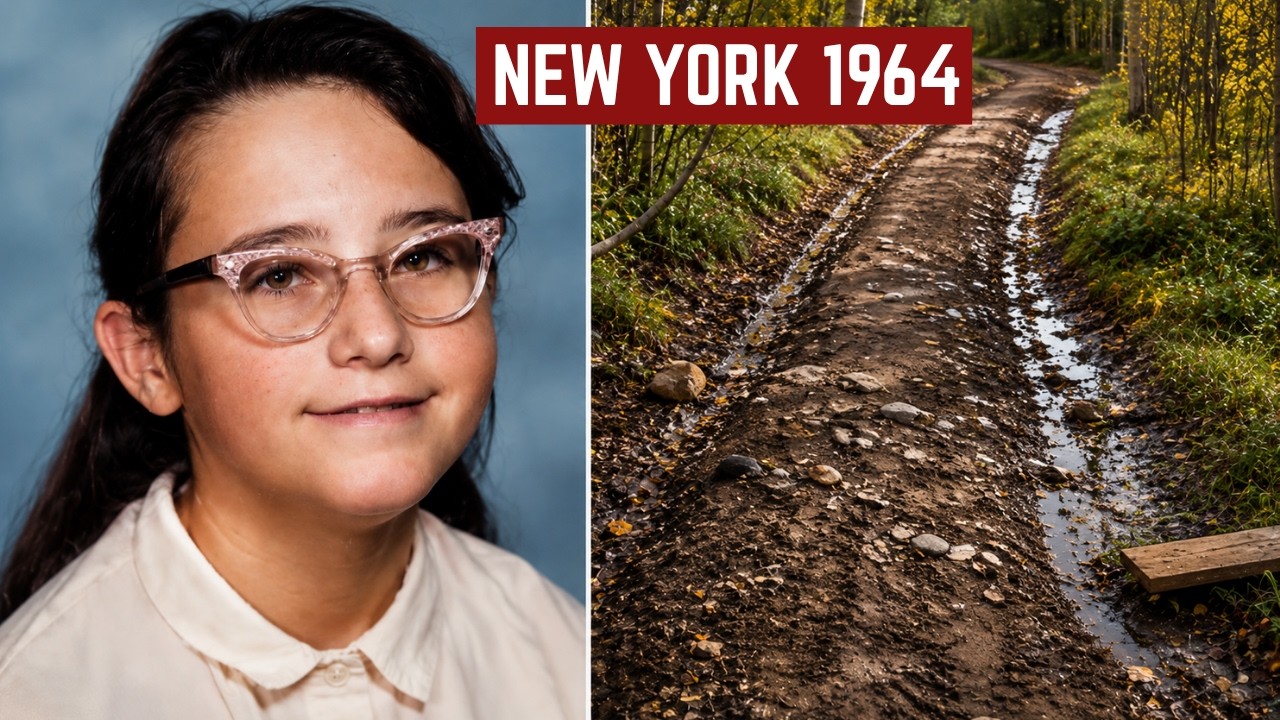
They believed his remains could finally answer a question the city had been asking since 1964. Who was responsible for the murder of 12-year-old Mary Theresa Simpson? Mary Theresa Simpson was born in Elmira, New York, in 1951. She grew up with her parents, Ellsworth and Rose Simpson, and three siblings.
In May 1963, her parents separated, and Mary went to live with her father on North Main Street. Family members remembered her as quiet and reserved with strangers. Among close family and friends, she was different. Energetic, cheerful, and full of life.
She was a Girl Scout, and her teachers remembered her as a dedicated and popular student. She took dance lessons with her sister Linda and spent summer afternoons on roller skates. Sunday, March 15, 1964, began as an ordinary day. Shortly after 3 p.
m. , Mary left her father’s apartment to visit relatives around Elmira. By early evening, she was heading home. Along the way, she stopped to say goodbye to two cousins and her aunt near a store in the neighborhood.
They were the last people who knew her to see her alive. Around 6:30 p. m. , a witness saw her near the intersection of East Market and Harriet Streets, walking in the direction of home.
After that moment, there were no more confirmed sightings. By 10:30 p. m. , Mary had not returned.
Her father called the Elmira Police Department to report her missing. The gap between that street corner and her doorstep remained the only information investigators had. Whatever happened to Mary Theresa Simpson occurred somewhere during those missing hours. Four days passed without a trace.
Then, on Thursday, March 19, 1964, a man searching a wooded area off Combs Hill Road in Southport, about seven miles from her home, made a horrifying discovery. Mary’s body was found partially hidden under branches and stones. A missing person case became a murder investigation. An autopsy determined that Mary had been strangled and assaulted.
Investigators concluded the attack occurred at or near the location where her body was found. The Elmira Police Department responded with everything it had. Officers canvassed the area around East Market and Harriet Streets, retracing the route Mary should have taken home. They interviewed relatives, neighbors, classmates, and anyone known to have been nearby that Sunday evening.
By October 1964, nearly 300 people had been interviewed. Despite the scale of the effort, no suspect emerged. There was no confession, no physical evidence clearly pointing to anyone. The case remained open, unsolved, without a suspect.
As the years passed, the investigation never officially closed, but progress stopped entirely. The local radio station WELM and the Elmira Star-Gazette offered a $1,000 reward for information leading to an arrest. No new leads emerged. Investigators continued working the case quietly, reviewing old statements and re-interviewing people whose accounts had changed over time.
By the early 2000s, the case file had grown to nearly 6,000 pages. Researchers from the Russell Sage College Criminal Investigation Resource Center, led by director Christina Lane, were brought in to organize and review the file page by page. Their work revealed gaps no one had realized existed. Some evidence had been sent for testing over the decades, but results had never been clearly recorded.
The review confirmed what investigators feared. The name they needed appeared nowhere. Yet another piece of evidence had remained in storage all that time, waiting for science to catch up. By 2003, forensic science had changed.
A preserved clipping of Mary’s clothing was sent to the New York State Police crime lab. Technicians found biological material that had survived for nearly 40 years. They extracted a DNA profile and entered it into CODIS, the national database used to match evidence against convicted offenders and known suspects. The search returned no results.
A second attempt in 2014 used newer technology focusing specifically on male DNA. The results were more precise, but again, no match was found. The problem was that database searches could only identify someone already in the system. If the man responsible had never been arrested or convicted of something requiring his DNA to be entered, there was nothing to compare against.
The answer would not come from a database at all. It would come from family. In 2022, Sergeant William Goodwin obtained a grant from the nonprofit Season of Justice and worked alongside the FBI to conduct a different kind of test. This was not another database search but a genetic genealogy profile designed to identify relatives rather than the man himself.
Genetic genealogy compares DNA against public genealogy databases built by ordinary people researching their family trees. If the man had never been caught, his family might still be findable. But very little sample remained, only about 0. 4 nanograms, an amount invisible to the naked eye.
DNA testing consumes the sample as it runs. There would be no second chance if this attempt failed. FBI Special Agent Kenneth Jensen packed the sample in dry ice and shipped it to Othram, a Texas laboratory specializing in building genetic profiles from extremely limited DNA. Then a snowstorm shut down the FedEx hub in Memphis, Tennessee, leaving the package stuck in a facility without power.
Jensen contacted FBI agents in Memphis. An agent searched the closed facility, found the package, and stored it in an FBI freezer until shipping resumed. The sample arrived in Texas intact. Othram analysts successfully built a usable genetic profile, something that had never existed for this case before.
The FBI began constructing family trees. Birth records, marriage records, and obituaries were all verified against age and location. The process took nearly three years. In 2025, the family tree work led investigators to a living man.
He was not a suspect. His significance came from something else entirely, the possibility that the unknown man behind Mary’s case was his biological father. Investigators approached him and explained why they needed his help. He agreed to provide a cheek swab.
The results confirmed a paternal relationship. The DNA found on Mary’s clothing belonged to this man’s biological father. That single result narrowed the search to one person. A local man in his early thirties at the time of the crime.
He had lived in Elmira his whole life. He worked, and he had started his own family. He had died in 2004, more than two decades earlier, long before DNA and genetic genealogy could link his name to a 12-year-old girl. He had never been interviewed.
He had never been listed as a suspect. He had never appeared once in 6,000 pages of police files. His name was Alfred Raymond Murray Jr. Murray was born in Elmira in 1931 and lived in the city for nearly his entire life.
He served in the United States Army during the Korean War. He worked as a truck driver. He was married with three children, and by 1964 he had two grandchildren. Old news archives suggested a connection to a prior case involving children from his teenage years.
When his identity was announced, police described his history as showing repeated involvement in offenses against children over the decades. Whether any of these allegations ever resulted in a conviction remains unclear. In November 2025, with a court order from Chemung County, the Elmira Police prepared to do something the department had never done in its history: exhume a grave for evidence. The National Center for Missing and Exploited Children helped fund the operation and brought in a certified forensic anthropologist from Detroit to oversee it.
Murray’s remains were carefully removed. Biological samples were collected at the site and sent to the New York State crime lab. There, technicians compared the new samples directly against the DNA profile preserved from Mary’s clothing since 1964. The results came back within weeks.
The DNA from Mary’s clothing matched Alfred Raymond Murray Jr. The probability of a coincidental match with an unrelated person was estimated at less than one in 320 billion. On February 10, 2026, the Elmira Police, the FBI, prosecutors, and members of Mary’s family gathered at the Chemung County District Attorney’s office. Police Chief Kristen Thorn addressed the gathering first.
She told reporters that investigators had taken the case as far as they could and formally named Alfred Raymond Murray Jr. as responsible for Mary Theresa Simpson’s death. The Elmira Police Department officially closed the case. Thorn also confirmed that if Murray were still alive, prosecutors would have intended to charge him with murder.
But he had died in 2004, more than two decades before his name was linked to the case. Investigators addressed a detail that had puzzled them from the start. No documented connection between Mary and Murray was ever found. No shared acquaintances, no prior contact.
Based on everything in the case file, they believed the attack was most likely a crime of opportunity. A stranger in the wrong place on an ordinary Sunday evening. Among those in the room that day was Mary’s sister, Linda Galpin, now 78 years old. Their mother, Rose, had died without ever knowing who was responsible.
After the announcement, Linda thanked the investigators for their work. She said she wished her mother had been in the room to hear it too. Some questions remain exactly where they were at the start. No one ever determined how Mary and Alfred Murray’s paths actually crossed on the evening of March 15, 1964.
The hours between her last sighting and her disappearance remain undocumented. Investigators now have a name, but they still do not have an account of what happened during those hours. The case shows why it took 62 years to reach even this point. In 1964, DNA did not exist as an investigative tool.
The genetic genealogy technique that finally solved this case has only existed for a few years, and it depended entirely on a relative choosing, for reasons unrelated to Mary, to take a DNA test. Without that decision, the case might still be stuck exactly where it was in 2014. A name cannot erase six decades of ignorance. It cannot let Mary’s parents hear the answer while they were alive.
But for the first time, the family finally had certainty. Elmira police confirmed that what may be one of the oldest murder cases in American history resolved through DNA had reached its end. For Linda Galpin, the announcement ended a wait of more than 60 years. She was 16 when her little sister disappeared.
After all that time, she finally learned the truth of what had happened to Mary Theresa Simpson.






