In the autumn of 1534, the sister of the Queen of England entered the royal court visibly pregnant by a husband no one knew existed. Within weeks she was banished, stripped of her inheritance, and crossed out of her family’s records as if she had never existed. History remembers Mary Boleyn as the foolish sister who slept with two kings and lost everything. But that disgrace is the only reason she kept her head, and her terrible reputation may have been the cruelest trick ever played on her.
She was born around 1499, most likely at Blickling Hall in Norfolk, into a family that treated social climbing as a full-time occupation. Her father, Thomas Boleyn, was one of the most influential figures of the Tudor age: a skilled diplomat, fluent in French, charming when it suited him, and never yielding. Her mother, Elizabeth Howard, was the daughter of the Earl of Surrey, which linked the Boleyns to the powerful Howard clan, one of the greatest noble families in England. In theory, it was a golden beginning.
In practice, the Boleyn household was run like a corporation, not a family. Children were investments. Daughters in particular were capital to be polished, displayed, and traded at the moment of maximum profit. That cold fact shaped every year of Mary’s life.
She grew up mainly at Hever Castle in Kent, alongside her brother George and her sister Anne. There are no precise records of her birth. Parish registers did not yet exist, but most modern historians believe Mary was the eldest. She received the usual education of a girl being prepared for court: reading, writing, French, music, dance, and the thousand small arts of courtly life.
Beyond that, her childhood seems a complete blank. That blank is significant. Of the three Boleyn children, Anne left letters and poems written in her honor, a tangible trace of her intelligence. George left letters and scandals.
Mary left almost nothing, save one important letter written in her own voice at the darkest moment of her life. Almost everything said about her came from the mouths of others, most of them hostile. Many wrote about her long after her death. One of them wrote a single sentence so poisonous that it branded her for five hundred years.
In 1514, Thomas Boleyn’s investment in his eldest daughter paid off. Mary, then about fifteen, was appointed a maid of honor to Princess Mary Tudor, Henry VIII’s younger sister, and sent to France for the princess’s wedding to King Louis XII. The bride was eighteen. The groom was fifty-two, suffering from gout, and seemed absolutely delighted.
He survived eighty-two days as a married man before dying on January 1, 1515. French gossip at the time joked that his teenage bride had danced him to his grave. The widowed princess remarried controversially, to her companion Charles Brandon, and sailed home. Mary Boleyn stayed in France for nearly five years.
She served at the French court under Queen Claude, the quiet, perpetually pregnant wife of the dazzling new king, Francis I. It was the most brilliant court in Europe and one of the most predatory. Here is what contemporary records say about Mary Boleyn’s conduct during those five years. Nothing.
Not a single account from the French court. Not a single letter from an ambassador. No record of payment, no complaint, no whisper of scandal from 1514 to 1519 mentions her at all. That silence would become crucial, because decades later someone would fill it with something ugly.
She returned to England by 1520, and on February 4 of that year she married William Carey in the royal chapel at Greenwich. Carey was a gentleman of the Privy Chamber, a rising young courtier, distantly related to the king, well-situated and well-liked. Henry VIII himself attended the wedding and made a modest gift. It was a respectable, useful, completely unremarkable marriage.
It did not remain unremarkable for long, because at some point during the following two years the king stopped looking at William Carey and began looking at William Carey’s wife. Around 1522, the date most historians agree upon, Mary Boleyn became Henry VIII’s mistress. There were no love letters. No court gossip survives from that exact moment.
Unlike Bessie Blount, the mistress who preceded her, Mary was not paraded publicly. The affair was conducted in almost total secrecy, which means its evidence comes not from romance but from accounting. Between 1522 and 1526, grants of offices, lands, and pensions rained down upon William Carey with suspicious generosity. That was the Tudor way of saying thank you, paid naturally to the husband.
How long the affair lasted, and what either of them felt, will probably never be known. What is certain is that it happened, because Henry himself confirmed it years later in the most damning way possible. When he decided to marry Mary’s sister Anne, he faced a legal problem. Under church law, sleeping with a sister made him effectively related to the other.
So in 1527 and 1528, his agents quietly sought a dispensation from the pope covering intimacy with the sister of his future bride. To marry Anne, Henry had to formally confess in writing to Rome what he had done with Mary. In 1533, when courtier George Throckmorton confronted him with rumors that he had meddled with Anne’s sister and mother, Henry replied sharply, “Never, not with them. ” He denied only the accusation he could deny.
The other charge he left standing. By that time, the affair had left its mark. Mary’s daughter Catherine was born around 1524. Her son Henry was born on March 4, 1526.
Both children arrived in timing that coincided perfectly with the royal affair. Both were legally legitimate. The whispers began early and never stopped. In 1535, a priest named John Hale confessed that a monk had once pointed out young Henry Carey as the king’s illegitimate son.
The boy’s name, after all, was Henry. But the king never acknowledged either child, with no title, no penny, nothing resembling the dukedom he lavished on the son of Bessie Blount. The paternity remains speculation to this day. No test was ever done, no evidence exists.
This creates one of the most astonishing ironies of the Tudor age: Henry VIII would soon tear England apart, break with Rome, and kill for a legitimate son, while a boy who may have carried his blood grew up before his eyes bearing another man’s name. Whatever the truth, by 1526 the king was finished with Mary. He had found someone new sitting at the same family dinner table, and Anne Boleyn was everything the court said she was. Mary was not sharp-witted, or magnetic, or ruthless in negotiation.
When Henry pursued Anne, she refused to become his mistress, and that refusal alone changed the course of European history. Mary was in the front row to witness her replacement. Then in June 1528, the sweating sickness swept through England, a terrifying disease so fast that contemporaries said a man could be merry at lunch and dead by dinner. On June 22 or 23, the illness took William Carey.
Mary was suddenly a widow at twenty-eight, with two small children, her husband’s debts, and no income. Now her family showed her their true value for her. Thomas Boleyn, the man who had profited from her marriage and profited again from her royal affair, refused to support his widowed daughter. Thomas Boleyn, the man who could turn a diplomatic banquet into a land grant, suddenly discovered he could not afford his own daughter.
It took the intervention of the King of England to rebuke him. Henry wrote to Anne, insisting that her father’s honor required him to shelter Mary, his own daughter as the king described her, in her great need. The pressure worked to a degree. An annual pension of one hundred pounds was arranged, passing through her father’s hands, and Anne was granted the wardship of little Henry Carey.
The arrangement was efficient and cruel in its silence. Mary’s own son legally belonged to her sister. Mary was now a dependent inside the machine her family was building, and that machine was about to reach the throne. The Boleyn rise was destructive in its speed.
In 1532, Mary accompanied the royal household to Calais for Anne’s semi-public debut as Henry’s future queen. In January 1533, Henry and Anne married in secret. That June, Anne was crowned Queen of England in a staggeringly expensive ceremony. Thomas Boleyn was now Earl of Wiltshire.
George sat at the heart of politics. Anne wore the crown. Mary, the eldest, the first, the one sent to France before Anne was anything at all, served in her younger sister’s household as a widowed lady-in-waiting on a pension. She was thirty-three, invisible, and entirely owned.
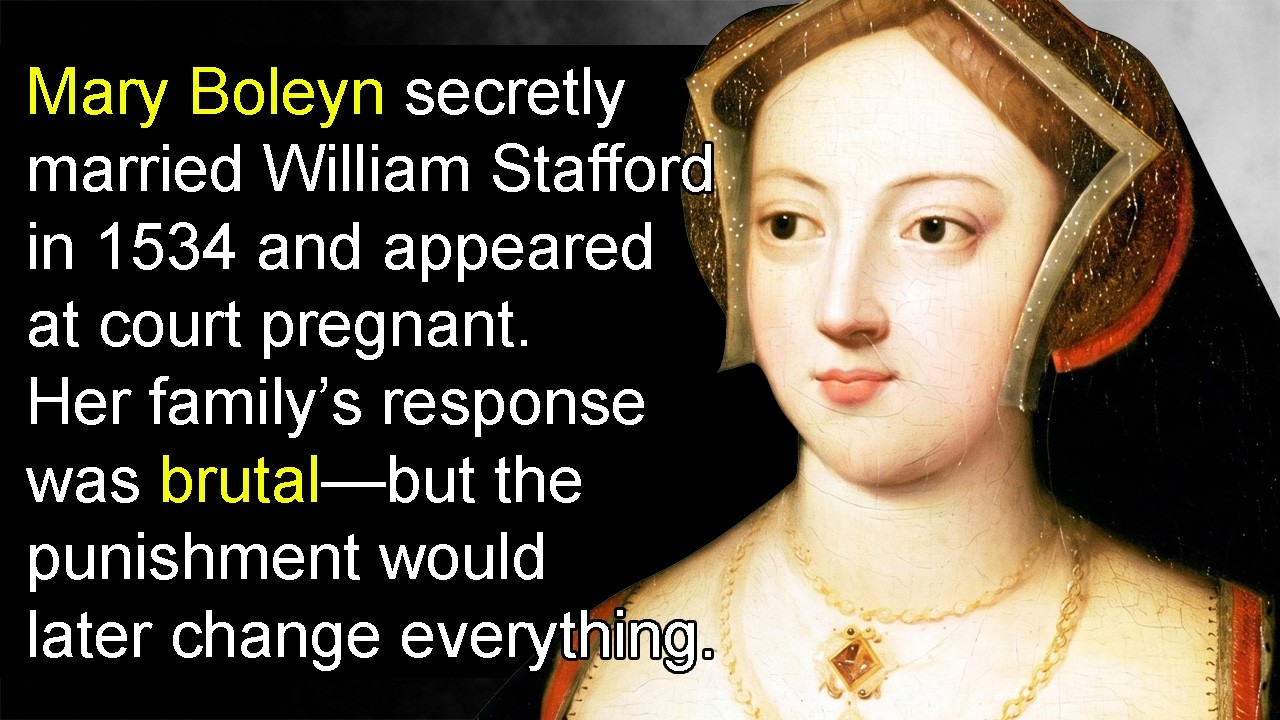
Then in 1534, she did the one thing no one in her family expected, and the one thing none of them would ever forgive. His name was William Stafford. He was a soldier in the Calais garrison, the younger son of a gentry family, about a decade her junior, without wealth, without title, without prospects worth mentioning. At some point that year, Mary married him secretly, without the king’s permission, without the queen’s permission, without her father’s permission.
A triple insult to the sister of a reigning queen whose marriage was a matter of state. The secret was kept until it became physically impossible to hide. Mary appeared at court visibly pregnant. The reaction was volcanic.
Henry was furious. Anne was said to be even angrier. Ambassador Chapuys recorded the fallout in his dispatches. Mary was banished from court.
Her father cut off her allowance entirely. The family that had built its glory on her body simply crossed her out. In a dynasty that had spent twenty years turning its daughters into titles and estates, Mary had committed the greatest treason. She had given herself away for free.
Her response survives. The one long document written in her own voice. Exiled and desperate, she wrote to Thomas Cromwell, the king’s chief minister, begging him to intervene. But the letter was not a plea at all.
She defended her husband’s honor. She admitted the marriage looked like madness. Then she wrote that she would rather beg her bread with him than be the greatest queen in the world. Read in light of what was coming, that sentence freezes the blood.
Her sister was the greatest queen in the Christian world. Mary was choosing bread. There is no evidence that Cromwell’s help, if it came at all, restored her position. She and Stafford vanished into the countryside, facing a life of real hardship.
Even if later legends exaggerated her poverty, her exile seemed the end of her story. The losing sister, drained and finally discarded. Eighteen months later, everything looked very different. In the spring of 1536, the Boleyn family was annihilated.
The speed of it still raises goosebumps. On May 2, Queen Anne was arrested and taken to the Tower, charged with adultery with multiple men and incest with her brother. The evidence was flimsy. The outcome was never in doubt.
On May 17, George Boleyn was beheaded on Tower Hill. Two days later, Anne knelt on the execution platform within the Tower walls, and a swordsman brought from Calais ended her life with a single stroke. In less than three weeks, the family project of twenty years ended in blood. Thomas Boleyn survived, but he was stripped of his offices and finished as a force.
Elizabeth Howard died less than two years later, in April 1538. Thomas followed in March 1539. As for Mary, nothing. She was not arrested.
Not questioned. Not summoned or mentioned or even noticed. No record places her anywhere near London that month. Not one surviving letter, petition, or recorded reaction.
She never spoke a single word about the slaughter of her sister and brother. The silence reads as heartbreaking or as pure survival instinct, depending on the observer. But the mechanics are undeniable. The exile of 1534, the shame, the poverty, the exclusion, had removed her from the blast zone before it detonated.
She was not at court to be accused or interrogated or dragged into the family wreckage. Every Boleyn who stayed at the family table died at it, or was destroyed beside it. The one thrown out the door was the only one left standing. Anne’s final insult had become an unintended mercy.
Mary’s shame was her shield. Her last years were quiet. The first years of her life that belonged to her alone. She lived with Stafford far from court.
Some genealogies suggest they had children, though the records are sparse and disputed. Then the deaths of her parents made the disowned daughter something no one had ever intended: the heiress. As the last surviving Boleyn sibling, Mary eventually stood as the sole heir to the family’s remaining wealth. On May 15, 1543, the crown formally granted Mary and William Stafford the rest of the Boleyn holdings in Essex, including Rochford Hall.
After a lifetime as an asset owned by others, Mary Boleyn finally possessed what remained of the family that had once possessed her. She had only nine weeks to enjoy it. On July 19, 1543, Mary died at forty-three or forty-four, most likely at Rochford. The cause of death was never recorded.
Neither was her burial place. To this day, no one knows where Mary Boleyn’s grave lies. The Tudor bureaucracy that processed her estate recorded her son’s age with minute precision, seventeen years, fifteen weeks, and five days, yet never bothered to note where her mother was laid in the earth. But the ending carries a strange, luminous tail.
Her daughter Catherine Carey became one of the closest and most trusted women in the court of Elizabeth I, Anne’s daughter. Her son Henry Carey was created Baron Hunsdon and served the queen for decades as a loyal kinsman. The children of the exiled sister flourished in the court of the daughter of the executed sister. The Boleyn blood that survived and thrived into the next reign was Mary’s.
But there was one last account to settle: the reputation itself. Because history does not remember Mary Boleyn as a survivor. It remembers her as a whore of two royal courts. The girl allegedly seduced and then crudely discarded by King Francis I of France.
The woman branded in the traditional translation as “a great and infamous whore. ” That label is the basis of every novel, every film, every sneering reference to the other Boleyn girl. So it is worth knowing where that label really comes from. It comes from a single letter.
A letter written on March 10, 1536, by Rodolfo Pio, a papal diplomat in France, a hostile Catholic agent writing at the height of England’s break with Rome, just weeks before Anne’s destruction, relaying a conversation with Francis by hearsay. He wrote it more than twenty years after Mary left France. He never met her. His letter is conclusively unreliable, containing outright errors about Anne’s last miscarriage.
Not a single source from Mary’s actual years in France, between 1514 and 1519, records any affair with Francis or any scandal at all. The silence about her youth was real. The shame was attached decades later. It may be even worse than that.
The infamous English phrasing was cemented by a nineteenth-century translation in the official State Papers. Alison Weir’s 2011 biography traced the distortion back to Pio’s letter, and in 2026 historian Sylvia Barbara Soberton re-examined the original Italian text, arguing that the passage merely refers to one of Anne’s sisters without naming Mary at all, and that the description was inflated in translation into her identity. Later polemicists such as Nicholas Sander added to the claims in 1585. A best-selling novel completed the job in 2001.
This places the real Mary Boleyn in a very different light. Not the scandal of two royal courts, but a woman whose reputation was retrospectively smeared by her family’s enemies to use as a weapon against her sister. A slander written when she was a worthless outcast, yet one that outlived her by five centuries. Mary Boleyn was punished in her lifetime for the one thing she actually did: marrying for love.
And history condemned her for something she may never have been at all. So the question divides cleanly in two. Was Mary Boleyn the Boleyn who lost the game, or the only player who understood the price of winning?
