The county clerk wrote Sally Crabtree’s page out in his neatest hand, and then somebody went back and tied it shut with string. Not torn out, not burned, just tied. The book still closed flat on the shelf, and a man reaching for it would feel the lump under his thumb and decide he had wanted a different volume after all. That page stayed tied for sixty-one years.
When it was finally cut open, the man who cut it said he wished he had left the string alone. It begins in a part of Missouri that the maps of the time barely bothered with, down in the southern hills where the rivers run clear and cold over gravel and the ridges fold up against each other so tight that the sun does not reach the bottoms until the morning is half gone. There was a settlement there called Six Mile, which was not a town so much as a store, a smithy, a meeting house, and a scatter of cabins thrown up wherever a man could find flat enough ground to stand a chimney. Six miles from the county seat, hence the name, though the road that connected them was the kind you measured in hours and not miles because of the fords and the mud and the way it climbed.
Up above Six Mile, following a thread of water they called the Naked Fork because nothing much grew along its banks, there was a hollow. The folks there called it Weather Hollow after the bellwether of a flock, the lead sheep, though nobody could tell you why a hollow with no sheep in it carried that name. It was a narrow place, steep on both sides, with timber coming down close to the water. Oaks and hickory so old and so thick that even at noon the light down there was the color of weak tea.
Cold, too. Colder than it had any right to be. A man would step off the ridge road into the head of that hollow and feel the temperature drop against his face like he had walked into a springhouse. In that hollow, in the autumn of 1884, lived a woman named Sally Crabtree.
Most of what people would later say about her was said after she was gone, and grief and fear reshape a person until you would not know them. This is how her neighbors knew her before any of it started. She was forty-one years old that autumn, a widow. Her husband, Dorsey Crabtree, had died four winters before, taken by a fever that swept the hollows one cold year.
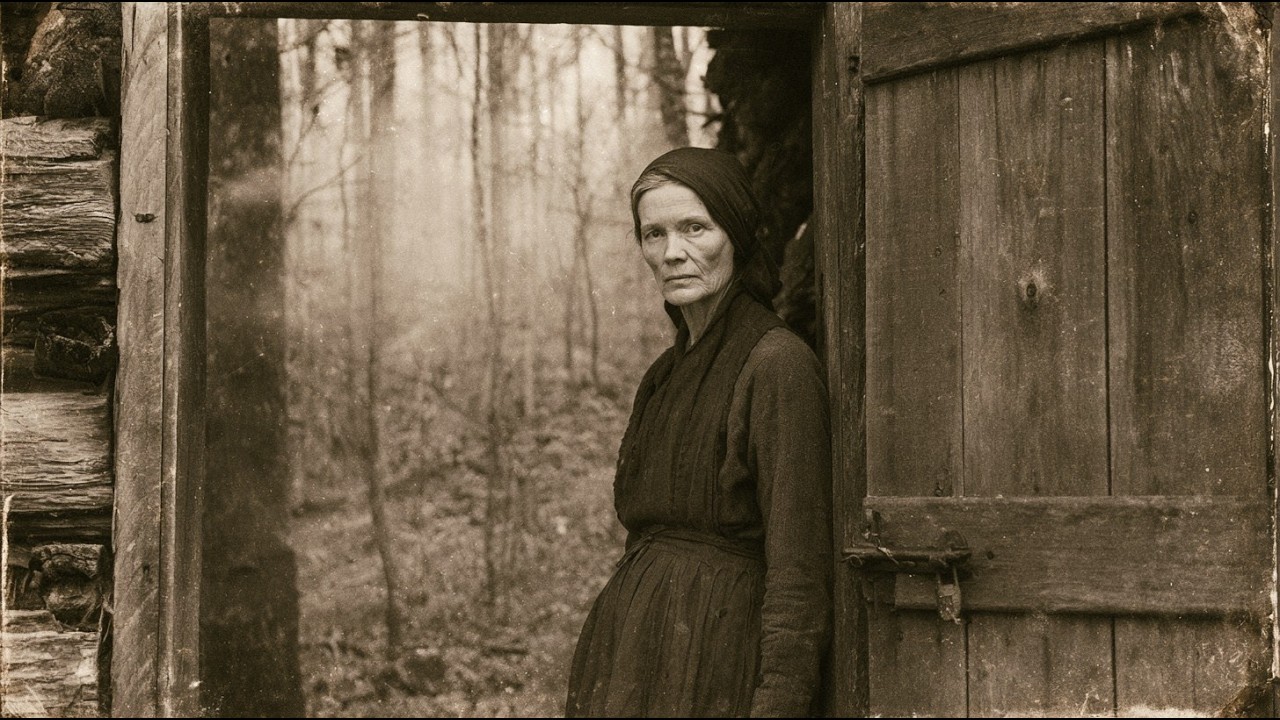
After he passed she stayed on alone in the cabin he built up at the deep end of Weather Hollow, where the water came out of the hillside in a little spring. She was not a large woman, but she was strong in the wrists and the back, the way women got who hauled their own water and split their own kindling. Her hair had gone gray early, the kind of gray that is nearly white, and she wore it pinned up tight under a dark cloth. Her face was long and weathered, and her eyes were a pale washed-out blue, the color the sky gets just before snow.
When she looked at you, the old-timer said, she looked at you a beat too long. Not unkindly. Just long enough that you started to wonder what she was seeing. Sally Crabtree was what the hill people called a yarb woman.
An herb woman. She knew which root to dig in which moon for which ailment, the bark that brought down a fever, the leaf that stopped a cut going sour, the bitter tea that eased a body’s pains when nothing else would. When a man up the Naked Fork took a chill that settled in his chest, his wife did not send for the doctor in the county seat, six muddy hours away and charging money nobody had. She sent for Sally Crabtree.
And Sally would come, walking out of that cold hollow with a basket over her arm, and more often than not the man would mend. So she was respected. She was not feared, not at first, not the way the stories would later have it. She was the woman you sent for.
And there was a strange double feeling that the hill folk had toward a woman like that. They were grateful to the one who knew the secret thing that saved them. And they were uneasy with them, too, for the very same reason. Because what kind of person learns the secret things?
What do you have to spend your nights doing to know the dark medicine the rest of us are glad we do not have to know? Sally kept to her hollow. People came to her or sent for her, and she helped them. They left gifts on her step, a sack of meal, a cured ham, a bolt of cloth, because she would not take money, saying money had a way of changing what the medicine was for.
The store at Six Mile was kept by a man named Elam Grimshaw, a heavy-set fellow with a bad hip and a careful way of talking. It is Elam Grimshaw’s account, written down years afterward, that gives us most of what we know about how the trouble started, because Elam was the first to notice that Sally Crabtree had stopped coming down. It was the back end of October, the leaves down, and Elam realized, standing in his store one gray afternoon, that he had not seen Sally Crabtree in three weeks. Ordinarily that would mean nothing.
She kept to herself in cold weather. But there had been a man up the fork, old Asbury Thorn, laid up with his lungs, and somebody had gone for Sally to come tend him, and she had not come. Somebody went a second time, and she had not come. That was not like her.
In four years she had never once failed to come when she was sent for. So Elam Grimshaw, on a raw afternoon with the light already going, closed up his store and walked the road up the Naked Fork to Weather Hollow to see about her. This is the first piece that does not sit right. As he came up the hollow toward her cabin, he could see smoke from her chimney, a good steady thread of smoke, the way a fire looks when it has been fed and banked properly and somebody is home tending it.
He was relieved. He called out to her from the path, the way you do so as not to come up on a body unannounced. He got no answer. He called again.
Nothing. When he came up into the dooryard, he saw that the smoke he had been watching the whole way up was coming from a fire laid in the yard, not the chimney. A fire of green wood, smoldering and wet, throwing up that thick gray smoke, built in the shape of a ring. A circle of stones, and inside the circle the smoldering wood, and inside that, set in the ash, things that Elam Grimshaw described in his account only as objects I did not care to name and will not.
He did not name them. In sixty years he never named them. The closest he ever came was to write that they were small and arranged and put me in mind of a person trying to keep something out or trying to keep something in and not being certain which. The cabin door stood open.
Sally was inside, sitting in her chair by a cold hearth with the door wide and the October air pouring in. When Elam stepped up onto the threshold, she turned her head and looked at him with those pale eyes, and said in a perfectly ordinary voice, “You ought not to have come up the hollow this late, Elam. It’s nearly dark. ”
He told her about Asbury Thorn, about the lungs, about how they had sent for her twice.
Sally Crabtree listened, and then she said the thing Elam Grimshaw carried with him to his grave. “I can’t come down anymore, Elam. It started following me when I come down, and I won’t lead it to other people’s doors. ”
Then she looked past him out the open door at the smoldering ring of smoke in her yard and the dark timber climbing up behind it, and said, quieter, “It’s most particular about the doors.
”
Elam Grimshaw was not a fanciful man. He kept a store. He weighed flour and extended credit and wrote his numbers in a straight column. He wrote years later that he stood on that threshold and felt the hair stand up all along his arms, and that for one moment, looking at the gray-haired woman in the chair and the cold hearth and the open door, he had the powerful and unreasoning sense that the two of them in that cabin were not alone.
That there was a third thing in the room. He could not have told you where. Behind the chair, maybe. In the loft, in the corner where the light did not reach.
He only knew, the way you know when somebody is standing behind you, that the room had one too many in it. He did not stay. He told her he was sorry, and he meant it, and he went back down the hollow in the failing light faster than his bad hip wanted to carry him. He wrote that the whole way down he did not look behind him, and that not looking behind him was the hardest walk of his life.
After Elam Grimshaw’s visit, the word went around Six Mile, low and quick, passed from porch to porch. Sally Crabtree had taken queer. Sally Crabtree would not come down. Sally Crabtree was burning fires in her yard and talking about a thing that followed her.
The hill folk did what hill folk do with a story like that. Some laughed, the young men mostly, who were brave in daylight. Some grew quiet and made sure their own doors latched. A few of the older women especially nodded as though this was a thing they had been half expecting, the way you nod when you hear that a sick old dog has finally died.
But there was one woman who did not laugh and did not nod. Her name was Verlie Ashmore, and she lived nearer to Weather Hollow than anyone, down at the mouth of it where the Naked Fork joined the bigger creek. She had been Sally Crabtree’s friend, as near to a friend as a yarb woman keeps. Verlie Ashmore was sixty-three that winter, a small straight-backed woman with knuckles swollen from years of work.
She did not hold with leaving a friend alone in a cold hollow when she had gone strange. So in the first week of November, Verlie Ashmore walked up to Sally’s cabin to sit with her. What Verlie found, she later told the constable, and her words were copied down. She found Sally thinner than she had been, gray in the face, not sleeping.
The cabin was clean the way it always was, but every window had been hung with dark cloth so that no light got in, and more to the point so that nothing could see in. There were lines of salt poured along every threshold and every sill. Sally Crabtree sat in her chair facing the door. She told Verlie Ashmore the whole of it in a calm and reasonable voice.
Verlie said that was the most frightening part, because a person raving you can dismiss, but a person calm you have to consider. Sally told her it had started in late summer. She had gone deep into the timber, farther than she usually went, up over the back of the ridge into a part of the woods the hill folk did not go into, looking for a particular root that grew only in the oldest and dampest ground. She found it and dug it, and on her way back out in the green dim under those old trees she heard something following her.
Not an animal. She knew every animal in those woods by its step and its breath. This was a step that tried to match her own, she said. When she walked, it walked.
When she stopped, after a half beat it stopped. She had never once seen it. No matter how fast she turned, she had only ever caught at the very edge of her eye the suggestion that something tall had just gone still behind a trunk that was not wide enough to hide it. She came home that day and thought little of it.
But it had followed her home. From that night on, it had been at the edge of her clearing every dusk. She could not see it, but she could feel the woods change when it arrived, the way a room changes when somebody comes into it. The birds would go quiet, the cold would deepen, and she would know it was there, just inside the tree line, watching her cabin, watching her door.
And it was learning. That was the thing she could not make Verlie understand, the thing that had her hanging cloth over the windows and pouring salt on the sills. Every night it came a little closer. The first nights it stayed up in the timber.
Then it came to the edge of the clearing, then to the woodpile. “And now,” she said, and here Verlie wrote that Sally’s calm voice did not change at all, which was somehow worse, “now it came up onto the step. ” Every night, just after full dark, she heard it come up onto the step and stand at her door, and she heard it try the latch. It can’t work a latch, Sally told her.
Not yet. Its hands aren’t right for it. But it’s studying on the latch, Verly. Every night it studies a little longer, and one of these nights it’s going to figure it out.
Verlie Ashmore did not run. She stayed the night. The two old women sat up together in that cabin with the dark cloth over the windows and the salt on the sills, a lamp burning low between them. Verlie Ashmore lived another nineteen years, and she would tell anyone who asked, until the day she died, that everything Sally Crabtree said came true that night.
Just after full dark, the woods went silent. The cold came down. Something heavy and slow came up the path and onto the step with a tread that was almost, but not quite, the tread of a person. It stood at the door, close, just on the other side of the boards, near enough that both women heard it breathing.
After a long while, a hand, or a thing like a hand, took hold of the latch and moved it up and down and up, patient, trying it, studying on it, just like Sally had said. Toward the gray of morning it went away. The birds came back, the cold lifted, and Verlie Ashmore went down out of that hollow on legs that would barely hold her. She went straight to the county seat, the full six muddy hours, to fetch the constable.
She had decided somewhere on that road that whatever was happening to Sally Crabtree, a man with a badge and a gun ought to be made to come and stand in that yard at dusk and see it for himself. The constable of that county was a man named Ambrose Teague. He was thirty-eight years old, lean and dark, an old soldier who had come west after the war with a limp and a reputation for not scaring easy. The records make clear he did not believe one word of Verlie Ashmore’s story.
He thought it was an old woman gone simple in a lonesome hollow, and another old woman who had sat up all night and spooked herself. He resented the long ride. But Ambrose Teague was a conscientious man in his way, and a woman alone and unwell up a hollow was technically his business. So in the third week of November 1884, Constable Ambrose Teague rode up the Naked Fork to Weather Hollow to look in on Sally Crabtree.
What he wrote in his report over the next several days is the heart of this story. It is the part that got the string tied around the page. He found her as Verlie had described. The cloth on the windows, the salt on the sills, the thin gray sleepless woman in the chair by the door.
He questioned her. He wrote that she answered every question plainly and sanely except for the matter of the thing in the woods, on which she was immovable and entirely calm. He examined the ground around the cabin for tracks, thinking to find a bear or a panther or a man playing a cruel trick. Here is the first line in Ambrose Teague’s report that the later clerk underlined twice.
He wrote that he found tracks on the step and the path, and that he could not account for them. They were deep, he wrote, the depth of a heavy man or a heavier animal, but they were not the tracks of any man or animal he knew. They had the rough shape of a bare human foot, but too long and too narrow, with the toes too many and set wrong. The impression of the heel was scarcely there at all, as though the weight came down forward on the front of the foot, the way a man’s would if he walked always on the point of pouncing.
He was a practical man, and a practical man confronted with something he cannot explain will sit up and wait for the explanation to arrive. So he decided he would stay the night. He would sit up in that cabin with the woman and her salt and her dark windows. When the bear or the trickster came around to frighten her, he, Ambrose Teague, would step out onto that step with his pistol and his lantern and put an end to it.
He wrote down with the flat confidence of a man who has not yet learned better, “I anticipate this matter will resolve itself by morning. ”
It did not resolve itself by morning. There is a particular quality to the handwriting of a man whose mind is changing as he writes. The early pages of Ambrose Teague’s report are written in a firm, even soldierly hand.
The later pages are not. They get smaller and crowd up against each other, the lines run uphill, and in two places the pen has dug clean through the paper. This was a hard man, a man who had seen a war, and the war did not put that into his handwriting. This did.
He wrote that just after full dark, exactly as the women had said, the woods went silent. Every insect, every settling bird gone quiet at once, as though a hand had been laid over the mouth of the whole hollow. Then the cold. He wrote that the temperature in the cabin dropped so fast that the breath came visible from their mouths, though the fire was built up high.
Sally Crabtree did not so much as turn her head. She only said, “Lo, it’s come. ”
Then the step. The slow, heavy, almost right tread coming up the path onto the step, the standing, the breathing on the far side of the door.
Ambrose Teague was a brave man, and he did the brave thing, the thing he had come to do. He stood up, took his lantern in one hand and his pistol in the other, and against Sally Crabtree’s whispered warning, he threw the latch and pulled open the door to confront whatever stood on the other side of it. There was nothing there. The step was empty.
The dooryard was empty. The lantern light fell on bare cold ground and the black wall of the timber beyond. But Ambrose Teague wrote that he stood in that open doorway with the cold pouring over him, and he knew, the way Elam Grimshaw had known weeks before, that the thing was there. It was standing in the dooryard six feet from him, exactly where the lantern light was, and the lantern light was simply going through the place where it stood and falling on the ground behind it, as though nothing were in the way.
He could not see it. But he could feel the weight of its attention turn from the door, where it had been fixed, to him, where he now stood. He wrote this line, the line I think about more than any other. “I have been looked at by men who meant to kill me.
This was not that. This was the way a man looks at a door he intends to learn to open. ”
Then Sally Crabtree took hold of his coat from behind and pulled him back inside hard, slammed the door, threw the latch, and stood with her back against it. The two of them listened as the thing on the other side, which they could not see, took hold of the latch and moved it up and down, up and down, patient, studying.
Ambrose Teague, the old soldier, sat down in the chair by the cold hearth and did not get up again until the gray of morning. He wrote that he prayed, which he had not done since the war, and that he did not feel it helped. He stayed three more days. Some of what he wrote in those three days about the nights, about the breathing that began to take on the shape of words it could not quite form, about the morning he found that the salt on the sill had been disturbed and a single long, narrow, wrong-toed track pressed into the dirt of the cabin floor just inside the door, three inches past the salt line — some of that does no good to anyone to hear.
But his conclusion is the thing the county could not abide, the thing that got the page tied shut. He concluded that Sally Crabtree was telling the truth. That there was in fact a thing in Weather Hollow, that it had followed her home from the deep timber, that it was real enough to leave tracks and chill the air and move a latch, and that it was slowly and methodically, like a patient man learning a craft, teaching itself how to get through her door. And he concluded in the last clear lines he ever wrote on the matter that the only mercy in the situation was that it was slow.
That whatever it was, it did things at the pace of seasons, not of nights, and that this gave them time. He wrote that he intended to bring Sally Crabtree down out of that hollow, by force if he had to, and lodge her somewhere with people and lamplight and locked doors and distance between her and that timber. He believed, he hoped, that if you took the woman far enough from the hollow, the thing would lose her trail. He was wrong about the time.
He thought it was slow. He thought he had until spring, maybe, before it learned the latch. He did not know that the thing had been learning faster than any of them understood, that it had only seemed slow because it was being careful, the way a thing is careful when it is close to getting what it wants and does not wish to spoil it by haste. He rode down out of the hollow on the fourth morning to fetch a wagon and another man, because you do not move an unwilling woman six muddy hours alone.
He was gone, by the wagon’s account, eleven hours. He came back up the Naked Fork in the dark with a hired man named Lonzo Pruitt and a wagon and a horse. They came up into the dooryard of Sally Crabtree’s cabin near midnight, and the door of the cabin stood open. The door stood open, and the salt across the threshold was swept back in a long smear, as though something had stood at the open door and brushed it aside with the side of its foot, almost idly, the way you would brush aside a thing that had finally stopped mattering.
Ambrose Teague and Lonzo Pruitt went into that cabin with their lanterns. What they found, Ambrose Teague did not describe. Not in his report, not ever, to anyone. He wrote one line.
“The condition of the cabin was such that I sent Pruitt to wait by the wagon. And what I saw within, I will carry alone, and I will not set it down for the sake of those who loved her, and for the sake of my own remaining nights. ”
That is all. The man who had written pages and pages, who had described the tracks and the cold and the breathing, came to the one room and the one thing he was sent to find, and he laid down his pen and would not.
Sally Crabtree was never seen again, not living, not otherwise. There was no funeral because there was nothing the men of Six Mile were willing to bury. The few who came up to that cabin in the days after to help Ambrose Teague nail the door shut and pile the windows over came down again, gray-faced and silent, and never spoke of it for the rest of their lives. Verlie Ashmore was not permitted to go up.
Ambrose Teague rode the six hours to her house to tell her himself. He stood on her porch with his hat in his hands, and the only thing he would say to her was, “She kept it from your door, Verly. To the last she kept it from coming to other people’s doors. You ought to know she managed that much.
”
Then he rode away. Verlie Ashmore sat down on her porch step and wept, she said, not only for grief, but because she understood, finally and fully, what her friend had been doing all those weeks alone in the cold with the cloth on the windows and the salt on the sills. She had not been protecting herself. She had been the door it wanted.
And she had stayed where she was and not let it down among the rest of them on purpose. Most tellings of the Sally Crabtree story stop there. But the matter did not end with the open door and the swept salt and the thing in the cabin that Ambrose Teague would not describe. It got worse afterward, and it got worse in a way that is harder to bear than anything before it.
It is the reason that page got tied shut sixty-one years instead of merely being forgotten. Ambrose Teague nailed the cabin shut and warned the people of Six Mile away from Weather Hollow. For a while they kept away. But you cannot keep people out of a hollow forever.
There is timber up there and a spring and good bottom ground, and a few years is all it takes for a hard story to soften into a tall tale that the young men dare each other over. By the late 1880s, folks were going up the Naked Fork again, hunting, fetching wood, courting in the cool of the bottoms. What they began to report, the thing that filled the rest of that tied-shut page, was this. The thing did not leave when Sally Crabtree was taken.
It was still up there in Weather Hollow, but it had changed. It no longer hid at the edge of the timber and followed people at the corner of the eye. Now, the report said, it came to your door. Anyone’s door.
Any cabin in or near that hollow on certain still nights would hear, just after full dark, a slow, heavy, almost right tread come up onto the step. It would stand at the door. It would breathe on the far side of the boards. And then it would take hold of the latch, and it would work it up and down, and the latch would lift.
Because it had learned. It had spent those patient weeks at Sally Crabtree’s door studying. Sally Crabtree had kept it occupied with her own door precisely, so that it would not learn on anyone else’s. Now that she was gone, it knew.
It carried the knowledge with it. It could open a door now. Any door. It had learned the latch.
The people of that hollow for years afterward began to do a thing that the constable’s report records in its very last lines, a thing Ambrose Teague himself instructed them in before he gave up his badge and moved away from that county and out of the record altogether. They began to bar their doors at night with a length of timber. Not a latch. Latches it knew.
A bar set in iron brackets that no working of a latch could lift. And they began to do the other thing, the thing the old folks in that part of the Ozarks would do for two full generations after and never quite explain to outsiders. When they heard the tread on the step after full dark and heard the latch begin to lift, they did not answer. They did not speak.
They did not, whatever they did, open the door. They sat still and waited and let it study the bar it could not solve. After a long while, it would go away. In the morning, they would find sometimes a single long narrow wrong-toed track pressed into the dirt of the step.
Ambrose Teague’s report ends with the bar and the silence and the instruction never to open the door. Then there is the clerk’s later note, the note from the man who tied the string, written in a different ink in 1891. It says only this: “Sealed by order. This account being of no use to the living and of considerable harm to their peace.
Let those who must go up the Naked Fork bar their doors and keep their counsel. The rest need not know. ”
So the string was tied and the book closed flat on the shelf. Sally Crabtree slid out of the county’s official memory and into the kind of story that grandmothers tell with the lamp turned low.
The story of the gray woman who lived up Weather Hollow and kept the thing at her own door so it would not come to yours. Who in the end was taken through that door. Whose great and terrible kindness was that she taught it patience at her own threshold so that it would learn slowly when it could have learned fast. The man who finally cut that string open wished he had left it alone.
He was the county historian who went through those old sealed pages in the 1940s, a careful and skeptical man who did not believe in any of it. He cut the string and read Ambrose Teague’s report and Verlie Ashmore’s deposition and Elam Grimshaw’s account. He wrote in a letter, now itself part of the dossier, that he had read the whole thing through twice and could explain none of it. What disturbed him was not the impossibility of it, but the consistency.
Three witnesses, he wrote, of different temperaments in different years, none of whom could have read the others’ words, all describing the same wrong-toed track, the same studied latch, the same cold, the same patient and learning thing. He wrote one more thing at the very bottom of his letter, almost as an afterthought. He wrote that on the night he finished reading the report alone in his house in the county seat, the modern county seat, with electric light and a paved road outside and the twentieth century all around him, he had heard, just after full dark, a slow heavy tread come up onto his porch and stop at his door. He sat very still in his chair and told himself it was a stray dog, a settling house, the wind.
After a while he heard, distinctly, the handle of his door turn once. He did not get up. He did not answer. He did not open it.
In the morning there was nothing on the porch at all, no track, no sign, nothing. He told himself the whole thing was the fancy of a tired man who had been reading frightening papers too late. He believed that, he wrote. He mostly believed that.
But he never read those papers again. He tied the string back on himself with his own hands, put the book back on the shelf, and wrote at the bottom of his letter, “I do not say it followed the account out of the hollow. I do not say a thing learns a latch and then learns a doorknob and then learns to find the man who reads about it. I do not say any of that.
I only say that I bar my door now, where I never used to, and that I do not answer it after dark, and that I would advise anyone who reads this to do the same. And I am aware of how that sounds, and I no longer care. ”
The cabin is long gone. The hollow is on no map you can buy.
But the Naked Fork still runs cold and clear over its gravel somewhere down in those Missouri hills, and the timber at the head of that hollow is older now than it was then, and darker. I have never been able to find out whether the people who live nearest to it still bar their doors at night. I suspect they do.
