The men who worked the Amethyst Mine knew a particular kind of silence. It was not the silence of a quiet room or a still night. It was the silence of two thousand feet of continental rock held in suspension above a man’s head, a silence that pressed in from every direction and told him exactly how thin was the margin between the air in his lungs and the stone that surrounded the tunnel carrying it down to him. The miners went into those shafts every morning anyway, because the silver was there, and the silver was money, and money was the reason everything in their world ran.
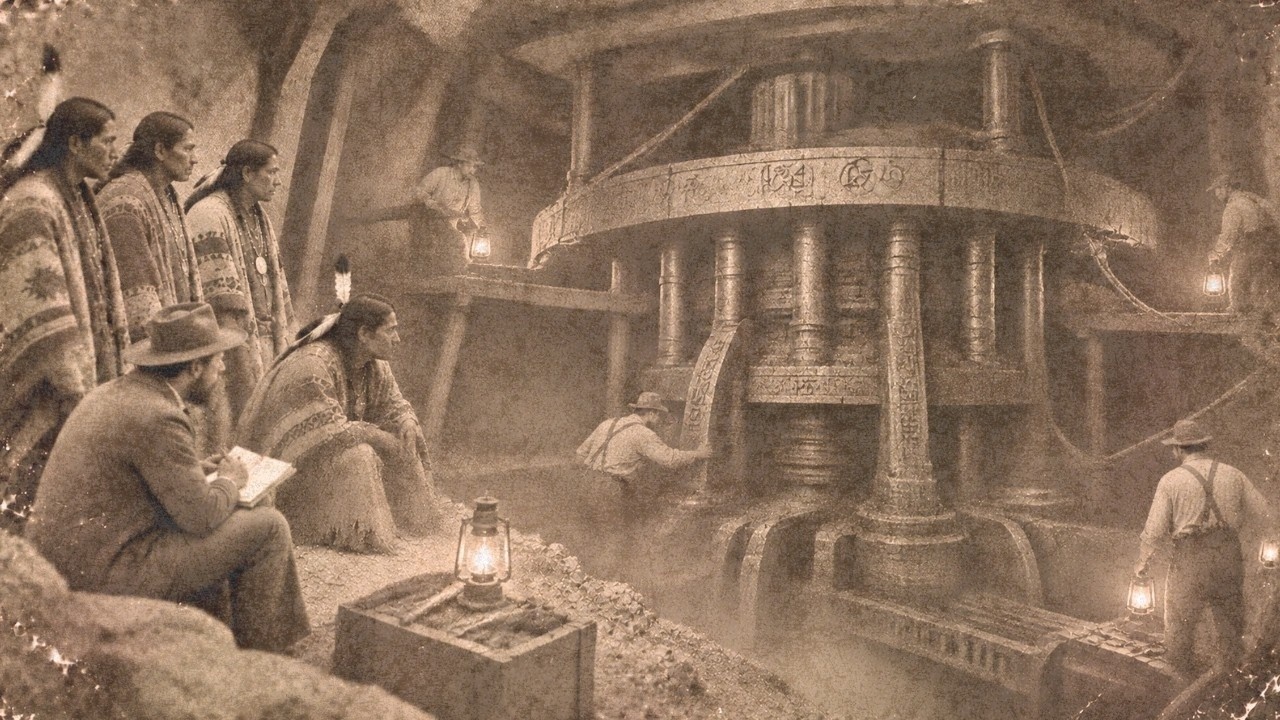
What they did not know in the autumn of 1903 was what waited at the bottom of the number four shaft on the south extension of the Amethyst vein. What they found there, and what was done afterward to ensure that very few people would ever learn of it, has circulated in pieces for more than a century. In the mining towns of southern Colorado, in the back rooms of assay offices, in the long silences of men who came home from certain shafts and never spoke of what they had seen, portions of it survived. A single letter written by a mineralogist from the Colorado School of Mines, sent to a colleague in Edinburgh and never answered, preserved more of it.
The notes of a county surveyor who in 1872 made a mark on a clay map he never explained, and who died the following spring before anyone thought to ask him, preserved a small cryptic fragment. Taken together, these pieces describe something that should not have been possible. Creede sits at the northern end of Mineral County, Colorado, in a canyon so narrow and steep that when the silver rush hit in 1890, the men who came had nowhere to put their buildings but in a single line along the creek. The canyon walls press in so close on both sides that in winter the sun reaches the valley floor for only a few hours, and the rest of the time the town sits in cold blue shadow at the base of cliffs rising nearly a thousand feet above the rooflines.
The ore beneath them was extraordinary. The Amethyst load ran silver in concentrations that left assayers writing cautious reports, then revising their caution upward when the second test confirmed the first. In the best years of the early nineties, the mines of the Creede district produced something in the range of ten million ounces of silver annually, putting this narrow canyon in the company of Leadville, the Comstock, and Tombstone. The crash came in 1893, when Congress repealed the Sherman Silver Purchase Act and the price dropped by roughly half overnight.
The large companies survived by cutting wages and running deeper into the mountain, searching for ore grades rich enough to justify reduced returns. By 1903, the number four shaft of the Amethyst had gone deeper than any other working in the district. It had passed through the levels earlier miners had developed, through the stopes where the first generation of Creede men had torn out the bonanza ore, through intermediate levels where the Denver company had spent five years chasing lean veins, and into ground that no human instrument had ever touched. The shift foreman at that depth is referred to in the surviving accounts only by his initial.
The letter from the Colorado School of Mines mineralogist calls him C and says only that he was a man of thirty years in hard rock mining who had worked shafts in Nevada and Arizona before coming to the Colorado camps. His name does not appear in any company payroll record researchers have been able to locate, which is not in itself unusual, since many Creede mining records from the early 1900s were lost in the fire of 1910 that destroyed much of the county courthouse. But the absence of his name in every surviving record from that period is something the mineralogist’s letter touches on obliquely, saying only that after the autumn of 1903, C was not seen again in any mining camp in Colorado. That disappearance did not happen at once.
It happened gradually, over weeks. He stopped speaking about the lower levels, then stopped speaking about anything that had happened in the shaft after September. One morning he was not at the cage when the morning shift went down, and the boarding house keeper said his room had been cleaned out, not hurriedly but carefully, as if by a man who had decided something and taken his time executing it. He left nothing behind.
He said goodbye to no one. But in the weeks before he left, he talked to the mineralogist. To understand what the finding meant, one must understand where Creede sits in the geology of that part of the world, because the geology is not ordinary. Beneath southern Colorado lies not a simple intrusion or a local hotspot but a catastrophic volcanic system, the remnant of supervolcanic eruptions that covered tens of thousands of square miles with ash and left collapsed calderas across a region that dwarfs every volcanic event in the recorded human past.
The nearest modern comparison is Yellowstone, and the Creede caldera complex makes Yellowstone look modest. The eruptions happened between twenty-six and twenty-eight million years ago. What followed was collapse, the crust above the emptied magma chambers sinking inward in great circular depressions. It is in the ring structures at the margins of those collapsed calderas that the mineral-rich hydrothermal fluids rose and deposited the silver the miners came to find.
The Amethyst vein sits in a resurgent ring fracture that runs deep, all the way down to where the old heat still lives in the rock. At fourteen hundred feet below the collar of the shaft, deeper than any working in the district had previously gone, the fracture widened in a way geologists described as anomalous, a zone where the fracture walls spread apart more than simple thermal expansion could account for. In this widened zone, the silver values that had been declining with depth reversed sharply. The ore grade went up, not down, which was unusual enough to notice.
But what C’s crew noticed first was not the ore grade. It was the shape of the widening, because the widening was not random, as fracture widening in response to tectonic stress usually is. It followed a geometry. It expanded on a plan, as if what had widened it was not pressure from below but removal from within.
As if the space had been made, not found. When C’s crew pushed the last broken rock out of the way and held their lamps into the opening, the walls of that space were dressed. The mineralogist’s letter takes considerable care to be precise. He had spoken with three of C’s crew separately, without telling any of them what the others had said.
The details they gave him matched in every significant particular. The walls of the room were not the raw fractured face that drill and shot leave behind. They had been worked. The working predated any contact with the mining company, predated any previous human activity at the location, predated, by the evidence of mineral accretion on the worked surfaces, any contact with any human hand within a time frame the mineralogist was not comfortable specifying in the letter.
The accretion was calcite. Calcite deposits on cave and mine walls at measurable rates under known conditions. The mineralogist took samples from the worked surfaces and comparative samples from the raw fracture walls nearby, formed in the same geological event and exposed to the same environment for the same length of time. The comparative samples showed a thin calcite film consistent with expected accumulation over the known age of the fracture.
The samples from the worked surfaces showed a calcite film of greater thickness by a factor his calculations placed at a minimum of several times the comparative sample, and at a maximum he declined to write down. He checked his calculations three times and wished his equipment were better. The room was larger than any account he had previously encountered on the subject. C’s crew determined from careful pacing that it ran roughly forty feet across at its widest point and rose to a ceiling at least twenty feet above the floor.
A spirit level set down in three places on that floor showed the bubble perfectly centered each time. The ceiling was vaulted in a manner C could not find a comparison for, following a geometry that seemed to shift subtly depending on where in the room you stood when you looked up at it. The surface was finished to the same quality as the walls, smooth enough to reflect lamplight back with a faint gloss, and it bore markings in a different arrangement from anything the accounts he had heard described, covering greater area, executed with a fineness that made previous descriptions sound imprecise. In the center of the room, on a raised section of floor, were the platforms.
Two of them, parallel, separated by a channel approximately eighteen inches wide that ran between them and terminated in conduits cut into the floor, going down into the rock below the level of the room. Each platform rose about two feet above the level floor and bore on its upper surface a mounting system of recesses and channels designed to secure what rested on them in precise alignment. The machines were similar to what earlier accounts from the San Juan country described, but not identical. Cylindrical at their core, made of a metallic substance that shifted in color depending on the angle of the light—gray in direct illumination, pulling toward blue at the edges, showing in certain angles something close to iridescence—and cold to the touch in a fashion that went a degree or two beyond what the surrounding rock temperature should have produced.
Where they departed from previous descriptions was in scale. These were larger, each standing close to eight feet at its highest point, and they were connected not by any mechanism of joining a mining man would have recognized, but by a formation of the same material as the machines themselves that bridged the channel between the platforms and linked the two devices at approximately midsection, in a structure that appeared to grow out of both of them simultaneously rather than being attached to either one as a secondary element. The bridge was thicker at the points of connection and thinner at its center, and its surface bore the same ridges and channels running across the outer faces of the machines, continuing without interruption from one device across the span and into the other, as if the whole assembly were a single object expressed in two forms joined by something in between. What distinguished this find from the accounts of the first was evidence of use.
In the San Juan stories of what men found in a chamber in the mountains to the south, there was no suggestion that the machine had ever been operated. It was dormant, intact, apparently functional, but inactive, waiting. Its surfaces showed no mark of operation, no residue, no thermal change, no sign that whatever it was designed to do had ever been done in the time the mountain held it. The machines in the Creede room were different.
C noticed it first on the second day, when light from multiple lamps was better distributed and the men could examine the surfaces more carefully. On the outer cylinders of both machines, in zones corresponding roughly to areas where the internal architecture was most densely arranged, the surface showed discoloration—not the uniform gray-blue of the rest of the material, but a deepening of the color into something darker and more complex, with an iridescence more pronounced here than elsewhere. The mineralogist, who saw it himself the following week, said it was the visual signature of sustained thermal exposure, not heat in the ordinary sense, not the blackening or oxidation fire leaves on metal, but something more controlled, more directional, as if whatever had produced the thermal change had been focused rather than diffuse, internal rather than applied from outside. The platforms beneath the machines showed it too.
The recesses and channels holding the devices in alignment were darker than the surrounding stone, in a pattern tracing precisely the edges where the machines made contact with the platform. The calcite sampling the mineralogist performed on the platform surfaces showed the same deep accretion as the worked walls of the room. Whatever had produced those thermal marks had done so in the same deep past that produced everything else in the chamber. The channel between the platforms showed the most striking evidence of all.
The channel floor was darker throughout its length, a shade the mineralogist’s letter described as charcoal gray verging toward black in the zones directly below where the connecting bridge passed over it. Its surface was pitted, small uniform pits distributed across the channel floor in a pattern dense at both ends, where the conduits went down, and sparser in the middle. The mineralogist took a sample of the channel floor material and spent three days examining it before writing that the pitting was consistent with what he had previously seen in laboratory settings when certain materials were subjected to sustained exposure to a high-energy field. He declined to specify what kind of field.
He said his instruments were not adequate to the question, and that the instruments adequate to it, as far as he knew, did not yet exist. Every surface in the room bore markings—the walls, the ceiling, the platforms, the outer surfaces of the machines, the connecting bridge. Three distinct systems of marking were present, each in different zones of the room, each following its own internal logic. The mineralogist copied every mark he could reach, filling a notebook sent to Edinburgh with the letter.
That notebook has not come to light in any archive or private collection. One system was composed of geometric forms organized hierarchically, larger forms containing smaller, the smallest containing smaller still, in a nesting arrangement his charcoal copy failed to capture because the finest elements were smaller than his medium could render. A second system used notational marks whose organization resembled numerical or sequential notation, with density increasing toward the floor. The third, appearing only in a narrow band at mid-height running continuously around all four walls and across the face of the connecting bridge, he could not categorize.
He wrote that it was unlike anything he had seen in any library, museum, or collection of ancient script samples. He described looking at it as recognizing something you have never seen. He sent the letter on a Tuesday. On Thursday morning, the company superintendent arrived at the mine without prior notice from Denver.
His name is preserved in the payroll records that survived the courthouse fire. He was called Alden Hoy, and before Creede he had managed operations for the same Denver partnership at two other Colorado properties and one in Nevada. He had not visited the Creede operation in fourteen months prior to that Thursday morning. He arrived by the morning stage from Wagon Wheel Gap and went directly from the stage office to the mine collar, without stopping at the company offices in town.
He spent the remainder of that day underground. The mineralogist, who encountered him at the shaft collar in the late afternoon, said the superintendent’s expression when he emerged was one he found difficult to characterize. Not the expression of a man who had been frightened. The expression of a man who had expected exactly what he found and was now calculating what to do about it.
At supper that evening, the mineralogist asked the superintendent directly what he intended to do about the room and the machines. Hoy said the question was above his level and that he had sent a telegraph that afternoon to Denver. He then asked how many people the mineralogist had spoken with. The mineralogist said he had spoken with C and three crew members, and his own cook.
Hoy asked whether he had written to anyone. The mineralogist said he had written to a colleague in Edinburgh. Hoy nodded and said nothing more on the subject. In the morning, two men arrived who had not come on the regular stage.
The mineralogist mentions them only briefly, noting their arrival and saying they were not introduced to him by name or position and volunteered nothing about themselves. They went underground with Hoy that morning and did not come back up until afternoon. One of them carried a leather case of the kind used for surveying instruments. That afternoon, Hoy informed the day shift that the number four shaft would be temporarily suspended pending a review of the lower level structural integrity.
On Friday evening, a man came to the mineralogist’s room at the boarding house and knocked. The mineralogist’s description of this visitor is spare. A man of perhaps fifty, in a dark suit that had seen some travel. He asked whether he might sit down.
They sat across a small table. The visitor said he understood the mineralogist had submitted professional reports on the ore grade anomaly. The mineralogist confirmed this. The visitor then said, with no change in tone, that the mineralogist’s further observations on any other aspects of his time at the mine were a matter of some sensitivity, and that if those observations had been written down, it would be appreciated if he would consider the disposition carefully.
The mineralogist asked who he was speaking for. The visitor said he was speaking for interests that preferred not to be named. The mineralogist asked whether that included the government. The visitor said the interests he represented were of a nature that did not fit neatly into the categories of government and private enterprise as those categories were commonly understood.
The mineralogist asked what specifically the visitor wanted him to do. He said he wanted only to make sure the mineralogist understood that his professional reputation and his continued employment at the Colorado School of Mines were things the interests he represented were in a position to affect. He said this in the same quiet tone as everything else. Then he stood, thanked the mineralogist for his time, and left.
The mineralogist sat at the small table for a while. Then he finished writing the letter to Edinburgh. Within two weeks of Hoy’s arrival, the water management system of the Amethyst Mine was modified. This was done not by the regular maintenance crew but by a team brought in from outside, identified in the single surviving work order as a contractor from Pueblo.
The modification redirected a substantial portion of the mine water being pumped from the lower levels. After the modification, that water instead drained back into the lower levels of the number four shaft. The rate of drainage was calibrated, the work order shows, to fill the lower level at a controlled rate rather than all at once. By the end of November, the water table in the lower shaft had risen to a point that made the room inaccessible without equipment the mine did not possess.
By the spring of 1904, the lower two levels were entirely submerged. They have remained submerged to this day. The county surveyor’s mark is perhaps the most unsettling element of what little evidence this story leaves behind. In the autumn of 1872, when the first prospectors were beginning to work the Creede district in a serious way, a county surveyor named Amos Crane was contracted to establish the legal boundaries of several claims in the area that would eventually become the Amethyst load.
His survey records for the 1872 season are models of the profession—precise, annotated in clear handwriting, the corners well described, the bearings accurately run. On the page covering the south extension of what would become the Amethyst claim, in the section where he describes the subsurface character of the ground as he understood it from surface evidence, Crane made a notation in the margin that does not appear on any other survey he produced. A small cross, drawn in a deliberate and careful hand, with two letters beside it. LD, which in the surveying convention of the period stood for locus depressus, a Latin phrase meaning depressed location or low point.
Surveyors used the notation occasionally to mark surface depressions that had structural significance. There is no surface depression at the location the cross marks. There never has been, so far as any subsequent survey has recorded. The location it marks, plotted against later surveys of the same ground, corresponds to a point on the surface directly above the room in the number four shaft, within a margin of error well within what a skilled surveyor of 1872 could have achieved if he knew exactly where he wanted to place his mark.
Crane died in the spring of 1873, six months after he made the mark, of an illness the territorial records describe as a winter fever. He left no papers and no estate of consequence, and nothing is known of his life before his arrival in Colorado. Step back and consider what the Creede events suggest when laid alongside what the San Juan accounts described four years earlier. Two separate discoveries in two separate mountain ranges, each involving a chamber below the working levels of a mine that no previous human activity had reached, each containing machines of unknown material and complexity, and each followed by the same swift suppression.
The men were silenced or disappeared. The physical evidence was sealed in one case with rock, in the other with water. The official record was quietly emptied of any trace. The suppression was not clumsy.
It was organized, quickly executed, and apparently coordinated between entities at the mine level and entities above—entities with the authority to redirect mine infrastructure and the capacity to produce men in dark suits who arrived without introduction and spoke in the language of professional consequences. There is also the matter of the Jesuit. He arrived on a Saturday. He was not sent for.
He came on the same stage from Wagon Wheel Gap that ordinary travelers used, took a room at the same boarding house where the mineralogist was staying, and introduced himself as a traveling priest making his way through the mountain parishes of southern Colorado. He carried a single bag and a breviary, ate his meals in the common room, and spoke pleasantly to whoever sat near him. He came to the mineralogist’s table after supper. He was perhaps sixty years old, soft-voiced, with a kind of stillness about him that was not passivity.
He said, in a tone that was not quite a question, that the mountains of Colorado had a way of producing unusual findings in deep rock. He said he had been traveling in the mountains of the West for thirty years, serving parishes and passing through mining camps, and in that time had heard, in confession and in private conversation, accounts of things found deep in the earth that did not correspond to any category of ordinary geological discovery. What was consistent across all of them, more consistent even than the physical descriptions, was what happened afterward: the finding was suppressed, the men were silenced, and a particular kind of person whose relationship to any named institution was always ambiguous arrived to manage the situation before it could become public knowledge. The mineralogist asked whether the priest was describing his situation specifically.
The priest said he was describing a pattern observed over thirty years that had led him, after much thought and prayer, to a conclusion he had found difficult to reconcile with a theology he had been trained in but could no longer find a way around. He did not say what the conclusion was. When pressed, he said only that the earth was older than the church thought it was, and that the things built in the earth before the church existed were older than the church found comfortable, and that the discomfort of the church was one of several forces that had organized itself over a very long time around ensuring those things remained unknown to the general population. When the hour was up, the priest said he would be continuing on his journey in the morning, and that he hoped the mineralogist’s letter to Edinburgh would find its recipient in good health.
The mineralogist had not told him about the letter. He had told no one in Creede except his cook. In the morning, the priest was gone, and the boarding house keeper said he had left before first light on foot, going north, which was not the direction of the stage road. The mineralogist’s letter does not speculate on who the priest was, or how he had known about the letter.
It simply records what was said and moves on. In the final paragraphs, the register shifts from careful professional neutrality to something closer to honest uncertainty. He writes that his professional training has made him resistant to reasoning that moves from a striking finding to a sweeping explanation without establishing every step in between. He writes that he has attempted to find an explanation for what he saw in the number four shaft that stays inside the boundaries of what is commonly understood about the age of human civilization, and that he has not been able to do it.
The thermal evidence on the machines, he writes, is not ambiguous. Something generated and directed heat in a controlled manner using those devices in that room before a date his calculations placed well outside any period in which any known human civilization could have done so. The channel between the platforms and the conduits descending from it suggests the process was directional, downward into the rock beneath the chamber. Two machines linked together and oriented downward into rock connected to an active caldera system, with evidence of sustained previous operation, constitute a description of something that was not decorative, not symbolic, not ceremonial.
Whatever the machines were, they were working devices that had worked. He does not complete the next sentence. What keeps him from dismissing it, he writes, is the existence of the channel and the conduit, because a decorative object does not need a drain, and a drain descending into the deep rock of a caldera region carries an implication he cannot dismiss, regardless of how much professional prudence argues for dismissing it. Consider what the deepening shafts were passing through when they broke into that room.
The ore being chased was deposited by hydrothermal fluids circulating through fractures left by the caldera eruptions of twenty-six to twenty-eight million years ago. The machines, by the mineralogist’s calcite calculation, predated any human civilization with a conventionally recognized history. Whether they predated the silver that surrounded them, whether they antedated even the volcanic events that formed the mountains above them, is a question the calcite sampling cannot answer with precision. What the calculation establishes is a minimum age.
The actual age could be considerably greater. If the machines predate the silver, they predate the eruptions. If they predate the eruptions, they predate the mountains in their present form. They were placed in ground that was, at the time of their placement, not the ground it would become, in anticipation of a geological future their makers understood.
The question of who those entities were, and how they came to move so efficiently in two separate locations within four years, is one this story does not answer. What the documents together require is that something happened in the number four shaft significant enough to bring an unannounced superintendent from Denver, an outside contracting team from Pueblo, two men with surveying instruments, and a man in a dark suit with the authority to threaten a researcher from the Colorado School of Mines, all within the space of a week, and to result in the deliberate flooding of the mine’s deepest level within a month. That is a great deal of response to a minor structural anomaly in a silver mine. Disproportion is the evidence that remains when everything else is accounted for.
It does not prove the machines. It proves the response. The response is documented. The Amethyst Mine sits behind its gate in the canyon above Creede.
The water in the lower levels has not moved in any direction worth measuring for decades. The cold of that water at fourteen hundred feet is the cold of a place where time moves differently than it does on the surface, where a hundred years is an interval so small it leaves no mark on the stone that holds it. The machines are there in that cold, if the mineralogist’s account is accurate, and the calcite that was already thick on their surfaces when the miners found them has continued to deposit micron by micron, sealing the evidence of what they did a little more completely with every passing year. The connecting bridge still links them.
The channel still runs between the platforms. The conduits still descend into the warm fractured rock below, connected by fracture systems to a magmatic source that has been quiet for millions of years but has not, by any geological measure, decided to be quiet permanently. Whatever the machines were listening for, or working toward, or doing, they have the patience for a very long wait. They had it before the mountains above them existed.
They have demonstrated that patience through everything since. The water in the shaft, the silence, the gate, the decades of no one coming—none of it has changed the problem they represent. None of it has answered the mineralogist’s unfinished sentence. The mountains hold what they hold.
The cold water holds what the mountains put in it. And the question that the shift foreman C, and the mineralogist from the Colorado School of Mines, and the Jesuit who left before first light all found themselves unable to answer, the question that Amos Crane knew enough to mark on a map in 1872 without ever being able to explain it, is the same question it was when the first lamp went into that room and lit the two machines waiting in the places they had been built to wait in. It is still waiting, too.
