On the night of November 7th, 1974, a Ford Corsair linked to Lord Lucan was found abandoned on Norman Road in New Haven, with blood stains inside and a lead pipe in the boot. It belonged to Richard John Bingham, the seventh Earl of Lucan, a man who had just walked out of a scene of unimaginable savagery in Belgravia and vanished. Behind him lay a bludgeoned nanny stuffed into a mail sack and a wife screaming for her life. Ahead of him lay a silence that has lasted half a century.
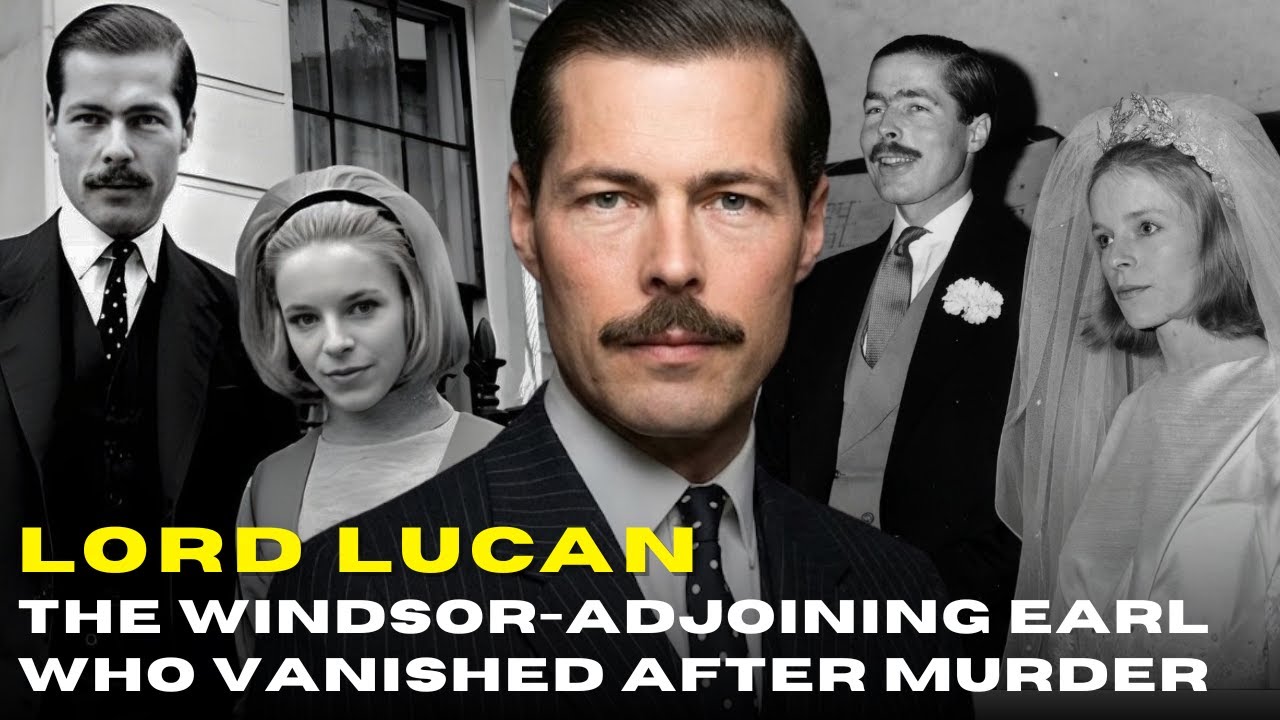
It is the ultimate ghost story of the British aristocracy, the tale of a man accused of murder, shaped by privilege and a sense of entitlement. Did Lucky Lucan commit the perfect crime and live out his days under an African sun? Or did the cold waters of New Haven finally claim the man who thought he was untouchable? The tragedy of Richard John Bingham is often painted as a sudden explosion of madness, but it was in truth a slow, methodical collapse.
It is a story about the brittleness of the British upper class in the face of the modern world. Lucan was a man built for a century that had already passed. He was raised to believe that his will was law, that his lineage provided a natural immunity to the consequences that befell ordinary men. When the modern world, in the form of a divorce court, refused to bow to him, he shattered.
The violence that was to come was not a crime of passion in the traditional sense. It was an act of corrective enforcement. In his warped mind, he was not planning a murder. He was planning a restoration of the natural order.
He believed he was the victim. On the eve of the attack, Lucan moved within the Clermont set he was known for. While events were already accelerating toward disaster, they saw Lucky Lucan, the good loser. They did not see the man who had already mentally crossed the line from aristocrat to executioner.
They did not know that the next hand he played would be written in blood. The 7th of November 1974 arrived in London with the damp, bone-chilling greyness typical of a British autumn. It was a Thursday, a day that should have been utterly unremarkable. In the grand houses of Belgravia, nannies were pushing prams through the mist of Eaton Square.
Milk bottles were rattling on doorsteps and black taxis were ferrying the masters of the universe to the city. But at 46 Lower Belgrave Street, the atmosphere was different. The air inside the tall white stucco house was heavy with the invisible static of a family under siege. For Sandra Rivett, the 29-year-old nanny, this Thursday was supposed to be a night of freedom.
It was a night she might otherwise have spent out. She had a boyfriend, John Hankins, a cab driver she was deeply fond of, and usually Thursday nights were reserved for him. A few drinks at the pub, a laugh, a moment to forget the tension of the Lucan household. But Sandra was tired.
She had been working in the household only a short time. The shadow of the earl, the silent phone calls, the weeping of the countess, it all took a toll. On a whim, a fatal tragic whim, Sandra decided to change her plans. It was a mundane choice, the kind we all make a thousand times in a life.
But for Sandra Rivett, this simple decision to stay home was a death sentence. Across the city in the sterile bachelor silence of his flat at 5 Eaton Row, Lord Lucan was preparing for a very different kind of evening. He was not a man prone to whims. He was a creature of rigid habit.
But today the routine was broken. He had spent the morning making phone calls, organizing his affairs with a strange, detached finality. He had lunched at the Clermont, but he hadn’t lingered over the port. He was a man moving through the steps of a procedure, cold and methodical.
He had acquired a car, not his own Mercedes, which was as recognizable in Belgravia as the number 11 bus, but a nondescript, dirty Ford Corsair, borrowed from a friend, Michael Stoop. He had told Stoop he needed it because his own car was having battery trouble. A lie, but a plausible one. In the boot were items later linked to the attack, including a heavy canvas bag and a length of lead piping wrapped for grip.
The pipe had been wrapped in tape to improve grip. A smooth lead pipe becomes slippery when wet with blood. The tape provided a grip. It was the thinking of a pragmatic man, not a maniac.
As evening fell, darkness swallowed the streets of London. Inside number 46, domesticity reigned. The children were put to bed. Veronica and Sandra sat in the first-floor drawing room, the television flickering in the corner.
They were an odd pair, the aristocrat and the working-class girl, but they were bonded by the strange besieged fortress they lived in. Around 8:55 p. m. , the thirst for a cup of tea, the most British of impulses, set the tragedy in motion.
“I’ll go down and make it,” Sandra said, standing up. She gathered the empty cups. “Would you? ” Veronica replied.
“Thank you. ” Those were likely the last words Sandra Rivett ever heard. She walked out of the drawing room and began the descent. The kitchen was in the basement, reached by a steep, narrow flight of stairs that plunged down into the bowels of the house.
As she descended, she would have noticed that the basement was unusually dark. Usually, a light would be left on, but tonight it was pitch black. Lucan was waiting. He had let himself in with his key, the key he had sworn to the courts he had lost.
He stood in the shadows, breathing shallowly, the lead pipe heavy in his gloved hand. He was waiting for a woman of a certain height, a certain build. He was waiting for the mother of his children. But in the gloom, shapes are deceptive.
Sandra Rivett and Veronica Lucan were roughly the same height. They both had short hair. As Sandra reached the bottom of the stairs and stepped into the kitchen, carrying the tray of cups, she was just a silhouette to the predator in the corner. The violence was immediate and catastrophic.
Lucan struck. He didn’t speak. He didn’t hesitate. He swung the lead pipe with the full force of a man fueled by years of suppressed rage and entitlement.
The blow struck Sandra on the head. She collapsed instantly, the cups shattering on the linoleum floor, but he didn’t stop. The post-mortem described multiple blows consistent with a sustained assault. He bludgeoned her until she stopped moving, until the only sound in the basement was his own ragged breathing and the ticking of the kitchen clock.
He began the next phase of the plan. He had to dispose of the body. He grabbed the canvas mail sack. He began to fold the broken body of the young nanny into the bag.
It was a gruesome, difficult task. Upstairs on the first floor, Veronica Lucan glanced at the clock. It had been ten minutes, maybe fifteen. Making tea didn’t take this long.
A prickle of unease, cold and sharp, ran down her spine. The silence from downstairs was absolute. No clinking of spoons, no running water. “Sandra,” she called out.
Silence. Veronica stood up. She was wearing a dress and heels. She walked to the top of the stairs.
“Sandra, are you all right? ” Still nothing. The silence was thick, heavy, vibrating with a wrongness she couldn’t articulate. Driven by a mixture of irritation and worry, Veronica began to walk down the stairs.
As she descended into the gloom, she called out again, “Sandra. ”
She reached the bottom of the stairs. The darkness was total. She sensed movement before she saw it.
A shadow detached itself from the deeper shadows. “Sandra,” she said, her voice trembling. The shadow lunged. The blow caught her on the forehead, splitting the skin, sending blood pouring into her eyes.
Veronica screamed. It was a scream of pure primal terror. She fell back, dazed, but she didn’t lose consciousness. The adrenaline of survival flooded her system.
She realized with a horror that defied sanity that she was being murdered in her own home. Lucan struck again. “Shut up,” he hissed. It was the voice of her husband.
The realization must have been more shattering than the blow itself. It wasn’t a burglar. It wasn’t a stranger. It was John.
It was the father of her children, the man she had vacationed with in Monte Carlo, the man she had loved. He was trying to beat her brains in with a pipe. Veronica Lucan fought back. She was small.
She was injured. She was blinded by blood. But she fought. She grabbed at him.
They wrestled in the dark, slipping on the blood-slicked floor. She could smell the sweat and stale tobacco on him. In the desperate close-quarter struggle, she managed to get her hand between his legs. She grabbed his genitals and twisted with every ounce of strength she possessed.
Lucan gasped. The pain broke his frenzy. He pulled back, panting. The violence stopped as abruptly as it had begun.
For a moment, they stood there in the dark, two ghosts in a ruined marriage, surrounded by the smell of blood. “John,” she gasped, her voice ragged. “Don’t, don’t hurt me. ”
The rage seemed to drain out of him, replaced by a surreal, exhausted pragmatism.
He sounded almost bored, or perhaps in shock. “I’m not going to hurt you,” he muttered, though the pipe was still in his hand. Veronica, with a psychological acuity that saved her life, realized she could not outrun him. Not yet.
She had to outthink him. She had to de-escalate. “Where is Sandra? ” she asked.
She’s dead, Lucan said. He said it flatly, as if commenting on the weather. I’ve killed her. She’s in the sack.
The horror of that sentence surely nearly broke her, but she held on. She knew that if she screamed again, she would join Sandra in a sack. She switched tactics. She appealed to his warped logic.
“I can help you,” she whispered. “We can, we can work this out, but I need to clean my face. I’m bleeding. ”
Lucan hesitated.
The adrenaline was fading, leaving him confused. The plan had gone wrong. He had killed the wrong woman. The right woman was standing in front of him, offering to help.
His rigid gambler’s mind couldn’t calculate the odds of this new scenario quickly enough. “All right,” he said. “Go upstairs. ”
They walked up the stairs together.
It was a macabre procession, the murderer and his victim walking up the carpeted steps of their family home. They went into the ground-floor cloakroom. Veronica looked in the mirror. Her face was a mask of crimson.
The cuts were deep. She needed a towel. “I’ll get a towel from the bedroom,” she said. Lucan stood in the doorway, the pipe still in his hand, watching her.
He was dazed, perhaps running through the options. Kill her now, but the noise, the neighbors. “Don’t scream,” he warned her. “I won’t,” she promised.
“I’ll just get a towel. ”
She walked into the bedroom. She could hear him breathing behind her. She knew this was the only chance she would ever get.
If she let him think, if she let him regain his composure, he would finish the job. He had to kill her. She was the witness. “I’m just going to wet a towel,” she said.
She moved towards the bathroom, pretending she needed to wet a towel, but she didn’t look in the mirror. Instead, seizing the brief moment of separation as he hesitated, she bolted. She turned and ran for the front door with the desperation of a hunted animal. She fumbled with the latch, her blood-slicked fingers slipping on the brass.
Open. Please God, open. The door gave way. The cold night air hit her face.
She burst out onto Lower Belgrave Street. She didn’t look back. She ran toward the lights of the Plumber’s Arms pub on the corner. She was screaming now, a raw guttural sound that tore through the polite silence of Belgravia.
“Murder! Murder! He’s murdering me! ”
Inside the Plumber’s Arms, the regulars were nursing their pints.
The atmosphere was warm, smoky, safe. Then the door crashed open. A woman stood there, her clothes torn, her face a mask of blood, her eyes wide with a terror that no one in that room had ever seen before. “Help me,” she shrieked, collapsing onto the floor.
“My children, save my children. He’s in the house. ”
Back at number 46, Lord Lucan stood in the hallway. He heard the door slam.
He heard the screams fading down the street. He knew with the cold certainty of a man who has bet everything on red and watched the ball land on black that it was over. He didn’t chase her. There was no point.
The police would be there in minutes. The plan lay in ruins. Sandra Rivett was dead in the basement. Veronica was alive and screaming his name to the world.
He made no move to go upstairs to check on his children, sleeping in their beds, unaware that their father had just become a monster. He didn’t pack a bag. He simply turned around, walked out of the front door, and climbed into the dirty Ford Corsair parked on the street. He turned the key.
The engine coughed to life. Lord Lucan pulled away from the curb, driving slowly, calmly, away from the wreckage of his life. He drove past the Plumber’s Arms where his wife was currently being tended to by shocked strangers. He didn’t look.
He drove into the night, a man who had ceased to be an earl and had become a phantom. In the chaos of Lord Lucan’s flight and the media storm that would follow, it is easy to forget the body in the basement. Sandra Rivett was not a player in the high-stakes games of the Clermont set. She was not a countess with a title to protect.
She was a young woman who loved life, who worried about her son, who was looking forward to a future with her boyfriend. She died in the dark, terrified and alone, bludgeoned by a man who didn’t even know who she was. Lucan didn’t kill Sandra Rivett because he hated her. He killed her because she was in the way.
To him, she was collateral damage, a variable he hadn’t accounted for in his grand equation. As the police sirens began to wail in the distance, converging on Belgravia, Sandra lay silent in the canvas sack, the teacups shattered around her. She was the first victim of Lord Lucan’s arrogance, but she would not be the last. The tragedy of that Thursday night was absolute, but the mystery was just beginning.
The Ford Corsair was moving south, carrying a man who was already disappearing mile by mile into the fog of legend. The drive from Belgravia to the sleepy town of Uckfield in East Sussex is roughly 42 miles. In a modern car on modern roads, it takes perhaps an hour. On the night of November 7th, 1974, in a battered Ford Corsair with a sluggish engine, it would have taken longer for the man behind the wheel.
It must have felt like a lifetime. Lord Lucan drove south. He left behind the wailing sirens of London, the blood-soaked basement, and the wife screaming in the pub. He drove into the black, silent countryside of the Weald.
The plan, the perfect, logical, necessary plan, had disintegrated into a bloody farce. He had killed the wrong woman. He had let the witness escape. He was no longer the master of his destiny.
He was a fugitive. Yet as he drove, a strange and terrifying composure seemed to settle over him. Lucan was a gambler. He knew that when the hand is lost, panic is useless.
You do not flip the table. You calculate the remaining moves. And as he steered the car through the dark lanes of Sussex, he began to construct the narrative that would protect his legacy, if not his life. He began to build the lie.
At approximately 11:30 p. m. , the Ford Corsair pulled into the driveway of a large, comfortable house called the Grants. This was the home of Ian and Susan Maxwell-Scott, old friends from the high-society set.
Ian was away, but Susan was home. She answered the door to find Lord Lucan standing there. He was dishevelled. His hair was messy, which was uncharacteristic, and there was a wet patch on his trousers, likely blood that he had tried to sponge off, but his manner was startlingly normal.
“Hello, Susan,” he said. “I’m in a terrible mess. ”
Susan Maxwell-Scott invited him in. She did not know that a murder had taken place in London.
She did not know that every police officer in the capital was currently looking for the man standing in her hallway. She simply saw a friend in distress. She led him into the drawing room, lit the fire, and poured him a scotch and water. Lucan sat down.
He took a drink, and then with the calmness of a man recounting a minor traffic accident, he told her the story he had concocted during the drive. “I was walking past the house,” he began. He claimed that he had been passing 46 Lower Belgrave Street and had glanced through the basement window. He said he saw a man attacking Veronica.
He claimed he had let himself in with his key, rushed down the stairs, and scared the intruder off. He admitted he had slipped in a pool of blood. He admitted that Veronica was injured. But then he said the hysteria took over.
He claimed Veronica in her madness had started screaming that he had done it. Realizing that she would never be believed and that he, the hated husband, would be framed, he had panicked and fled. It was a preposterous story. It relied on a series of impossible coincidences.
Why was he walking past the house with a piece of lead pipe in his car? Why did the intruder vanish without a trace? Why did he flee if he was the hero? But Susan Maxwell-Scott listened.
She was a woman of her class and generation, conditioned to trust the word of a peer of the realm. She didn’t press him. She offered him sympathy. But Lucan knew the story wouldn’t hold up in court.
He wasn’t telling it to convince a jury. He was telling it to convince his world. He was setting the record straight for the Clermont set. He wanted to ensure that when the news broke, his friends would say, “Poor John, he tried to save her, and that mad woman blamed him.
”
After the story was told, Lucan asked for a pen and paper. He sat at a small writing desk in the Maxwell-Scott’s drawing room. The house was quiet. The fire crackled in the grate.
Outside, the wind was picking up. That night, Lucan wrote letters explaining his version of events, including one addressed to his brother-in-law, Bill Shand Kidd. These documents are the most chilling artifacts of the entire affair. They are not the scribblings of a maniac.
They are the precise, arrogant, and delusional justifications of a man who believes he is the victim of a cosmic injustice. In the first letter, he repeated the intruder lie. But then the mask of the hero slipped and the cold pragmatist emerged. “The circumstantial evidence against me is strong in that V says it was me,” he wrote.
“V has demonstrated her hatred for me in the past and would do anything to see me accused. ” He continued, writing the sentence that has haunted investigators for 50 years: “I will lie doggo for a while. ”
Lie doggo. It is an old-fashioned public school phrase meaning to hide, to stay quiet, to go to ground.
It suggests a temporary state. It suggests a man who thinks he can wait out a murder charge in a country cottage until the heat dies down. Or perhaps it meant something more permanent. But the most disturbing aspect of the letters is what is missing.
There is no mention of Sandra Rivett. He had just bludgeoned a young woman to death a few hours earlier. He had stuffed her body into a sack. Yet in his final correspondence, she does not warrant a single word of regret, pity, or even acknowledgement.
To Lucan, Sandra Rivett was not a human being. She was merely a prop in the tragedy of his own life, a regrettable complication. His focus remained entirely on himself, his children, and his hatred for Veronica. In the second letter, the financial reality of his ruin bled onto the page.
He wrote about the sale of the family silver at Christie’s. He gave instructions on which creditors to pay. Even on the precipice of oblivion, he was worried about his standing as a gentleman who pays his gambling debts. He asked Bill Shand Kidd to look after the children, to ensure they were raised with the right values.
Values that evidently included the belief that their mother was a monster. “When they finish with my wife,” he wrote, “I will be condemned. ” This line is the key to his psyche. He wasn’t afraid of justice.
He was afraid of judgment. He knew that a trial would drag the Lucan name through the mud. It would expose his bankruptcy, his cruelty, his failures. He would be stripped of his dignity.
And for a man like Lucan, dignity was worth more than life itself. He finished writing in the early hours of Friday, November 8th. He sealed the envelopes. He stood up.
Susan Maxwell-Scott asked him what he intended to do. “I must get back,” he said vaguely. “I must sort things out. ” He didn’t say where he was going.
He walked out into the cold night. He climbed back into the Ford Corsair. The engine turned over. He drove down the driveway of the Grants and turned onto the road.
Susan Maxwell-Scott watched the tail lights disappear into the darkness. She was the last credible witness to see Richard John Bingham alive. Lucan drove south again. He was heading for the coast.
He drove towards Newhaven, a ferry port that offered a gateway to France. At some point in the early hours of the morning, the Ford Corsair pulled into Norman Road in Newhaven. Lucan parked the car. He turned off the engine.
The silence rushed back in. He sat there for a moment. In the boot of the car lay the bloodstained lead pipe. The interior was smeared with the evidence of his crime.
He knew the police would find it. Perhaps he wanted them to find it. He left the car unlocked. What happened next is the void into which a thousand theories have been poured.
Did he walk to the ferry terminal and board a boat to France using a false passport provided by his powerful friends? It is possible. The Clermont had the means. They had private planes, yachts, and contacts in high places.
Did he walk to a private airfield nearby where a light aircraft was waiting to spirit him away to Africa, to live out his days on a ranch in Rhodesia or South Africa protected by the old colonial network? This is the romantic theory, the great escape. Or did he do the one thing that his code of honour dictated? The most plausible and perhaps the bleakest theory is that Lord Lucan walked out of the car and headed towards the harbour.
The English Channel is cold and unforgiving in November. The currents around Newhaven are strong. If Lucan realized that the lie doggo strategy was a fantasy, if he realized that the net was closing and that the shame of a trial was inevitable, he may have decided to take the gentleman’s way out. He was a man who believed in the stoic acceptance of a bad hand.
He had played his ace, the murder of his wife, and he had lost. The game was over. Imagine him standing on the edge of the breakwater, the icy wind whipping his coat, the lights of the town behind him, the black emptiness of the sea ahead. Did he jump?
Did he weigh himself down with a stone, or perhaps another piece of lead pipe, to ensure he never surfaced? If he did, the sea kept his secret. No body was ever found. No piece of clothing washed up on the shore.
He simply ceased to exist. Back in London, the machine was starting to turn. The police burst into 46 Lower Belgrave Street. They found the body of Sandra Rivett in the sack.
They found the blood. They found the children upstairs, unharmed, but sleeping in a house of horror. And they found the silence. As soon as the news broke, the Clermont set closed ranks.
The police detectives, led by Detective Chief Superintendent Roy Ranson, found themselves hitting a wall of upper-class indifference. When they interviewed Lucan’s friends, Aspinall, Goldsmith, Shand Kidd, they were met with arrogance and obstruction. “He’s an Earl,” one friend reportedly told a detective. “You can’t just treat him like a common criminal.
” They didn’t seem horrified by the murder of the nanny. They seemed annoyed by the mess. They spoke of Lucan as a victim of his wife’s hysteria. They repeated the intruder story, even though they must have known it was a lie.
They held private meetings at the club, strategizing, pooling resources. Were they planning his escape, or were they managing the PR damage to their social circle? The police were outmanoeuvred. They were used to dealing with street thugs and professional criminals, not men who played backgammon with MPs and dined with royalty.
Critics later argued the early investigation lost crucial time. By the time they issued a warrant for Lucan’s arrest, he had been gone for days. The Ford Corsair was later found abandoned in Newhaven, but Lucan himself was gone. By the time they dusted it for fingerprints, the trail was freezing cold.
For Roy Ranson and his team of hardened detectives, the hunt for Lord Lucan was unlike any murder inquiry they had ever conducted. They were used to the criminal underworld of London, the Kray twins, the bank robbers, the street thugs. In that world, loyalty was bought and sold, and pressure usually cracked a witness. But as they turned their attention to the Clermont set, they hit a wall of diamond-hard arrogance.
They were not dealing with criminals who feared the law. They were dealing with aristocrats who regarded the police as little more than uniformed servants who had forgotten their place. When the detectives arrived at the Clermont Club to interview Lucan’s inner circle, they were met with a reception that bordered on the surreal. Men like John Aspinall and Sir James Goldsmith did not act like witnesses to a brutal homicide.
They acted like a board of directors managing a minor public relations inconvenience. They were calm, dismissive, and utterly uncooperative. They offered the police tea, but they gave them nothing. The Clermont code was simple: loyalty to one’s class superseded loyalty to the state.
In the days following the murder, while the police were scouring the ports and airports, Lucan’s friends were reportedly holding private summits. Aspinall, the zoo owner with a philosophy that fetishized the predatory strength of the elite, became the ringleader of the defence. He openly told the press that if Lucan had come to him, he would have helped him. “If a close friend of yours comes to you,” Aspinall famously said, “and he’s in a mess, you help him.
You don’t hand him over to the police. That’s the morality of betrayal. ” It was a staggering admission. Here was a prominent public figure essentially admitting he would harbour a suspected murderer because they went to the same school and belonged to the same club.
The police suspected that a kitty, a fund of money, had been raised by the Clermont set to aid Lucan’s flight. There were rumours of private planes chartered to France, of safe houses in the Scottish Highlands, of contacts in the South American junta. But rumours are not evidence. The police could not arrest a billionaire for arrogance.
They needed proof, and the Clermont set was careful to leave none. While the police banged their heads against the wall of silence, the British legal system prepared for a historic spectacle. In June 1975, seven months after the murder, an inquest was held at the Westminster Coroner’s Court. It was a piece of legal theatre that belonged to the 18th century, yet it was playing out in the disco era.
The courtroom was packed. The press of the world descended, hungry for every detail of the aristocrat and the nanny. But the star of this tragedy was the woman who had survived it. Veronica, the dowager Countess of Lucan, took the stand.
It was a moment of supreme courage. For years, her husband had told the world she was mad. He had told his friends she was a paranoid hysteric. Now she stood before the world, the scars of his attack still visible on her forehead, and told her story.
She spoke quietly, describing the darkness of the basement, the blow to the head, the fight for her life, and the terrifying realization that the man trying to kill her was her husband. She was composed, lucid, and devastatingly credible. The mad wife narrative that Lucan had carefully constructed crumbled under the weight of her testimony. The jury heard about the lead pipe.
They heard about the mail sack. They heard the evidence of the pathologist who described the brutal injuries inflicted on Sandra Rivett. The inquest jury returned a swift verdict that made legal history. They named Lord Lucan as the killer.
Murder by Lord Lucan. The verdict was historically striking, naming a member of the aristocracy directly. It was a definitive, damning judgment. In the eyes of the law, the mystery was solved.
Richard John Bingham was a killer. But a verdict cannot handcuff a ghost. The naming of Lucan as the murderer did not bring him back. It only intensified the global obsession.
With the legal confirmation of his guilt, the story transformed from a police investigation into a modern myth. The sightings began in earnest, turning Lord Lucan into a recurring modern myth, endlessly spotted and never confirmed. He was seen everywhere. A hiker claimed to see him on a mountain in Colombia.
A tourist spotted him in a bar in Mozambique. He was reported to be living as a monk in India, a sheep farmer in New Zealand, a waiter in San Francisco. The Metropolitan Police were forced to investigate thousands of leads, chasing shadows across five continents. One of the most persistent and credible theories centred on Africa.
Lucan had spent time in South Africa in his youth. He loved the country, and more importantly, his friends had deep connections there. It was a place where a white man with a posh accent and money could disappear easily into the colonial woodwork. Detectives flew to Cape Town.
They chased leads in Botswana. They found men who looked like Lucan, tall, moustached, distant, but they never found the man himself. The press, fuelled by the silence of the Clermont set, began to spin wilder theories. Had Aspinall, with his private zoo of tigers and gorillas, disposed of the body?
Aspinall himself fuelled this macabre speculation, once quipping darkly that the best way to get rid of a body was to feed it to his tigers. It was likely a sick joke designed to taunt the police. But it added a layer of gothic horror to the mystery. Was Lucan in Africa?
Or was he nothing more than bone fragments in a tiger cage in Kent? But while the world played a parlour game of Where’s the Earl, a very real and brutal tragedy was continuing to unfold in London. The true victim of the Clermont set’s protection racket was not the police. It was Veronica Lucan.
In a just world, Veronica would have been treated as a survivor of domestic abuse and attempted murder. She would have been supported. But high society is not a just world. The tribe that protected Lucan turned its collective fury on his wife.
They blamed her. In their warped logic, Veronica was the architect of the tragedy. If she hadn’t been so difficult, if she hadn’t fought for custody, if she had just accepted her place, poor John wouldn’t have been forced to snap. She was ostracized.
Friends stopped calling. Invitations dried up. Even her own family, the social circle around the royal family, seemed uncomfortable with her presence. She was a reminder of the darkness beneath the surface.
The press, initially sympathetic, turned on her too. She was portrayed as cold, odd, reclusive. The final crushing blow came in the courts. In the years following the murder, Veronica’s mental health understandably deteriorated.
The strain of raising three children alone under the glare of the media and the hostility of her husband’s powerful friends was immense. In a cruel twist of irony, the Lucan family, the same family that had produced the murderer, launched a new bid for custody of the children. In 1982, custody was transferred to Lucan’s brother-in-law, Bill Shand Kidd, the very man Lucan had written his letters to. The children were raised in the world of their father, the world of the Clermont set.
Veronica was left alone in the house on Lower Belgrave Street, the house where the murder had happened, surrounded by the ghosts of that Thursday night. She became a recluse, rarely leaving the property, living out a long, silent sentence for a crime she didn’t commit. Meanwhile, the legend of Lucky Lucan grew more absurd with every passing year. In 2003, a book claimed he was living in Goa, India under the name Barry Halpin, a banjo-playing hippie known as Jungle Barry.
The British press went into a frenzy. Photos were analysed. Facial recognition experts were hired. It turned out to be exactly what it looked like: a banjo-playing hippie from St Helens who happened to have a moustache.
But the fact that the story made front-page news nearly 30 years after the murder proved the enduring power of the Lucan brand. He had become a symbol of the ultimate escape. He represented a dark fantasy, the idea that if you are rich enough and connected enough, you can literally get away with murder. However, as the 21st century dawned, the wall of silence began to crack.
The men of the Clermont set began to die. James Goldsmith passed away. John Aspinall died. And as they left the stage, the fear they inspired evaporated.
New witnesses began to whisper. A secretary who worked for Aspinall came forward to say that she had been instructed to book flights for Lucan’s children to travel to Africa to meet their father in the late 1970s, a trip that was abruptly cancelled. A former detective revealed that the police knew Lucan had made a call to a friend hours after the murder, a call that was never officially logged. The investigation was officially cold, but the file was never closed.
Every few years, a new lead would emerge. A new excavation would be planned. A new sighting would be reported. But the man himself remained elusive.
Was he sipping gin and tonics on a veranda in Botswana, laughing at the Scotland Yard detectives? Or was he truly dead, a skeleton rolling in the deep currents of the English Channel, the lead pipe still in his pocket? For the family of Sandra Rivett, the speculation was a constant reopening of the wound. Her son, Neil Berriman, who had been given up for adoption and only learned of his true identity years later, began his own quest for justice.
He didn’t care about the Earl or the glamour. He wanted to know where the man who killed his mother was hiding. He doggedly pursued leads, challenging the police, refusing to let the case become just a piece of folklore. As the 40th anniversary of the murder approached, the pressure mounted for a final legal resolution.
The Lucan family wanted closure. They wanted the title to pass to the son, George Bingham. To do that, they needed a death certificate. But issuing a death certificate for a man whose body has never been found is a complex legal matter.
It requires a presumption of death. And in the case of Lord Lucan, presumption is a dangerous thing. The story had one final act to play out in the high courts of London. It was time to legally kill the ghost.
But as the lawyers gathered and the judge prepared to rule, the question that hung over the courtroom was not just legal, but moral. Can you declare a man dead if the world is still convinced he is watching from the shadows? On a grey morning in February 2016, inside the austere, wood-panelled surroundings of the High Court in London, the ghost of Lord Lucan was finally officially laid to rest. But it was not a funeral.
There was no coffin, no body, and certainly no tears. Instead, it was a dry administrative procedure, a battle of paperwork fought between two middle-aged men who were bound together by the violence of a night 42 years earlier. On one side stood George Bingham, the son of the fugitive Earl. He was a man in his late 40s, dignified, weary of the shadow that had hung over his entire life.
He simply wanted to move on. He wanted the death certificate that would allow him to inherit the title and become the eighth Earl of Lucan. To him, his father was long dead, a tragic figure who had likely taken his own life in the English Channel hours after the murder. On the other side stood Neil Berriman.
He was the son of Sandra Rivett, the nanny who had been bludgeoned to death in the basement. He had been given up for adoption as a baby and had only learned the horrifying truth of his biological mother’s fate years later. To Neil, the granting of a death certificate felt like an eraser. It felt like the establishment was closing the book before the final chapter had been read.
He believed, and still believes with a fierce burning conviction, that Lord Lucan escaped, that he lived a life of luxury in Africa, shielded by his powerful friends. The judge, Mrs Justice Asplin, listened to the arguments, but the law is a blunt instrument. There had been no proof of life for four decades. The police file was dormant.
Under the Presumption of Death Act, she had no choice. She issued the ruling. Richard John Bingham was presumed dead. Outside the court, the new eighth Earl spoke to the cameras.
“Our family has no idea how our father met his own end,” he said, his voice measured. “Whether he did so at his own hand or by the hand of others remains a mystery. ” It was a polite, aristocratic closure. But for Neil Berriman, and for the obsession of the British public, a piece of paper changed nothing.
You cannot legislate a legend out of existence. However, while the lawyers argued over the fate of the man who vanished, the woman who had been left behind was facing her own final, solitary battle. The true tragedy of the Lucan affair is not the mystery of the Earl. It is the slow, silent destruction of the countess.
Veronica Lucan had survived the lead pipe, but she did not survive the peace. For over 40 years, she had lived in the house on Lower Belgrave Street, the very house where she had fought for her life in the dark. Most people would have fled that place with its bloodstained memories and its ghosts. Veronica stayed.
It was an act of stubborn, perhaps masochistic defiance. She refused to be driven out. But her victory was hollow. She became a recluse, a woman in black, seen only fleetingly by neighbours.
She was estranged from her children, who had been raised by her husband’s family. She was estranged from her sister. The high society that had once toasted her beauty had completely ostracized her, regarding her as the difficult woman who had caused the fall of a great man. In 2017, a year after her husband was legally declared dead, the police forced entry into the house in Belgravia after concerns were raised that she hadn’t been seen for days.
They found Veronica Lucan dead. She had not died of old age. She had taken her own life. Fearing a loss of independence amid declining health, she died by suicide after taking a quantity of pills and alcohol.
She laid herself down to die alone in the house that had been her prison for half a century. It was the final heartbreaking casualty of the night of November 7th, 1974. Veronica Lucan was the one who had told the truth. She was the one who had fought back.
Yet she died alone, labelled mad to the end by the very people who protected her attacker. In her final television interview, given just months before her death, she had spoken with a chilling clarity. She said she believed her husband had escaped. She believed he had watched her from afar.
“I don’t know if he is dead,” she said. “I never knew. ” Even in death, the mystery would not sleep. In the years since the death certificate was issued, the hunt has only intensified.
Neil Berriman, the son of the murdered nanny, has become a relentless one-man investigation unit. In later years, periodic claims surfaced alleging Lucan may have lived abroad, including Australia, but none have been proven, and police have not confirmed them. The trail went cold again, but the hunger for the story remains voracious. Why does a sordid domestic murder from the 1970s still captivate the world?
Because it is not just a murder mystery. It is a story about the British soul. It is about us and them. The disappearance of Lord Lucan exposed the dark, rotting underbelly of the class system.
It revealed a world where a group of wealthy men believed they were a separate species, exempt from the laws of God and man. The Clermont set proved that if you have enough money and enough arrogance, you can rewrite reality. They didn’t just help a friend. They gaslit a nation.
They turned a brutal killer into a folk hero, a roguish figure on a postcard. We look at the grainy photo of Lucky Lucan, the moustache, the tuxedo, the raised eyebrow, and we see a symbol of ultimate impunity. He represents the fear that the game is rigged, that the house always wins. 50 years have passed.
The Clermont Club is gone, turned into a different luxury venue. The main players, Aspinall, Goldsmith, Shand Kidd, Veronica, Sandra, are all dead. The Ford Corsair was crushed into scrap metal decades ago. But somewhere, perhaps in the deep silt of the English Channel, or perhaps in an unmarked grave under an African acacia tree, the truth lies buried.
Richard John Bingham, the seventh Earl of Lucan, committed the perfect crime, not because he was clever, but because he was protected. He bet his life on the silence of his friends, and for 50 years that bet has paid out. The water at Newhaven is dark and deep. It keeps its secrets well.
And until the sea gives up its dead, the man who walked into the night and simply never came back will continue to haunt the imagination.
