In 1971, sixty-one percent of American adults were middle class—the highest share ever recorded. Today, that figure stands at roughly fifty percent. A man who found his late father’s 1996 tax return saw the whole picture on one line: $42,000 a year. On that income, his father bought a three-bedroom house in a good school district, raised two children, drove a used Buick for eleven years, paid off the mortgage in twenty, and put a little away each month.
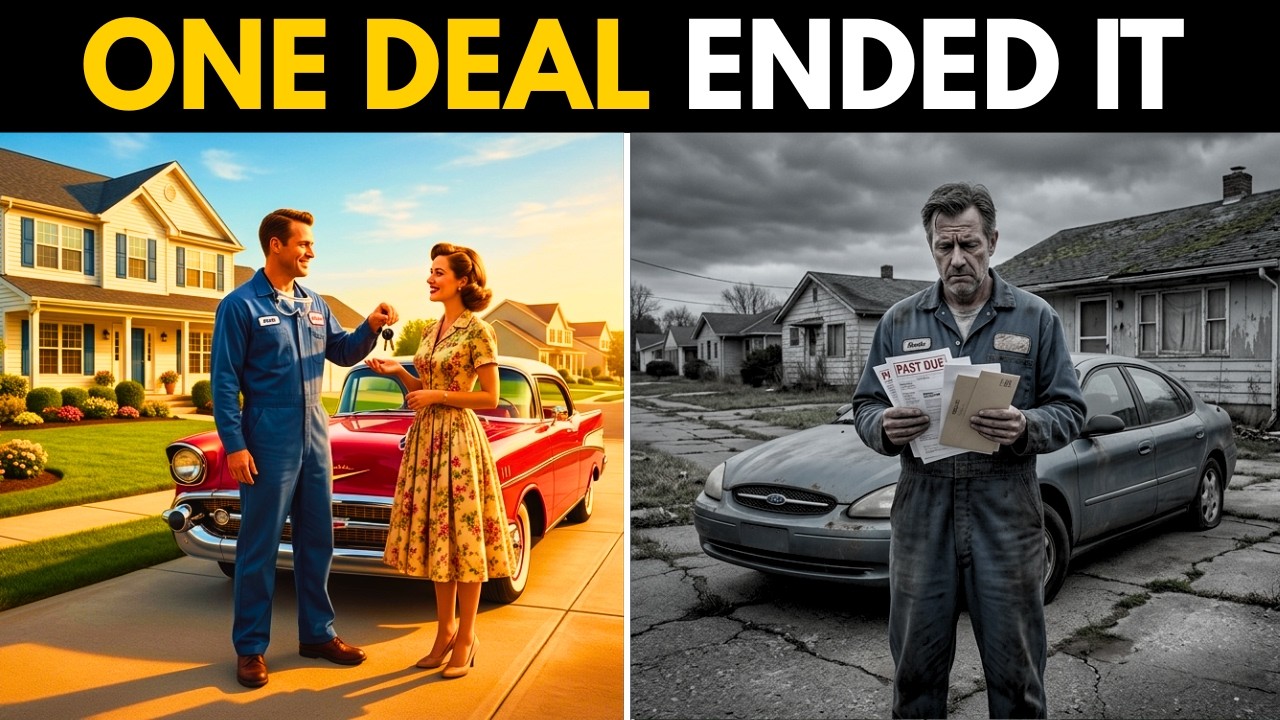
He never once worried about keeping the lights on. That was a comfortable middle-class life. The son now earns three times what his father earned. A friend of his, making $95,000 a year, shares a two-bedroom apartment with a roommate at age thirty-nine.
A couple he knows, pulling in $160,000 combined, has postponed having children for four straight years because they cannot afford daycare and a mortgage at the same time. If the father were starting over today on the same salary adjusted for inflation, he could not qualify for the mortgage on the house he already paid off. The life he built, in the very building where he built it, would be out of his reach. To understand what was lost, consider what ordinary family life actually looked like in the 1960s and 1970s.
A new Chevrolet Impala cost about $3,200. Household income hovered between $10,000 and $18,000 for the decade. A new home ran roughly $30,000—a price-to-income ratio of about two to one. Two years of work could buy a house.
That was the math. One person remembered growing up in that era. His father was a college professor, a good income, yet the family never had air conditioning. They did not get a second car until high school.
They never had a color television until he left for college. They never took a vacation overseas. Eating out happened only on special occasions. The key fact about that era was not how high the standard of living was, but that it was rising—and that made everything feel possible.
Families did not spend the way they do now. Going to a nice restaurant was something wealthy people did. Even ordering pizza was an occasion. Kitchens were small and utilitarian.
Basements had low ceilings. Many homes were heated with a single space heater in the living room. Vacations meant piling into a station wagon with a cooler of sandwiches, chips, and Kool-Aid. Motels cost twenty to thirty dollars a night.
Fast food was a treat, not a routine. Camping was the budget vacation of the decade: a tent, a Coleman stove, sleeping bags, folding chairs, mosquito spray, and cans of SpaghettiOs. Kids had paper routes and mowed lawns for pocket change. Families gathered around one television for shared evening rituals.
Nobody touched the dials without asking first. You did not need much, and that was the point. The essentials were affordable. Job security was solid; it was common to spend an entire career with one employer.
The possibility of moving up was real. Companies invested in their workers. Unions negotiated fair wages. Productivity gains were shared.
The CEO-to-worker pay ratio was twenty-one to one. Manufacturing employed 19. 5 million Americans. Towns were built around a single factory that sustained entire communities for generations.
A steelworker could buy a home, raise a family, put his children through a state college on a few hundred dollars a year in tuition, and retire at sixty with a full pension. For about twenty-five years, the machine worked. Productivity went up. Wages went up.
From 1948 to 1973, productivity and wages rose in lockstep, both roughly doubling. If you made more for the company, you got paid more. After 1973, they divorced. Productivity kept climbing—up 64.
7 percent from 1979 to 2019. Hourly compensation rose just 17. 3 percent in the same period. Workers kept producing more.
They just stopped getting paid for it. That split did not happen by accident. It had a blueprint. On August 23, 1971, a corporate lawyer named Lewis Powell sat down and wrote a memo.
Addressed to the United States Chamber of Commerce and marked confidential, it was never meant to be public. Powell argued that the American free enterprise system was, in his words, under broad attack from labor unions, consumer advocates, regulators, and universities. He laid out a step-by-step plan for a coordinated corporate counteroffensive—not just in business, but in media, the courts, schools, and politics. One memo became the playbook for everything that followed.
Two months later, Richard Nixon nominated Powell to the Supreme Court, and he was confirmed. That same month, Nixon made another decision that would reshape the economy for the next fifty years: he suspended the dollar’s convertibility to gold. The Bretton Woods system was over. Fiscal policy was untethered from any physical constraint.
The door to deficit spending, financialization, and the slow migration of the economy from making things to trading things swung wide open. The memo was the match, but the fire needed fuel, and in the 1980s it got everything it needed. Ronald Reagan took office in January 1981, and within months the rules that had built the middle class began to be systematically dismantled. The top marginal tax rate was slashed from 70 percent to 28 percent.
Corporate tax rates dropped. The theory was simple: cut taxes at the top, and wealth would trickle down. It did not. In 1978, the top one percent held seven percent of the nation’s wealth.
Today, they hold 38 percent. The money did not trickle; it flooded upward. Then came the unions. In August 1981, the Professional Air Traffic Controllers Organization went on strike.
Their members were working mandatory overtime in high-stress conditions and wanted better pay, a shorter work week, and updated equipment. Reagan gave them forty-eight hours on national television, then fired them all—11,345 workers, gone, with lifetime bans from federal employment. Within five years, strike activity collapsed. Union membership plummeted from 35 percent to roughly ten percent.
It has never recovered. Reagan did not just fire air traffic controllers; he fired the entire idea that workers had leverage. Then came deregulation. Banking rules loosened.
Wall Street grew. The economy’s center of gravity shifted from making things to trading things. CEO pay attached itself to stock price, creating every incentive to cut workers, offshore production, and chase quarterly returns. The idea that a corporation owed something to its workers, its community, its town was replaced by a single metric: shareholder value.
The nineties enforced those rules with one deal that sent jobs overseas and left entire towns to die. NAFTA was signed in 1993, sold with grand promises of 200,000 new American jobs a year. Instead, it gave corporations a green light to move production to countries with cheap labor and sell the products back into the United States. After NAFTA, 62 percent of union drives faced employer threats to relocate abroad.
Some companies literally loaded machinery onto trucks during wage negotiations. The message was clear: the equipment is headed for Mexico. Then the factories started closing—not one or two, but thousands. In Danville, Virginia, the Dan River Mill had operated since 1882.
Four generations worked there. It employed 6,500 people in 1993. After NAFTA, layoffs began immediately. By 2001, every single job was gone.
In Celina, Tennessee, a town of 1,400 people, the beating heart of the economy was an OshKosh B’gosh factory. When NAFTA shut it down, everything collapsed with it—the video store, the diner, the small shops. In Greenville, Michigan, the Electrolux factory employed 2,700 people. The company closed it and built a new one in Juarez, Mexico, slashing labor costs tenfold.
A worker among three generations of her family to have worked there received $1,500 in severance. She said the job was her escape, and that losing it pretty much destroyed her. Manufacturing jobs fell from 19. 5 million to 11.
5 million. Then China joined the World Trade Organization, and the bleeding accelerated. Americans tried to maintain their standard of living the only way left: debt. Credit cards, student loans, home equity lines.
The middle-class lifestyle did not disappear; it was financed on borrowed time. In 1960, 68 out of 100 Americans could afford to buy a home. By 2019, only 43 could. Wages went up four times, but houses went up ten, cars nine, gas nine, bread eleven.
The middle class did not just lose money. It lost the deal: the understanding that if you worked hard and played by the rules, you would be okay, and your kids would do better than you. A factory job was not just a paycheck; it was identity, community, purpose. When the plants closed, men did not just lose income.
They lost their reason to get up in the morning. The towns they left behind have never come back. Churches, bowling leagues, Little League—all sustained by one thing, stable jobs. When those left, the social fabric collapsed completely.
The house from the beginning of this story, bought for $127,000 on a $42,000 salary, is now assessed at $385,000. The house is still standing. The life it represented is not. Some of the shrinkage is people moving up; the upper middle class has nearly doubled.
Technology has improved life in ways the 1970s could not have imagined. But ask any family working two jobs to afford what one job covered in 1970, and tell them it feels like progress. Think about that factory worker in 1971: the house, the car, the pension waiting at the end. He did not know what was coming.
None of them did. They played by every rule, and the rules changed underneath them. It was not inevitable. It was a series of choices made by people with power at the expense of people without it.
America built the strongest middle class the world had ever seen, and then made a deal that let it all go.
