
OTTAWA — Social media lit up this week after viral posts claimed that Ontario had rejected a large shipment of U.S. beef at the border, framing the move as a dramatic escalation in ongoing trade tensions between two historically close allies. The firestorm spread with remarkable speed.
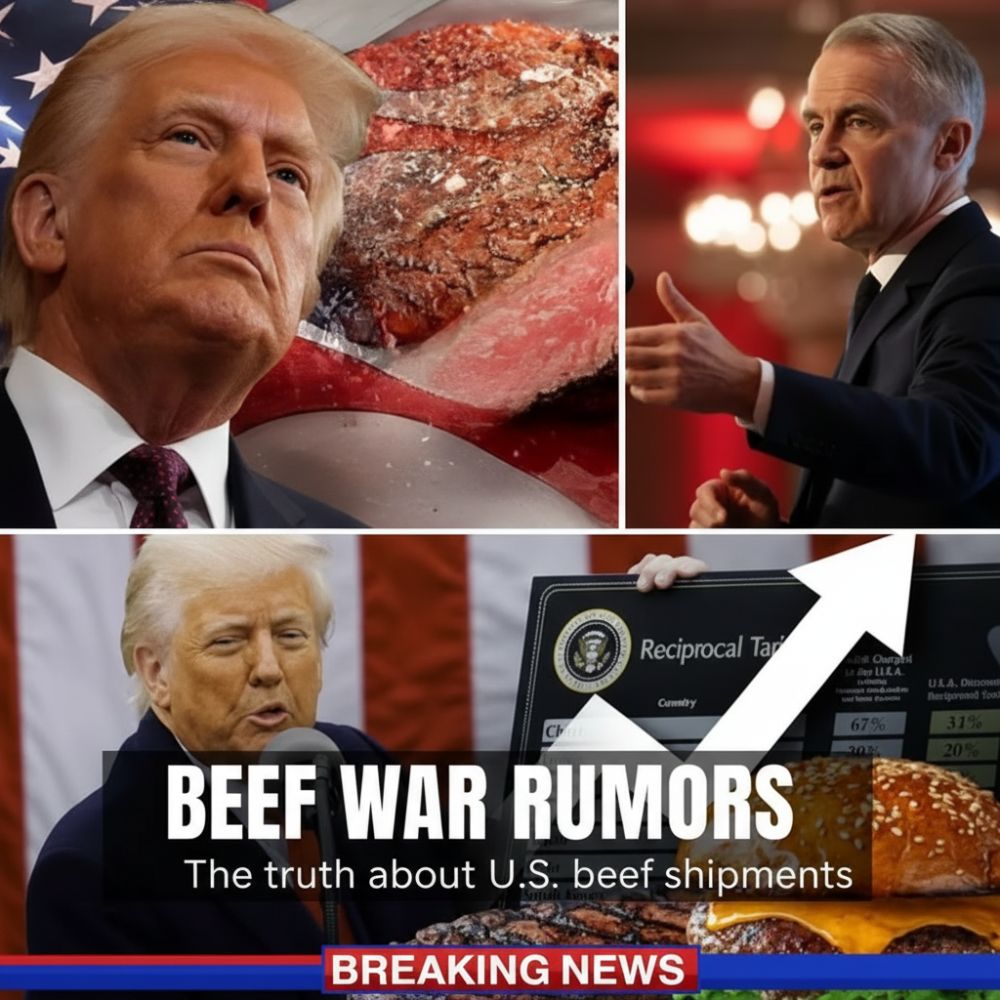
The original post, shared by an account with 200,000 followers, alleged that “Canadian inspectors turned back an entire convoy of American beef” due to unspecified safety concerns. Within hours, the hashtag #BeefWar was trending across North America, with some commentators portraying the incident as a strategic blow to American exporters.
But the truth, as is often the case in the fog of viral outrage, appears far more complicated. As of now, there has been no widely verified confirmation of an extraordinary nationwide ban or sudden collapse in U.S. beef exports to Canada. Neither the Canadian Food Inspection Agency nor the U.S. Department of Agriculture has issued any emergency statement.
Trade flows between the United States and Canada are complex and often subject to regulatory reviews, inspection protocols, and routine disputes that can be amplified online beyond all proportion. According to multiple industry sources, the incident in question — if it occurred at all — likely involved a single shipment held at the border for standard documentation or labeling issues.
“This happens dozens of times a week in both directions,” said Marcus Hollings, a trade consultant based in Windsor, Ontario. “A truck gets flagged for missing paperwork or a minor violation, and it sits at the crossing for a day or two. That is not a trade war. That is Tuesday.”
Yet the viral reaction highlights how sensitive agricultural trade remains, especially amid broader geopolitical and economic uncertainty. The United States and Canada are each other’s largest agricultural trading partners, with bilateral agri-food trade exceeding $70 billion annually. Beef alone accounts for nearly $4 billion in cross-border commerce.
Analysts note that supply chains, inspection standards, and tariff frameworks can all influence short-term disruptions without signaling a full-scale trade breakdown. The Canada-United States-Mexico Agreement, which replaced NAFTA in 2020, includes detailed dispute resolution mechanisms precisely to prevent isolated incidents from spiraling into diplomatic crises.
So why did the story explode? Experts point to a perfect storm of preexisting tensions. The U.S. dairy industry has long complained about Canadian tariff-rate quotas. Canada, in turn, has bristled at American “Buy America” procurement rules. A recent dispute over softwood lumber remains unresolved. Into this anxious environment, a single unverified social media post landed like a match in a dry forest.
The reaction on both sides of the border has been telling. U.S. senators from farming states demanded immediate clarification from the Biden administration. Canadian provincial officials accused American commentators of “manufacturing a crisis” to pressure Ottawa in unrelated trade negotiations. Reasonable voices were largely drowned out.
Industry groups have urged calm. The National Cattlemen’s Beef Association issued a statement noting that “there is no evidence of any systemic change in Canadian border practices.” Similarly, the Canadian Meat Council reminded its members that “regulatory holds are routine and do not constitute a trade action.” Neither statement received even a fraction of the attention given to the original viral post.
The broader lesson, according to trade law expert Professor Linda Grewal of the University of Toronto, is that the digital information ecosystem has fundamentally altered how trade disputes unfold. “In the past, you had a problem at the border, you fixed it quietly,” she said. “Now every inspection is potentially a headline. That makes de-escalation much harder.”
As of press time, no second shipment has been reported rejected. No embassy has issued a formal protest. No trade sanction has been triggered. But the viral firestorm has already done its damage — sowing doubt, stoking anger, and reminding everyone that in an age of instant outrage, the line between a routine inspection and a diplomatic crisis has never been thinner.