On the 28th of November 2002, at three in the afternoon, a wheel worker named Barry Wheat finished the last bicycle component ever made in Nottingham. It was not a famous racer or a stylish chopper. It was a 20-inch wheel for a child’s bicycle, a Little Max, and with it more than a century of British bicycle manufacturing came to an end. There were no television cameras.
A reporter from the local evening paper watched the last 280 employees drift off toward a pub crawl through the streets of Radford, and noted that the great factory felt like the Marie Celeste, emptied of its thousands, falling quiet in the November dark. The place that died that day had once been the largest bicycle factory the world had ever seen, a self-contained industrial town on the western edge of Nottingham where 7,000 workers had built machines that carried the Raleigh name to 140 countries. The story had begun with a dying man. Frank Bowden, born in Exeter in 1848, had made himself rich on the Hong Kong stock market, but the work had ruined his health.
By his late thirties he was a wreck, and the doctors gave him about six months to live. They prescribed rest, air, and, on a visit to the spa town of Harrogate, advised him to take up cycling. The bicycle of the late 1880s was still a slightly disreputable contraption, not the machine of a dying financier. But Bowden had seen a safety bicycle in a London shop window, two equal wheels, chain-driven, stamped with the name of the street where it had been built: Raleigh.
He bought one. Instead of gently pedaling around a spa town, he rode through France, Italy, and back across England. The man given six months rode himself healthy, and somewhere in those miles he became convinced that this simple machine would change how ordinary people lived. In the autumn of 1888 he went looking for the workshop that had built it.
He found a tiny operation on Raleigh Street, a dozen men turning out three bicycles a week. Bowden had money, and he had certainty. In December 1888 he founded the Raleigh Cycle Company, and within a few years he had taken full control. His timing was extraordinary.
The 1890s brought a national bicycle boom, a sudden hunger for a machine that did not eat, did not tire, and gave ordinary people a freedom they had never known. Bowden understood that the future belonged not to the man who made the finest bicycle by hand, but to the man who could make a good bicycle by the thousand and stand behind it. He borrowed, gambled on scale, and by 1896 the little workshop was employing some 850 people and producing 30,000 cycles a year, already described as the largest bicycle maker in the world. Then came the invention that made Raleigh unstoppable.
In 1902 the Sturmey-Archer three-speed hub gear appeared, a mechanism sealed neatly inside the rear wheel that let a rider change gear without external chains and cogs. Over 80 million of them would be sold around the world, and Raleigh made everything itself, from raw steel to finished bicycle, under its own roofs. By 1913 it was once again unambiguously the largest bicycle manufacturer on the planet, and when the world went to war, the factory turned to munitions, as British factories did. It survived the First World War, survived the depression that broke half its rivals under Frank’s son Harold, and by 1938 was turning out nearly half a million bicycles a year.
The best was still ahead. When the Second War ended, a battered Britain found it still possessed the greatest bicycle factory that had ever existed, and the world was hungry for bicycles. In 1946 Raleigh accounted for 95 percent of all bicycles imported into the United States. In 1951 annual production passed one million machines, as much as 70 percent of them sent overseas.
The heartland of the empire was Africa, where the heavy, nearly indestructible Raleigh roadster held around 85 percent of the East African market. At home, the factory reshaped the city around it in ways that mattered beyond bicycles. When the Windrush generation brought Caribbean workers to Britain, Raleigh changed its hiring policy after local campaigning, becoming the largest employer of black workers in Nottingham, and for a generation of Caribbean families the Lenton works was where a life in Britain was built. In 1960 came the decision that looked like a crowning triumph.
The conglomerate Tube Investments bought Raleigh and folded into it the whole British Cycle Corporation, absorbing Phillips, Hercules, Norman, and Sun. Overnight, TI Raleigh controlled roughly 75 percent of the entire British bicycle market. There was nowhere left to climb. And that, precisely, was the danger.
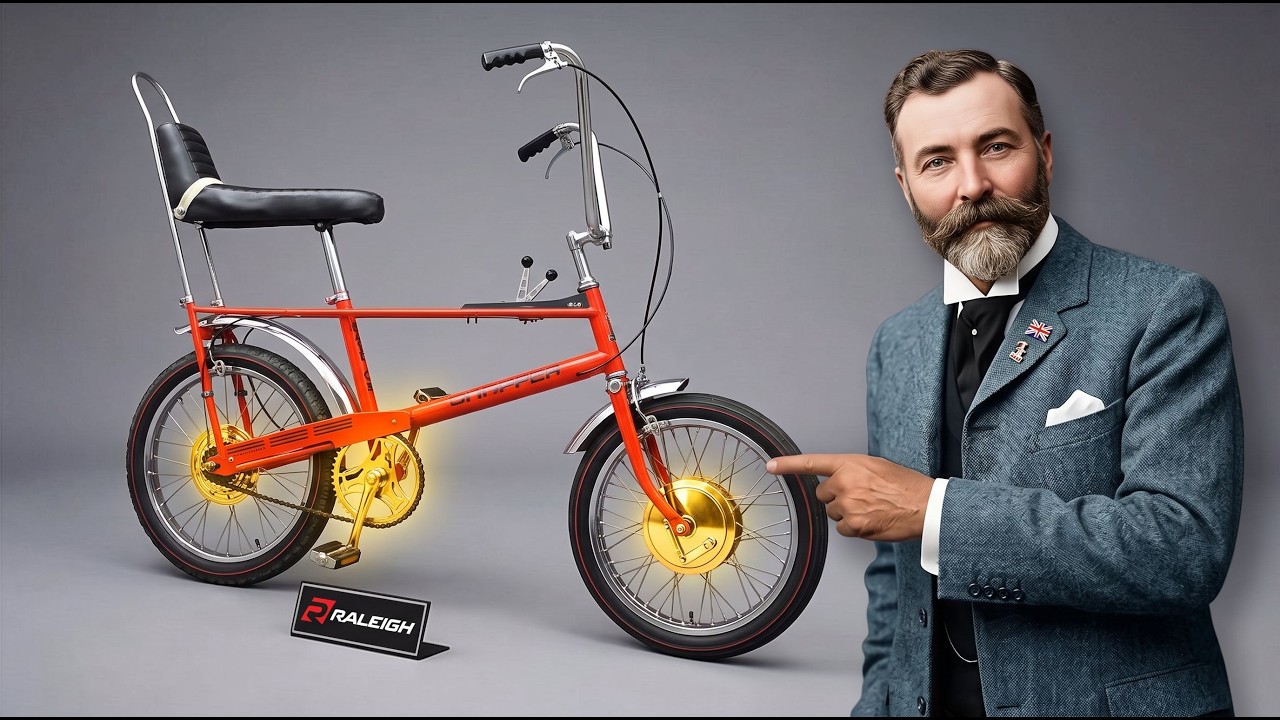
The 1970s brought the Chopper, a heavy, slightly impractical bicycle styled like a chopped American motorbike, and the most desirable object in Britain. It sold about a million and a half machines in the United Kingdom alone. Then came the Grifter and the Burner, which helped drive Raleigh back to roughly half the entire British market. In 1980 the TI Raleigh racing team won the Tour de France, and that TI Raleigh machine remains the only British-built bicycle ever to win it.
But the youth boom was a sugar rush, spectacular and short, and the shadows were already there. Between 1950 and 1962 British bicycle sales roughly halved, as the motor car took the working man off his bike and out of the factory gates. The newly independent nations of Africa and Asia raised tariff walls and wanted their own industries. And Tube Investments, the owner that had bought the company, declined to invest in it.
In 1973 Sturmey-Archer engineers designed a seven-speed hub, a working, ready successor to the greatest hub gear ever made. TI would not fund it. It sat in a drawer for more than twenty years, until the world had moved on and the makers who owned that ground were German and Japanese. By 1981, for the first time in Raleigh’s long history, imports of foreign bicycles into Britain overtook exports.
Under TI’s stewardship, Raleigh’s share of the British market fell from 75 percent to 36. In the hills of Marin County, California, in the mid-1970s, a handful of young men had been racing old balloon-tired clunkers down a mountain, burning the grease out of their hubs. Out of that came the mountain bike, and in 1981 a woman named Yvonne Rix, who had risen through Raleigh from secretary to the chief designer, came home from America certain that mountain bikes would come down off the hills and onto the streets. The board asked who needed mountain bikes in England, where there were few mountains.
She told them you did not need a four-wheel drive to drive in London either, and yet you saw plenty of Range Rovers in Chelsea. She was right. Raleigh did not launch a mountain bike in Britain until 1985, and it did not sell well. But the mountain bike refusal was not the single blow that felled the giant.
It was a symptom of a company that had forgotten how to believe in the future. Raleigh was late, but not fatal. After the company changed hands in 1987, it threw itself into mountain bikes and sold more than three million of them. The disease was older and slower: years of an owner who found bicycles boring, a seven-speed hub left unbuilt, a factory site sold without securing a new one, and a price that no British worker could ever be paid low enough to beat.
The ownership churned. Tube Investments sold Raleigh in 1987 to a company assembled by a tax lawyer, and for a while it thrived, catching the mountain bike boom and growing into the largest cycle group in the world. But manufacturing was moving east, first to Japan, then Taiwan, then China, and each move dropped the price of a bicycle a little further. In 1999 the new owners sold the factory site to the University of Nottingham without first securing anywhere else to make bicycles.
The frame-making machinery went under the hammer at auction that December. In December 2000 the assets and trademarks of Sturmey-Archer were sold off, and the greatest name in British cycle engineering became a Taiwanese brand. In August 2001 Derby Cycle filed for bankruptcy protection. A management buyout rescued the name, and in 2012 it was bought by the Dutch Accell Group, which still owns it.
The name survives. The factory did not. The last hope had been a plan to move production to a new plant on allotment land at Bulwell. It was blocked partly by a small group of allotment holders who would not give up their ground, and partly by protected wildlife living on the site.
One local member of Parliament called it the straw that broke the camel’s back. Another found the truer words: this was not so much a factory closure as a bereavement. The buildings came down in 2003. In their place rose the University of Nottingham’s Jubilee Campus, arranged around a long serpentine lake.
Where 7,000 workers once poured through the gates in the gray of a winter morning, undergraduates now cross a footbridge over ornamental water. The Howitt building, the handsome old headquarters, still stands, listed and protected, a single fragment of the empire. The works themselves are gone as though they had never been. No chimney, no gate, no hooter to sound the shift.
A lake where the foundry stood. What remains is memory, and the people who took the trouble to save it: the recorded interviews with the men and women who worked those lathes and laced those wheels, the voices of the Caribbean families who built their British lives inside those gates. The last thing the factory ever made was a wheel for a child’s bicycle. A company that began with a dying man riding himself back to life ended with a small wheel built by hand for someone just learning to ride.
Frank Bowden had been told he had six months to live, and he built something that stood in Nottingham for 114 years. It was not murdered. It was outlived by the world that had made it giant.
