The night watchman at the Crescent Hotel had been on the job for nine years, and he had long since stopped being afraid of the building. That was the first thing he told the young assistant manager who came to him with a notebook, asking questions about what the older employees had seen. You couldn’t work nights in a place like that and stay afraid of it, the watchman said. You either got used to it or you found other work.
His name was Tuckerman Olcott Brace. He was sixty-one when he came to the hotel, after twenty-eight years on the railroad, and he had carried a thermos of coffee on his rounds every night since. His wife painted china. They had a small house in town.
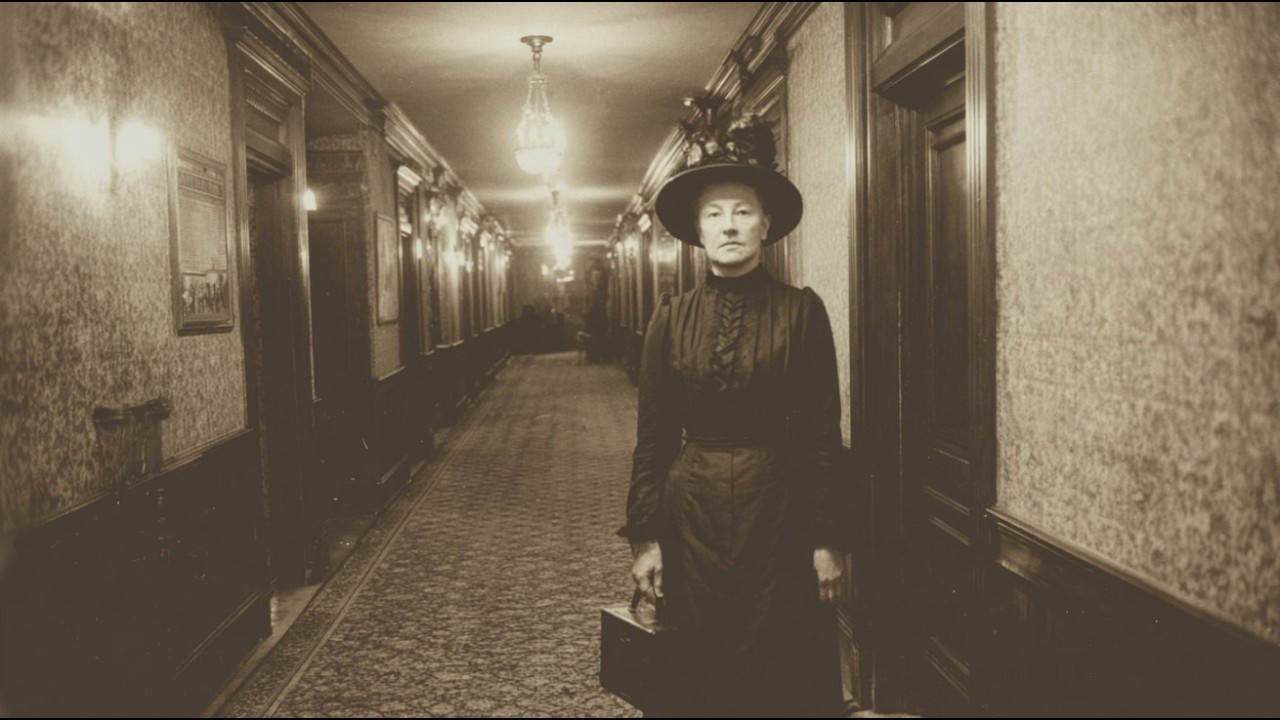
He was not a man given to fancies. But he told the assistant manager that the most consistent thing in the building was the lady with the doctor’s case. She came up the stairs from the lobby maybe once a week. She walked the fourth floor first, and then the fifth.
She never came up to the sixth or the seventh. She didn’t bother him, and he didn’t bother her. One night, he said good evening to her the way he would say it to any guest. She inclined her head and answered, “Good evening, Mr.
Brace. ” She had used his name. He stood in the corridor for a while after she walked past. It was the only time in nine years that he was actually afraid.
He told the young man that the building had something in it, something that wasn’t a ghost, or maybe it was. He didn’t know the difference. He had been in a derailment in his railroad years, the only man in his car who walked out, and he had stood by the wreck for hours afterward waiting for the doctor to come. The doctor had been delayed.
By the time he arrived, the people Brace had been sitting with were past helping. He sometimes thought about that doctor, about how long it took him to arrive. The lady in the hotel, the one with the case, was a person who had been on her way somewhere and had never quite gotten there. He didn’t believe she was angry.
He didn’t believe she was lost. He believed she was working. The building had given her something to do. That conversation was the last interview Tuckerman Brace ever gave.
He died of a heart attack in his own kitchen about three months later, in the spring of 1960. The young assistant manager wrote his article, but none of the ghost stories made it in. He wrote about the architecture, the limestone, the springs. His editor had cut all the rest.
The hotel didn’t want that kind of attention. The past should stay in the past. The article ran in the summer issue, and the hotel sold copies of it in the lobby. To understand what the night watchman was talking about, you have to go back to the beginning, to a building that was never meant to hold what eventually moved into it.
The men who poured its foundation believed they were laying the cornerstone of a grand mountain resort. White limestone was hauled by mule from a quarry less than a mile away. Eight stories of native stone rose out of the Ozarks like a cathedral that had wandered too far from any city to remember why it had come. They called it the Crescent.
The grand opening was set for the twentieth of May, 1886. The newspapers in Little Rock called it the most luxurious hotel built west of the Mississippi. The owners called it a temple to health and refinement. The people who worked there after a year or two started calling it other things.
The Crescent sat on a ridge above the town of Eureka Springs, Arkansas. The town itself was a strange one, built around mineral springs that local people had used long before any surveyor came through with chains and compasses. The water was supposed to cure things: rheumatism, skin complaints, whatever was wrong with you. By 1886 the town had grown around that promise.
Boarding houses, bathhouses, a new opera house, every kind of small business that could survive on the steady traffic of the unwell and the curious. The hotel was the crown of all of it. Two hundred guest rooms. Steam heat.
Hydraulic elevators. A ballroom on the top floor with a hand-painted ceiling. A staff of more than a hundred. The first guests arrived in carriages from the railway station at the bottom of the hill, and the orchestra played in the lobby until midnight.
For about three years, it was everything the brochures had promised. Then it wasn’t. The man at the center of what happened there was named Wilcom Henshaw Pettigrew. He was forty-four years old, hired in the autumn of 1888 as the night porter.
The position meant he sat at a small mahogany desk near the service stairs from ten in the evening until six in the morning, dealing with anything that needed dealing with: a guest who had lost a key, a guest who had had too much wine and couldn’t find their floor, a faucet running in an empty room, a complaint about footsteps. Pettigrew was a heavy man, tall in the shoulders, with a long, sad face and hands that had spent thirty years doing manual labor before he traded them for a porter’s coat. He had been a teamster, then a foreman at a sawmill in Missouri. After an accident with a chain left his left leg shorter than his right, he had come south looking for indoor work.
The hotel hired him because he didn’t mind the night shift and didn’t drink. Both were rarer qualifications than you’d think. For the first month, Pettigrew thought the job was a small piece of heaven. Warm in winter.
Quiet most of the time. The kind of work where you sat with a newspaper and a pot of coffee and let the building hold itself up. The first thing that struck him as strange was the elevator. There were two elevators in the hotel, both hydraulic, with brass cages and lacquered wood interiors.
At night, after the last guests had gone up to their rooms, they were supposed to sit at the lobby floor, doors open, lamps low. That was the rule. In Pettigrew’s third week, around two in the morning, he heard the hum of the south elevator starting up. He looked.
The doors were closing on an empty cage. The needle on the floor indicator above the door began to climb. Second floor. Third.
Fourth. It stopped on the fifth. He sat very still and listened. After about a minute, the cage came back down on its own.
The doors opened. There was no one inside. He wrote it in the night log the way he was supposed to. The morning manager, a Mr.
Oberon Crisp, looked at the note, sighed, and crossed it out with a pencil. “Don’t put that in the book,” Crisp said. “It’s an old building. Old buildings settle, cables stretch.
Sometimes the cage moves on its own. ”
“It went up five floors, sir. ”
“Then it went up five floors. Don’t write it down.
”
Pettigrew, who had been a foreman and knew what a man means when he tells you not to write something down, didn’t write it down again. The elevator did it three more times that month, always between two and three in the morning, always to the fifth floor. He stopped logging it. He started watching for it.
One night in late October, he was watching when the south elevator began its climb. He set down his coffee, limped across the marble floor to the service stairs, and went up after it. He was on the fifth floor when the cage came to rest. He stood at the end of the long corridor and watched the doors open.
There was a woman standing in the elevator. She was older. She wore a high-necked dress of a kind that hadn’t been fashionable for twenty years. Her hair was put up under a small dark hat.
She did not look at him. She stepped out of the cage, turned to her right, and walked the length of the corridor away from him. She did not limp. She did not hurry.
She walked the way a woman walks who has done it a thousand times. About halfway down the corridor, she turned and went into a room. He couldn’t tell which one. The corridor was dim, the gas lamps turned low for the night.
He walked after her. His leg complained on the carpet. When he reached the place where she had turned, he stood and looked at the door of room 518. The door was closed.
There was no light coming from underneath it. He knocked. He waited. He knocked again.
Then he used his master key, the way he was supposed to in an emergency, and opened the door. The room was empty. The bed was made. The curtains were drawn.
The air was very cold, the way a room is cold when no one has slept in it for a long time. There was no sign that any woman had been in the room for any reason at all. He stood in the doorway and felt something he hadn’t felt since he was a young man in a logging camp, the year a fire took the bunkhouse and four of his friends with it. It was a feeling of being held by something, of being noticed.
He locked the door behind him. He went back downstairs. He did not write any of it in the log. The second strange thing began in the kitchen, a place Pettigrew didn’t ordinarily have any business with.
The hotel had a basement kitchen the size of a small armory, all copper and iron and tile, and at night it was supposed to be empty. The cooks finished at midnight. The dishwashers were done by one. By two, the kitchen should have been silent.
One night in November, a maid named Loveday Quint came up the service stairs in tears. She was a young woman of perhaps twenty-two, thin and dark-haired, with the kind of pale skin that showed every feeling she had. She had been carrying a bucket of cold tea to the second-floor pantry and had stopped at the kitchen door because she had heard a man singing. A low voice, she said, a man’s voice, singing in a language she didn’t know.
Not French, not German. She had grown up in a town with plenty of both. This was something older. She pushed the kitchen door open with her foot because her hands were full.
The kitchen was dark except for the watchman’s lamp at the far end. The singing stopped the moment the door opened. She stood there long enough to see that the lamp at the far end was sitting on its hook, and there was no one within twenty feet of it. Then she heard the singing again, this time from behind her, from the corridor she had just left.
She dropped the bucket and ran. Pettigrew found her at the top of the service stairs shaking. He sat her down, made her a cup of strong tea from the porter’s pot, and listened. He believed her.
He had been hoping someone else would notice these things, and now someone had. The next morning he asked the head cook, a Norwegian woman named Sigrun Halvorsen, whether anyone had ever sung in the kitchen at night. She looked at him for a long moment. She was a tall woman in her fifties, broad in the shoulders, with hands that had cracked themselves brown from a lifetime of hot water and lye.
“You have heard him,” she said. “No, ma’am. One of the maids. Loveday.
”
Sigrun Halvorsen took a long breath and let it out. She put down the knife she was holding. “There is a man who sings in the kitchen sometimes. He was here when I came.
He will be here when I leave. ”
“What does he sing? ”
“I don’t know. I have stopped listening.
”
She picked up her knife again. The conversation, as far as she was concerned, was over. By the spring of 1889, Pettigrew had a quiet understanding with several of the staff: with Loveday Quint, the maid; with Sigrun Halvorsen, the cook; with a porter named Easton Bramwell who worked the day shift; and a laundress named Verity Spurlock who came in three times a week. They didn’t talk about what happened in the hotel.
They didn’t write it down. But when one of them looked at another in a corridor or across a stack of folded sheets, they understood each other. The hotel had something in it. They didn’t know what.
They had agreed, without ever saying so out loud, to keep it. The guests came and went. Some of them complained. The complaints were always vague.
A guest from Memphis said her water glass had moved across the nightstand while she watched. A guest from St. Louis said the man in the next room had argued with a woman all night, although the room next to his had been empty and locked. A guest from Galveston said she had woken to find the bedclothes pulled down to the foot of the bed, neatly folded, her own hands resting on top of them.
A guest who had been a Confederate cavalry officer, now in his seventies, said he had seen a man in the corner of his room who had no face at all, only a shape where a face ought to be. He had laughed at the man and gone back to sleep because he had seen worse things at Shiloh. Mr. Oberon Crisp settled all of these complaints with brandy and reduced bills.
He never raised the matter with the owners. He had a son in college and a wife who liked nice furniture, and he was not the sort of man who put his livelihood in danger over things he couldn’t see. The first time Pettigrew saw the woman from the elevator clearly enough to remember her face was the night of the eighteenth of February, 1890. There had been a heavy snow that day, the kind that piles itself against the second-floor windows of a building set on a hillside, and by the time he came on shift, the hotel was almost empty.
Twelve guests on the second floor, four on the third, a small party of railroad investors on the sixth. The rest of the rooms were dark. He was sitting at the desk a little after one in the morning when the south elevator began its climb. This time, instead of waiting for it to come back or following it up, he went and stood in front of the doors when they opened on the lobby floor.
She was there. She looked at him. She was a woman of perhaps fifty. Her hair was iron gray, put up under that same small dark hat.
Her face was thin, with high cheekbones and a long mouth and very large pale eyes that did not blink as long as he looked at her. She held a small leather case in her right hand, the kind a doctor used to carry. She did not speak. He took off his porter’s cap.
He didn’t know why; he just did. “Ma’am,” he said. She inclined her head very slightly. It was the gesture of a woman acknowledging a porter, the kind of gesture he had received a thousand times.
It was so ordinary and so out of place that he had no answer for it. She stepped past him. She did not pass through him. She moved around him the way any woman would have moved around a man in her path.
She crossed the lobby to the main staircase, took hold of the banister, and walked up. He followed her this time, all the way to the fifth floor. She didn’t seem to mind. He stayed two or three paces behind her like a porter helping with luggage.
She walked the corridor he already knew. She stopped at the door of room 518. She turned and looked at him. “He’ll be here soon,” she said.
Her voice was low, dry, like a woman speaking through wool. “Who, ma’am? ”
She smiled very faintly. It was a smile of patience, of someone who has answered the same question many times and is willing to answer it once more.
“The doctor. ”
Then she opened the door of room 518, walked through it without using the handle, and was gone. He stood in the corridor for a long time. The door was closed.
The hallway was very cold. After a while, he went back down to his desk. When the morning manager came on, Pettigrew didn’t tell him. But the next afternoon, on his way home, he went to the library at the railway station and asked the station master’s wife, who kept the lending books, whether the hotel had been anything else before it was a hotel.
She told him it had been a hotel since it opened, always. And before that? Before that, it was a ridge. There was nothing on it but trees.
She paused. There was a sanatorium that was supposed to be built here years ago. Before the hotel, the land was bought for it. There were plans.
Money was raised. Then the railway came through, and the investors decided a hotel would make more money. The sanatorium plans were sold to a man in Hot Springs. What kind of sanatorium?
She thought about it. The kind for women, I think. For women’s nerves. I don’t remember.
My mother might know. She’s the one who told me. Pettigrew went home that day and sat at his small kitchen table for a long time. He was a widower, had been for almost ten years.
His wife had died in the same accident that had shortened his left leg, and he had never quite recovered from either thing. He thought about a woman with a doctor’s case stepping out of an elevator in a hotel that had once been planned as a sanatorium for women’s nerves. He thought about what it meant that the plans had been sold but the land had been built on anyway. He thought about Loveday Quint, who was twenty-two years old and had been crying when he handed her a cup of tea.
He thought about whether buildings remember what they were almost made into. He didn’t have answers for any of it. He went back to work that night. He kept watching.
There is no single great event that happened in 1890. No fire, no murder, no newspaper article. The hotel went on being a hotel. The guests came and went.
The strange things happened more or less the way they always had. The woman with the doctor’s case rode the elevator up. The man in the kitchen sang his song. Every now and then a guest would come downstairs at three in the morning saying she couldn’t stay in her room, and Mr.
Oberon Crisp would put her in a different one and offer her brandy. This went on for years. The Crescent passed through a slow decline that nobody outside the building noticed for a long time. The railway investors stopped coming.
The wealthy from Memphis and New Orleans found newer places to spend their summers. By the late 1890s, the hotel was being run as a women’s college part of the year and a summer resort the other part. By 1910 it had been sold twice and was struggling on either function. In 1911, it became something else.
A man named Cassius Valoren Trumbo bought the building, the grounds, and the right to use the springs. He was a heavy man in his sixties with a white mustache that hung down to his collar. He had made his money in patent medicines in Kansas City. He was not a doctor.
He had never been a doctor. But he had read enough medical books, he said, to know more than most of them. He believed he had a cure for cancer. He renamed the Crescent the Baker Cancer Hospital.
He took out advertisements in newspapers in eight states. He filled the rooms with patients who came to him with diseases that other doctors had given up on. Because of what was done in that building during the Trumbo years, the records that survived were sealed for decades. What people remember of it now, they remember through what the staff told their grandchildren.
The newspapers, when they finally caught up to what had happened, used words like “fraudulent” and “unfit. ” The federal authorities, when they finally moved on the place, took crates of records away in wagons. Most of those records were destroyed because of what was in them. A nurse who worked at the Baker Cancer Hospital during its first year was a woman named Idalene Chesterfield Pruitt.
She was thirty-one years old, trained at a proper hospital in St. Louis. She had taken the job because her father, who lived in Berryville, was dying of consumption and she wanted to be close to him. She had been told the hospital was a real one, and she had believed it for the first three weeks.
She wrote a letter to her sister in Indiana sometime in the autumn of 1911. The letter survived, one of the few first-hand documents from inside that place that has come down to us. She wrote that she had begun to dream of the building, not in the way a tired nurse dreams of her ward, but in a different way. The building seemed to know her.
During her night shifts she had become aware of being followed from floor to floor by something that wasn’t a patient and wasn’t a colleague. The elevator went up by itself sometimes, to the fifth floor. One of the older orderlies had told her not to worry about it. He had been there since the Crescent days.
“There is a lady who rides up to the fifth floor. She has been doing it as long as anyone has worked here. She doesn’t trouble anyone. Don’t trouble her.
”
Idalene Pruitt wrote that one night in October she was sitting at the nurse’s desk on the fourth floor a little after two in the morning when a woman in a high-necked dress and a small dark hat came up the stairs from the lobby. She had a doctor’s case in her right hand. The woman walked the length of the corridor to where Idalene was sitting. She set the case down on the desk.
She opened it. Inside were a stethoscope, a small bottle of something dark, and several instruments that Idalene did not recognize. They were not modern. They were not from any hospital catalog she had ever seen.
The woman looked at Idalene and said, in the same low voice Pettigrew had heard twenty years before, “There is nothing in this building that helps them. ”
Then she picked up her case, walked back down the corridor, and went down the stairs. Idalene stayed in her chair for the rest of the shift without moving. When the morning nurse came on, she went directly to Cassius Trumbo’s office and gave her notice.
He laughed at her. He told her she would be replaced by the end of the week. He told her that hysterical women were not welcome at the Baker Cancer Hospital. She walked out of the building with what she could carry.
She never went back. The letter ended with a sentence that has stayed with everyone who has read a copy of it. She wrote: “I do not know whether the lady on the stairs was a ghost, but I know that she was there before that man, and she will be there after him, and she was telling the truth. ”
The Baker Cancer Hospital operated for about seven years.
The federal authorities became involved. There were court proceedings. There were findings. Cassius Valoren Trumbo died of natural causes shortly before he was to stand trial.
His son tried to keep the operation going for another year and was eventually shut down too. The building stood empty for a long while after that. The staff who worked there in those years all reported, in one form or another, the same set of things. A woman who came up the stairs at night with a doctor’s case.
A man who sang in the kitchen in a language no one understood. The south elevator going up to the fifth floor by itself between two and three in the morning, with no point in trying to stop it. And the patients in their last hours sometimes spoke to someone the staff couldn’t see. They would look at a chair by the window and have a long, quiet conversation.
They would seem comforted by it. Afterwards they would tell the staff that the lady had come to sit with them, and the staff would write it down as a fever or a sedative, anything else they could think of to write. After the hospital was closed, the building changed hands again. It was a junior college for a few years.
It was a hotel again. Bought and sold, renovated and renovated again. Walls came down. New wings went up.
The lobby was redone in 1946 and again in 1958. The kitchen was modernized. The hydraulic elevators were replaced with electric ones. The fifth floor was not renovated as often as the others.
When the staff were asked why, they would say the fifth floor didn’t need it. That was always the reason given. The fifth floor didn’t need it. The hotel is still standing.
It is on the National Register of Historic Places. People go there now for weekend getaways and weddings. The staff, when asked, will tell you very pleasantly that the building has a reputation for being haunted, and they will smile in the way staff smile when they have been asked the same question seventeen thousand times. But every now and then, if you stay long enough and you are in the right corridor at the right hour, you will see something.
A man who is not the kind of man who makes things up stayed in room 318 during a long weekend in the autumn of 2001. He had gone there for his anniversary, with his wife. They were in their fifties. They had been to forty hotels in their married life and had never had any kind of experience.
He woke up at two in the morning. He didn’t know why. The room was dark. His wife was asleep beside him.
He sat up and looked toward the door, the way you do when something has woken you and you don’t know what. A woman was standing in the corner of the room. She was older. She wore a high-necked dress.
A small dark hat. A leather case in her right hand. She looked at him for what felt like a long time. He said he was not afraid.
No, he was, he said, surprised. The strangest thing about her was that she looked tired. She looked like a woman who had been working for a very long shift and was not yet done. She nodded to him.
He nodded back. She turned and walked out of the room through the door without opening it. He sat there for a while looking at the door. He turned to see if his wife had woken.
She hadn’t. He lay back down and went to sleep, and he slept better that night than he had in a long time. In the morning, he told his wife about it over breakfast in the lobby. She listened.
She didn’t laugh. When the waitress came to refill their coffee, his wife asked her very casually whether there had ever been a woman in the building who carried a doctor’s case. The waitress was a woman of about forty. She set the coffee pot down on the table.
She looked at the wife. She looked at the husband. “You saw her,” she said. “My husband did.
”
The waitress was quiet for a moment. “That’s nice,” she said. “She likes the third floor. Some weeks she’s up on the fifth, and some weeks she’s down here.
She doesn’t usually let you see her unless you need to see her. ” She picked the coffee pot back up. “I hope you both had a good night. ”
Nobody who has ever seen her in eighty years of stories has described her as cruel.
They describe her as patient. They describe her as occupied. They describe her as a woman who has work to do and is doing it, willing to nod to you on her way past. She was the doctor who was supposed to run the sanatorium that was never built.
She was a real person, or the memory of one, who had been promised work in a building that was sold out from under her before she ever set foot in it. She came anyway. When the Baker Cancer Hospital opened, she finally had patients to attend to. She is still there.
She is still working. What she is keeping is not a room. What she is keeping is a promise.
