In this photograph, she is twenty-nine years old, wearing the uniform of the Women’s Auxiliary Air Force. There is something in her expression that does not quite fit. She looks like the sort of person who would be kind to you on a bad day, not someone three months away from being the only Allied spy still operating inside occupied Paris. The Nazis killed her at Dachau on the morning of September 13th, 1944.
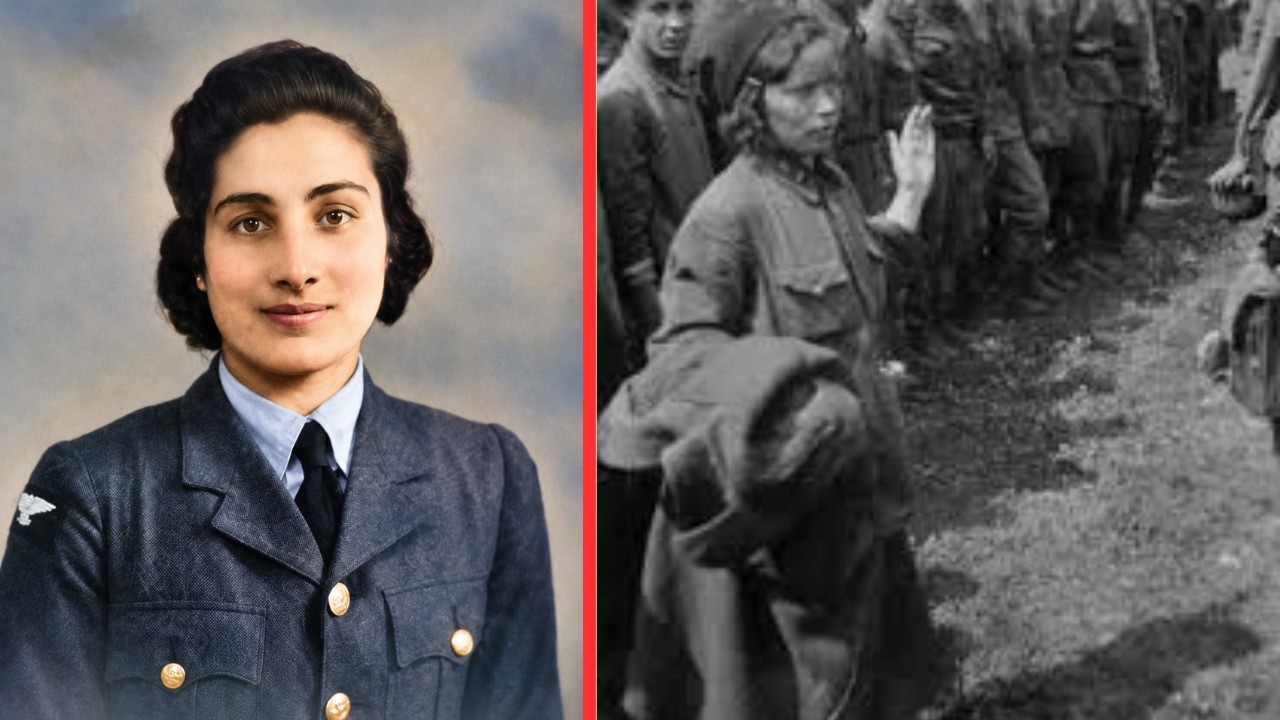
She was thirty years old. In the eleven months between her capture and her death, through interrogation and imprisonment and chains, she did not give them a single name. Not one safe house. Not one radio frequency.
Noor Inayat Khan was born on New Year’s Day, 1914, in Moscow, which tells you something about the family she came from, because that family was rarely in one place for long. Her father, Hazrat Inayat Khan, was descended from Tipu Sultan, the eighteenth-century ruler of Mysore, one of the most celebrated and defiant figures in Indian history, the man who fought the British Empire to a standstill before dying in battle rather than surrender. He himself was a musician and Sufi teacher who spent years traveling across Europe and America spreading what he believed was a universal spiritual message. Her mother, Ora Ray Baker, was an American from New Mexico who had converted to the Sufi path and taken the name Amina Begum when she married him.
By 1920, the family had settled in Suresnes, just outside Paris, in a house given to them by supporters of the movement. Noor studied child psychology at the Sorbonne and music at the Paris Conservatory under Nadia Boulanger, which is not a small thing. Boulanger taught Aaron Copland, Philip Glass, and Quincy Jones. Noor learned harp and piano, wrote poetry, and published a book of children’s stories, a retelling of ancient Buddhist Jataka tales, the year before the war started.
Her father died in 1927 when she was thirteen. From that point, she became essentially the adult of the household, looking after her grief-stricken mother and three younger siblings, holding things together quietly, which is what she always did. The last thing anyone, including Noor herself, expected was that any of this would lead to war. When Germany invaded France in the summer of 1940, the family fled south to Bordeaux and crossed to England by sea, arriving in Cornwall on June 22nd, the same day France signed its armistice with Hitler.
Noor had been raised in a household where non-violence was not a political opinion but the foundation of everything. Yet she watched what the Nazis were doing to the country she had grown up in and decided that sitting it out was its own kind of moral failure. She joined the Women’s Auxiliary Air Force that November, trained as a wireless operator, and by late 1942, the Special Operations Executive had found her. She spoke fluent French, knew Paris intimately, and was fast and accurate on a wireless set.
They recruited her for the French section. Her training assessments were not flattering. One examiner wrote that she was unsuitable for intelligence work, too sensitive, too honest, too likely to crack under pressure. Another suggested she was not, to use their words, overburdened with brains.
The SOE sent her anyway, partly because by the middle of 1943, trained French-speaking wireless operators were not exactly queuing up for the job. On the night of June 16th, 1943, she was flown into France in a Lysander and landed in the dark. She was the first female wireless radio operator the SOE had ever sent into occupied France. The SOE’s main Paris network, code-named Prosper, was already being quietly rolled up by the Gestapo when she arrived.
In the weeks after Noor landed, arrests swept through the resistance. Colleagues she had only just met were gone. The network she had been sent to support essentially ceased to exist around her. London told her to come home.
She said no. She was now the only SOE wireless operator still active in Paris. The only working radio link between the French resistance and British intelligence. If she left, that connection went dark entirely.
So she stayed, moving from apartment to apartment with her wireless set in a suitcase, transmitting from different locations while Gestapo direction-finding teams worked the streets below trying to triangulate her signal. The Germans had her description and knew her code name, Madeleine. For months, they could not find her. Then someone sold her.
In October 1943, she was betrayed, almost certainly by a Frenchwoman paid 100,000 francs to hand her location to the Gestapo. On or around the 13th of October, Noor was arrested and taken to Gestapo headquarters at 84 Avenue Foch. She fought them physically during the arrest, and under interrogation she gave them nothing. Not one name, not one address, not one person in the network.
She did make one serious mistake, though. It was not cowardice. It was inexperience. She had kept meticulous copies of all her encoded transmissions, which she was not supposed to do, and the Gestapo found them.
That meant they could now impersonate her on the radio and lure new SOE agents straight into arrest. It was a catastrophic failure that cost people their lives. But it was the kind of mistake a conscientious person makes when nobody has told them clearly enough what the rules actually require. She had been keeping records the way you would keep records at any normal job.
They got nothing out of her directly, not then and not in the ten months that followed. She tried to escape twice. The first time, she got out of a window and was picked up within hours. The second, in November 1943, was something else entirely.
She planned it with two other prisoners at Avenue Foch, British Captain John Starr and French Major Leo Faye. They removed the bars from their cell windows, knotted blankets into ropes, climbed onto the roof of Gestapo headquarters in the middle of the night during an air raid, and lowered themselves down to the adjacent rooftops. Getting that far out of one of the most heavily secured buildings in occupied Paris was remarkable in itself. They were caught before they could clear the area.
After that, the head of the Paris Gestapo, Hans Kieffer, demanded she sign a document stating she would never attempt to escape again. She refused. Kieffer sent word to Berlin describing her as a dangerous and desperate case. On November 27th, 1943, she was transferred to Fort Schirm prison in southern Germany, classified as a Nacht und Nebel prisoner: night and fog.
The designation meant she was to vanish without trace. No contact with the outside world. No communication with anyone. Her own organization did not know where she was.
At Fort Schirm, she was kept in solitary confinement with her hands and feet in chains. That lasted nearly ten months. What kept her going through that, we do not fully know. Those who later pieced together her story found accounts suggesting she meditated and held on to her father’s teachings, that she found something inside herself her captors simply could not get to.
What is certain is that they got nothing out of her. No information, no cooperation, no signature on any document. By the end, they had branded her highly dangerous, which, given what they had put her through to arrive at that conclusion, is almost darkly funny. On September 11th, 1944, Noor was moved from Fort Zinna to Karlsruhe prison, where she met three other SOE women for the first time: Yolande Beekman, Madeleine Damerment, and Eliane Plewman.
Each of them carried their own version of what Noor had been through. On September 12th, the four were transported to Dachau. A Dutch prisoner held at the camp survived the war and gave testimony about what he witnessed in those final hours. On the night of the 12th into the early hours of the 13th, the women were beaten by SS guards.
Noor was singled out for the worst of it. She had been flagged as the most resistant, the one who had refused everything they had asked of her. The beatings went on through the night. At dawn on September 13th, 1944, the four women were marched into a yard inside the camp and forced to kneel as their death sentences were read out.
Noor was shot in the back of the head. Her last word, according to that Dutch prisoner, was “Liberté. ” Their bodies were taken to the crematorium immediately. Britain did not know the full truth of what had happened for years.
There was genuine confusion about which camp she had even been taken to, and it was not until 1947 that investigators pieced together the real account. France awarded her the Croix de Guerre with gold star in 1946, and Britain followed with the George Cross, its highest civilian honor, in 1949. A memorial bust now stands in Gordon Square Gardens in London, not far from where her family once lived, unveiled in 2012. She was the first South Asian woman to be given a public memorial in Britain.
The assessors who wrote her off as too sensitive, too honest, too naive for this kind of work had her character exactly right. They just had no idea what that character was capable of holding. In the end, the Gestapo, with all their methods and eleven months to use them, never found the bottom of her.
