The order came in a low voice, close to the ear, and it was not a request. Deputy Sheriff Ted Hinton had just helped kill Bonnie Parker and Clyde Barrow, had watched the Ford V8 shudder under more than a hundred rounds of gunfire, had seen blood pool and scatter across the front seat. Now his boss was pulling him aside in the chaos of that Louisiana roadside and telling him the bodies had to be moved. The scene needed to look better for the photographers.
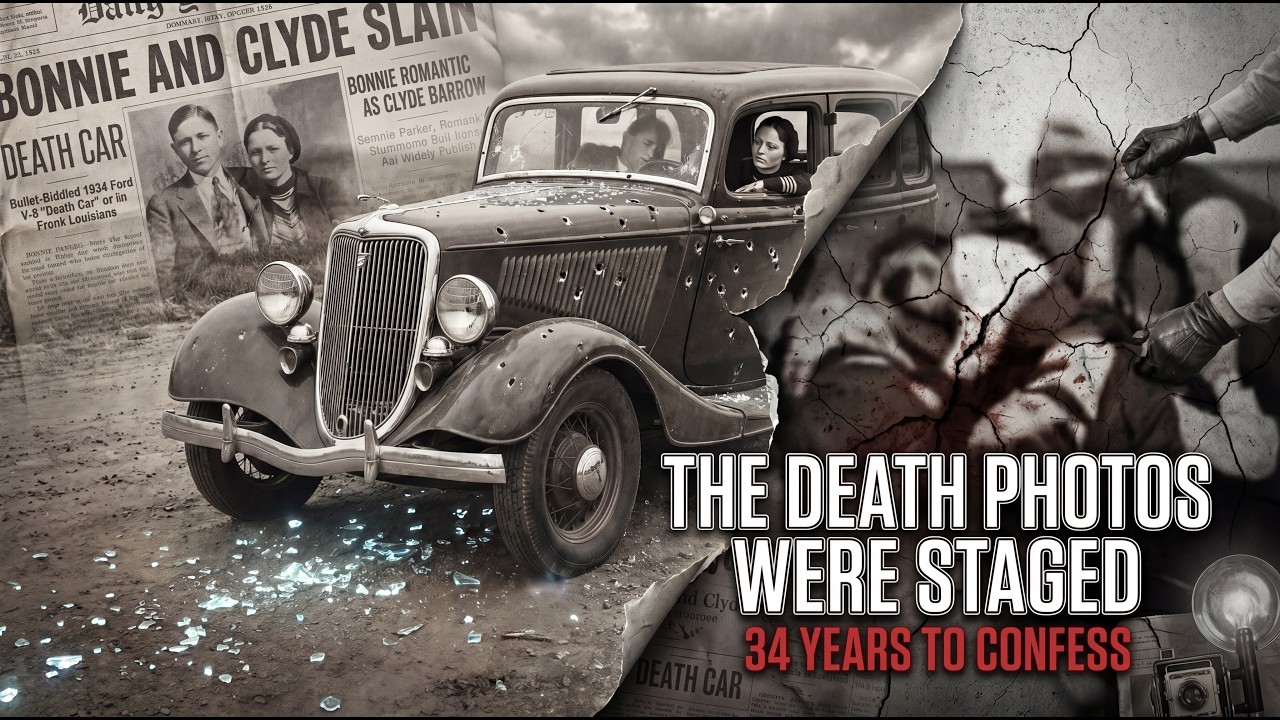
Hinton did what he was told. He went to the car, took hold of Bonnie Parker, and rearranged her against Clyde Barrow so that the cameras would capture something the real scene had never contained. For the next thirty-four years, he did not tell a soul. The most famous crime scene photographs in American history may be entirely staged.
For ninety years, the images have held a fixed place in the national memory: Bonnie Parker slumped against Clyde Barrow in their bullet-riddled Ford, frozen in what looks like their final moment together. The pictures seem to show exactly how the two outlaws died—her head resting near his shoulder, his tipped back against the seat, two young criminals caught in a strange, almost intimate stillness. Generations looked at those photographs and believed they were seeing history as it happened. The evidence now suggests the photographs were arranged, carefully constructed by the very lawmen who had killed them, to tell a story that the brutal truth could not support.
The question that should trouble anyone looking at those images is why a deputy sheriff waited more than three decades to admit he had moved a dead woman’s body. There are other inconsistencies that refuse to go away. Glass fragments scattered across the corpses do not match the bullet trajectories recorded in the official reports. A small-town Louisiana mortician went to his grave insisting he had been ordered to lie about what he witnessed that day in May 1934.
The death car photographs were never just historical documents. They were evidence—and that evidence points to one of the most carefully constructed deceptions in American crime history. The official version of events was straightforward, and for decades it went largely unchallenged. On May 23, 1934, in Bienville Parish, Louisiana, six lawmen ambushed Bonnie and Clyde after a months-long manhunt.
Approximately 130 rounds were fired in about sixteen seconds. Both outlaws died instantly in the stolen Ford V8 sedan. The photographs taken hours later showed exactly how they were found: Bonnie collapsed against Clyde’s right shoulder, Clyde’s head tilted back against the seat, their bodies riddled with bullets but positioned as if death had been almost gentle. The images became the definitive ending to the Bonnie and Clyde saga—proof that crime did not pay, evidence of swift frontier justice delivered by professional lawmen.
Within hours, the photographs circulated in newspapers nationwide, cementing the narrative of two young criminals meeting their inevitable fate. But photographs can lie, especially when the people controlling the scene have reasons to construct a specific narrative. The ambush team was made up of six men with everything to lose if the operation went wrong. Frank Hamer led the group—the legendary former Texas Ranger whose reputation for infallible law enforcement was on the line.
Ted Hinton was the young deputy sheriff from Dallas County, and he had known Bonnie Parker before she turned outlaw. The other four officers represented multiple law enforcement agencies whose credibility depended on ending the Bonnie and Clyde crime spree cleanly and professionally. Around them swirled a widening pool of people with their own interests: local Louisiana law enforcement trying to manage chaos as thousands of souvenir hunters descended on the ambush site; C. F.
“Boots” Bailey, the Arcadia mortician tasked with handling the bodies, who would later claim he received very specific instructions about how to prepare the corpses; and newspaper photographers racing to capture what they knew would be the scoop of the decade. The stakes extended far beyond two dead outlaws. This was about Frank Hamer’s reputation as a lawman who always got his target. It was about the credibility of multiple law enforcement agencies that Bonnie and Clyde had embarrassed for over two years.
It was about a Depression-era nation hungry for closure to a crime spree that had made folk heroes out of cop killers. Everyone involved needed this to look perfect. The official timeline placed the ambush at 9:15 in the morning on a rural Louisiana highway near Gibsland. The posse waited in roadside bushes after receiving a tip about Bonnie and Clyde’s location.
Clyde was driving their stolen Ford. Bonnie was reportedly eating a sandwich in the passenger seat. The ambush began without warning. According to all six officers, the outlaws never had a chance to surrender, though whether surrender was ever a real option remains disputed.
The car rolled to a stop after absorbing over a hundred rounds. Both occupants were clearly dead. Silence. Then chaos, as locals emerged from nearby farms and businesses, followed by law enforcement securing the scene.
Within hours, photographers arrived from Shreveport and other regional newspapers. They documented everything methodically: the bullet holes in the car, the weapons found inside, the blood. But most importantly, they captured Bonnie and Clyde in death, positioned almost intimately in the front seat. Those photographs became evidence, history, and legend simultaneously.
They proved the efficiency of American law enforcement and the finality of criminal justice. The case was closed not just legally but in the public imagination. Justice served. Two cop killers stopped permanently.
Frank Hamer became a national hero. The other officers received commendations. The photographs served their intended purpose perfectly. For thirty-four years, the story held without contradiction from any of the six ambush participants.
Then, in 1968, Deputy Ted Hinton published a memoir titled *Ambush*. Buried in its pages appeared a shocking admission that changed everything about those famous photographs. Hinton wrote, in his own words: “I rearranged them for a better picture. ” He had moved Bonnie’s body.
He had positioned her against Clyde for the photographers. The admission raised immediate questions that Hinton did not fully address in his memoir. Why admit it thirty-four years after the fact? Why had none of his fellow officers ever mentioned the detail in their own accounts?
What exactly did “rearranging for a better picture” involve? And most troubling of all: what had the scene actually looked like before Hinton’s intervention? The answers began to emerge in the 1980s, when crime scene analysts started examining the death car with more sophisticated techniques. Glass fragments were scattered across the bodies in patterns that did not match the bullet trajectories documented in the official reports.
If Bonnie and Clyde had been shot through the car windows, as claimed, physics suggested the glass should have fallen differently. The fragments appeared to be lying on top of blood that should have flowed after the shooting stopped. That indicated the bodies had been moved after the initial blood loss but before the glass had settled. Someone had disturbed the scene.
In 1979, the aging mortician Boots Bailey broke decades of silence about his role in handling the bodies. Bailey insisted he had received specific instructions about how to prepare Bonnie and Clyde for transport and viewing. He claimed law enforcement told him to position the bodies in particular ways, though he never specified exactly what those instructions involved. Why would law enforcement care about post-mortem arrangements if they were simply transporting corpses to the morgue?
Bailey’s statement suggested coordination between the ambush team and local officials to control how the bodies would be presented to the public. The real stakes became clearer when the media pressure surrounding the case was taken into account. Frank Hamer’s entire career depended on this ambush looking clean, professional, and completely justified. Any suggestion of evidence tampering or scene staging could destroy multiple reputations and careers.
The American public of 1934 needed heroes and villains, not questions about police procedures. The timing problems multiplied under scrutiny. How had photographers managed to get such perfect, well-composed shots so quickly at a chaotic crime scene? Why did some contemporary witness accounts describe the bodies in different positions from what the famous photographs showed?
And why were certain early photographs taken at the scene never released to the public? More significantly, why had five of the six ambush participants maintained absolute silence about any scene manipulation for decades? Ted Hinton had been the youngest member of the team, the one who knew Bonnie personally from his Dallas County work. Something was eating at him, and that something finally compelled him to break his silence in 1968.
The 1990s brought forensic blood spatter analysis to the death car examination. Modern techniques revealed what investigators in 1934 either could not detect or chose to ignore. The blood patterns told a dramatically different story than the official photographs suggested. Bonnie’s blood showed that she had initially been positioned forward over the dashboard, not gracefully leaning against Clyde’s shoulder.
The spatter patterns indicated she had died face down, likely with severe facial trauma that would have made her unrecognizable. Clyde’s position appeared more consistent with the photographs, but even his final pose showed signs of post-mortem adjustment. Enhanced analysis of multiple photographs taken that day revealed the truth about the scene staging. Early crime scene photos, taken before media photographers arrived, showed the bodies in markedly different positions.
Later photos—the ones that became historically famous—showed the repositioned bodies that created the iconic image of Bonnie and Clyde dying together. Someone had absolutely staged the scene. The question was no longer whether it had happened, but who had ordered it and why. Ted Hinton’s private papers, discovered by researchers decades later, contained the full confession that his published memoir had only hinted at.
The complete truth was more disturbing than anyone had imagined. Hinton had been explicitly ordered to reposition Bonnie’s body because the actual death scene was too gruesome and undignified for public consumption. Bonnie had been shot multiple times in the face and was slumped forward in what Hinton described as an unglamorous position that did not fit the story they needed to tell. The brutal reality of 130 bullet wounds and destroyed faces would not serve law enforcement’s narrative needs.
They required photographs that showed a clean end to the Bonnie and Clyde saga. The cover-up was not about hiding police misconduct or an unjustified shooting. It was about controlling public perception and historical narrative. Law enforcement wanted photographs that depicted two outlaws who had died together almost romantically, rather than the savage reality of what happens to human bodies when hit with that volume of gunfire.
Frank Hamer and the other senior officers made a calculated decision: the American public needed a palatable version of violent justice. Ted Hinton, as a junior member of the team, was assigned to create that version. What is known now, based on ninety years of investigation, is that the most famous crime scene photographs in American history were indeed carefully staged—not to conceal a wrongful shooting or cover up criminal behavior by law enforcement, but to construct a more acceptable version of brutal justice for mass media consumption. Ted Hinton carried the psychological weight of that deception for thirty-four years before finally admitting his role in creating false historical evidence.
The staged photographs became the accepted truth that three generations of Americans believed without question. The real scene was apparently too graphic, too honest about what violence actually looks like, for the mythology being constructed around Bonnie and Clyde’s death. The repositioned bodies created a narrative of romantic outlaws meeting their fate together, rather than two people destroyed by overwhelming firepower. Several questions remain disputed among investigators and historians.
Did all six lawmen participate in the staging, or was it primarily Hinton’s responsibility? Were there other crime scene manipulations beyond the repositioning of the bodies? How many other historical photographs from that era were similarly arranged for public consumption rather than documenting actual events? The truth, ninety years later, does not change what Bonnie and Clyde did during their crime spree, or the likelihood that they would have continued killing law enforcement officers.
But it reveals how authorities were already manipulating crime scene evidence for media consumption in 1934, establishing practices that would become standard procedure for decades to come. It also demonstrates how easily false narratives become accepted history when they serve everyone’s interests. Law enforcement got their heroic story. The media got compelling photographs.
The public got closure. Only the historical record suffered.
