The tent flap opened, and the room went cold before a single word was spoken. A young aide crossed the headquarters floor with a pale face, clutching a telegram in his trembling hand. The red border around the paper meant one thing: immediate operational intelligence. Montgomery took the message from him and read it once, then twice, as if the words might rearrange themselves into something more acceptable on the second pass.
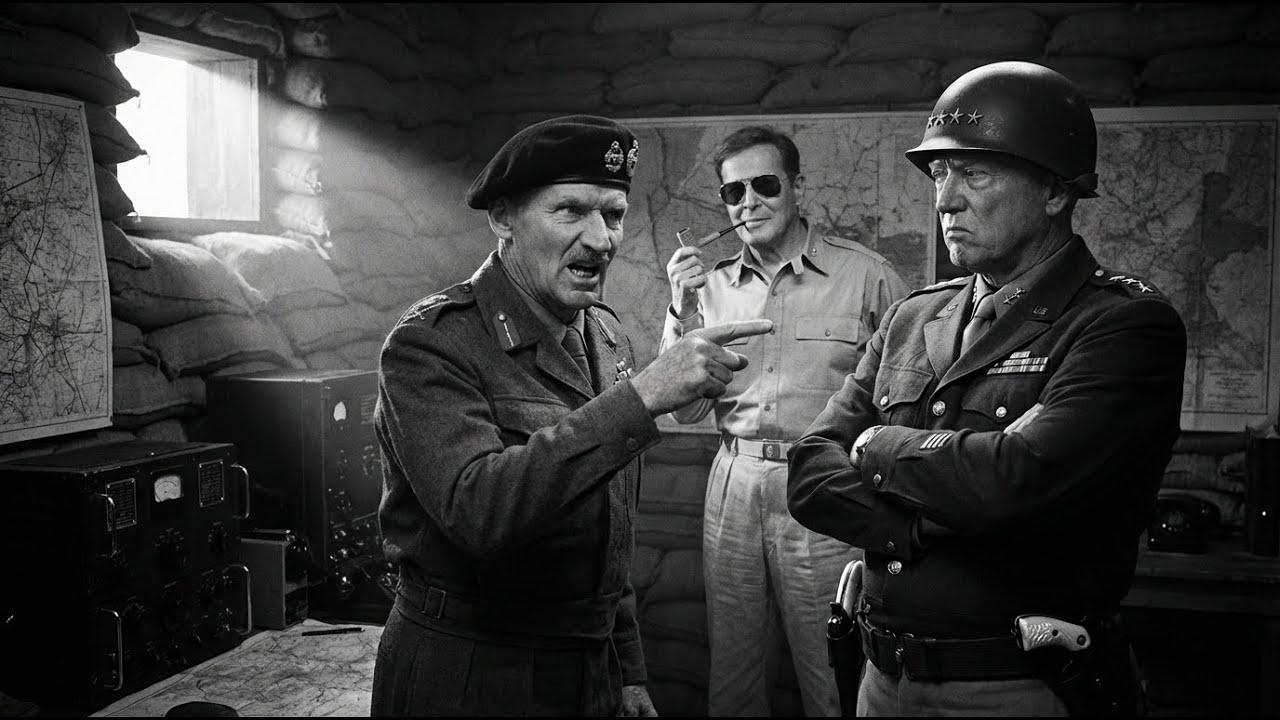
The Third US Army crossed the Rhine last night. Oppenheim sector, light resistance. Patton. Silence filled the command post.
The other officers froze, sensing the shift in the air without yet understanding its cause. Montgomery’s expression remained controlled, but those who knew him saw the subtle tightening of his jaw, the barely perceptible narrowing of his eyes. No coordination. No ceremony.
No permission. No prior warning. While Montgomery had been perfecting every detail of Operation Plunder, his massive artillery bombardment, his coordinated airborne and amphibious landings, his carefully staged media coverage meant to showcase Allied power under British command, George S. Patton had simply crossed the Rhine under cover of darkness in small assault boats.
No noise. No complex preparations. Just soldiers, boats, and the night. By dawn, American forces held the eastern bank.
Engineers were already laying pontoon bridges. Tanks were preparing to cross. The Third Army was advancing while Montgomery’s meticulously planned moment of glory remained in its final preparation stages. The triumph that Montgomery had crafted so carefully, the victory that would cement Britain’s place after years of sacrifice and determination, had been reduced to a historical footnote by an American general who had refused to wait his turn, refused to respect the chain of planning and authorization, refused to accept that some moments demand patience and coordination.
“Get me Eisenhower,” Montgomery said quietly. His voice was controlled, but the sharp edge in it told every officer in the room this was no routine request. Within hours, he would craft a letter demanding something unprecedented in Allied command relations: the removal of George S. Patton from his post.
It would be formal, detailed, and unambiguous. Montgomery would argue that Patton’s actions constituted disobedience of orders, undermined operational coordination, and threatened the very foundation of Allied unity. Far away in the Pacific theater, Douglas MacArthur, another general who understood controversy and ego perhaps better than any living man, would offer a response that would shock Allied command and alter the course of the crisis in ways no one expected. But this confrontation had not been born in a single night of unauthorized river crossing.
It was the culmination of nearly two years of rivalry, resentment, and fundamentally different visions of how to win a war. A struggle that threatened Allied unity from the shores of Sicily to the hedgerows of Normandy, from the catastrophic bridges of Market Garden to the desperate winter fighting in the Battle of the Bulge. And now, on the eve of final victory over Nazi Germany, it threatened to tear the alliance apart entirely. Bernard Law Montgomery and George Smith Patton Jr.
were not merely two commanders with different styles. They embodied two opposing philosophies of war itself, shaped by different experiences, different national military cultures, and fundamentally different beliefs about how battles are fought and won. Montgomery had survived the trenches of the First World War, where he witnessed firsthand what happens when generals send men forward without adequate preparation. He watched the flower of Britain’s youth slaughtered in futile attacks against fortified positions.
He saw how improvisation and bold initiative meant death and disaster, while careful planning and overwhelming force meant survival and eventual victory. Those experiences, etched into his consciousness during the most formative years of his military career, shaped everything that followed. He rose through the methodical British military culture, a system that valued precise preparation over inspiration, and believed wars are won by systematic planning, not brilliant improvisation. His approach was almost scientific, almost mathematical.
Calculate the force required. Amass overwhelming superiority. Plan for every contingency. Execute with discipline and coordination.
Victory through certainty. Victory through ensuring the battle is decided before it begins. Every variable must be controlled. Every possibility must be planned.
Nothing should be left to chance or the inspiration of the moment. Montgomery believed wars were too important to be left to the chaos of combat. They must be decided in planning rooms before the first shot is fired. George S.
Patton believed the exact opposite, with equal conviction. Speed is salvation. Momentum is everything. Hesitation kills more soldiers than enemy fire.
Wars are won by commanders willing to seize fleeting opportunities before the enemy can react, leaders who understand that war is fundamentally about will and speed rather than careful calculation. Strike hard before the enemy expects it. Move fast before they can respond. Force the enemy to fight your battle on your terms, not theirs.
Keep them off balance, reacting to your movements rather than executing their own plans. Victory through momentum. Victory through denying the enemy time to prepare, coordinate, or build the fortifications that make frontal assault so costly. Patton’s philosophy came from different experiences.
He had studied cavalry warfare where speed and shock were everything. He had absorbed military history, particularly Napoleon’s campaigns, where rapid movement and bold maneuver decided battles against superior numbers. He believed in the spirit of the offensive, in the moral weight of aggressive action, and in leadership that inspires rather than merely manages. Their collision was inevitable from the moment they were assigned to work together.
But coalition warfare made it catastrophic, magnifying personal and professional disagreements into matters of national prestige and alliance politics. Britain fought for survival and pride after years of standing alone against Nazi Germany. Every victory mattered not just militarily but symbolically. British commanders viewed caution as wisdom earned through bitter experience.
Having survived where others had fallen, they understood the true cost of reckless action. America fought with industrial confidence and restless energy. American generals saw the war as a problem to be solved through the application of overwhelming resources and aggressive action. They viewed British caution as cowardice disguised as prudence, a refusal to take the risks necessary for victory.
And standing between them was Dwight David Eisenhower, a diplomat in military uniform who fought his greatest battles not against the Germans but between the Allies. His genius lay not in battlefield tactics but in political maneuvering. He managed egos that would have destroyed lesser men. He balanced national pride, soothed wounded feelings, and kept the Montgomery-Patton rivalry from shattering the alliance.
But even Eisenhower, with all his diplomatic skill, could not reconcile their fundamental beliefs about war. He could manage the symptoms, but he could not cure the disease. Montgomery saw Patton as reckless at his core, a “cowboy” whose theatrical behavior and aggressive tactics endangered soldiers’ lives for personal glory. Patton saw Montgomery as paralyzed by caution, a “bureaucrat” whose endless planning squandered precious opportunities and needlessly prolonged the war.
Each considered himself indispensable to Allied victory. Each considered the other a danger to the war effort. In July 1943, they faced their first test together on the island of Sicily, where military victory proved far easier than maintaining the partnership. Operation Husky, the Allied invasion of Sicily, was designed from the start to be a showcase for Montgomery’s abilities.
When Allied planners discussed invasion strategy in the spring of 1943, Montgomery’s influence was decisive. He argued forcefully for his preferred approach, leveraging the reputation he had earned at El Alamein, where he secured Britain’s first major land victory over German forces. The final plan concentrated the British Eighth Army on Sicily’s eastern coast, positioned to drive north directly toward Messina, the strategic prize of the island. Whoever controlled Messina controlled the narrow strait separating Sicily from the Italian mainland.
It was the key to everything. Patton’s Seventh Army was assigned to protect Montgomery’s left flank, essentially a supporting role in what was planned to be a British-led triumph that would restore Britain’s military prestige after years of setbacks. Patton refused to accept that role. Once his forces landed, he began planning something different, something that would vindicate his methods and establish American independence from British command.
While Montgomery advanced steadily along the eastern coast against stiff German resistance, exactly as planned but at a slower pace than hoped, Patton improvised brilliantly. He wheeled his army westward, racing across Sicily’s mountainous terrain in a lightning campaign that captured Palermo on July 22. The Americans moved so quickly that German forces barely had time to establish defensive positions before being flanked and bypassed. Then Patton turned his entire army east toward Messina, transforming what was supposed to be a flank-protection mission into a race for glory.
What followed was less military necessity and more personal competition. Both armies drove toward the same objective down parallel roads. The commanders were fully aware they were racing each other as much as fighting the enemy. Patton arrived first, on August 17, 1943.
Photographers captured American troops celebrating in the streets of Messina. Headlines across America praised Patton’s boldness and speed. Radio broadcasts celebrated American initiative and offensive leadership. Montgomery arrived hours later to find the glory already taken, the photographs already snapped, the headlines already written, and the carefully planned British victory overshadowed by American improvisation.
Publicly, Allied leaders celebrated a successful campaign that secured Sicily in just thirty-eight days. Privately, Montgomery seethed. His reputation as Britain’s premier field commander had been challenged and diminished. The narrative he had built was crumbling.
Meanwhile, Patton grew bolder. He had proven his methods worked. Speed had triumphed over systematic caution. Bold action had succeeded where careful planning moved slowly.
The lesson seemed clear. The Allies had won a decisive victory in Sicily, but rivalry had replaced partnership. Cooperation had been poisoned by contempt. What began as professional competition was turning into something more dangerous, a personal vendetta that would follow both men to the shores of Normandy and beyond, threatening Allied unity at every critical turn.
When planning began for Operation Overlord, Eisenhower appointed Montgomery to command all Allied ground forces in the invasion’s early stages. Montgomery’s plan was strategically sound. Capture Caen quickly to anchor the eastern flank, force German armored reserves to fight there, and create conditions for the American breakout in the west. Caen was supposed to fall on D-Day, June 6, 1944.
It took six brutal weeks instead. British and Canadian forces ground forward through some of the fiercest fighting of the European war, suffering heavy casualties against entrenched German SS Panzer divisions. Every village became a battlefield. Every field was seeded with enemy positions.
In London and Washington, questions mounted. Why was the advance so slow? Why were casualties so high? Why had Montgomery failed to achieve the breakout he had promised?
Montgomery responded by reframing failure as strategy, claiming the prolonged battle was always intentional, carefully designed to draw German strength away from the American sectors. Whether this was true or a post-hoc justification remains debatable, but it preserved his reputation while raising doubts among American commanders. Meanwhile, Patton waited in England, still marginalized after the infamous incidents in Sicily where he had slapped two soldiers suffering from combat fatigue. From his forced position, he watched the Normandy campaign bog down, watched Montgomery’s promised breakthrough fail to materialize, watched the entire invasion seem to sink into the mud.
But on August 1, he returned to active command, leading the newly activated Third Army. What followed was militarily astonishing. Patton’s forces raced across France in one of the fastest advances in military history, liberating territory at speeds that defied conventional doctrine and German expectations. His tanks covered in three weeks what Montgomery’s armies had struggled six weeks to achieve.
One city after another fell to American forces that moved faster than German commanders could respond. The breakout from Normandy became an American triumph. Newspapers shifted their focus from the grinding British battles to the spectacular American breakthroughs. Public attention moved from Montgomery to Patton.
The narrative Montgomery had carefully controlled was slipping from his grasp. What had been a professional rivalry in Sicily became a war over reputation in France. Montgomery no longer simply disagreed with Patton’s methods. He needed to prove them wrong.
He needed to show that careful planning achieved better results than reckless speed. Strategy became personal. Ego became military doctrine. And as the Allied armies raced toward the German border, Montgomery demanded not merely priority but total control.
That gamble would cost thousands of lives, precious momentum, and whatever small measure of trust remained between the Allies.
