The cage had no bars. That was the worst part of it. Two boys sat on cushions stitched with silver thread in chambers where the air smelled of cardamom and crushed rose petals. Trays arrived without asking.
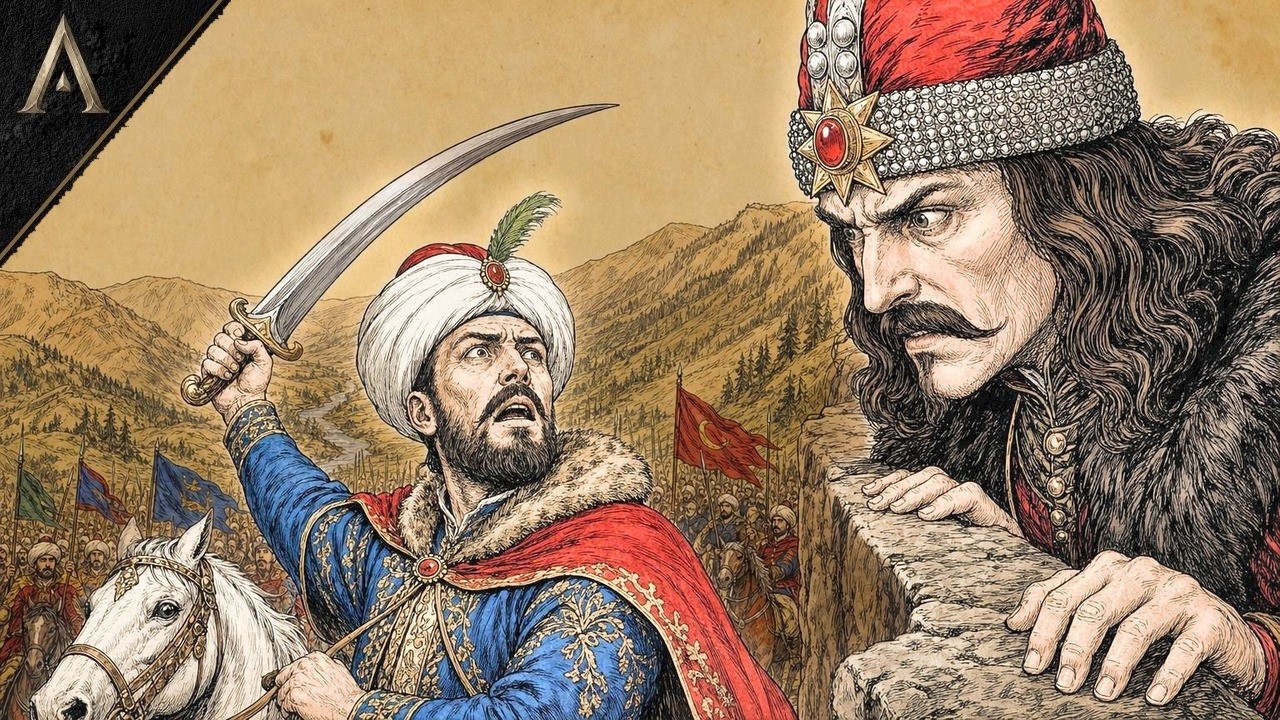
Honeyed pistachios, lamb pulled apart by saffron and slow fire. Tutors filed in at dawn with scrolls on geometry, the stars, the verses of the Quran. From the courtyard walls, it looked like a gift. Inside those walls at the Ottoman court of Edirne, it was a transaction.
Two children taken from their homeland, handed over by their own father to keep his throne warm. Their names were Vlad and Radu. One was about eleven. The other had just turned six.
And every sweet thing placed in front of them carried the same silent message: if their father broke his word, they would die before sundown. Vlad learned the language fast, then used it to study his captors the way a hunter studies the animal he intends to kill. He watched how the empire moved its soldiers, how it punished its disobedient, how it broke proud men into kneeling shapes. He stored every detail behind eyes that, according to those who met him, never stopped counting.
Radu went the other way—younger, softer, beautiful in the way that turns the heads of powerful men. He did not resist the Ottoman world. He stepped inside it. He walked its corridors with a smile, charmed its princes, and slid into the bed of a young heir named Mehmed.
The boy who would one day take Constantinople. One forge, two blades. One pointed outward, burning with hate. The other turned inward, polished, patient, smiling.
This is not the story of Dracula the vampire. That legend buried the real one. Forget the mountain castle. Forget the cape, the coffin, the fangs.
The truth is a civil war that began in a child’s bedroom and ended with a severed head packed in a jar of honey. Vlad the Impaler, the man who made Mehmed the Conqueror turn his army around and retreat, was not brought down by an empire. He was brought down by his little brother. Radu the Handsome, the boy who traded his country for silk sheets, is the name history almost erased.
He is also the one who won. AD 1442. Two boys kneel on a marble floor inside the throne room of Sultan Murad II, and neither of them is shaking. The hall is enormous.
The ceiling is painted in geometric patterns of gold and indigo that repeat themselves into a kind of mathematical infinity. Lamps of beaten brass hang on chains from beams of cedar imported from Lebanon. The floor under the boys’ knees is veined marble cut from quarries near Marmara, polished so cleanly it reflects the lamps as though the room were doubled. Janissaries line the walls in their tall white headgear, motionless, the brass plates on their belts catching the lamplight.
The air smells of alderwood smoke from a censer near the throne, and of the lanolin grease the guards rub into their leather. The older boy, Vlad, is around eleven. The younger one, Radu, is six or seven, small enough that the silk kaftan on his shoulders bunches at the wrists and pulls around his knees. Behind them stands their father, Vlad Dracul, prince of Wallachia, a sworn knight of the Order of the Dragon, the chivalric brotherhood founded by Emperor Sigismund of Luxembourg in AD 1408 to push back the Ottoman tide.
The dragon device sits on his cloak: a serpent curled into a ring, swallowing its own tail, the cross of St. George burned across its back. He is a man who has taken an oath before God and Christendom to bleed for the cross. He is also a man who has just placed his two living sons at the feet of the Sultan as a guarantee—proof of his obedience written in the bodies of his children.
He will mount his horse and ride home to Wallachia. They will not. No chronicler recorded what he said to them before he turned around. Not the Byzantine Ducas, not the Ottoman Ashik Pashazade, not the German chronicles compiled later at St.
Gall. No farewell, no written apology, no surviving letter pulled from any archive. He walked out, and the cedar doors of the Ottoman court swung shut behind him like the lid of a coffin. To understand how a Christian prince ends up handing his children to a Muslim sultan, you have to back up only a few months, to a trap so elegantly built that one of the cleverest rulers in Eastern Europe walked into it without seeing the wire.
Vlad Dracul had spent years balancing the impossible geometry of fifteenth-century Wallachia: a small principality wedged between the Kingdom of Hungary to the north and the rising Ottoman Empire to the south, roughly 75,000 kilometers of forest, river valley, and Danube plain. Too weak to fight either neighbor. Too valuable, sitting on the trade roads between Brașov and the Black Sea ports, to be ignored. Wallachian princes survived by playing both giants against each other, taking protection from whichever side offered better terms, then betraying both when the wind shifted.
Dracul was a master of this game. In AD 1437, he had marched with Murad against Transylvania. In AD 1441, he had welcomed John Hunyadi into Târgoviște and helped plan a campaign against the same Sultan. By AD 1442, the bill came due.
Murad summoned him to Gallipoli, the fortress port at the mouth of the Dardanelles, the same crossing the Ottomans had used to step into Europe almost a century earlier. Dracul rode in expecting negotiation, maybe even an alliance. He was wrong. According to the Ottoman court historians, Murad had him seized the moment he passed the gates, bound and held under guard, while the terms of release were laid out in three lines: go home, swear loyalty, pay an annual tribute of 10,000 gold ducats, and leave your sons behind.
The boys would be treated as guests—educated, fed, clothed in fine cloth—but they would remain inside Ottoman walls for as long as the Sultan wished. The day Wallachia rebelled, the day Dracul broke his word, those two boys would be the first ones to bleed. The Ottomans had been perfecting this mechanism for generations. The Byzantine emperors had used it before them.
The Persians before that. Hostage-taking in plain language, but the empire dressed it in softer clothes: an educational arrangement, a cultural privilege, a chance to study at the most refined court in the known world. The framing was not entirely a lie. What was done to these children was not flogging or starvation.
It was something colder and more permanent. They built a world around the boys so complete, so beautiful, and so impossible to leave that, piece by piece, it began to overwrite the one they had been taken from. Edirne in the 1440s was the heartbeat of an empire that ran from the Balkans deep into Anatolia. The city sat at the meeting of three rivers—the Tundzha, the Maritsa, and the Arda—and the bridges crossing those rivers were thick with traders from Ragusa, Kaffa, Bursa, and Cairo.
The Friday call to prayer rolled off the minaret of the Eski Camii, the old mosque finished only twenty-eight years before the boys arrived, and the sound carried over tile rooftops still steaming from the morning rain. Caravans from the east unloaded saffron from Khorasan, silk from Tabriz, indigo cakes pressed in Bengal. The palace where the brothers lived was not a prison in any familiar sense. It was a maze of courtyards and gardens, libraries and training yards staffed by scholars and soldiers and courtiers pulled from every land the Sultan had swallowed.
There were gardens of pomegranate trees brought from Persia, water clocks that struck the hours with brass figures of horsemen. The food alone would have stunned two boys raised on Wallachian bread and boiled meat: spice blends with no equivalent north of the Danube, layered pastries soaked in syrup, lamb cooked with dried plums and pomegranate seeds, rice stained yellow with saffron from Anatolian highlands. The buildings themselves spoke a vocabulary of power they had never seen—arched colonnades, tile work in lapis and turquoise, geometric and endless, fired in the kilns of Iznik, indoor fountains that ran day and night because the empire could afford to let water run for no reason except beauty. If Wallachia was woodsmoke and frost and mud-rutted forest roads, Edirne was the opposite of every memory their bodies carried.
The Ottoman program for training elite hostages was not improvised. It was a system refined since the reign of Murad I in the previous century, organized through the institution that would eventually become known as the Enderun, the inner palace school. Tutors arrived for Turkish, then Arabic, then Persian. The boys studied the Quran—not as a conversion lever in those first years, but as the foundational text of the civilization they now lived inside, the way a student in a Roman court would have been drilled on Virgil.
They learned mathematics through the works of al-Khwarizmi, astronomy from copies of Ulugh Beg’s star tables, the geometry of fortifications, the logistics of moving armies across long distances, the mechanics of siege engines, including the bronze bombards that would, within a decade, crack the walls of Constantinople. They trained their bodies—horseback, bow, sword, wrestling—alongside other hostage sons drawn from the conquered nobility of Serbia, Bulgaria, Greece, and the Anatolian frontier: the sons of Branković, the sons of the Lazarević line, boys from Albanian clans whose fathers were already negotiating with a young captain named George Kastrioti, the one who would later become Skanderbeg. It was one of the most efficient machines history has ever built for turning the children of defeated peoples into instruments of the empire that defeated them. Both brothers were sharp.
The sources, thin as they are, agree on that. They picked up the language quickly. They moved through the curriculum without stumbling. But the way each of them stood inside this new world was not the same.
And the difference showed early. Vlad watched. He moved through the Ottoman court the way a wolf moves through unfamiliar woods: quiet, patient, mapping every exit. He was not studying a subject.
He was studying an enemy. He noted how power flowed through the empire’s veins, how obedience was extracted from the conquered, which methods broke a man, and which methods only made him angrier. He paid attention to which faces went still when a certain vizier walked into a room. The chronicler Laonikos Chalkokondyles, writing decades later, describes the young Vlad as openly hostile to his Ottoman handlers, talking back, refusing instruction, fighting other students, punished for it more than once.
The specifics did not survive in detail, but the shape of them did: a boy who would not perform gratitude for the gift of his own captivity, and who took the beatings rather than smile. He was not broken. He was taking notes. There is one thing in particular that Vlad saw during these years that would never leave him: the Ottoman practice of impalement.
This matters because popular memory hands impalement to Vlad as if it were some Wallachian peasant custom he dreamed up in a candlelit tower. It was not. Impalement as a method of execution and mass intimidation was an Ottoman instrument, used across the empire’s expansion to keep conquered populations frozen in place. The stakes went up outside city gates after rebellions in Anatolia.
They went up along the Danube frontier after each Wallachian uprising. The boys at Edirne would have seen the bodies the way a child raised near a slaughterhouse becomes familiar with the smell without ever being formally introduced to it. The stake was part of the furniture of Ottoman power. Vlad filed it away the way he filed everything else: as a study in how fear scales.
Radu, inside the same walls, became a different creature entirely. He did not resist. Some of that was age. A six-year-old is softer clay than an eleven-year-old, and the Ottoman court began molding him before whatever he might have become in Wallachia had time to harden.
But the chronicles point to something more than age. Radu had a quality his brother did not: people wanted to be near him. The sources are unusually consistent about his physical beauty, which is why the epithet cel Frumos, the Handsome, stuck the way it did. And it wasn’t only the face.
It was the way he entered a room, the way he listened, a warmth that drew powerful men toward him without anyone deciding to be drawn. He used it, whether knowingly or by instinct hardly matters. In court politics, the line between real charm and weaponized charm is mostly a fiction. What the records show is that Radu rose.
He was welcomed into circles most hostage princes never breathed in. And the most important of those circles belonged to the heir apparent—a prince several years older, fiercely intelligent, hungry, strange. Mehmed, son of Murad, who at the age of twelve had briefly held the Ottoman throne when his father attempted to retire to a Sufi lodge in Manisa. Mehmed, who already spoke six languages by the time Radu met him.
Mehmed, who would within a decade make himself the most feared man on three continents. The future Conqueror. The exact nature of the bond between Radu and Mehmed has been argued over for centuries, though the argument is less about evidence than about how much modern readers want to flinch from it. Ducas writes that Mehmed, drunk one night, attempted to force himself on Radu, who at first defended himself with a dagger, and that the relationship deepened from there into something neither violent nor distant.
Other Byzantine and Ottoman chronicles speak more carefully, but agree that Radu occupied a place beside Mehmed that went far past court protocol. The physical specifics are not the point. The political consequence is: Radu, the Wallachian hostage, became indispensable to the man who would soon command the largest army in the Eastern world. Not a prisoner being managed—a person the most dangerous man alive wanted close.
That kind of position rewrites a life. While these two versions of the same boy were being built inside Edirne, the country they had been stolen from was eating itself exactly the way Wallachia tended to. The news arrived in pieces. Catastrophic news always does.
Fragments first, then the full shape of it, which is always worse than the fragments suggested. The year was AD 1447. Their father, Vlad Dracul, was dead. Not in battle, not by Turkish hands.
He had been hunted down by a faction of Wallachian boyars—the noble class whose loyalty and treachery powered every princely dynasty in the region—working in coordination with John Hunyadi, the voivode of Transylvania, the same man Dracul had once welcomed into Târgoviște six years earlier. Dracul had played one side too many. Worse, he had failed to support Hunyadi at the disaster of Varna in AD 1444, where King Władysław III of Poland was killed and the last crusader army of the century was shattered. Hunyadi never forgave him.
The sides had finally closed. Dracul was ambushed at Bălteni in the marshlands north of Bucharest, pulled from his horse and killed in the reeds. The news about their older brother Mircea was uglier. Mircea had been ruling beside their father, carrying the family’s claim to the throne.
The same boyars caught him alive in Târgoviște. They blinded him first—a standard medieval method of political erasure: hot iron pressed into the sockets, burning out the eyes to make a man legally unfit to rule under the customs of the age, the same technique Byzantine emperors had been using on rivals for six centuries. Then, with him still breathing, they buried him. Whether he was conscious when the dirt closed over his mouth is a question the sources do not answer.
The answer doesn’t really matter. Hold that information for a second. Picture it landing in Edirne. A messenger crossing the Bosphorus by ferry, riding the post road through Thrace, dismounting in a courtyard where two boys are being drilled in Arabic conjugation.
Two boys already torn from their country, already living as expensive prisoners under a foreign sky, told that their father is rotting in a swamp and their older brother was blinded and buried alive by his own countrymen. Not killed by enemies. Killed by Wallachians. By the same noble class they were supposed to rule.
One day, the same news struck each brother from a different direction. And those two directions explain almost everything that comes next. For Vlad, it locked into place the lesson he had been building for years inside the Ottoman court. Trust was bait.
Loyalty was a costume men put on before they stabbed you. The boyars who had butchered his family were the same class he would have to rule one day, and his father’s death proved that ruling through their cooperation was a fantasy that ended with a prince face down in a marsh. The only stable bond between a ruler and his subjects was fear—not love, not respect, not negotiation—fear maintained at a temperature so high that a man would prefer death to disloyalty. Vlad did not become this from damage.
He became this from arithmetic. For Radu, the same news ran through a mirror. Wallachia was a slaughterhouse of greedy nobles and dying dynasties. A cold, poor, miserable place where every prince eventually got the same ending.
And here he was, inside the strongest empire on earth, beside the man who would soon command its armies, eating from silver plates, sleeping without a blade under his cushion. His brother could go back and burn for that mess if he wanted. Radu was not going home. The Ottoman court was not his cage anymore.
It was where he belonged. He had chosen. The final split came when the Ottomans decided Vlad had grown into something useful. He had the bloodline.
He had the name. He had a claim to the Wallachian throne that could be played whenever the current prince got inconvenient. That current prince was Vladislav II, installed by Hunyadi himself, which made the Ottomans nervous. They needed a counterweight.
Vlad was it. He was also, after years of Ottoman schooling, deeply familiar with how the empire fought, which meant Constantinople thought it could predict him. They would put him on the throne. He would pay tribute.
The leash would be managed from the south. Vlad accepted—not from gratitude, not because Murad had won him over. He accepted because the men who killed his father lived in Wallachia, and the road home now ran through the Sultan’s blessing. Years of captivity had taught him patience.
They had also given him a route back to the people he intended to bury. Radu did not go with him. No record shows him asking. No source describes him grieving the separation.
He stayed in Edirne, and then in Constantinople after May 29th, AD 1453, when Mehmed’s bombards finally cracked the Theodosian walls and the queen of cities fell after a thousand years of standing. Radu was inside Mehmed’s inner circle on the day the Sultan rode through the breach at the Gate of St. Romanos. Radu cel Frumos stayed exactly where he had placed himself: at the right hand of the Ottoman world.
Comfortable. Powerful. Loyal. Two brothers.
The same father. The same stolen years. The same cold marble under their knees in a foreign throne room. One went home to burn down the people who had destroyed his family.
The other decided those people had been right. Vlad rode back into Wallachia for the first time in AD 1448, taking advantage of Hunyadi’s absence at the second battle of Kosovo, where the Hungarian army was being smashed by Murad on the same field where the Serbian nobility had died fifty-nine years earlier. Vlad held the throne for about two months before Hunyadi returned and threw him off again. He scattered into exile—Moldavia first, to the court of his cousin Bogdan II, where he met a boy his own age named Stephen, the future Stephen the Great, the prince who would one day defeat the Ottomans at Vaslui.
The two of them swore to help each other onto their thrones. Then Bogdan was assassinated in AD 1451, and Vlad ran again—this time straight into the lion’s mouth, to Transylvania, to the court of John Hunyadi himself, the man who had killed his father. He convinced Hunyadi that he was a better Ottoman counterweight than Vladislav II. Hunyadi believed him.
History rarely produces a stranger alliance. The permanent return came in AD 1456. Hunyadi died of plague that summer outside Belgrade, days after winning the siege that saved Hungary from Mehmed. The political balance cracked.
Vlad moved. He killed Vladislav II in single combat near Târgoviște. The chronicles are sparse but consistent on this. And he sat down on the Wallachian throne for the reign history would remember.
His first act was not a treaty, not a tax reform, not a fortress, not a letter to Constantinople. He threw a feast. He invited the boyars who had killed his family and buried his brother. He sent the invitations under his princely seal.
He called it an Easter celebration. He told them to come in their finest clothes. He told them to bring their wives and their sons. And what happened inside that hall on Easter Sunday, AD 1457, is still being whispered about six centuries later.
Easter Sunday, AD 1457. Târgoviște. The bells of the princely court ring across the muddy streets of the Wallachian capital, and the boyars come walking out of the spring fog in their finest cloth. They come from the great families—the Craiovești from the south whose lands lay along the lower Olt; the Albești from the foothills near Curtea de Argeș; the Florescu; the Bărcănești; the Mihăilă.
Names that appeared in donation charters during the reigns of nine different princes: princes they had served, betrayed, replaced, and outlived. They wear cloaks lined with marten and sable, silver belts forged in Sibiu workshops, boots stitched in Brașov. The women walk a step behind in long gowns of Florentine wool dyed crimson with kermes and indigo from Ottoman trade routes, with silver pectoral crosses at the throat. The sons and daughters trail them, scrubbed for the occasion, pulled from monasteries at Cozia and Tismana and country estates along the Argeș for what has been announced as a feast of reconciliation.
Vlad had sent the invitations under his princely seal: the dragon coiled around its tail, the emblem of the Order of the Dragon, the same device his father had worn the day he was pulled from his horse at Bălteni and killed in the reeds. The invitations went to every major boyar house. The old patriarchs who had sat in the council chamber the morning his father was condemned by silence. The middle generation who had inherited their fathers’ rings and their fathers’ debts.
The young heirs whose only crime was the surname on their baptismal records. They came because to refuse was treason. They came because Wallachian boyars had been managing princes for a hundred years and they assumed they could manage this one. They came because the prince was twenty-six, recently installed by force of arms in August AD 1456 after killing Vladislav II in single combat near Târgoviște.
They had managed his father. They had managed Vladislav II. They had managed Alexandru Aldea before him. They had managed Dan II before that.
The machine had worked for four generations. Until it did not. The hall in the princely court was lit with tallow candles set in iron stands wrought by smiths from the Slătioara guild. The trestle tables had been laid with linen from Sibiu and decorated with sprigs of basil, the herb of Easter blessed at the Metropolitan Church earlier that morning.
The kitchens had been working since before dawn: roasted boar from the Vlasia forest; carp from the Ialomița baked whole in clay; bread from the ovens beneath the chapel of St. Nicholas; sheep’s milk cheese rolled in sea salt; wine from the Dealu slopes, dark and resinous, poured from glazed pitchers into pewter cups. The smell of beeswax and roasting fat and damp wool drying near the hearth. Behind a wooden screen, a fiddler from the Romani settlement outside the walls was playing a slow doina, the melody Wallachian shepherds used to call sheep down from the high pastures.
Vlad sat at the head of the table. He wore a kaftan of dark red velvet in the Hungarian cut he had adopted during his exile at the court of John Hunyadi—a deliberate visual statement, since most of the boyars present had Ottoman tastes from years of accommodating the Porte. His mustache was long. His eyes, according to the diplomatic report Modrussa would write later for Pope Pius II, were green and unusually wide, the lashes thick and dark, the gaze of a man who did not blink at expected intervals.
The chroniclers who later reconstructed the scene—Saxon clerics writing from refuges in Brașov and Sibiu, monks at the monastery of Snagov copying down what survivors whispered, the anonymous author of the Slavic narrative known as the Scazanie o Dracula Voievod—agree on the prince’s face that afternoon: still. Watching. The stillness men mistake for calm when it is in fact arithmetic. He let them eat.
He let them drink. He waited until the wine had loosened tongues and the second course was on the table. Then he stood. He did not speak about loyalty.
He did not speak about reform. He asked them a single question: how many reigns had each of them lived through? The boyars answered. They counted aloud.
Some said seven. Some said ten. The oldest among them, a man whose beard had gone white during the reign of Mircea the Elder at the turn of the century, named thirty princes by memory—every Wallachian ruler since the days of Radu I, the entire bloody carousel of the Basarab and Dănești houses, every poisoning and exile and forced abdication and decapitation. He said the number with the small pride of a man who had survived all of it.
Vlad listened to every answer. He did not interrupt. He did not write anything down. He had already written it down in his head, years ago, in a room in Edirne where he had been twelve years old.
Then his guards moved. They came in from the side doors—mercenaries Vlad had brought down from Transylvania during his exile years, men with no ties to any Wallachian house, paid in silver minted at the Sibiu workshops and bound to him by oaths sworn at the chapel of St. John in Făgăraș. The old patriarchs were seized first: the gray-bearded ones, the ones who had been in the room when his father was sold.
They were dragged through the side doors into the inner courtyard, where the stakes had been driven into the earth the previous night. Impalement, when done by men trained in the practice, was an unhurried craft. The stake was rounded at the tip, never sharpened. A sharp point pierced organs and killed too fast.
The wood was greased with mutton fat. The Ottoman manuals from which the technique was borrowed described the proper angle of insertion, the rate of progress, the way to follow the natural channels of the body so that the stake displaced rather than cut. A man impaled correctly remained alive on the wood for a day, sometimes two. The screams from the courtyard rolled back through the high windows into the hall.
The fiddler had stopped playing. The dogs under the table had stopped chewing. The younger ones—the men and women still capable of work—were spared the stake for now. They were bound at the wrists with hemp rope, separated from the bodies of their parents and grandparents, and marched out of Târgoviște that same afternoon in the clothes they had worn to dinner.
Five hundred of them, by the count given in the Scazanie. Other sources give different figures. The German chronicler Michael Beheim, writing his verse account, Story of a Bloodthirsty Madman Called Dracula of Wallachia, around AD 1463 from interviews with a Cistercian monk named Brother Jacob who had escaped Wallachian territory, counts the men and women of the procession separately and arrives at a similar order of magnitude. The march went north.
The destination was Poenari, on the cliff above the Argeș Gorge, roughly fifty kilometers into the Carpathian foothills, along a road that climbed through the villages of Aninoasa and Corbeni and finally crossed the river at the wooden bridge below the cliff. Easter in the southern Carpathians is not spring in any sense a Venetian or Florentine would have recognized. Snow still sits in the high passes above two thousand meters. The Argeș runs dark and full from the melt.
The wind off the Făgăraș peaks comes down through the gorges in a slow river of cold air that moves against the body like cold water. The boyars walked it in slippers stitched for marble floors. The women’s gowns, weighing five or six kilos dry, weighed twice that wet within the first hour of rain. The chronicles record the procession as a slow caterpillar of disintegrating finery moving up the river road, guarded by mounted men carrying lances, leaving a trail of fabric scraps and bodies in the ditches.
Those who fell were not picked up. The guards killed them where they lay. The survivors reached Poenari to find a ruin—a crumbling fortification from the early thirteenth century, raised originally by the Basarab dynasty and abandoned for decades, half collapsed on its limestone shelf above the gorge. Vlad’s engineers, men brought up from the building yards of Curtea de Argeș, had marked out where the new walls would rise.
The boyars were handed tools: iron mauls, wooden levers, leather buckets. They quarried the stone from the cliffside. They mixed mortar with lime hauled up from the kilns in the valley. The women carried bricks in baskets strapped across their backs, up paths a goat would have negotiated carefully.
They worked in the clothes they had worn to the feast until those clothes fell off them in strips, and then they worked in the burlap rags the guards threw down from a pile. Beheim’s account names a boyar woman called Anca, the widow of one of the patriarchs impaled in the courtyard, who reportedly worked at Poenari for forty days before her hands could no longer close around a hammer shaft. The detail survives because Brother Jacob had known her family. Those who survived the construction became the new servants of the completed fortress.
The ones who did not were folded into the foundations or thrown over the cliff into the river two hundred meters below. When Poenari was finished—and it was finished within a year, an extraordinary pace for the work involved—it became Vlad’s true throne. Not the princely court at Târgoviște, where ambassadors were received and the chancellery kept its ledgers. Poenari was where he slept when he wanted to sleep without dreaming.
A fortress accessible only by a single ridge approach, with the river running in a bend two hundred meters below on three sides. Walls built from limestone hauled up by the hands of the people who had murdered his father. The architecture itself was the message. The message required no translation in any language spoken in Eastern Europe.
What Vlad built across Wallachia between AD 1456 and AD 1462 was not a government in any shape the Italian or Hungarian chancelleries would have recognized. It was a single instrument tuned to a single note. And the note was fear. He impaled criminals.
He also impaled merchants who short-weighted their grain at the markets in Târgoviște. Wives who took lovers—the Scazanie records a case where Vlad personally inspected the body of an executed adulteress and ordered her displayed in the market until the corpse fell apart. Servants who stole from their masters. Beggars he judged capable of working.
One account describes Vlad inviting all the beggars of Târgoviște to a feast at an abandoned barn outside the city, locking the doors after they entered, and burning the building down with them inside. The Saxon pamphlets that began circulating across the Holy Roman Empire in the AD 1460s catalog case after case in a tone that wavers between horror and bookkeeping. The legal logic was deliberate. If the punishment for petty theft is identical to the punishment for treason, the population cannot calculate.
There is no minor offense. There is no acceptable risk. There is only the stake. The same stake for everything.
Foreign merchants traveling Wallachian roads during these six years reported a country in which crime had vanished. Not because the people had grown virtuous, but because the roadsides were lined with the ones who had not. The famous story of the golden cup appears in nearly every chronicle of the period. Vlad set a solid gold drinking cup at a public fountain in Târgoviște for any traveler to use.
The cup remained at the fountain for the entire length of his reign. No hand touched it. The Saxon campaigns came next, and they pushed Vlad’s name out of Wallachia and into the imagination of Europe. The Transylvanian Saxon cities—Brașov, Sibiu, Bistrița—had been quietly sheltering rival claimants to the Wallachian throne.
Pretenders kept on retainer in Saxon townhouses, spares in case the current prince needed replacing. The Saxons had played this game since the reign of Mircea the Elder. They had also been undercutting Wallachian merchants in cross-border trade, refusing to honor the price agreements signed under Vlad’s father. The trigger came when Brașov sheltered a claimant named Dan, a member of the rival Dănești line.
Vlad demanded his extradition. Brașov refused. The mayor of Brașov at the time, a German named Christian, sent back a letter of polite refusal written in Latin. Vlad answered in April AD 1459.
He crossed the Carpathians through the Bran Pass, burned the suburbs of Brașov—including the village of Bartolomeu outside the city walls—and torched the chapel of St. Jacob, where Saxon pilgrims had gathered for an Easter procession. The bodies of the pilgrims were collected for what came next. He raided again in AD 1460.
And outside the walls of Brașov, beneath the limestone face of the Tâmpa Hill that looms over the Saxon city, he produced the tableau that would feed European nightmares for the next three centuries. He dined outdoors. A long oak table was carried out and set on the open ground at the foot of the Tâmpa. Around the table, in concentric rings, he had stakes planted.
The count in the German pamphlets ranges from several hundred to over twenty thousand, with most modern historians settling around three to four thousand bodies for the Brașov episode specifically. The taller stakes at the outer perimeter, the shorter ones stepping inward toward the table, so that the whole formation read as a radiating wheel of the dead, with Vlad’s place setting at its center—a geometry visible from the watchtowers of the Saxon city, from the bell tower of the Black Church still under construction in the AD 1450s. The townspeople climbed the walls to look. Then they climbed down and did not look again.
He ate. He drank. He dipped his bread in the boar gravy. The smell—and this is the detail that survives in every retelling, because it is the detail every witness fixated on—was the smell of late spring decomposition in mass quantities in open air.
A wet, heavy stench that coated the back of the throat. One of his own boyars at the table, a man whose name the chronicles do not preserve, covered his nose with a sleeve. Vlad noticed. He asked the man what was the matter.
The boyar said the stench was making him ill. Vlad had him impaled on a stake taller than all the others. He explained, in the version recorded by the Saxon priest Conrad Justinger, that the man would now be raised high enough that the smell would no longer trouble him. That story moved.
It moved because the printing press had just been invented. Gutenberg had produced his first Bibles in Mainz in AD 1455. By AD 1463, the workshop of Markus Ayrer in Nuremberg, the press of Bartholomäus Ghotan in Lübeck, and printers in Augsburg, Strasbourg, and Bamberg were turning out pamphlets—short, cheap, eight or twelve pages, illustrated with crude woodcuts. The Dracula pamphlets are among the earliest examples of what media historians recognize as the first mass news cycle in European history.
Titles like Die Geschichte Dracole Waide ran through fourteen separate printings in the German lands by AD 1500. The woodcuts showed the prince at his table, the stakes around him, the bodies rendered in the stiff vertical lines that early woodcut technique allowed. The pamphlets traveled. They reached the court of King Matthias Corvinus in Buda, where they were used to justify Vlad’s later imprisonment.
They reached Pope Pius II in Rome, who incorporated material from them into his Commentaries, the only autobiography ever written by a sitting pope. They reached the Republic of Venice, where the Senate read them aloud during deliberations on Balkan policy. They reached the French court of Louis XI. They reached, eventually, the Russian principality of Moscow, where the Slavic narrative Scazanie o Dracula Voievod was composed around AD 1486 by a diplomat in the service of Ivan III, possibly Fyodor Kuritsyn, who had passed through Wallachia on embassy.
Vlad Dracula entered the European mind as a category that had not previously existed: not a war criminal in the old sense, not a tyrant in the classical Roman style of Suetonius’s Twelve Caesars, but something more modern and more disturbing—a ruler who used atrocity as a policy instrument, applied with bureaucratic consistency at home and abroad. A man who had read his Tacitus on Tiberius’s purges and his Plutarch on the proscriptions of Sulla, and decided the bloodier passages had been instruction manuals. From Vlad’s own perspective, the reputation was an asset. A prince no one could predict was a prince no one would conspire to replace.
Every boyar who heard about Brașov understood Brașov was also about them. Every Hungarian diplomat negotiating with Wallachia understood the texture of the man across the table. He was building a name the way a smith builds a blade: slowly, with intent, tempered for a single purpose. The collision with the Ottomans was always coming.
Wallachia owed tribute to the Sublime Porte: ten thousand gold ducats annually, plus five hundred boys for the Janissary Corps, by the terms negotiated decades earlier under his father. Vlad had stopped paying in AD 1459. He had also stopped sending the boys. By AD 1461, the unpaid tribute had compounded into a debt the Sultan could not ignore without losing face across the Balkans, where every other tributary state was watching to see what happened.
Mehmed II sent envoys to Târgoviște in the autumn of AD 1461. The Greek diplomat Thomas Katabolinos, a converted Byzantine working in the Ottoman foreign service under the name Yunus Bey, led the delegation. With him rode Hamza Pasha, the Bey of Nicopolis, an old soldier with orders to seize Vlad and bring him south in chains if the prince refused to come willingly. The demands were laid out at the audience: pay the back tribute, send the boys, travel personally to the Porte to renew the oath of vassalage.
Both sides understood that the last item was a polite way of asking Vlad to walk into his own execution at the Topkapı. The envoys, following Islamic protocol, kept their turbans on in the prince’s presence. This was not an insult under their own customs. It was religious observance.
Vlad chose to receive it as one. He asked them why they would not bare their heads before a prince. They explained, through Katabolinos’s translator, that their faith did not permit it. Vlad said he would help them honor their faith more permanently.
He had them seized. He had iron nails brought in from the smithy in the lower court. The nails were driven through the cloth of the turbans into the skulls beneath. Slowly enough that the men were alive for the first several blows.
Hamza Pasha received special treatment. He was taken alive to a separate location and impaled on a higher stake than his men, as befitted his rank. Their bodies were returned south with messengers. The diplomatic message was unmistakable.
Mehmed received it inside the Topkapı, the new imperial complex he had been raising since AD 1459 on the promontory above the Bosphorus where the old Byzantine acropolis had stood. He was thirty years old. He had taken Constantinople nine years earlier. He had crushed the Serbian despotate in AD 1459 and absorbed the Empire of Trebizond on the Black Sea coast in AD 1461.
The Genoese had paid him tribute. The Venetians negotiated with him from a position of fear. He was not a man who accepted being humiliated by a vassal prince whose entire country could fit inside one of his sanjaks. In the winter of AD 1461 into AD 1462, Vlad moved first.
He crossed the frozen Danube at multiple points between Zimnicea and Chilia. He attacked the Ottoman river settlements with mounted columns dressed in Ottoman uniforms and speaking Turkish. The language he had been forced to learn as a hostage in Edirne now turned against the men who had taught it to him. He burned villages from Nicopolis to Ruse.
He destroyed granaries, fortresses, mosques, ferry stations. He moved by night in small groups, using local guides paid in advance. He returned to Wallachia before the Danube thawed. Then he sent the letter.
It is dated February 11th, AD 1462. Written from Giurgiu and addressed to King Matthias Corvinus of Hungary. It survives in the original Latin in the Hungarian state archives in Budapest. In it, Vlad itemizes the dead by region, by settlement, by category of victim.
He arrives at a total of 23,884 Turks and Bulgarian Muslims killed, “without counting those whom we burned in their homes or whose heads were not presented to our officers, because the cutting of heads was difficult in the dark. ” He presents the count as services rendered to Christendom and asks Matthias for crusader reinforcements to finish the work. The number may have been rounded. It may have been precise.
It does not matter. It was meant to be read by two audiences. The first was Hungary, where Matthias was being asked to commit to a Balkan war. The second was Constantinople, where Mehmed was meant to feel the shape of what had been done to his frontier.
Mehmed assembled an army. The numbers from contemporary sources vary. Laonikos Chalkokondyles, writing in Greek, puts the force at 150,000. The Ottoman court records collected later in the Tarih-i Ebü’l-Feth of Tursun Bey suggest 90,000 to 100,000.
Modern historians settle around 60,000 to 90,000. By any count, it was the largest force Mehmed had personally commanded since the siege of Constantinople in AD 1453. Janissaries from the barracks at Edirne. Sipahi cavalry from the Anatolian provinces.
Akıncı raiders from the Rumelian frontier. Bombards hauled by teams of oxen across the post road through Plovdiv. Camels from the Anatolian baggage train brought into Europe for the first time on this campaign. A Danube flotilla of twenty-five galleys and 150 smaller craft.
Mahmud Pasha, the Sultan’s most experienced commander and a man who had been with Mehmed since the conquest of Constantinople, served as second in command. The man who briefed Mehmed on the Wallachian terrain was Radu. He was twenty-seven years old. He had been at the Sultan’s side throughout the planning.
He sat in the war councils inside the Topkapı construction camp, beside Mahmud Pasha and the chief of staff, Mehmed Niyancı. He marked the maps with ink. He named the river crossings: Vidin, Nicopolis, Turnu Severin. He identified the boyar families likely to defect.
He knew the language of every village along the line of march. He knew his brother’s habits of mind—the patience, the patterns of thought, the tactical preferences—because he had once shared a stone floor with him in Edirne and listened to the same tutors and drawn the opposite conclusion from every lesson. Radu had not seen his brother in fourteen years. He was about to walk back into Wallachia at the head of the largest invasion force the country had ever faced, carrying in his own head the most precise intelligence the Ottoman command possessed about the man waiting on the other side of the river.
Mehmed’s army crossed the Danube on the night of June 4th, AD 1462, near the fortress of Nicopolis. The crossing took three days. The Janissary regiments waited ashore under cover of the bombards firing across the river, and Mehmed himself crossed on the fourth day at the head of his household troops, riding a white Arabian. The lead columns fanned out into the Wallachian plain at dawn on June 7th and began the march north toward Târgoviște along the road that ran beside the old river.
They expected a battle. They expected a siege. They expected a defeated prince fleeing into the Carpathians toward Hungary. What they found instead was a country that had vanished.
Empty villages with the doors hanging open. Wells poisoned with the carcasses of dogs. Fields burned to black stubble. Granaries emptied and torched.
The wells along the line of march had been not only fouled but deliberately collapsed—in some cases, the stone linings pulled down so the water table could not be reached. The wind blew through abandoned doorways and carried nothing but the smell of smoke and the rot of dead animals left in the road. The Ottoman scouts pushed further. They found nothing.
No livestock. No grain. No human voices. Three days into the march, the first cases of dysentery began appearing in the camp, from the few wells the men had drunk from before realizing what had been done.
And somewhere ahead—in the woods, in the river bottoms, in the marshes east of the road, in places the Janissary outriders could not yet see—Vlad was waiting. Not with an army drawn up for battle. With something else. Something nobody in the Ottoman command—not Mehmed, not Mahmud Pasha, not Radu, not the war planners who had spent six months mapping every road and ford—had imagined a prince of his size and resources was capable of building.
Vlad did not wait for them at the river. His cavalry struck the bridgehead on the night of June 4th, AD 1462, hitting the Janissary lead elements as they came off the pontoons at Nicopolis. He drove horses into the shallows where the footing was bad and the Ottoman ranks had not yet locked into combat formation. Arrows in the torchlight, sabers in the wet sand, men screaming in two languages over the noise of the current.
The river ran fast at that point. The Danube widens before the Iron Gates, and the water carries broken branches and silt, and bodies pulled in by the current were found later as far downstream as Silistra. He did not try to stop the crossing. He knew he could not.
He was writing the first sentence of a different argument: every step into this country will be paid for. What the Ottoman army marched into across the next ten days was a country its own ruler had taken apart with the precision of a butcher dressing a carcass. Vlad had spent six months stripping the land between the Danube and Târgoviște down to the bone. Wells salted with brine hauled in ox carts from the Transylvanian salt mines at Ocna Sibiului and Ocna.
Dead horses dropped into wells too deep to clean. Lime poured into cisterns. Foxglove leaves crushed into the flour stores of villages along the road. Dysentery does not appear at the well.
It appears two days later, when the column has already moved past three more sources. By June 12th, the Ottoman field surgeons were reporting cases in the hundreds. By June 14th, the cases were in the thousands. The Greek physician serving in Mahmud Pasha’s household, a man named Iakovos who had trained at the medical school of Padua, recorded the symptoms in a letter sent back to a colleague in Adrianople: bloody stools, fever, the characteristic gray pallor of profound dehydration, the men collapsing in the marching ranks and refusing to rise.
He emptied the granaries. He burned the standing rye in the fields before it could be threshed. He drove the livestock north into the high pastures above Câmpulung, along the Rucăr–Bran corridor, into mountain summer grazing grounds where Ottoman foraging parties would not reach them. The chronicle of the Tismana monastery records that the prince’s men took the bells from village churches with the livestock, melted them down in mountain forges to deny the bronze to Ottoman smiths who might repair siege equipment with it.
The Saxon merchant Hans Aldenberger, captured later that summer and ransomed for forty Hungarian florins, described the Ottoman camp at the latitude of Bucharest as reeking of vomit and feces, because the soldiers had been drinking from the marshes for days. The summer of AD 1462 ran unusually hot across the Balkans. Climate records preserved in tree-ring data from the Carpathians confirm what the chronicles describe: a season of drought and elevated temperatures. The Wallachian plain reached forty degrees Celsius in the open at midday.
There was no shade where Vlad had burned the villages. There was no fodder where he had reaped the fields. The Janissaries marched in their wool coats under a sun that did not move behind clouds. The Anatolian camels brought across the Bosphorus for the first time on this campaign as pack animals began to die from a combination of heat and the wrong fodder.
The veterinary records from Mehmed’s army quartermaster list 1,400 camels lost in the first three weeks of the campaign—a number that on its own would have broken a smaller commander’s logistics. Vlad used the forest. Fifteenth-century Wallachia was not the open agricultural plain it would become four centuries later. Much of the central country was old-growth oak and beech woodland: the Vlasia forest stretching from north of Bucharest to the Argeș; the Teleorman covering the western plain; the Codrii Cosminului running into Moldavia—unbroken canopy across thousands of square kilometers.
Cavalry could not maneuver inside it. The paths were known to local hunters, to the men of the prince’s household, to the Roma trackers Vlad had retained on retainer at three silver pieces per month. A small force that knew the paths could appear at a column’s flank, kill thirty men, and dissolve into the trees before the Ottoman commander could even identify the direction of the attack. He hit supply convoys on the road between Giurgiu and Bucharest.
He ambushed rearguard units separated by a river crossing or a defile. He killed sentries every night by twos and threes with crossbows fired from the dark. The crossbow bolts found in the camp the following mornings were of Wallachian manufacture, fletched with goose feather, tipped with the square-section steel heads forged in the workshops of Sibiu. By the second week of the campaign, Janissary regiments were posting double watches and still losing men to silent killers who left no trace beyond an empty post and a body cooling on the ground.
The campaign of psychological dismantlement reached its sharpest edge on the night of June 16th to 17th, AD 1462: the night attack of Târgoviște. Vlad did not plan a conventional assault. The Ottoman force was too large for that, and he knew the arithmetic of his own troops with the precision of a man who had counted them himself. What he planned was an execution.
One specific target. Mehmed II. He led a force the Slavic Scazanie puts at 10,000, though Ottoman sources reduce the number, and modern military historians settle around 7,000 to 8,000. The men wore captured Ottoman kaftans.
They carried Ottoman bows and Ottoman sabers stripped from the dead at Nicopolis. They spoke Turkish—the language Vlad had been forced to learn at Edirne, now spoken by a unit of Wallachian assassins moving through the outer rings of an Ottoman camp at midnight. The camp was a temporary city of 40,000 tents pitched across a Wallachian plain north of the Neajlov River. Tursun Bey’s history describes it: separate quarters for the Anatolian sipahi and the Rumelian sipahi; the artillery park with its bombards on wheeled carriages; the bazaar of camp followers and Armenian merchants selling dried apricots and Cretan wine; the iç oğlanı, the inner palace pages—boys of twelve and fourteen taken from Christian families in Bulgaria and Serbia under the devşirme—bivouacked closer to the Sultan’s tent complex; the Janissary battalions in concentric rings around the imperial pavilion.
The pavilion itself was lit at night by oil lamps hanging from cedar poles, the silk walls glowing from within like a paper lantern, visible from a kilometer away. Mehmed slept inside it on a low couch under a wool blanket dyed Tyrian purple, with a guard of forty solak archers standing within arm’s reach and the chief of his bedchamber, the silahdar Hasan Ağa, sleeping at the foot of the couch. Vlad came in from the south. He divided his force into two columns.
The first, under his direct command, was supposed to strike the Sultan’s tent directly. The second, under a boyar named Galeș, was meant to attack from the west and create the confusion that would let the first column reach Mehmed before the guard could mass around him. Galeș did not arrive. The Scazanie and the verse account of Beheim disagree on whether his force lost the road in the dark, whether he hesitated and turned back, or whether he had been bribed.
What they agree on is that the western assault never came. Vlad attacked anyway. His men cut their way into the camp at the third hour past midnight, using the Turkish passwords he had drilled into them. They burned tents.
They killed pages and grooms and Armenian merchants who came out of their stalls to see what was happening. They reached the section of the camp where they believed Mehmed slept. They were wrong. The Slavic chronicle says they entered the tents of two viziers, Mahmud Pasha and Isa Bey, killing the household staff and burning the silk walls before the deception was understood.
The pages of Tursun Bey describe Mehmed waking inside his actual pavilion, half a kilometer eastward, to the sound of his own camp screaming. Hasan Ağa pulled the Sultan’s mail shirt over his head before he was fully awake. Mahmud Pasha—the same Mahmud who had stood beside Mehmed at the breach of Constantinople nine years earlier, a Serbian-born Christian taken in the devşirme as a boy and raised inside the palace school—rallied the inner Janissary regiments and pushed back against the Wallachian raid. Isa Bey, commanding the Anatolian column, moved his cavalry to cut off the line of retreat.
Vlad disengaged before the noose closed. He rode back into the dark with most of his force intact. Three thousand Ottomans dead by the lower estimates, fifteen thousand by the higher ones. The man who mattered was alive.
The morning of June 17th found the Sultan alive and a different kind of dangerous than he had been the day before. A powerful man who has just been attacked in his bed does not return to sleep easily. Mehmed gave the order to advance on Târgoviște. What he expected on the road into the Wallachian capital is not preserved in language that allows certainty.
What any commander in his position would expect is a defended city, a garrison behind walls, perhaps a delegation under a flag of truce. Vlad had built him something else. Târgoviște was empty. The population had been evacuated days earlier, herded into the forests and the river valleys north of the city by the prince’s household troops, leaving behind a city whose buildings still stood, whose gates still hung on their hinges, whose churches still smelled of incense from the last mass said inside them.
The Metropolitan Cathedral’s silver vessels were buried in the courtyard. The princely treasury at the Curtea Domnească had been emptied in the same week. The city’s physical form was intact. The city was a corpse.
And surrounding it, in concentric arcs that extended for two kilometers outward from the walls into the approach roads through which the Ottoman army was marching, stood a forest not of trees. The count from the Ottoman chroniclers present at the scene runs between 20,000 and 30,000 stakes. Tursun Bey, writing with the Sultan’s staff, gives 20,000. Chalkokondyles, writing later in Greek from interviews with Ottoman participants, gives the higher figure.
Modern historians settle around 23,000 to 25,000. On each stake, a body. The stakes had been driven into the earth in a deliberate spatial design. The field was not random.
The taller stakes—some reaching five meters—stood at the outer rim. The shorter ones stepped inward toward the city walls, so that the entire formation read as a radiating geometry visible from the high ground of the surrounding hills. The bodies were a catalog of the campaign: Ottoman soldiers captured during the river ambushes; Bulgarian villagers seized during the winter raid across the Danube; Wallachian criminals from the prince’s standing supply of condemned men. Hamza Pasha’s body was identified among them, mounted higher than the others by rank, his beylerbey’s robes still recognizable on the desiccated frame.
The Greek translator Katabolinos was found beside him on a slightly lower stake. The state of decomposition varied across the field. Some corpses were fresh enough to still bleed when the crows landed on them. Some were skeletal, the rib cages picked clean, the skulls catching the late afternoon sun.
The variation gave the field a particular character. It implied duration. It implied a mind that had been preparing this exact tableau for months. The crows were the loudest detail in every account.
Tens of thousands of crows, ravens, and Egyptian vultures drawn up from the lower Danube on the heat thermals. The air above the field thick with them, the noise audible from three kilometers off. The ground beneath the stakes was white with droppings. The smell reached the Ottoman vanguard first.
A field of twenty thousand bodies in July heat produces an olfactory mass that travels downwind for many kilometers. The advanced scouts smelled the city before they saw it. When they crested the last rise of the road from the south and the field came into view, the column halted—not by command. The kind of halt that happens when the human nervous system receives information it cannot translate into motion fast enough.
A Janissary officer named Hüseyin Çelebi, whose pension records survive in the Ottoman archives, reportedly dismounted and was sick on the road. He was not punished for it. The chronicler noted only that he was not the first. Mehmed rode forward to see it himself.
He came up the road on a chestnut Karabakh stallion, with Mahmud Pasha at his right and Radu at his left. He had taken Constantinople. He had stood inside the Hagia Sophia after the fall and quoted the Persian verse of Saadi on the transience of empire: “The spider weaves the curtains in the palace of the Caesars; the owl calls the watches in the towers of Afrasiab. ” He had watched Trebizond fall the previous year, and the imperial family of the Grand Komnenoi led away in chains.
He looked at the forest of the impaled and was visibly disturbed. Every primary source—Ottoman, Byzantine, and Saxon—records this. Chalkokondyles preserves the line attributed to him: that a man capable of such things could not be driven from his land by force, and that the throne of such a man could not easily be taken from him. The register is not admiration.
It is the recognition that comes when a predator meets something outside its own category and chooses to walk away. Radu was silent. He had not seen his brother in fourteen years. He was looking at the work of a mind he had once shared a stone floor with.
He said nothing the chroniclers recorded. Mehmed ordered the retreat. Not a withdrawal to consolidate. Not a tactical realignment.
A retreat—back toward the Danube, back across the river, back into the lands where the dead were buried instead of displayed. The man who had broken a millennium of Theodosian walls walked his army out of Wallachia and did not look behind him. The march south took eleven days. The army lost another two thousand men to dysentery and ambush along the way.
By the time the last regiments recrossed at Nicopolis on June 29th, Mehmed had already left for Adrianople by fast horse, escorted by sixty solaks, leaving the army’s command to Mahmud Pasha. By any conventional military standard, this was Vlad’s greatest hour. He had no realistic prospect of beating the Ottoman army in the open. He had no allied relief column on the march.
He had no diplomatic instrument that could neutralize the Sultan’s mobilization. What he had was an architect’s understanding of where the limits of a human nervous system live, and the willingness to construct an object on the field designed to reach those limits in the specific person he needed to stop. It worked. Then Mehmed handed the problem to Radu.
This is the turn most retellings miss. The popular version of this story stops at the retreat and files the rest as Vlad’s twilight. The actual sequence is where the lesson sits. It is not a story about military genius.
It is a story about what happens to a regime built on fear when someone arrives carrying a different offer. Radu crossed back into Wallachia in late summer of AD 1462 with a smaller Ottoman force: four thousand Janissaries detached for the purpose, and a sack of imperial gold drawn from the Edirne mint. He did not present himself as a conqueror. He presented himself as a prince by blood: son of Vlad Dracul, brother of the current ruler, raised at the Ottoman court, but Wallachian by birth and by Orthodox baptism.
He spoke fluent Romanian without an accent. He carried no stake. He sent letters under his own seal—a falcon, the device of his branch of the family—to the great boyar houses, to the abbots of the major monasteries at Cozia, Tismana, and Snagov, to the town councils of Brăila, Urziceni, and Râmnicu. The message was clean.
Vlad’s reign was finished. The Ottomans had not been defeated, only redirected. Radu would rule as a vassal of the Porte, which meant ten thousand ducats a year in tribute and the formal recognition of Ottoman suzerainty. It also meant the feasts would end at the end of the meal.
For the boyar families that had survived the first Easter purge of AD 1457 and the subsequent six years of arbitrary terror, this offer had a specific weight. Tribute to the Sultan was a known cost. It was a number written down in a treaty document, predictable to the ducat. Vlad was not a number.
Vlad was a mood that could change between breakfast and supper, and leave a family’s daughters carrying stones up the cliff to Poenari before the week was over. They chose Radu. The Craiovești came over first—the most powerful house in the south, with lands along the lower Olt and Danube, three fortified manors, and roughly fifteen hundred armed retainers. Their defection set the pattern.
The Florescu followed. The Bărcănești. The boyars of the Buzău region under Neagoe of Glodeanu. The chronicle of the Cozia monastery records that by October AD 1462, most of the southern half of Wallachia was paying allegiance to Radu, with the boyar Mihail of Florești delivering the keys of the Cetatea de Floci fortress in person at a ceremony attended by the Metropolitan bishop.
A regime of fear has one structural flaw. The infrastructure of terror is held together by the calculation that defection is more dangerous than loyalty. The moment a credible alternative arrives, the math reverses. Suddenly staying is more dangerous than going, because every defector reduces the prince’s capacity for retribution.
And every reduction accelerates the next defection. The coalition does not erode. It collapses. Vlad fell back through the country he had built.
He retreated to Poenari in late autumn AD 1462, into the stone walls his enemies had carried up the cliff face fourteen years before. He held it briefly. The Ottoman force under Radu’s command did not assault it directly—the position was genuinely difficult, accessible only by a single switchback path that a small force could defend against many times its number—but it cut the supply routes from the valley villages and waited. The story of Vlad’s wife belongs to this stretch of the chronology.
Romanian folk memory preserves it with a precision that suggests it carries at least a kernel of fact. She threw herself from the upper walls of Poenari rather than be taken by the Ottomans. The folk ballad collected by Vasile Alecsandri in the nineteenth century from oral tradition in the Argeș valley names her Elena and places her last words in a single line: “Mai bine prada peștilor decât roaba turcilor” — better the food of fish than the slave of Turks. The river below the castle still carries the name the local villages gave it after that fall: Râul Doamnei, the Lady’s River.
Whether she jumped, whether she was pushed by the chaos of the siege, whether she existed in the form the legend describes—the castle fell, or became untenable, and Vlad escaped through the underground passage that local tradition says ran from the cellars down through the limestone to the riverbed below. He ran north. He climbed the passes through the Făgăraș Mountains in early winter snow, crossed the high pass at Balea above two thousand meters in conditions that killed two of his retainers, and emerged into Transylvania at the village of Cârțișoara. He rode for the court of King Matthias Corvinus at Buda.
Matthias was the son of John Hunyadi—the same Hunyadi who had killed Vlad’s father at Bălteni, and whom Vlad had later allied with anyway. Vlad had written Matthias the letter of 23,884 dead in February. He had expected crusading partnership. What he received was a pair of chains.
Matthias arrested him on November 26th, AD 1462, at the Transylvanian fortress of Kunigstein—today’s Piatra Craiului. The mechanics of the betrayal have been argued for five centuries. Matthias had received forty thousand gold ducats from Pope Pius II earmarked for a crusade against the Ottomans, with another sixty thousand expected from the Venetian Senate. He had spent the money.
He had not raised the crusade. He needed a reason. Vlad provided one. The Hungarian chancellery produced a set of letters purported to be from Vlad to Mehmed, offering to switch sides and lead Ottoman forces into Transylvania.
The letters are almost certainly forgeries. The Romanian historian Nicolae Iorga identified inconsistencies in the chancery hand in the early twentieth century, and modern paleographic analysis has confirmed his judgment. They served their purpose. Vlad was framed for treason against Christendom by a king who had pocketed the crusade money.
The papal nuncio Nicolò Modrussa, sent to investigate, wrote a report describing Vlad in person—the green eyes, the long mustache, the unblinking gaze—and concluded that he could form no firm judgment on the treason charge. Pius II received the report and recorded it in his Commentaries with the dryness of a man who suspected the truth and chose not to dig further. Vlad was imprisoned at Visegrád, the royal fortress on a bend of the Danube north of Buda. The Solomon Tower on the lower terrace of the complex was his cell for most of the twelve years that followed.
The duration deserves to be held for a moment. The man who had impaled twenty thousand bodies around his capital, who had ridden through the Sultan’s camp at midnight trying to reach his throat, who had killed enough Ottoman subjects in one winter to itemize the corpses in formal diplomatic correspondence, spent twelve years in a Hungarian castle. The chronicles describe him at Visegrád catching mice in his cell, fashioning miniature stakes from splinters pulled from the bed frame and impaling them in rows along the windowsill. Birds caught at the window, insects pinned to the wooden frame.
The Florentine humanist Antonio Bonfini, working at Matthias’s court decades later, recorded the detail with the careful tone of a man writing down something he had heard from people who had actually seen it, whether literal or constructed retrospectively. The image fits. Radu ruled in his brother’s absence. His reign spread across portions of thirteen years between AD 1462 and AD 1475, with multiple displacements by Stephen the Great of Moldavia—the same Stephen who had sworn brotherhood with Vlad at Bogdan II’s court in AD 1450, and who now turned against Radu out of fear of Ottoman expansion northward.
Stephen defeated Radu at the Battle of Soci in AD 1471 and again at the Bârlad campaign in AD 1473. Radu was driven out and restored more than once, with Ottoman backing each time. He did not govern with the iron certainty of his brother. He governed by negotiation, by marriage alliances—his daughter Maria Voichița later became the wife of Stephen the Great himself—and by the practiced flexibility of a man who had lived his entire adult life inside the Ottoman court.
He raised no forests of the impaled. He kept the tribute current. He died in January AD 1475, probably of syphilis contracted at the Ottoman court years earlier, in a bed under a roof, with his wife Maria Despina and his daughter at the bedside. He was buried at the Tânganu monastery near Bucharest.
For a fifteenth-century Wallachian prince, this was an outcome that bordered on miraculous. Vlad was released from Visegrád in stages beginning in AD 1474. Matthias’s diplomatic context shifted. Ottoman expansion into Hungarian territory required an experienced anti-Ottoman commander, and Vlad was the most experienced one available.
He converted to Catholicism, formally reconciling from Orthodoxy, in the chapel at Buda. He married Ilona Szilágyi, a Hungarian noblewoman who was a cousin of King Matthias himself. He fought in Hungarian campaigns through AD 1475 and AD 1476, including the expedition into Bosnia under the Hungarian general Pál Kinizsi, where he reportedly impaled Ottoman prisoners after the engagement at Srebernica—the only language he had ever learned to speak fluently. In late AD 1476, he returned to Wallachia for the third and final time.
The throne was empty. Radu had been dead nearly two years. His successor, Basarab Țepeluș, had alienated both the Ottomans and Stephen the Great. Stephen backed Vlad’s return, because Stephen needed a Wallachian prince hostile to the Porte, and Vlad was the only available candidate who fit the description.
Vlad entered Bucharest on November 26th, AD 1476, in a procession led by Stephen Báthory of Transylvania at the head of a Hungarian relief force. The third reign lasted less than two months. The boyars who had survived the first reign by defecting fourteen years earlier had no intention of submitting to a second. The Ottomans had no intention of accepting Vlad’s restoration.
Stephen the Great withdrew his forces back to Moldavia within weeks, because Stephen could not afford a prolonged Wallachian campaign while his own northern frontier needed garrisoning. Sometime in late December AD 1476 or early January AD 1477, Vlad was killed in a forest south of Bucharest, near the village of Snagov. The circumstances are not preserved in detail. The cleanest reconstruction comes from a letter Stephen Báthory sent to the bishop of Brașov in February AD 1477.
Vlad was caught in a small skirmish with an Ottoman raiding column near Snagov Lake. His escort, composed partly of boyars whose families had been damaged by his first reign, broke and ran. Some accounts say they turned on him themselves. He was struck down while trying to climb a ridge to survey the terrain.
The Hungarian retainer who survived to carry the news to Báthory reported that he died fighting with his back against a beech tree, surrounded by men in Ottoman uniform, killed by a sword stroke to the neck. His head was removed from his body. It was preserved in a jar of honey—a standard medieval method for transporting flesh across long distances without decay, recorded in Byzantine and Persian practice for centuries before this—and carried south. It was delivered to Mehmed II at the Topkapı in Constantinople sometime in February or March AD 1477.
The Sultan reportedly had it displayed on a stake outside the imperial gate of the palace for public viewing. The man who had impaled twenty thousand was finished by the technique he had perfected, inside the city of the brother who had chosen the other side. The final destination of that head—inside the capital of the empire that had taken both brothers as children, displayed in the city Radu had spent his life serving, preserved in sweetness for the court that had raised the man who broke his brother’s regime—carries a precision too narrative to feel invented. It probably was not invented.
The Ottoman court kept records. The display was witnessed by the Genoese consul in Galata, who mentioned it in dispatches to the Bank of St. George. Radu chose correctly, in the only sense the word holds inside fifteenth-century Balkan politics.
He read the available options. He picked the one that ended in a bed at Tânganu rather than a forest at Snagov. He understood his brother’s structural flaw: that a kingdom built on fear holds no loyalty inside it, only the temporary compliance of people waiting for a credible alternative. And he became that alternative, with the precision of a man who had been studying the architecture of human motivation since he was six years old at Edirne.
Vlad was wrong about almost everything that matters to a ruler’s long-term survival. He was wrong about the durability of fear as a binding agent. He was wrong about the loyalty of boyars terrorized into kneeling. He was wrong about Matthias Corvinus.
He was wrong about the limits of what a Sultan would tolerate before reaching for a different instrument. He died alone in a forest, after three reigns and a combined total of perhaps seven years on the Wallachian throne, distributed across two decades of exile, imprisonment, and intermittent power. And yet Vlad is the one history remembers. He is the one whose name became large enough to absorb a fictional vampire four centuries later.
Bram Stoker, writing at the Royal Hotel in Whitby in August AD 1890, copying notes from William Wilkinson’s 1820 study of Wallachia and Moldavia, reached into a vague Romanian historical memory and pulled out a name that already carried its own gravitational field. He did not know Vlad’s biography in detail. He did not need to. The name was enough.
Radu cel Frumos—the brother who actually won, who dismantled the regime of terror from inside using gold and patience and a reasonable face—is a footnote in his brother’s biography. Sometimes not even that. This is what history does with people whose method of survival requires them to be palatable. The terrible ones leave marks on the landscape: woodcuts, chronicles, folk songs, a name that crosses centuries.
The reasonable ones leave administrative records and die quietly. The reasonable ones are harder to remember, because understanding them is more uncomfortable than contemplating the monster. The choice Radu made—to align with the power that had taken something from him, to trade principle for survival and call it wisdom—is not a choice that requires a fifteenth-century court to feel recognizable. The brothers lie in different kinds of silence.
Vlad’s grave has been searched for repeatedly, at the Snagov monastery on the island in the lake where local tradition placed his burial. Excavations conducted by Dinu Rosetti and George Florescu in AD 1933 found a headless skeleton in the position the legend specified—without a skull, because the skull was in Constantinople—wrapped in fragments of a purple cloak with a faded device that may have been a dragon. The bones were sent to the Bucharest Archaeological Museum and lost during the bombing of the city in AD 1944. Later digs at Snagov in the AD 1970s found nothing in the expected place.
The man who built his reign on the certainty of stakes does not have a certain location in the ground. Radu’s burial at Tânganu is known. The stones are quiet. The story popular culture chose—a vampire count in a Carpathian castle, vulnerable to garlic and crucifixes—has the convenience of being simple.
The story it replaced is the one worth holding. Two boys handed to an emperor by their own father. Raised in the same chambers. Taught by the same tutors.
Given the same news from a burning country in the spring of AD 1447. Drawing opposite conclusions, and spending the rest of their lives proving each other wrong. One burned everything and became a legend. The other smiled in the right rooms and inherited a country.
The tragedy is not that Vlad was monstrous. It is that he was comprehensible. Every choice he made after Edirne followed a logic the conditions of his childhood had built into him. The same childhood built Radu.
Same fire. Same marble. Same tutors. Same news of a father in a marsh and a brother under the dirt at Târgoviște.
Two boys, two conclusions. One stake. One smile.
Radu proved it last.
