The shot came without warning. Doc Holliday stepped through the saloon door in Las Vegas, New Mexico, with a cocked revolver in his hand, and opened fire before anyone even knew he was there. Charles Wright was behind the bar serving customers, but he recognized his old enemy from Dodge City in that instant. Wright ducked just in time.
The customers hit the floor. Then Wright came up with his own six-shooter, and the two men began a duel in dead earnest—many shots exchanged at close range, none of them finding their mark. Eventually one of Doc’s bullets struck home, and Wright dropped to the floor in what historian Mark Lee Gardner described as a lifeless heap. Doc stepped casually outside and went about his business.
The fight was over, or so it seemed. Wright would be back on his feet by later that day, his wound nothing more than a graze near the spine that had temporarily paralyzed him. The trouble was, nobody could agree on what had actually happened. The entire account came from a single source—Miguel Otero’s book My Life on the Frontier, published more than half a century later.
It might have happened exactly as Otero claimed. Or Otero might have fabricated the whole incident. As with so much of Doc Holliday’s life, the record would not give a clean answer. By the time those shots rang out in Las Vegas, Doc Holliday had already lived through more than most men see in a lifetime.
Back in 1878, Dodge City, Kansas had been a veritable who’s who of the Wild West. Bat Masterson served as county sheriff. The legendary Charlie Bassett held the office of town marshal, and a young lawman named Wyatt Earp served as his second in command. The town also hosted Bill Tilghman, J.
J. Webb, the mysterious Dave Mather, and a dentist-turned-gambler known as Doc Holliday. It was there in Dodge, during the spring or summer of 1878, that Wyatt Earp and Doc Holliday formed a friendship that would last a lifetime. The story went that Earp found himself surrounded one evening by a gang of desperadoes.
Outnumbered and with no way out, Wyatt had no choice but to stand his ground and face whatever came. Then, just as things seemed dire, Holliday came running out of a saloon with pistols in both hands, holding the desperadoes at bay while Wyatt placed them under arrest. Doc and Wyatt had first become acquainted down in Texas months before, but according to Earp, it was because of that episode in Dodge that he became Holliday’s friend ever after. There were additional stories about Holliday’s time in Dodge, claiming he was everything from a dangerous drunk to a con artist.
But so far as the official records were concerned, he kept a relatively low profile. Bat Masterson later confirmed that Holliday stayed out of trouble the entire time he was in Dodge. He did place an advertisement in the Dodge City Times offering his services as a dentist, though how much dentistry he actually accomplished was unknown, given all his drinking and gambling. He was said to carry what was described as a pocket dental office—a small kit of basic tools he hauled around in a case.
Eventually Doc and his companion Kate Elder followed the railroad west to Trinidad, Colorado, a town a journalist once described as having all the numerous necessary evils you always find in a live, wide-awake, go-ahead town. In other words, there were plenty of saloons and gambling joints for Doc’s trade. They would not remain in Trinidad long. Possibly on account of Doc shooting a man known as Kid Colton, or Kid Dalton.
There were few details on the incident. The only sources were Wyatt Earp and Bat Masterson, and neither could agree on the man’s name. According to Masterson, Doc shot him over a very trivial matter. After that, Doc and Kate moved on again, this time about 130 miles south to Las Vegas, New Mexico—or to be more precise, the Montezuma Hot Springs just north of Las Vegas.
There was no cure for tuberculosis in those days, and Doc’s condition was not improving. In fact, by the time they left Trinidad, he was in rough shape. Hence the hot springs, which were thought to have curative effects on various ailments, including tuberculosis. The springs north of Vegas even had something known as the Lungers Club.
They had a motto: “Cure our maladies, we tuberculars unite. Coughing and wheezing, we continue the fight. For rest and recuperation, in hot springs we soak. ” The hot springs offered no real remedy, of course—there was nothing magical about the water—but the heat, the rest, and the dry air did get Doc feeling a little better.
Once he was able, he and Kate moved into Las Vegas proper. There, Holliday opened a dental practice again and resumed the life of a gambler. Only problem was that the territorial government had recently issued a law prohibiting gambling. Over the next six months, Doc was arrested three times: twice for gambling and once for carrying a pistol.
One story often heard about Holliday was that he left Las Vegas in the spring or summer of 1879 to help Bat Masterson recruit gunfighters for Colorado’s Royal Gorge War. But there was really no evidence whatsoever that Holliday was involved. Masterson never once mentioned Doc helping to recruit fighters. The only source for Holliday’s participation came from vaudeville actor Eddie Foy, who wrote about it in his 1928 autobiography and claimed Doc tried to recruit him.
But Foy was known to stretch the truth. In all reality, Doc remained in the vicinity of Las Vegas. At one point he traveled north to Otero, now the town of Raton, New Mexico, where he was alleged to have killed a man—but once again, there was nothing in the way of evidence proving it. As historian Mark Lee Gardner put it: “While in Otero, Doc may or may not have killed a man in self-defense.
Probably not. ”
On July 19, 1879, Doc opened his very own saloon in Las Vegas, New Mexico—coincidentally the same day he killed a faro dealer named Mike Gordon. Gordon had been drinking in Doc’s establishment during the grand opening and tried talking one of the sporting girls into leaving with him. When she refused, Gordon stepped outside, pulled out his gun, and started firing directly into the saloon.
What happened next was chaotic, and details differed depending on the source. But it was known that Holliday managed to step outside and put a bullet straight into Gordon’s chest. There was a coroner’s inquest, but Gordon hadn’t been well liked, and nobody was willing to identify Doc as the shooter. He got off scot-free.
Las Vegas, New Mexico, was much like Dodge City in that respect—full of notable Old West characters. Not only did it have the same men who had been in Dodge, like J. J. Webb, Rudabaugh, and Dave Mather, but also Hoodoo Brown and Clay Allison.
Eventually Billy the Kid would hang out there. Even Jesse James was rumored to have visited. And at some point in the late fall or early winter of 1879, so did Wyatt Earp—just not for very long. Wyatt had resigned his position in Dodge City the previous September and was looking to try his luck in the booming new town of Tombstone.
According to historian Mark Lee Gardner: “At Las Vegas came the cheerful reunion between Wyatt and Doc. Kate Elder, though, found nothing cheerful about it. She was jealous of anything or anyone she saw as competition for Doc’s intentions. She went into a rage when she once found another woman with Doc.
Brandishing a big knife, Kate threatened to rip her open. Doc’s gal never threatened Wyatt, but she didn’t like him, and she especially didn’t like the strong influence he held over her lover. And Kate blamed Wyatt for all the subsequent trouble she had with Doc. ”
“I love Doc and thought the world of him,” she said decades later.
“And he was always kind to me until he got mixed up with the Earps. ” This reunion, she said, “meant the end of the happiness we had enjoyed. ”
Indeed, Wyatt really did have a strong influence on Holliday. He soon convinced Doc to tag along to Arizona, and Kate, her hatred of Wyatt notwithstanding, decided to join him.
The group stopped over in Prescott, where Wyatt’s brother Virgil was living. Doc did not make much of a first impression on Virgil’s wife. “Wyatt kind of casually introduced him to us as a dentist,” she later recalled. “Right away, I said, ‘How’d you like to yank out a loose tooth of mine?
‘ He gave me a nasty look and said, ‘Keep your baby teeth in your mouth where they belong. I’ve got no use for them. ‘ Wyatt roared like it was a big joke. ”
Wyatt and Virgil pulled out for Tombstone just a few weeks later, but Doc and Kate chose to remain behind in Prescott, most likely at Kate’s urging.
The area was ripe for the picking. There was even a part of town known as Whiskey Row, which catered not only to prospectors but also to soldiers from nearby Fort Whipple. For a seasoned gambler like Holliday, it must have been like shooting fish in a barrel. Doc headed back to Las Vegas in late February of 1880 to get one of his old gambling charges dismissed.
And since he was already in town, he decided to go ahead and kill Charles Wright. Supposedly, Doc and Wright had known one another back in Dodge City, where, per Holliday biographer Gary Roberts, Wright had a shady reputation. Roberts also alleged that Wright was related to Dodge City businessman Robert Wright—the same man who had tried to get Clay Allison to kill Wyatt Earp. And when money came up missing from Robert’s store, Charlie falsely accused Doc of being the culprit.
There was not much evidence to support any of these claims, but if they were true, it could at least somewhat explain Holliday’s actions in Las Vegas. Doc heard that Wright was in town working as a bartender, so he made a point of looking him up. The duel that followed ended with Wright paralyzed on the floor, and then, by later that day, back on his feet tending bar. Charlie Wright, by way of a side note, had also allegedly seen action during the Second Battle of Adobe Walls.
Robert Wright had been part owner of the store where several of the defenders holed up. Skip ahead to Fort Worth in 1890, and Charlie Wright narrowly avoided death yet again when he got into a gunfight with Luke Short. Both men were wounded but survived. Not only did Charlie Wright survive the Kiowa and Comanche, but he survived gunfights with two of the deadliest gunslingers of the Old West.
He outlived both of them, dying of a self-inflicted gunshot wound in 1907. All of this came with a very big asterisk. It was not certain that the Las Vegas Charlie was the same Charlie who shot Luke Short, nor whether he was related to Robert Wright, nor if the Charlie who died in 1907 was the same man who fought at Adobe Walls. And it was not even certain that Doc Holliday tried to kill him.
That whole story came from one source, published over half a century after the fact. This was a big theme throughout Holliday’s story. There were so many legends and tall tales surrounding him, but when you got down to it, many of his alleged exploits were completely lacking in credible sources. He may have shot Wright exactly as Otero claimed, but it was also possible that Otero fabricated the entire incident.
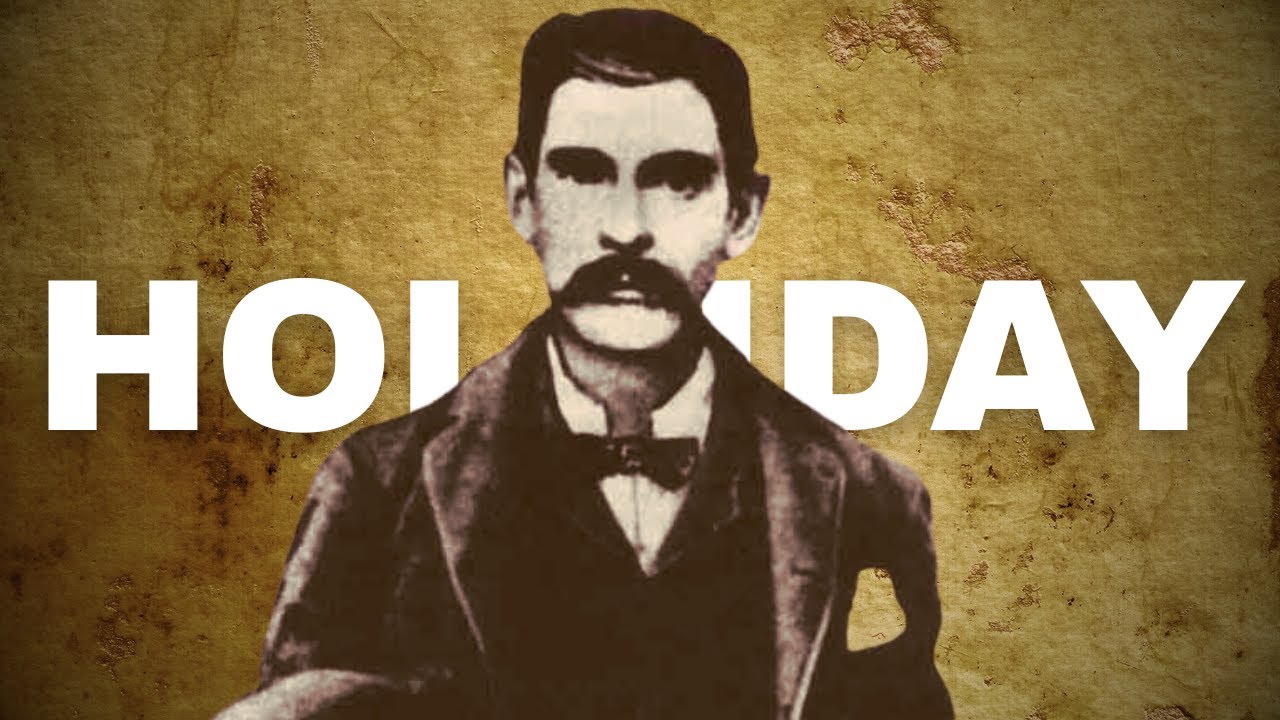
The evidence simply was not there. Either way, Doc headed back to Prescott shortly thereafter and had his likeness taken by photographer Daniel Mitchell. Believe it or not, there were only two images of Holliday as an adult that were provably authentic: one from when he graduated dental school, and the one taken at Prescott. All the others seen online were either of unknown provenance or verified fakes.
The Prescott photograph was definitely the real deal. By mid-September of 1880, Doc finally made the move to Tombstone. Things had changed quite a bit since he and Wyatt had last seen one another. Wyatt and his brother Virgil had initially planned on starting their own stagecoach business, but there were already a couple of stage companies in Tombstone.
So Wyatt instead took a job riding shotgun for Wells Fargo, while Virgil settled in as a deputy U. S. marshal. It was in Virgil’s capacity as marshal that the first clash between the Earps and the Cowboys occurred.
He had led a posse, including brothers Wyatt and Morgan, after some stolen army mules, which they found in the possession of the McLaury brothers, Tom and Frank. In time, the feud between the Earps and the Cowboys would greatly intensify. Wyatt Earp was not yet an official lawman when he had that run-in with the McLaurys. He was just working for Wells Fargo, doing a little speculating and a whole lot of gambling.
But by the time Doc arrived, Wyatt had already accepted a position as deputy sheriff for Pima County. Doc was not even in Tombstone for a full month before he got arrested. He and another gambler by the name of Johnny Tyler—the madcap Johnny Tyler—began quarreling at the Oriental Saloon on the night of October 10th. Things escalated quickly, and just as Doc and Tyler were about to go for their guns, a crowd rushed in to separate them.
Pistols were confiscated, and the saloon’s manager, a man named Milt Joyce, ordered Tyler to get out. Joyce then turned his attention to Doc and started berating him for causing trouble. Holliday did not like such loose talk, so he started giving it right back—at least until Joyce, a former blacksmith, physically threw him out the front door. Doc returned moments later demanding his gun, but Joyce told him to kick rocks.
That was probably not the smartest of choices. Doc showed back up later that night with a borrowed pistol, which he used to shoot Joyce in the hand. He fired a total of three shots before Joyce managed to rush in and disarm him. Per historian Mark Lee Gardner: “Virgil arrested Doc and escorted him from the saloon.
When Doc was finally able to appear before the justice of the peace, four witnesses curiously failed to appear. A charge of attempted murder was dropped and Doc pleaded guilty to the lesser charge of assault and battery. He got off with a fine plus court costs. Milt Joyce, however, came very close to losing his hand.
The gunshot wound eventually healed, but the scar was a bitter reminder that Doc Holliday had tried to kill him. And the fact that Holliday and the Earps were tight didn’t make Joyce think too kindly of the Earps either. ”
Once again, Doc was not exactly making a great first impression. Just a couple of weeks later, cowboy leader Curly Bill Brocius shot and killed Tombstone Marshal Fred White.
Contrary to what some of the movies showed, this was an accidental killing. It was proved in court later that the revolver had a malfunction allowing it to fire on half-cock. Marshal White was only about thirty or thirty-one years old at the time of his death. Despite Brocius otherwise being a complete outlaw, the charges were eventually dropped.
There was a group of rustlers in Pima County known as the Cowboys. They were essentially a loose confederation of ranchers and, in many cases, outright bandits who routinely joined forces to steal cattle and rob stagecoaches. They had a ready market for stolen beef in Tombstone with all the hungry prospectors, and they also sold cattle to the reservation at San Carlos. Curly Bill Brocius was one of the leaders, but there were also the McLaury brothers; the notorious Johnny Ringo; Pony Diehl; Billy the Kid Claiborne; Frank Stilwell; Sherman McMaster; Michael Rourke, also known as Johnny-Behind-the-Deuce; and of course the infamous Clanton brothers, Ike, Phin, and Billy.
Estimates varied as to their numbers, but according to Virgil Earp there were around two hundred of them. As violent as the Cowboys were, they were not universally hated. They had quite a few allies in Tombstone. Again according to Virgil Earp, the Cowboys spent money “free as water in the saloons, dance houses, and faro banks.
And this is one reason why they have so many friends in town. All that large class of degraded characters who gather the crumbs of such carouses stand ready to assist them out of any trouble or into any new rascality. The saloons and gambling houses into whose treasuries most of the money is ultimately turned receive them cordially and must be called warm friends of the Cowboys. A good many of the merchants fear to express themselves against the criminal element because they want to keep the patronage of the Cowboys’ friends.
And the result is that when any conflict between officers and cattle thieves or stage robbers occurs, followed by shootings around town, most of the expression of opinion comes from the desperado class and their friends. And the men who should speak the loudest and the most decisively to correct the condition of affairs are generally the quietest. ”
It was not just the saloon owners who were buddy-buddy with the Cowboys. A few of the local politicians also realized the Cowboys constituted a large voting block and likewise solicited their approval.
When Pima County Sheriff Charles Shibell ran for reelection in November of 1880, it was the Cowboys who helped him win by stuffing the ballots. Wyatt Earp eventually quit his job as deputy sheriff out of protest following that rigged election. He then thought about running for sheriff of the newly formed Cochise County, where Tombstone was located. Rather than risk losing to his rival Johnny Behan, the pair made a deal: if Wyatt dropped out of the race, Behan would appoint him as undersheriff.
And then they sweetened the pot. Behan agreed to split the tax revenue. In those days, one of the main responsibilities of a sheriff was to collect taxes, and in many places the sheriff kept a portion of the revenue to pay his deputies and various other expenses. In the year 1882, the sheriff’s office in Cochise County collected over $24,000 in taxes.
Wyatt felt it would be a lucrative deal, so he agreed. Only thing was, when Behan received the appointment, he completely reneged on the offer. And when Wyatt and Virgil helped apprehend a stagecoach robber, Behan refused to reimburse him on account of not officially swearing him in as a deputy. Needless to say, there was no love lost in Tombstone between the Earps and the Cowboys and Sheriff Behan.
Not to mention men like Milt Joyce. As for Doc Holliday, he too stayed busy. He dabbled in a few mining properties as well as water rights, and even ran a faro bank at the Alhambra Saloon. He also reunited with Kate Elder.
It was likely an argument with Kate that caused him to get arrested yet again on March 10th, 1881. The Daily Epitaph reported the following: “A man about town named Doc last night, while under the influence of too much ‘family disturber,’ grew noisy and disorderly, and officers Ramsay and Kirkpatrick proceeded forthwith to take him in. While that transaction was in progress, the inevitable gun made its appearance and in the melee was somehow discharged. The shot fortunately striking no one.
The shootist was taken before Judge Wallace, and when that official got through with Doc, the latter was $25 poorer. ”
Holliday had gotten liquored up and started fighting with Kate. She had initially chosen not to come with him to Tombstone, and when she finally showed up, she was still jealous over his relationship with Wyatt Earp. And in all fairness, this was not just a woman’s intuition.
By all accounts, Holliday really was fully devoted to Wyatt. Bat Masterson would describe Doc as having his whole heart and soul wrapped up in Wyatt Earp, always ready to stake his life in defense of any cause in which Wyatt was interested. According to Virgil Earp: “Outside of us boys, I don’t think he had a friend in the territory. He was a slender, sickly fellow, but whenever a stage was robbed or a row started and help was needed, Doc was one of the first to saddle his horse and report for duty.
”
There was another man in Tombstone that Doc was friends with: a dope fiend and fellow lunger by the name of Bill Leonard. And it was Leonard’s role in the Benson stage robbery that, as fate would have it, would eventually lead to the infamous gunfight at the O. K.
Corral.






