Deputy Augustus Vale had been in the woods long enough to know that a warm fire pit meant someone had been there moments before. On the morning of November 12th, 1893, standing at the edge of a clearing called Devil’s Kettle, he called out again into the silent trees. No answer came. The embers still glowed.
Whoever had tended this fire had left in a hurry, and everything they owned was still here. The camp was meticulously organized. Two bedrolls rested on platforms of woven branches, insulated from the cold earth. Rifle cases leaned against the back wall of a carefully built lean-to, each holding a well-maintained weapon.
Folded clothing sat in canvas bags. Cooking equipment was cleaned and arranged near the fire pit. And there were pelts, dozens of them, properly cleaned and stretched, representing weeks of successful trapping. Nothing indicated struggle, haste, or emergency.
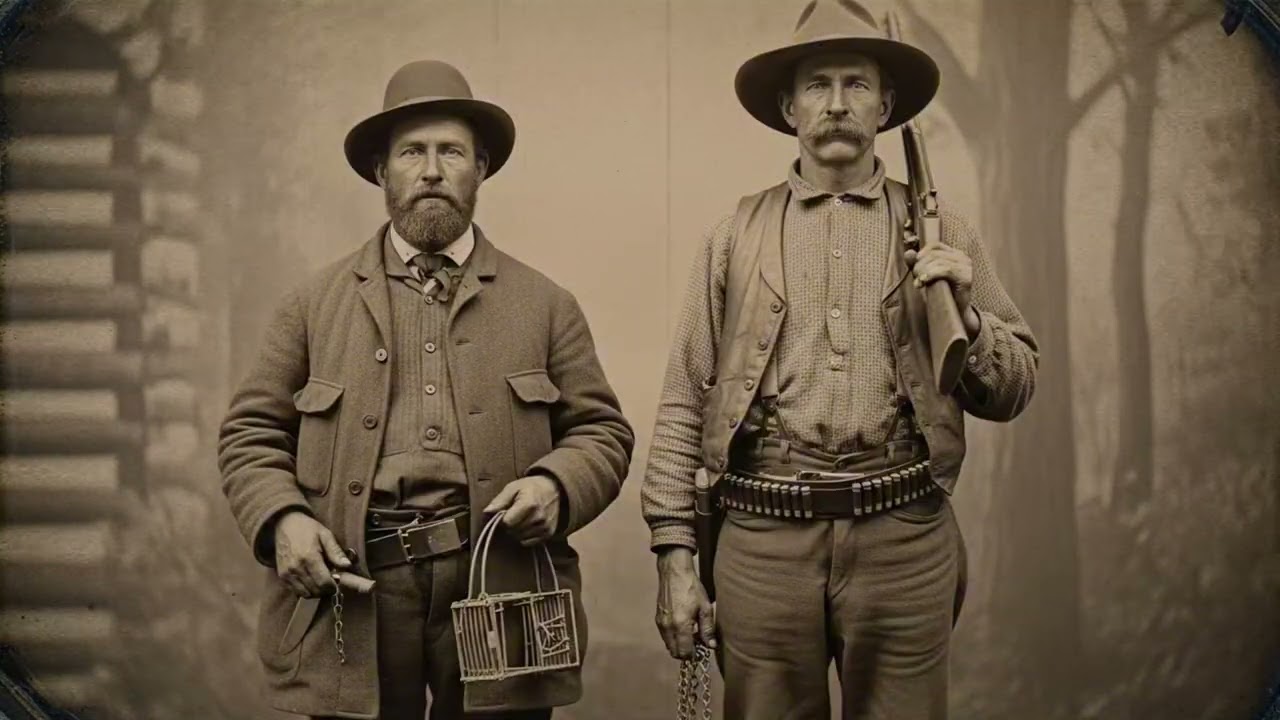
The camp’s occupants had simply walked away from everything they owned, including a leather-bound journal that would tell investigators far more than they ever wanted to know. The missing men were Ezekiel Thornfield and Matias Crane, two experienced trappers from Cuba, Missouri. Thornfield, thirty-four, had worked these Ozark woods since he was eighteen, learning the trade from his father and developing a reputation as a methodical planner who kept detailed maps of his trap lines and recorded weather patterns and animal behavior. Crane, thirty-nine, had come from Pennsylvania in 1885, drawn by reports of abundant fur-bearing animals.
He was the innovator, forever seeking new techniques and unexplored territory, sometimes with spectacular success, sometimes with complete failure. For three seasons they had worked adjacent trap lines, competing at first, then discovering that their different approaches complemented each other. By the autumn of 1893 they had established a routine of working together during the most productive months, sharing both risks and profits. The families had expected them home by October 25th.
When that date passed without word, Cordelia Thornfield and Beatrice Crane grew concerned. Thornfield had never been late by more than two days, and he always sent word ahead if weather delayed him. Crane had been particularly excited about this expedition, telling his wife that he and Thornfield had identified an area that other trappers had largely left unexplored. They expected to return with the most profitable load of pelts either man had ever secured.
As the days stretched into weeks, and other men working the same region returned on schedule, concern turned to alarm. Vale assembled a team of eight experienced hunters and trackers and departed Cuba on November 10th. For two days they worked through dense undergrowth, steep ravines, and creek crossings that heavy autumn snows had made treacherous. They found old campsites, evidence of recent use, but nothing they could link to the missing trappers.
Then, on the morning of the twelfth, they discovered a regularly maintained trail leading deeper into the wilderness than any of them had explored before. Broken branches and disturbed ground showed that people had moved along this route within the past few weeks. Following it for roughly three miles brought them to Devil’s Kettle. Thornfield’s journal, found among the abandoned possessions, began with the expedition’s start on September 30th.
“Weather clear and cold, perfect for the season,” he wrote. “Matias suggests we push further east than either of us has been before. The old-timers in town spoke of beaver dams in the headwaters of Little Piney Creek that have never been properly worked. If we can locate these sites, this could be our most profitable season yet.
” On October 3rd they found what they were looking for, three separate dam complexes within two miles of camp, animals undisturbed by human activity. Crane had developed an innovative approach to trap placement, using the natural geography to funnel animals into efficient capture positions. By October 8th, Thornfield noted they were catching twice what he would normally expect in territory this rich, enough pelts to justify an extra week beyond their original schedule. The first hint of trouble appeared on October 12th.
Crane had spent most of the previous day investigating what he claimed were unusual rock formations about a mile north of camp. Thornfield examined the area himself and saw nothing remarkable, but Crane insisted there were signs of previous human activity, stone tools, evidence of old fire pits. Thornfield told him that Indian camps were not uncommon in these hills. Crane seemed convinced that what he had found was somehow different.
Three days later, Thornfield found his partner examining what Crane claimed were carved symbols on a boulder near the creek. Thornfield spent two hours looking at the rock and saw only natural weathering patterns. When he suggested they focus on checking the trap lines, Crane became defensive and accused him of lacking intellectual curiosity. “This is not like him,” Thornfield wrote.
“Matias is normally as focused on practical matters as I am. ”
By October 18th, Crane was spending entire days away from the trap lines, returning with stones he insisted were tools made by people who had lived in these hills long before any known Indian tribes. The items appeared to be nothing more than ordinary stones to Thornfield, but Crane spoke of finding caves containing evidence of human habitation, locations he refused to show his partner, saying Thornfield would not understand their significance. On October 22nd, Crane’s claims escalated.
He spoke of tools showing impossible precision, of cave paintings depicting events that could not have been witnessed by primitive people, of evidence that these ancient inhabitants possessed knowledge modern science could not explain. “I fear that the isolation is affecting his mind,” Thornfield wrote. October 25th was the day they had planned to begin their return journey. Crane refused to leave.
He said they could not abandon what he had discovered, that the world must know about the evidence he had uncovered. When Thornfield reminded him of their responsibilities to their families, Crane became angry and accused him of being willing to sacrifice scientific discovery for mere profit. Three days passed beyond their planned departure. Then Crane left camp early on the morning of October 28th, carrying his pack and promising to bring back definitive proof of his claims.
He was gone for two days. The weather was turning colder, and Thornfield feared they might be trapped by snow if they did not leave soon. Crane returned at dawn on October 29th, carrying a canvas bundle he guarded jealously. He appeared exhausted, as though he had not slept during his absence.
He claimed to have found a cave system extending deep into the hills, chambers showing evidence of habitation by people whose level of development exceeded anything associated with the native tribes of the region. He spoke of preserved artifacts, cave paintings depicting astronomical events, evidence of metallurgy that should not have existed in this part of the world. When pressed for details, he would only say that some knowledge was too dangerous to share without proper preparation. Thornfield attempted to convince his partner that they must leave immediately.
Weather reports from the south suggested severe storms were moving in, and if they delayed much longer, they risked being trapped until spring. Crane agreed that departure was necessary, but insisted on making one final expedition to the cave system to retrieve additional evidence. On November 2nd, snow began to fall heavily. Checking their route back to Cuba, Thornfield found that several creek crossings were already becoming dangerous due to ice formation.
“If we do not leave within the next 2 days, we will be forced to remain here until weather conditions improve,” he wrote. “Matias seems unconcerned about our situation, claims that what he has discovered is worth any risk. ”
On November 4th, Crane finally revealed the contents of the bundle he had been guarding. The artifacts appeared to be made from metals Thornfield did not recognize, worked with a precision that suggested tools far more sophisticated than anything he had ever seen.
More disturbing were the copies Crane had made of cave paintings, images depicting events and creatures Thornfield could not identify, rendered with an artistic skill that seemed impossible for primitive people. On November 5th, Crane finally agreed to show his partner the cave system. What Thornfield saw there shook his understanding of the region’s history. The caves were extensive, with chambers showing clear evidence of long-term human habitation.
The artifacts Crane had collected represented only a tiny fraction of what remained in those underground rooms. The caves contained evidence of sophisticated engineering, water management systems that controlled drainage and airflow, living spaces carefully designed for comfort and security. The paintings depicted not only animals and hunting scenes but astronomical events, geographical features rendered with map-like precision, and human figures engaged in activities Thornfield could not interpret. Most disturbing were paintings that appeared to show the caves themselves, with detailed representations of chambers extending far deeper into the earth than either man had been able to explore.
But it was something else that convinced Thornfield the situation had become genuinely dangerous. During their exploration, the two men found evidence that the caves were currently being used by someone else. Fresh food stores. Recently used fire pits.
Sleeping areas showing signs of regular occupation. Someone was living in these caves, and they were aware of the trappers’ presence in the region. The final entry in the journal, dated November 8th, described the conclusion the two men had reached after extensive discussion. “We cannot return to civilization with knowledge of what we have discovered here,” Thornfield wrote.
“But we also cannot ignore our responsibility to protect others who might venture into this area. Tomorrow we will take steps to ensure that the secrets of these caves remain protected while also ensuring that the current inhabitants are not disturbed by future expeditions. Some knowledge is too dangerous for the outside world. ”
The journal ended there.
Four days later, Vale’s search party found the abandoned camp. An extensive search of the surrounding area revealed several partially filled excavations, suggesting the men had been engaged in some form of digging activity in the days before their disappearance. No evidence was found of what they might have been attempting to bury or retrieve. The canvas bundle Crane had guarded so jealously was cataloged and transported to the Crawford County Courthouse, its contents listed as fragments of worked metal, pieces of carved stone, and sheets of paper bearing copied images from cave paintings.
The official records contain no detailed analysis of their significance or origin. Vale, however, decided to find the cave system himself. Using a rough map found among the trappers’ possessions, he assembled a small team of experienced woodsmen and conducted a systematic exploration of the underground chambers. His private notes, discovered among his personal effects after his death in 1923, provide a detailed account of what they found.
The underground complex was far more extensive than Thornfield’s journal had suggested, with chambers extending deep into the hillside. The cave dwellers had carved rooms from natural rock and furnished them with carefully constructed furniture made from stone and wood. Water management systems channeled underground streams throughout the complex, while ventilation shafts ensured adequate airflow even in the deepest chambers. Artifacts demonstrated a level of craftsmanship inconsistent with the primitive technology typically associated with prehistoric inhabitants of the region.
Metallurgy was evident in numerous objects with alloys and working techniques far more sophisticated than anything documented among Native American cultures of the historical period. The cave paintings were even more remarkable than the journal had suggested, covering walls with detailed images of hunting and ceremonial scenes, astronomical observations, geographical surveys, and technical diagrams that appeared to represent engineering principles. But the most disturbing discovery was evidence that the caves were indeed currently inhabited. Fresh food stores.
Regularly maintained fire pits. Sleeping areas showing evidence of ongoing use. Storage areas containing preserved food, manufactured goods, and personal belongings indicating a well-established community. Throughout their exploration, team members reported the persistent sensation of being observed.
Sounds and movements in unexplored sections indicated the presence of people deliberately avoiding contact. On several occasions, the investigators found that areas they had examined during previous visits had been altered, objects moved and passages blocked in ways that suggested systematic efforts to conceal the full extent of the underground community. And then, in the deeper chambers, the exploration team found evidence of activities that Vale found deeply disturbing. His notes describe areas that appeared to have been used for purposes that fell far outside the boundaries of acceptable human behavior, implements and arrangements whose exact nature he chose not to record.
Vale made the decision to classify this information and to recommend that the cave system be permanently sealed. The other members of the exploration team unanimously agreed. The public interest, they concluded, would be better served by ensuring that the underground community remained isolated from the outside world. The sealing was accomplished with dynamite, collapsing the main entrances and effectively trapping the current inhabitants within the underground complex while preventing outside access to the chambers and their contents.
Vale’s notes suggest the action was taken reluctantly, with full awareness that it condemned unknown numbers of people to permanent underground imprisonment. But the conviction held that the alternative posed unacceptable risks to the surrounding communities. The official investigation was closed in the summer of 1894. Thornfield and Crane were declared dead due to unknown causes.
The case files contain no reference to the cave exploration or the decision to seal the underground complex. Subsequent inquiries were directed to the standard conclusion that the men had been victims of a wilderness accident. The story, however, did not end there. Over the years that followed, reports accumulated of unusual activity in the forests around Devil’s Kettle.
Hunters and loggers described encounters with individuals who appeared to be living entirely off the land, people who possessed wilderness skills exceeding those of even the most experienced outdoorsmen, who could move through the forest without making a sound, who seemed to possess intimate knowledge of animal behavior and seasonal changes. Most disturbing were reports of systematic theft from hunting camps and logging operations. Equipment and supplies disappeared from secured locations, always taken by someone who could approach and remove items without leaving any detectable traces. Footprints were never found.
Witnesses were never able to provide detailed descriptions. The stolen items disappeared completely, without any evidence of where they might have been taken. By the early 1900s, many experienced hunters and trappers had begun avoiding the region around Devil’s Kettle entirely, effectively creating an unofficial wilderness preserve. The most detailed account of contact with the mysterious forest dwellers comes from a hunting party that entered the region in October of 1902.
Led by an experienced guide named Isaiah Montgomery, the party planned a routine deer hunting expedition in an area that had previously been considered safe and productive. From their first day in the field, they noticed signs that they were not alone. Equipment carefully secured each night would be found in slightly different positions the following morning. Game that they successfully tracked during the day would disappear overnight, apparently taken by someone who could approach and remove the animals without leaving tracks the experienced hunters could follow.
On multiple occasions, party members reported the sensation of being watched from the surrounding forest, but extensive searches never revealed any sign of human presence. On their fourth night, they were awakened by sounds suggesting someone was moving around their camp. Several party members saw shadowy figures at the edge of their firelight, observing them from the darkness. When they called out, the figures retreated immediately, moving through the underbrush with a silence that seemed impossible for human beings.
The following morning, they discovered that the visit had not been a shared hallucination. A message had been carved into the bark of a tree near their fire pit, consisting of symbols none of the party members could interpret. More disturbing, their food supplies had been systematically examined during the night. Containers had been opened, their contents apparently tested or sampled, then carefully resealed and returned to their original positions.
The precision suggested that whoever had conducted the examination possessed considerable skill and detailed knowledge of how such supplies were typically packed. The hunting party cut their expedition short and returned immediately to Cuba. Their report to the state game commission recommended that the region around Devil’s Kettle be officially designated off-limits to recreational hunting, arguing that the area appeared to be occupied by individuals whose relationship to the civilized world had been severed so completely that contact between the two groups could only result in tragedy. The recommendation was never officially implemented, but word spread rapidly.
By 1905, few licensed hunters or trappers were willing to venture into the deeper sections of the forest. In 1908, the state of Missouri designated a large section of Crawford County wilderness as a protected natural area, citing the need to preserve unique geological features and protect sensitive wildlife habitats. Local residents understood that the real purpose was to ensure that the general public would not accidentally encounter whatever or whoever was living in the deep woods around Devil’s Kettle. The final documented reference to the Thornfield-Crane case appears in a series of letters written between 1920 and 1925 by Father Michael Shannon, a Catholic priest who served the scattered rural communities of Crawford County.
Shannon became aware of the situation through conversations with parishioners who reported encounters with individuals living outside the boundaries of normal human society, people who seemed to possess supernatural abilities to survive wilderness conditions, who avoided all contact with organized communities, and who appeared to follow a form of social organization bearing no resemblance to anything recognized by mainstream society. Shannon made multiple attempts to establish contact, leaving food, clothing, and religious materials in locations where he hoped they would be discovered. The supplies were consistently taken, suggesting that his intended recipients were indeed finding and using them. But he never succeeded in making face-to-face contact.
More troubling were the responses he began to receive. On multiple occasions, he returned to locations where he had left supplies to find that religious symbols and biblical passages had been carved into nearby trees. The messages suggested that his intended audience was literate and familiar with Christian theology, but their content indicated a theological perspective that diverged significantly from orthodox church teaching. The carved messages frequently referenced themes of judgment, purification, and the need for separation between the righteous and the corrupt.
In the summer of 1922, Shannon found what appeared to be a cemetery in a remote clearing deep within the protected forest area. The burial ground contained approximately two dozen graves marked with simple wooden crosses, arranged in rows suggesting careful planning and maintenance over many years. Fresh wildflowers and carefully arranged stones indicated that someone was tending these graves with considerable devotion. The dates on the markers spanned from the 1890s through the early 1920s, and several bore dates that corresponded to the period immediately following the disappearance of Thornfield and Crane, raising the possibility that the missing trappers’ final resting place had been located.
Shannon decided to conduct religious services at the cemetery. His attempt was interrupted by clear signs that his activities were being observed and that his presence was not welcome. He heard movements in the surrounding forest suggesting the presence of multiple people, along with sounds he interpreted as attempts at communication or warning. When he continued with his planned service, he found his movements deliberately impeded by obstacles that appeared in his path and by equipment that mysteriously malfunctioned.
His final letter regarding the matter, written in December of 1925, describes his decision to discontinue his direct intervention efforts. The priest had concluded that the inhabitants of the deep woods had created a form of society that, while radically different from mainstream civilization, appeared to provide them with everything they needed for survival and even a form of spiritual fulfillment. He had observed evidence of cooperation, planning, and mutual support suggesting that these people had successfully adapted to their environment and created sustainable ways of life that did not depend on contact with the outside world. His recommendation was that the forest dwellers should be left alone, arguing that their survival over many decades demonstrated that they had found solutions to the challenges of their existence and that attempts to force them back into mainstream society would likely do more harm than good.
The diocesan archives contain no record of any official response to Shannon’s letters. They do note that he continued to include the wilderness community in his regular prayers and maintained his practice of leaving occasional offerings at the edge of the protected forest area until his own death in 1934. The evidence accumulated over decades paints a picture of people who, faced with circumstances that ordinary society could never understand or accept, made the extraordinary decision to abandon the civilized world entirely and create something new in the depths of the American wilderness. Whether Thornfield and Crane ultimately joined the forest community they discovered, met their deaths in attempting to protect its secrets, or found some other fate entirely, the evidence suggests that both men concluded that their duty to protect the forest dwellers from outside interference outweighed their obligations to their families and their community.
It was a decision that cost them everything they had previously valued. The Missouri wilderness that claimed two experienced trappers in 1893 continues to guard its secrets. And perhaps that is exactly as it should be.
