In the early morning of June 4, 1942, American dive bombers plunged out of the sky over the Japanese carrier force north of Midway Atoll. Within six minutes, three of the Imperial Japanese Navy’s finest carriers—Akagi, Kaga, and Soryu—had been struck by bombs that tore through their flight decks. All three were doomed. The fires that consumed them could not be put out.
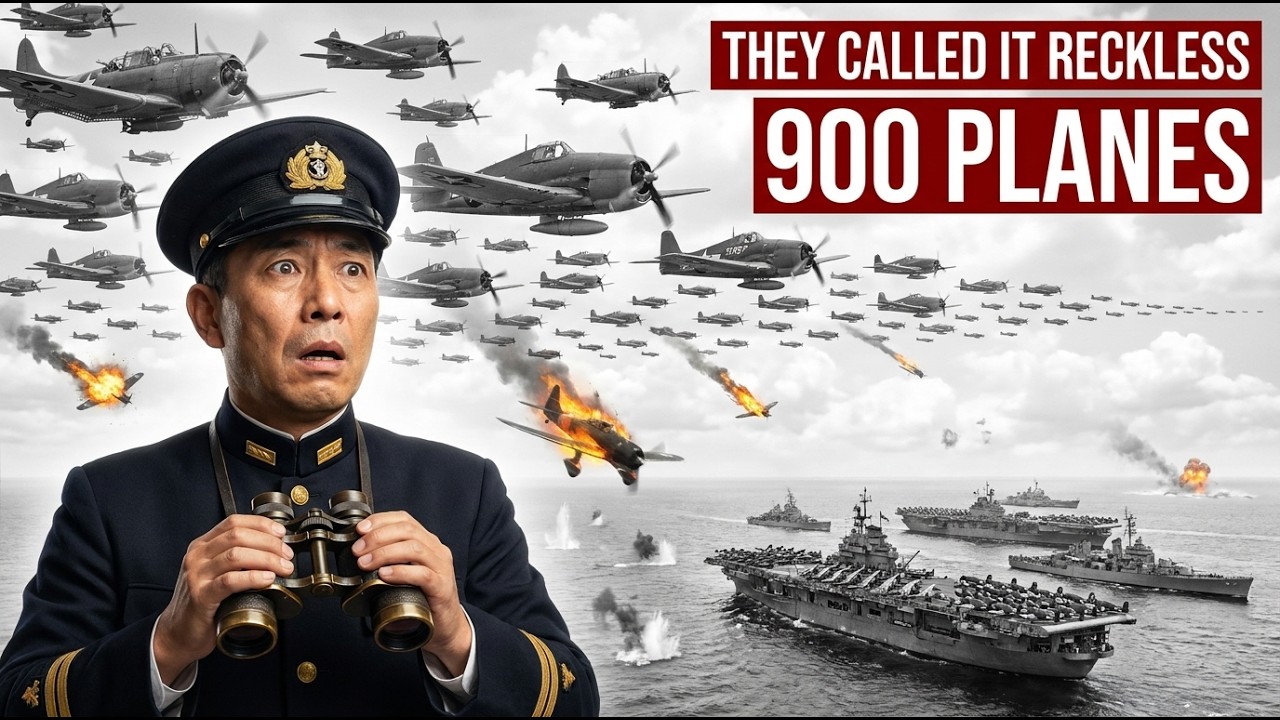
The two navies had looked at the same danger and reached opposite conclusions. Japanese officers watching an American flight deck in 1942 saw recklessness: armed aircraft sitting in the open, fuel lines stretched across an exposed surface, one lucky hit capable of turning everything into an inferno. The Imperial Japanese Navy kept its planes behind steel walls, sealed inside enclosed hangars below deck where they would be safe from weather and enemy fire. The Americans accepted the risk and kept their aircraft on deck, where they could be moved, armed, and launched quickly.
The Japanese answer had emerged in the 1920s, when the first generation of fleet carriers was designed. For the men who planned Akagi and Kaga, both converted from battlecruiser hulls after the Washington Naval Treaty made completing them as battleships illegal, the flight deck was simply a runway. Aircraft were meant to remain below in hangars that ran most of the length of the ship, enclosed on all sides, where they could be maintained, fueled, and armed out of the wind and spray. Akagi carried her air group in two stacked hangar levels separated by thin steel decks, serviced by elevators that moved one or two planes at a time.
Ventilation was mechanical, forced, and limited. The sides could not be opened to the sea. Kaga had the same arrangement. Soryu and Hiryu, built from the keel up as carriers, also had enclosed hangars.
The design reflected a firm conviction: armed and fueled aircraft belonged behind steel walls. The American approach grew out of different constraints. The U. S.
Navy had fewer carriers than Japan, and for most of the 1930s they were smaller. The Yorktown class, which entered service in the late 1930s, had only one hangar below the flight deck, smaller than the combined Japanese hangar spaces and holding fewer planes by itself. But the American hangar had something Japanese hangars lacked: folding steel curtains along both sides of the ship, mounted in tracks and operable by hand to admit outside air. When open, the hangar was no longer a tightly sealed compartment.
Fuel vapors, heavier than air and prone to pooling in enclosed spaces, could rise through the flight deck gratings instead of gathering inside. The American system also permitted a practice the Japanese considered unacceptable. Aircraft that did not fit in the hangar were parked on the flight deck, wings folded where design allowed, armed and fueled in rows with just enough space for the next launch. This was called deck parking.
It gave American carriers a major operational advantage: each ship could carry and operate a larger air group than the hangar alone could hold. A Yorktown-class carrier could handle roughly 80 to 90 aircraft when the deck was full, while Japanese fleet carriers of similar displacement, operating from enclosed hangars without permanent deck parking, typically ran 60 to 65. More than capacity, deck parking provided flexibility. American deck crews could rearm and refuel planes in the open, working on several machines at once without waiting for the elevator cycles that governed everything inside an enclosed hangar.
The cost was real, and the Japanese were right to identify it. An armed, fueled aircraft sitting on an open flight deck was ammunition waiting for a match. A single bomb or a stray piece of anti-aircraft shrapnel could ignite a chain of fires and explosions across the entire deck. Aviation gasoline does not so much burn as explode when its vapor mixes with air in the right proportion.
Every American carrier captain understood this. The Navy accepted the arrangement because the alternative was fewer planes on each ship, and in the spring of 1942, with Lexington lost at the Coral Sea and Saratoga in a repair yard on the West Coast, the fleet did not have enough flight decks to afford that reduction. The Japanese system had its own cost, less visible because it was measured in time rather than on the deck. Arming, fueling, and maintaining aircraft inside enclosed hangars, then moving them to the flight deck via elevators one or two at a time, was slow.
The bottleneck was the elevator, not the speed of the crew. On an American carrier, rearming happened on the flight deck in the open air, with ordnance crews working on half a dozen aircraft simultaneously. The Japanese cycle was slower not because Japanese sailors were slower, but because the design confined operations inside spaces that allowed only a few aircraft to be moved at once. On the morning of June 4, that clock inside the Japanese hangars became one of the deciding factors at Midway.
Vice Admiral Chuichi Nagumo, commanding the First Air Fleet from Akagi, had launched 108 aircraft against Midway Island at dawn and had received word that a second strike was necessary. He had kept a reserve strike force armed for attacks on enemy ships. Torpedo planes aboard Akagi and Kaga were equipped with torpedoes; the reserve dive bombers carried bombs suitable for attacking ships. No scouts had yet reported enemy surface ships.
Around 7:15, Nagumo ordered the torpedo planes rearmed with land-attack bombs for a second strike on Midway. The rearming began inside the enclosed hangars. Then a scout plane from the cruiser Tone, which had launched late due to a catapult malfunction, reported American surface ships to the northeast. The report was vague and mentioned no carriers.
Nagumo hesitated, then canceled the rearming order. A correction followed: there was a carrier in the American formation. Nagumo faced a decision debated by historians ever since: strike immediately with what could be readied, or recover the returning Midway strike force and organize a coordinated attack. He chose to recover first.
The planes in the hangars had been fueled and armed, and ordnance handling was underway. The American carriers faced no such dilemma that morning. Enterprise and Hornet began launching their strikes shortly after 7:00, pushing aircraft off the flight deck where they had sat armed and fueled since before dawn. The process was slow and messy, involving deck crews wrestling loaded aircraft across a steel surface slick with oil and salt spray.
Yorktown launched her group independently about an hour later. The American system was slower at getting a full strike into the air than the Japanese system at its best, but the aircraft that took off carried what they had, with no need to descend below and change weapons. The dive bombers arrived from two directions at nearly the same moment. Lieutenant Commander Wade McClusky, leading the Enterprise air group, had flown to the expected position of the Japanese fleet and found only empty ocean.
Many of his pilots had already passed the point of guaranteed return. McClusky turned southwest on a hunch, broadening the search, then spotted a white line cutting through the water far below. It was the wake of the destroyer Arashi, which had dropped out of formation earlier that morning to depth-charge the American submarine Nautilus and was now rushing at full speed to rejoin the carriers. McClusky followed the wake, and it led him directly to Kido Butai.
At about 10:22, Lieutenant Richard Halsey Best, leading Bombing Squadron Six from Enterprise, pushed his Douglas SBD Dauntless into a steep dive toward the nearest carrier below. Best had flown with a faulty oxygen breathing apparatus since takeoff; the soda lime canister meant to purify recycled air was leaking caustic powder into his mask. He had been coughing blood for most of the climb. He flew anyway.
When he began his dive, he saw that the scout squadron ahead had already targeted Kaga, so he pulled his three planes toward the next carrier in line. That carrier was Akagi, the flagship from which Nagumo commanded the entire strike force. Akagi took one direct hit amidships that penetrated the flight deck into the upper hangar, plus two near misses that caused damage. What happened next is beyond dispute.
The explosion tore through a hangar full of aircraft. Aviation fuel from ruptured lines and wing tanks fed the fire. Armed ordnance being handled during the rearming began to detonate in the heat. The enclosed hangar, designed to protect the planes from weather and salt spray, trapped the heat and smoke.
The steel bulkheads kept temperatures rising. The mechanical ventilation system, which had circulated air all morning, now pumped superheated air and smoke through the same ducts. The hangar burned from bow to stern within the hour, and the ship could not be saved. In the same minutes, Kaga took four bomb hits from other Enterprise dive bombers.
Each bomb followed the same path through the flight deck into the enclosed hangar. A bomb near the island and bridge killed Captain Jisaku Okada and many of the ship’s senior officers, crippling damage control. A truck loaded with fuel on the flight deck caught fire, spreading burning fuel across the bow. Kaga burned for nine hours before sinking, taking more than 800 of her crew with her, the highest death toll of any ship lost at Midway.
At nearly the same time, three bombs from Yorktown’s Bombing Squadron Three hit Soryu. The squadron commander, Lieutenant Commander Maxwell Leslie, had lost his bomb to an electrical failure on the way in and dived on Soryu unarmed, holding his dive steady to guide his pilots. They did not miss. Three hits, three penetrations into the hangar, the same fire in the same enclosed space.
Soryu was consumed by uncontrollable fires and secondary explosions within minutes. She sank that evening with more than 700 of her crew. Captain Ryusaku Yanagimoto remained aboard and went down with the ship. By 10:30, three of the six carriers that had attacked Pearl Harbor six months earlier were burning beyond hope of recovery.
The attacks had lasted no more than six minutes. The enclosed hangars had made each hit unsurvivable. Once fire reached a Japanese hangar containing fueled aircraft, the ship was virtually certain to be lost. The only surviving carrier of the Japanese force, Hiryu, had been positioned several miles north of the other three.
Her air group commander launched two counterstrikes against the American carriers that afternoon. Eighteen dive bombers found Yorktown around noon and scored three hits, one of which penetrated the boiler uptakes and extinguished fires in two boilers. Yorktown lost power and stopped dead, smoke rising from her. Her crew went to work with a speed and discipline that reflected training and doctrine.
Damage control teams closed the torn uptakes, relit the remaining boilers, tied in steam lines, and redistributed power. Within an hour she was steaming at 19 knots; within two, she was making 20 knots and back to flight operations. The gasoline lines had been purged with carbon dioxide, following the procedure developed after the loss of Lexington. Admiral Nimitz’s report on Midway later noted that the absence of gasoline fires aboard Yorktown was likely due to the effective use of carbon dioxide in the fuel system.
Yorktown had absorbed three bomb hits and survived because her crew had a procedure drawn from studying a previous loss, and because her hangar could be ventilated. Japanese pilots returning for the second strike saw a carrier steaming and conducting air operations and assumed it was a different ship. Ten torpedo planes attacked; two torpedoes hit Yorktown’s port side. She listed heavily to port, reached 26 degrees, and the captain, fearing the ship would capsize and trap the crew below, ordered abandonment.
But Yorktown did not sink. She stayed afloat through the night and into the next day. A salvage party boarded on June 6, and that afternoon the Japanese submarine I-168 found her and put two torpedoes into her hull. Yorktown finally capsized and sank on the morning of June 7, three days after the first bomb hit her flight deck.
Hiryu herself was found late that afternoon. Her deck was full of aircraft being prepared for a third strike when four bombs from Enterprise’s air group hit her. The enclosed hangar that had consumed Akagi, Kaga, and Soryu now consumed Hiryu. The fires raged through the night.
Rear Admiral Tamon Yamaguchi, who had led the Second Carrier Division from Hiryu’s bridge and had launched the only counterstrikes of the day, chose to remain aboard. Captain Tomeo Kaku stayed with him. Both men went down with the ship when she was scuttled the next morning, along with nearly 400 of her crew. The pattern was unmistakable.
Four fleet carriers, each with enclosed hangars, each hit by American bombs that pierced the hangar deck, each consumed by fires that could not be ventilated or controlled. The loss of those four carriers cost Japan more than 2,000 men. The closed hangar, the fueled and armed aircraft, the secondary explosions, and weaker Japanese damage control all contributed to the destruction. No single factor explains Midway, but the enclosed hangar made every hit unsurvivable.
The American system proved its value again on June 19, 1944, in the Battle of the Philippine Sea. The Japanese fleet carrier Taiho, designed with an armored flight deck and improved damage control, was the newest and largest carrier Japan had ever built. She had been strengthened against bomb damage based on the lessons of Midway, but her hangars remained enclosed. Struck by a single torpedo from the submarine Albacore near the aviation fuel tanks, she suffered cracking fuel lines.
The damage initially seemed minor; Taiho continued flight operations. The damage control officer, attempting to clear gasoline vapors, ordered the ventilation system opened and the forward elevator pit used as a vent. The effect was the opposite of what was intended. The vapors spread through the ventilation system throughout the ship.
About six hours after the torpedo hit, a spark ignited the accumulated vapors. The explosion was catastrophic. Taiho, hit by only one torpedo and never approached by an American aircraft, sank about an hour and a half later. In the same battle, the Japanese launched roughly 450 aircraft in four waves against an American fleet of 15 carriers carrying about 900 planes.
The Japanese aircraft were spotted on American radar at 60 to 70 miles, giving combat information centers more than 30 minutes to direct fighters toward each incoming wave. F6F Hellcats, armored and with self-sealing fuel tanks, met the Japanese formations long before they reached the American ships. Of the aircraft Oza wa sent off that day, nearly 300 did not return. American losses in the air battles were 29 aircraft.
The Americans called it the Great Marianas Turkey Shoot. For the Japanese, the tactical hope had been range. Japanese carrier aircraft had been designed to outrange their American counterparts, sacrificing armor for distance. Admiral Ozawa planned to strike the American fleet from beyond Mitscher’s reach.
It did not matter. Deck parking, radar-directed fighter defense, the American training system, and the sheer number of Hellcats in the air made the range advantage meaningless. It was not enough that the Japanese could strike from farther away if their strikes were destroyed before reaching the ships. At dusk on June 20, Mitscher launched a strike at extreme range, knowing his pilots would have to return in darkness and many would not have enough fuel to reach the carriers.
They found and sank the carrier Hiyo, hit by a torpedo from a TBF Avenger, and damaged several other ships. The return flight was the ordeal Mitscher had anticipated. He ordered the fleet to turn on its lights—every searchlight, navigation light, and deck-edge lamp—knowing Japanese submarines might see them. Pilots were forced to ditch alongside carriers because the decks could not recover them fast enough.
Hellcats were pushed overboard to make room. Destroyers moved among the sinking aircraft, retrieving pilots from the water. Mitscher lost about 80 aircraft and nearly 50 aircrew to fuel exhaustion and darkness that evening. It was a deliberate trade of material and men for the chance to destroy the enemy fleet.
The American carrier system could absorb that loss. No other navy in 1944 could absorb such losses and continue operating the next morning. The soda lime that damaged Dick Best’s lungs never healed. He coughed blood during the dive over Akagi and for weeks afterward.
Diagnosed with tuberculosis in 1943, his flying career ended. He was medically retired from the Navy in 1944 at age 34, decorated with the Navy Cross and the Distinguished Flying Cross, and never piloted a Navy aircraft again. He worked as a civilian researcher, first at Douglas Aircraft and later at the RAND Corporation, and died at home on October 28, 2001, at age 91. Admiral Nagumo, who had watched the crisis unfold in the enclosed hangars beneath him, shot himself on Saipan on July 6, 1944, two weeks after the Battle of the Philippine Sea, as the island fell to American forces.
The Japanese had been right in 1941 that an armed and fueled aircraft on an open flight deck was a danger waiting for a spark. The Americans recognized the same danger and reached a different conclusion. The answer was not hiding aircraft below the decks behind steel walls. The answer was more aircraft, more flight decks, stronger damage control, radar-directed air defense, and an industrial and training system that could replace losses faster than the enemy could inflict them.
The closed hangar tried to keep fire out, and when it failed, it made survival impossible. The open hangar accepted fire as inevitable and gave the crew a chance to fight it. Midway showed how catastrophic a carrier could become when bombs pierced hangars containing fueled and armed aircraft. The Philippine Sea showed the operational value of the large deck, the radar-guided defense, and the expanding industrial system.
By 1944, when Japanese pilots looked at the American formation and counted the aircraft overhead, they found more planes above those flight decks than the entire Japanese carrier force had brought to the battle. The Imperial Navy had looked at the American fleet in 1941 and called it reckless. They had failed to count the decks.
By 1944, there were enough decks to settle the argument, and each one carried more aircraft than any Japanese carrier ever had.






