The afternoon of February 13th, 2017, started like so many others for fourteen-year-old Libby German and her best friend, thirteen-year-old Abby Williams. They had a day off from school, and they planned to spend part of it the way they had spent plenty of other afternoons: outside, together, walking the Delphi Historic Trails, a scenic path that runs along Deer Creek and crosses an old abandoned railroad trestle everyone in town simply calls the Monon High Bridge. Libby’s older sister dropped the two girls off at the trailhead that afternoon. The plan was simple.
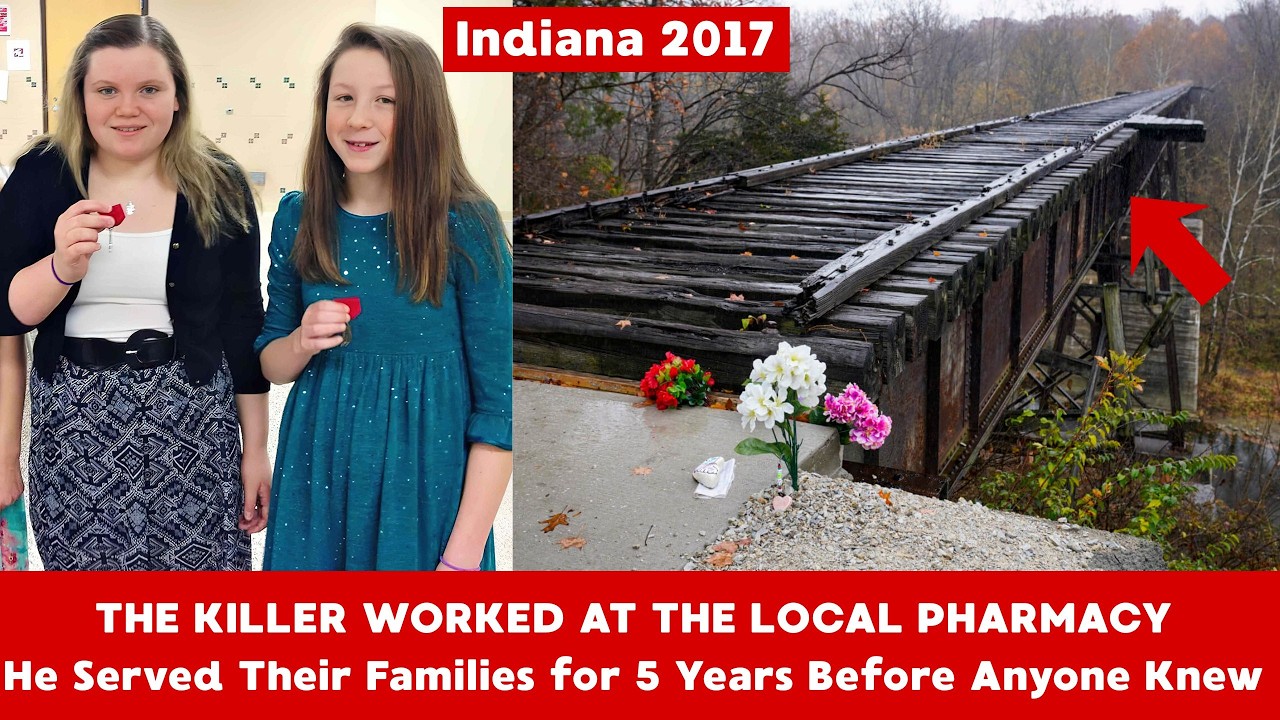
They would hike, take some pictures, and get picked up again a couple of hours later. Nobody came to get them that afternoon, because by the time anyone realized something was wrong, both girls were already gone. When they did not show up at the agreed pickup time, family members went looking, and it did not take long for genuine alarm to set in. This was a small town.
Two teenage girls simply do not vanish from a public hiking trail in the middle of the afternoon without something being very wrong. An enormous search effort mobilized almost immediately, pulling in local police, state police, and eventually hundreds of volunteers combing the woods along Deer Creek through the night and into the next day. On February 14th, searchers found them. Abby and Libby were discovered in a wooded area not far from the trail, and it was immediately clear to everyone at that scene that this had been a deliberate, violent act, not a tragic accident.
Both girls had been killed with a knife. What matters for the story of the investigation that followed is that whoever did this to them wanted it to be brutal, and whoever did it left behind worse than almost any piece of physical evidence: a record of his own presence, captured on a young girl’s phone in the last minutes of her life. Before the five years of silence that followed, it is worth knowing who these girls actually were, because in a case this heavily covered, this endlessly discussed online, it becomes strangely easy to lose sight of the fact that Abby Williams and Libby German were just two middle schoolers who liked spending their day off outside together. Libby was the one who carried her phone that day, the one who would eventually leave behind something that would matter more than anyone in that moment could have imagined.
Abby was described by people who knew her as warm, easy-going, the kind of friend who made ordinary afternoons feel a little brighter just by being there. They came from the same small circle of friends and family that makes up so much of life in a town the size of Delphi. The kind of place where kids grow up walking the same trails their parents walked. Where a hike on a day off from school is about as unremarkable an afternoon as a teenager can ask for.
They were best friends taking a walk on a day off from school. That is the entire ordinary truth of how this began. And here is the detail that turned this case into one of the most talked about unsolved investigations in the history of American true crime. Sometime in that window before they were killed, Libby’s phone recorded a short video and captured in the background both an image and audio of a man on the bridge behind them.
He can be seen walking toward the girls. His voice can be heard giving them what investigators would describe as an instruction, something short, something that made clear he wanted them to change direction, to go down off the main trail with him. Police released that image publicly within days, along with the audio, hoping someone, anyone, in a town where most people know most other people, would recognize either the walk, the voice, or the description that came with it. That image, grainy, backlit, taken from a young girl’s phone in the last minutes of her life, became known across the entire true crime world simply as Bridge Guy.
It is to this day one of the most widely circulated pieces of evidence in unsolved case history, precisely because it is real, and because it captures, however briefly, the actual presence of the person responsible for what happened next. And for five years, it was not enough. Investigators released not one but two separate composite sketches of Bridge Guy over the following two years, in 2017 and again in 2019. The two sketches looked different enough from each other that some people following the case wondered whether they were even looking for the same man.
Tips poured in from across the country, thousands of them by some estimates. Every one of them, for half a decade, led nowhere solid enough to make an arrest. Meanwhile, Delphi, a town of about three thousand people, lived inside this case every single day. Anniversaries were marked publicly year after year with vigils and searches and renewed pleas from the families for anyone, anywhere, to come forward.
True crime communities online treated Bridge Guy’s photo and voice like a puzzle to be endlessly re-examined, a genuinely rare piece of real, unfiltered evidence sitting out in public for anyone to study, frame by frame, syllable by syllable. Amateur investigators built entire forums dedicated to nothing but analyzing that walk, that jacket, that handful of spoken words. Local businesses hung posters in their windows for years after most missing person cases would have quietly faded from public view. And still, nobody came forward with the one detail that would have closed the gap.
A name. Detectives, for their part, never stopped working it. Task forces formed and reformed. Indiana State Police brought in additional resources as the years passed with no resolution, re-interviewing witnesses, revisiting old leads, running down tips that arrived by the thousands from true crime forums, psychics, amateur sleuths, and ordinary residents who simply could not let it go.
It became, for a stretch of years, one of the most heavily discussed unsolved cases in the country, precisely because there was real footage, an actual voice, evidence that felt tantalizingly close to an answer without ever quite producing one. The break, when it finally came in October of 2022, arrived with an almost unbearable irony sitting quietly underneath it. The man investigators eventually charged, Richard Allen, was not some stranger who had slipped through town undetected. He was a long-time Delphi resident.
He worked as a pharmacy technician at a CVS just a few blocks from the very courthouse where he would, years later, stand trial. And according to authorities, he had actually been interviewed by police back in 2017 in the earliest days of the investigation, specifically because he told them he had been on that trail on the same afternoon Abby and Libby disappeared. Somewhere in the flood of leads and tips that followed, that interview simply did not lead anywhere at the time. He, in the words investigators would later use, fell through the cracks.
He stayed in that gap for more than five years, working an ordinary job in an ordinary pharmacy in the same small town where two teenage girls’ murders had become a kind of permanent unhealed wound in the community’s memory, presumably serving some of those very same searching, grieving families across a pharmacy counter more than once. When he was finally arrested in October of 2022, one piece of physical evidence tied everything together. An unspent . 40 caliber bullet found on the ground between where Abby and Libby’s bodies were discovered had, according to forensic testimony, been cycled through Allen’s own SIG Sauer handgun at some point.
Not fired at the scene, simply present there, chambered and later ejected. The kind of small, almost accidental detail that a person in the middle of committing an unthinkable act might not even notice slipping out of their weapon. What happened when this case actually reached a courtroom did not go smoothly, and some of what came out during that process is almost as unsettling as the crime itself. The path to trial took two more years after Allen’s arrest, delayed repeatedly, complicated by a leak of case evidence to the public, and by the withdrawal and eventual court-ordered reinstatement of Allen’s own public defenders by the Indiana Supreme Court.
Jury selection eventually happened in Fort Wayne, more than two hours away, because finding twelve people in the immediate area who had not already formed an opinion about a case this locally consuming had become close to impossible. The jury was then brought to Delphi itself for the actual proceedings, seated in the same small town where the murders happened, hearing testimony about a trail most of them could have walked to from the courthouse steps. The defense pursued an alternate theory that pointed away from Allen entirely, arguing the girls had been killed in a ritual sacrifice carried out by a group of white nationalist Odinists, followers of a pagan Norse belief system, rather than by their client acting alone. The judge sharply limited how much of that theory the defense could actually present to the jury, ruling much of it speculative and unsupported.
What the jury did hear at length was something else entirely. Recordings of Richard Allen, while incarcerated awaiting trial, confessing to the murders. Not once, according to prosecutors, but more than sixty separate times, to his wife, to his own mother, to a psychologist treating him in custody, to the facility’s warden, to guards, to fellow inmates. The defense argued these confessions were involuntary, made while Allen was in a documented mental health crisis, at one point back on suicide watch.
The jury heard the audio anyway, and they heard the ballistics testimony connecting that single unspent bullet directly to his gun. And prosecutors were careful in their closing argument to acknowledge something striking on its own. No DNA, no fingerprint, no forensic trace evidence directly tied Richard Allen to the scene of the murders. The case that convicted him was built almost entirely out of a bullet and his own repeated words.
The jury deliberated for roughly nineteen hours across three days. In November of 2024, they returned guilty verdicts on all four counts against Richard Allen: felony murder in the death of Abby Williams, felony murder in the death of Libby German, and two additional counts of knowing murder for both girls. In December of that year, a judge sentenced him to sixty-five years for each murder, served consecutively, a total of 130 years, the maximum the law allowed. Allen showed no visible reaction as the sentence was read.
None of his family attended. Libby’s grandmother, Becky Patty, spoke directly to him at that hearing. She told him in front of the courtroom that she hoped he would live with the same fear he had caused the girls in the final hour of their lives. Abby’s grandmother, Diane Erskine, spoke about something almost harder to hear than anger: the ordinary, quiet passage of time she had had to watch happen without her granddaughter in it.
Watching Abby’s friends graduate high school, then college. Wondering, she said, how many great grandchildren had effectively been murdered on that trail, too. The whole unlived future that disappeared along with one thirteen-year-old girl on an ordinary afternoon in February. Allen’s attorneys have said he maintains his innocence and intends to appeal, hoping for a new trial.
That process, as of this telling, is still working its way forward, the way appeals in cases this significant often do, slowly and without any guarantee of a different outcome. For the community of Delphi and for two families who spent nearly eight years without a single name attached to their daughters’ murders, the wait for whatever comes next is simply one more chapter in a wound that has already stretched on far longer than anyone in that small town in 2017 could have imagined. There is a specific kind of horror sitting at the center of this case that is worth naming directly, because it is not really about Bridge Guy, or the bullet, or even the confessions. It is about the interview in 2017 that led nowhere.
Richard Allen told police in the earliest days of this investigation that he had been on that exact trail that exact afternoon. He said it himself, voluntarily, to the very detectives searching for a killer who had, according to everything that came after, already been standing directly in front of them. And somehow, in the noise and volume of an active sprawling investigation, that thread simply did not get pulled hard enough. Not for another five years.
It is the kind of detail that makes you wonder how many other cases right now have exactly that same thread sitting quietly in a file somewhere, already answered, already sitting in plain sight, simply waiting for someone to look at it again. Abby Williams was thirteen. Libby German was fourteen. They took a walk together on a day off from school on a trail they had probably walked before without a second thought, in a small town where everybody more or less knew everybody, including, it turned out, the man who would take both of their futures from them in the span of an afternoon.
For five years, that man worked behind a pharmacy counter a few blocks from where he would eventually be sentenced, in the same town that never stopped looking for him, filling prescriptions presumably for some of the very people who spent those same five years wondering if they had ever passed their daughter’s killer on the street without knowing it. Delphi is still a town of about three thousand people. It is also now permanently one of the most discussed small towns in America, known to millions of people who will never visit it for a single afternoon in February that two teenage girls never got to walk away from.






