On a clear July afternoon in 1930, in an orchard in the Kentish village of Marden, searchers walked between the apple trees and found the body of a woman who had fallen out of the sky. There was little left by which to know her. In the end, they were certain of her only by her string of pearls. Her name was Lady Rosemary, a duke’s daughter, born in a Highland castle into one of the grandest families in Britain.
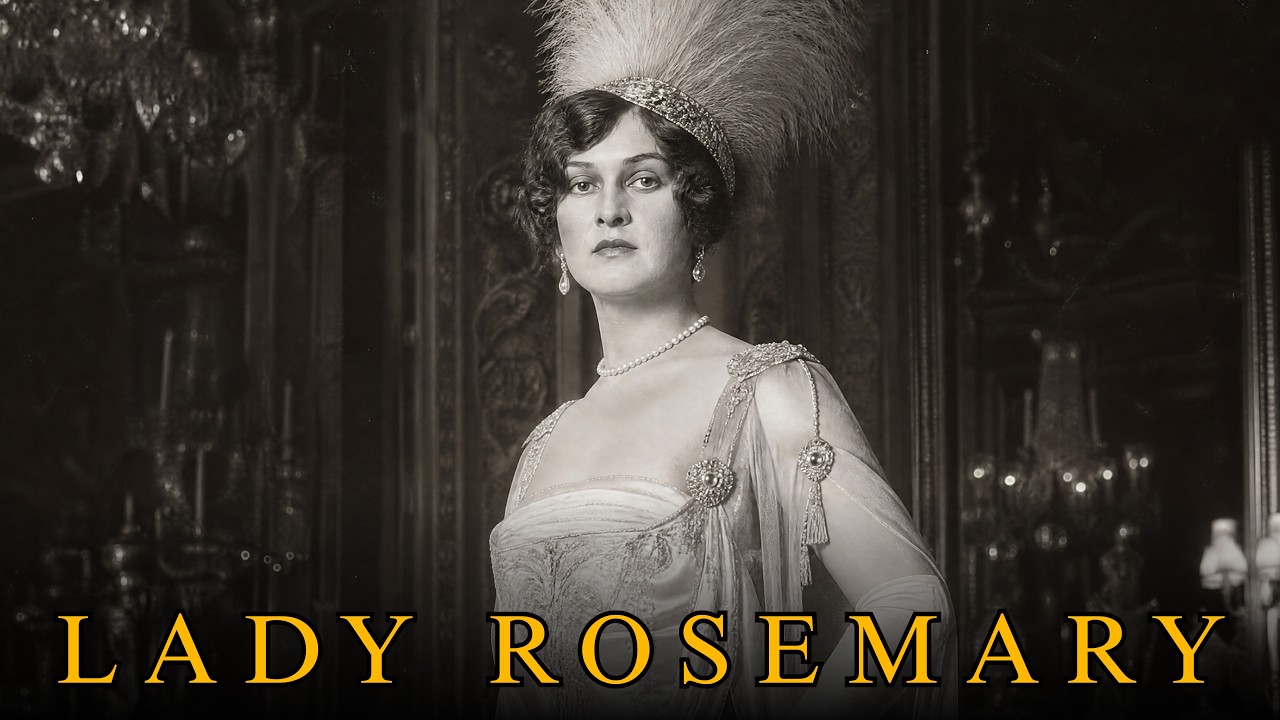
And thirteen years before that fall, the man who would one day be King Edward VIII had asked her to marry him and been told no. Not for anything she had done, but for the family she had been born into. She is the woman the crown refused long before it lost a king to another. She was born in a fairy tale castle on the far northern coast of Scotland into a family that had once owned more of Britain than anyone alive.
The place was Dunrobin, a forest of pale turrets rising above the North Sea in the county of Sutherland, one of the grandest private houses in the whole of Britain. It belonged to her father as easily as the coat on his back. On the 9th of August in the year 1893, Lady Rosemary Millicent came into that house, the youngest of four children, the daughter of Cromartie, heir to the dukedom of Sutherland, and of his wife Millicent, a woman the whole of society already knew by her first name alone. Rosemary was a duke’s daughter from her first breath, and the world arranged itself around that fact before she could speak.
The height she started from shows best in the houses. There was Dunrobin in the Highlands above its cold northern sea. There was Trentham, the family’s great hall in Staffordshire, set in parkland that seemed to have no edge to it. And there was Stafford House in London, so vast and so gilded that Queen Victoria herself, arriving to visit, is said to have told the Duchess that she had come from her house to the Duchess’s palace.
A reigning queen, walking into a subject’s home, and feeling that she had stepped up rather than across. That was the family Rosemary was born into. That was the plain, unremarkable shape of her childhood, the ordinary weather of her days. The Sutherlands had been, by the measure of land, the largest private land owners in the whole of Europe.
Their holdings spread across the far north of Scotland in acres too many to walk in a single lifetime. The money that kept the turrets warm and the long tables laid came from that land and from the industrial age that was remaking the country around them. And it came in quantities that made the family a fixture of every great occasion, every royal season, every list of the people who counted for anything at all. Her eldest brother, George, would in time become the fifth duke.
The whole apparatus of a great house moved around the children like a slow and certain machine. A child raised inside that certainty does not learn that she is rich any more than a fish learns that it is wet. She simply learns the manners of the top of the world. And Rosemary learned them at Dunrobin and Trentham and Stafford House, moving through the seasons of the year and the houses of the family like a small bright figure crossing a very large canvas.
She was, by every account that survives, a warm child who grew into a warm woman. Those who knew her spoke of her mother’s smile passed down whole to the daughter, of a charm that was not performed but simply there in the room with her, of a beauty that the newspapers would later call remarkable without troubling to exaggerate it. She had the long features and the level, unhurried gaze that the portrait painters of the age admired. And she had something the paint could never quite catch: a genuine kindness that people remembered long after the music had stopped and the guests had gone home.
In a world built on advantage and quiet calculation, she was liked simply and widely for herself. And on her from the beginning, there were the pearls. A string of them, the plain and expected ornament of a girl of her rank, worn at the throat for a portrait or a party, and thought about no more than one thinks about the buttons on a coat. Every well-born woman of her world had them.
They were the badge of the class, the quiet sign that said: here is a daughter of a good house. Nothing more and nothing less. Rosemary wore hers through the seasons of her girlhood, without once imagining what those pearls would one day be asked to do in a field on the worst afternoon there would ever be. For all the acres and all the houses, for all the queens who felt small in the family’s hallways, there was a single thing that even a Duke of Sutherland could not simply hand to his daughter.
And it was the thing that would come in the end to define her whole life. He could not choose whom she would be allowed to love, and neither, when it mattered, could she. That decision lay with an older law and a higher house than his, and when the time came, it would be made over her head, against her wishes, and for reasons that had nothing to do with the woman she actually was. But that was years off yet.
First, there was a mother to reckon with, and the mother was a story all her own. The woman who gave Rosemary her smile and her charm was also one day the reason a king said no. Her name was Millicent, Duchess of Sutherland, and she was one of the most talked-about women of her age, admired and disapproved of in almost equal measure. A great lady who flatly refused to be merely decorative.
To know Rosemary at all, one has to know her mother first, because the daughter’s fate would turn entirely on the family’s name. And it was Millicent who gave that name both its brightness and its shadow in the same restless life. She had been born in the autumn of 1867, a daughter of the house of Rosslyn, and she had married Rosemary’s father on her seventeenth birthday, a girl handed into a dukedom before she was fully grown. She might have settled, as so many duchesses did, into a long and comfortable career of hosting and being seen and doing nothing that anyone would remember.
Instead, she turned her considerable energy outward into the grim industrial world that lay just beyond the parkland of Trentham. In the pottery towns of Staffordshire, where the family held land, she saw the workers who glazed the fine china that graced tables like her own, and she saw what the lead in that glaze did to their bodies over the years. And she decided, duchess or not, to do something about it. They called her “meddlesome Millie” for it, half in mockery and half in grudging awe.
She campaigned to have the lead taken out of the glazes, and she won real changes, sparing lungs and lives in towns that had never once expected a great lady to notice they existed. The novelist Arnold Bennett, who knew those towns from the inside, put a version of her into his books, a countess with an interfering meddlesomeness that so often exasperated the people around her. It was not meant as a compliment. Millicent would not have cared in the slightest.
She had discovered that a duchess could be far more than an ornament, that the same rank which trapped so many women could, in the right and stubborn hands, become a lever. And she pulled on it hard for the rest of her days. When her husband died in 1913, and then when the Great War came the following year, she pulled harder still. She raised and paid for her own ambulance unit and took it to the front herself, and she was there at the siege of Namur in Belgium in the very first weeks of the fighting, close enough to the guns to hear them working.
She set up and ran field hospitals in the north of France, real hospitals doing real surgery on shattered men. And for that service she was honored by three separate nations, given the War Cross of France and the decorations of Belgium and of Britain for work done under fire. Whatever else was ever said of Millicent, and a great deal was said, she was brave, she was useful, and she was formidable. One of the genuinely admirable women of her whole generation.
And yet the same woman carried, in the careful eyes of the court and the respectable families, a whiff of the unsuitable that never quite blew clear of her. After the Duke’s death, she married again, twice over, and both marriages ended in the divorce courts, the first on the grounds of her new husband’s infidelity, the second on grounds more private and more damaging still. Around her in the wider family, there were others whose names made the guardians of respectability wince and look away. There was the uncle, the Earl of Rosslyn, a man who married three times and gambled away a fortune until the bankruptcy courts finally caught up with him.
There was the great aunt, a celebrated beauty of the previous generation, who had been for years the acknowledged mistress of a Prince of Wales who went on to become a king. The blood of that family was brilliant and quick and charming, and it was also, by the strict and unforgiving reckoning of the palace, tainted. Here is the cruelty that sits at the very center of this story, and it should be seen plainly before the rest of it unfolds. The very qualities that made Millicent remarkable—her refusal to stay quietly in her place, her willingness to marry for herself and to leave a marriage when it failed her, her whole vivid and unruly life—were the qualities that the court would one day count against her daughter.
Rosemary had done nothing. Rosemary was, by every surviving account, gentle and good and kind. But she carried her mother’s name and her mother’s blood. And in the world she was about to walk into as a grown woman, a person was judged not by her own conduct but by the reputations that gathered around her like relatives crowding into a photograph.
The bravest woman of her war would become, in the cold ledger of the monarchy, the reason her own daughter could not have the man she wanted. First, though, Rosemary had to meet him. And she met him in the very place her mother had gone to make herself useful. She met him at the war.
When the war came, the beautiful girl from the castle went to France and learned to sit with men who could no longer speak. She might have done what so many young women of her rank did—rolled bandages in the drawing room of a country house or lent her fine name to a fund and thought her duty done. Instead, like her mother before her, she went to where the wounded actually were. She trained and served as a nurse under the Voluntary Aid Detachment, the great volunteer force of women who staffed the hospitals of that war.
And she gave the better part of four years to it, crossing the water to France and working through the long grinding seasons of the fighting in 1915 and again through 1916 and into 1917 and on toward the bitter end of it. It was not gentle work, and it was not decorative, and it could not be performed at a flattering distance. The hospitals of the Western Front took in men torn apart by the new industrial weapons: men with faces gone and limbs gone and minds gone past finding. And the nurses lived close inside that ruin day after day after day, with the smell of it in their clothes.
Rosemary was a duke’s daughter, raised among marble and footmen and the quiet certainty of comfort, and she chose to spend the years of her early twenties among the carbolic and the blood and the low crying of the dying. What survives of her from those years is not the record of a great lady playing prettily at charity for a season. It is the record of a woman who was genuinely and unshowily good at a hard and necessary thing, and who was recognized for it by people who did not hand out such recognition lightly. She was mentioned in dispatches in the January of 1917, a real honor for real service under strain.
And after the war, she was made an Associate of the Royal Red Cross. There is one story from that time that says more about her than any list of medals ever could, and it deserves to be told slowly, in full. Among the men in her care was a soldier broken not in his body but in his mind. One of the many the age had learned to call shell-shocked, who had retreated so far down inside himself that he no longer spoke at all to anyone.
He lay silent past the reach of the doctors and their notebooks, past the reach of ordinary words. And Rosemary sat with him, not for a brisk professional minute on her rounds, but for hours, and then for hours again, day after day, saying whatever it was she said, offering whatever it is that a steady and kind voice can offer to a man who has stopped answering the world. And in the end, after all that patience, he spoke. The first word he had said in no one knew how long, drawn up out of the dark by a young woman who simply would not give up on him, was a single tender word.
Darling. Look hard at what that scene shows, because it is the truest picture of her that exists. Here was a woman who could have coasted through the whole war on her name and her looks, admired safely from a comfortable distance, and instead she gave her hours and her patience and something harder to name to the least glamorous work that war could offer: the slow coaxing of a ruined man back toward the land of the living. That was the Rosemary the war made visible for the first time.
Not the ornament to be looked at, but the nurse who did the looking, who saw a man that everyone else had quietly written off and refused, for hour after hour, to write off herself. The kindness that people had noticed in the child had become, under the pressure of the war, something much closer to a gift, and a rare one. And it was this woman, competent and tender and holy herself, whom a very lonely young man happened to see. The Western Front in those years drew everyone toward it, the lowborn and the high alike.
And among the many figures who passed through that hard world was the most watched young man alive on the earth: the heir to the throne of the British Empire, in France in a plain uniform, aching to be treated as something other than a prince for once. He was surrounded always and everywhere by deference and careful distance. He was famous far past the point where fame becomes a kind of solitude. And somewhere in that gray landscape of hospitals and headquarters, he came to know the nurse from Dunrobin.
And he found in her the one thing his whole position had always denied him. Someone who saw the man and not the crown standing behind him. The war had lifted Rosemary to the highest point of her life so far. She had proved herself, been honored, become fully and finally the person she was meant to be.
She was admired across two continents, spoken of everywhere as one of the loveliest and most eligible young women alive. And now, the future king himself had turned his lonely attention toward her. From the outside, it must have looked like the opening of a fairy tale. The nurse and the prince, the beauty and the throne waiting behind him.
It was the very peak of her rise. And like most peaks, it was the last high ground before the long fall began. Because the prince was about to want something that princes of all people in the world are not always permitted to have. The heir to the throne was twenty-three.
Adored by millions and desperately alone. And then he met a nurse. His name was Edward, Prince of Wales. And one day, for a short and ruinous while, King Edward VIII.
In the summer of 1917, he was a young man carrying the whole weight of an empire’s expectations and almost none of its ordinary comforts, hemmed in on every side by protocol, watched by everyone who came near him, genuinely close to no one at all. He had the kind of fame that hardens over time into a form of solitude, that puts a pane of glass between a man and every person in the room. And into that solitude walked Lady Rosemary, warm and steady and unimpressed by the glass. And he fell, by every account that has come down to us, very hard indeed.
One of those who watched it happen up close was a close friend of Rosemary’s, a woman remembered as Lady Victor Paget, and it is largely through her that the story is known at all. She saw the prince’s feeling for Rosemary grow from friendship into something a great deal more serious, saw the heir to the throne of England behave like any young man anywhere in the grip of a first great love. By one account, he was crazily in love with her, unable to hide it and unwilling to try. He had been given everything a human being could be given except the one freedom that matters most: the freedom to choose for himself.
And here, in a nurse from a Highland castle, was a person he wanted to choose entirely on his own, for no reason of state at all. It is easy to see what Rosemary offered him, and the seeing explains the whole affair. She was not a courtier angling quietly for advantage, the way so many around him always were. She had grown up higher than almost anyone he was ever likely to meet, so his rank did not dazzle her the way it dazzled the daughters of the season.
She had spent years at the beds of dying men, so she had a depth and a steadiness in her that the drawing rooms could not manufacture. And she was genuinely kind, the sort of person who had once sat for hours beside a silent soldier until he found a word. To a young man half-starved of ordinary human warmth, she must have seemed like clean water in a dry country. He did not want her because she was useful to the monarchy or its future.
He wanted her because, for once, in his watched and gilded life, someone made him feel like a man rather than an institution on two legs. There is a real complication in the record here, and honesty requires that it be set down plainly beside the romance. In later years, it was said that Rosemary herself claimed she had never wanted to marry the Prince of Wales at all, and that when she did briefly consider it, she did so thinking she might, as the phrase of the time went, “make something of him. ” Whether that was the plain truth of her own heart, or the protective story of a proud woman who had been publicly turned down and would not show the wound, no one can now say, and it would be dishonest to pretend to a certainty the record does not give.
Both things can be held in the hand at once. A prince deeply and helplessly in love, and a young woman a good deal more guarded about her own feelings than the fairy tale would prefer. The record hands us his ardor plainly, and her heart only in glimpses, and the glimpses do not all agree with one another. What is not in any doubt is that the feeling ran serious enough to move toward marriage.
This was no flirtation of a single London season to be forgotten by the autumn. The thing was spoken of and weighed and edged steadily toward, in the way that only a real and settled intention is ever edged toward. And that is exactly what made it so dangerous, because a Prince of Wales cannot simply marry the woman he loves and be done with it. His marriage is not a private matter between two hearts in a quiet room.
It is an affair of state, bound about with law and with the will of the reigning king. And the very moment the prince’s feeling hardened into a real intention, it stopped being a love story and became a question for the palace to sit in judgment upon. So the young man who had, at long last, found someone he wanted purely for himself came up hard against the one wall that all his rank could not knock down. He could have palaces and yachts and the roaring adoration of crowds in every corner of the empire.
He could not, it turned out, have Rosemary unless his father first agreed to it. And his father was the King of England. Everything now hung on a single decision to be made in a room the lovers would not be allowed to enter, by a man weighing his son’s happiness against the reputation of a family in a distant part of Scotland. The proposal was coming.
And so, from the other direction, was the answer. One day she came to Lady Paget and told her the prince had asked her to marry him, and for a moment it seemed the century itself might turn on it. That is how the friend remembered the moment, simply and without any embroidery. The proposal had been made.
The heir to the throne had asked Lady Rosemary to be his wife, which meant, in the plain and startling arithmetic of the monarchy, that he had asked her, in time, to be his queen. A nurse from Dunrobin, a duke’s daughter with her mother’s smile and a war behind her, stood for one breath at the very threshold of the throne of England. And then the door was shut firmly from the other side, by the king. The law that shut it was old and cold and precise.
Under the Royal Marriages Act, passed in the year 1772, no descendant of the sovereign could marry without the sovereign’s express consent. It had been written a century and a half before for exactly this purpose: to stop a prince from marrying where his heart rather than the interests of the state directed him. And it handed King George V an absolute and unarguable veto over his son’s choice of a wife. There would be no eloping, no marrying in secret and asking pardon afterward.
Without the king’s yes, freely given, there could be no marriage at all, in law or in fact. And the king, having turned the matter over, said no. Why he said it is the one part of this whole story where the records do not fully agree, and the honest course is to lay out what they offer rather than to reach for the neatest single version. What every account agrees upon is that the objection was never to Rosemary herself.
King George is said to have liked the young woman well enough. The objection was to her family, to the blood and the reputation on her mother’s side of the house. One strand of the record points to the wider Rosslyn connection: to the great aunt who had been a royal mistress, and the uncle who had gambled himself into open bankruptcy across three marriages, to the general sense of instability and scandal running loose in the line. Another strand points more narrowly and more sharply at the duchess herself, at Millicent’s own remarriage and her separation from her second husband, a great lady twice now at the center of the divorce courts and the gossip that swirled around them.
The emphasis shifts from one telling to the next. The verdict never shifts at all. The family was judged unsuitable, and the daughter was refused for it. Sit for a moment with the true shape of that decision, because it is the beating heart of everything that follows.
A young woman who had done nothing whatever wrong, who had in plain fact spent her war doing a great deal that was right and hard and good, was told that she could not marry the man who loved her because of things that other people in her family had done long before and far away. Her mother’s courage under fire counted for nothing against her mother’s divorces. Her own service at the dying men’s beds counted for nothing against her uncle’s gambling debts. She was, in the coldest possible sense, guilty by association.
Refused a crown for scandals that were never once hers. And the instrument of that refusal was a law about permission. The sovereign’s permission. The one consent in the land that simply could not be worked around or lived without.
Everything else in her life had been given to her freely: the houses, the honors, the wide admiration. The one thing she wanted, or the one thing at the least that was being offered to her, required a permission that was withheld. For the prince, the refusal was a wound that did not close over. His friend, Lady Paget, put it into words that have outlasted almost everything else about the affair.
The prince, she said, was bitter and furious, and she did not think he ever forgave his father. Hold on to that sentence and carry it forward, because it will matter far more than it can seem to now. The young man who was told he could not marry for love in 1917 was a young man learning a hard and permanent lesson about kings and fathers and hearts. A lesson he would carry folded away inside him for the rest of his life.
He obeyed. He was, after all, still only the heir, and the great machinery of the monarchy was stronger by far than a young man’s will. But he obeyed the way a man obeys a thing he has come to hate. Storing the resentment somewhere deep, where it would sit and wait and slowly harden into something else.
And for Rosemary, the refusal quietly set the pattern of all the rest of her days. She had reached the highest point that a woman of her world could reach, the very threshold of the throne, and she had been turned back from it. Not by any failing or fault of her own, but by an accident of birth she was powerless to undo. The great houses and the great name that had opened every other door in her life had, at the one door that mattered most of all, become the very reason it was locked against her.
She would not be queen. She would not, it seemed, even be permitted to decide the question for herself, one way or the other. The palace had decided it for her. Now the world would arrange the rest, and the world, as it always did with women like Rosemary, would find her a suitable marriage and move briskly onto other business.
The prince was bitter and furious, and something in him did not forgive the king who had refused him. That was the immediate and visible wreckage of the decision, and it is easy enough to see, because Edward was famous, and his moods were watched and recorded. What is harder to see, and matters every bit as much, is the quieter wreckage on the other side of it, in the woman who had been the whole reason for the quarrel without ever once being consulted about it. The refusal is nearly always told as the prince’s tragedy, the great romantic wound of the future king.
It was also, and far less noticed by anyone, entirely Rosemary’s. Think carefully about what it meant to be her in those months. She had been courted by the heir to the throne, spoken of openly as a possible queen of England, lifted for a moment to the very summit of what a single life could be. And then she had been set quietly aside.
Not because the prince had stopped loving her, but because a committee of her betters had gone carefully through her family tree and found it wanting. There is a particular and lasting humiliation in being rejected for who your relatives happen to be. It is a verdict you cannot argue against, because it is not about anything you yourself have done or left undone. She could not become any less related to her gambling uncle.
She could not undivorce her mother. She had been weighed on a scale she was not allowed to touch, and found unsuitable for reasons that were by their very nature permanent and forever beyond her reach to change. This is the place where the whole story shows its true and lasting subject. And that subject is powerlessness standing at the very summit of power.
Rosemary had, on paper and in every photograph, almost everything a person could name. She was the daughter of one of the richest and grandest families in all of Britain. She had beauty and charm and hard-won honors and the genuine love of the most eligible man alive in the world. And with the whole of it in her hands, she could not command the single outcome she might most have wanted, because the decision was never once hers to make.
It belonged to the king, in a room she would never see. Her own wishes, whatever they truly were beneath the guarded surface, formed no part of the calculation at all. A woman could own a share of the largest fortune in Europe and still not own the answer to the most important question of her own life. That gap between everything she had and the little she controlled is the gap this entire life keeps falling into.
Her own later words, if they were truly and freely hers, read very differently in this hard light. If she said that she had never really wanted to marry the prince, that she had only considered it thinking she might make something of him, then perhaps that was the plain and level truth of a guarded and private heart. Or perhaps it was the carefully worn armor of a proud woman who had been publicly turned down before the whole of society, and who would not ever give the watching world the satisfaction of seeing that it had hurt her. People who have been rejected very often insist loudly and for years that they had never wanted the thing in the first place.
It is one of the oldest and most human ways of keeping one’s dignity whole. No one can see down into her now, and it would be false to strain to try. But the possibility hangs over the whole story like weather sitting on the hills: the possibility that the woman at the dead center of the great royal romance may have spent the rest of her short life quietly insisting that it had never mattered to her at all. What is certain is that both of them were now free only in the emptiest possible sense of the word.
Free to marry, so long as it was someone else. The prince would carry his old grievance against his father and against his own throne forward with him for years. A man who had been taught early and cruelly that his heart did not get to cast a vote. And Rosemary would be steered gently and firmly, as the young women of her class were always steered, toward a match that the world would find suitable.
Which is to say, a match that offended nobody at all and stirred nothing much in anyone. The season would provide, as the season always did. There was, most conveniently, a young man of exactly the right rank and exactly the right fortune close at hand. A man who happened also to be the prince’s own closest friend.
And the arrangement, when it finally came, would carry a neatness to it that was very nearly cruel. For if Rosemary could not have the prince, she could at the least be given the next best thing available: a man cut from the very same cloth, moving in the very same charmed set, trusted deeply by the very man she had just been refused. It was a solution that let every party to it save face and move on. The prince kept his friend close.
The families kept their dignity intact. Rosemary was respectably and visibly settled. Only the single question of her own happiness was left politely unasked, because in the machinery that governed women like her, her happiness had never really been the point of the exercise. The point was a good marriage, correctly made.
And a good marriage was now duly arranged for her. If she could not have the prince, the world arranged the next best thing: the prince’s closest friend. His name was William Ward, known to everyone as Eric, Viscount Ednam, heir to the Earl of Dudley. And on the 8th of March in the year 1919, less than two years after the refusal, Rosemary married him at St.
Margaret’s Church in Westminster, in the very shadow of the abbey, before the great and the grand of the whole land. It was one of the weddings of the season. A duke’s daughter and a viscount. Two famous families joined at the altar, the newspapers full of the dresses and the guest list and the flowers.
From the outside, it looked like nothing but a triumph. Looked at closely and slowly, it was something a good deal more complicated than that. Ednam was, by the exacting standards of his own world, a considerable catch for anyone. He was a decorated soldier, a cavalry officer who had served hard through the war and come out of it with the Military Cross for bravery under fire.
No small thing in a generation that had seen so much of it. He was heir to one of the great industrial fortunes of the age. He was handsome and well-liked and moved with ease in the very highest circles of the country. And he was, most tellingly of all, an intimate personal friend of the Prince of Wales himself, part of the same fast and charmed set, close enough to the prince that Edward would stand as godfather to the couple’s own firstborn son.
There is a strange and painful arithmetic buried in that fact. The woman the prince had been forbidden to marry was now the wife of the prince’s own dearest friend. Folded neatly back into his world at a single remove. Kept near to him always, and married to him never.
Whether Rosemary loved Eric Ward on the day she married him, no one can now say with any honesty. What can be said is that the marriage carried, from its very first morning, the unmistakable shape of a settlement rather than a romance. Two people of precisely the correct rank, brought together at precisely the correct moment, doing precisely the correct and expected thing. She had been refused the man who loved her, and given instead a man who suited her.
And the whole difference between those two plain verbs is the difference that all the rest of her life would be lived quietly inside. She became Viscountess Ednam that morning. In time, had she only lived long enough, she would have become Countess of Dudley, mistress of one of the great houses of England. The path laid out ahead of her was gilded and secure, and entirely conventional in every particular.
The smooth path of a great lady in a great and proper marriage. The wedding itself was a set piece of its era, the kind of glittering spectacle that the age performed better than any age before or since. St. Margaret’s filled to its doors with the assembled aristocracy of two famous houses.
The bride, admired for her looks across two whole continents, came down the aisle a duke’s daughter and walked back up it a viscountess. And at her throat, in all likelihood, the pearls. Worn now as a bride wears them on the great day, the same quiet string that had marked her as the daughter of a good house since her girlhood, doing once again their ordinary and expected work of signifying that here was a woman of rank at the most public moment of her life. No one looking at those pearls on that bright March morning could ever have guessed what they would be needed for in the end, or where.
The prince was there through all of it, woven into the very fabric of the arrangement, whether he stood in the church or not. He gave his friendship to the marriage. He gave his own name to its firstborn child. He kept Rosemary close in the only way that was now left open to him in the world: as the wife of a man he trusted completely, a familiar presence at the bright edge of his life for years to come.
It would be said in the years that followed the wedding that Rosemary was still sometimes seen in company with the prince, and with other men of their circle besides, and that the marriage of the Wards was not the sealed and settled and happy thing that the wedding photograph so carefully suggested. But that is the next part of the story, and it can wait its turn. On her wedding day, the arrangement held firm. The families smiled for the cameras, and the door to the throne closed for good and all behind her.
What opened in its place was a different kind of grandeur entirely. Not the ancient royal kind she had been so firmly refused, but a newer and a harder sort, one dug and hammered and smelted out of the very middle of England. For the family she had just married into had not received its great fortune as a gift from kings. It had made that fortune itself, from coal and from iron, from the black and burning country where England was busy building the whole modern world.
And that fortune, and the great house it had paid for, would now become the setting for everything that came next in her life. The family she married into had not inherited its money from kings. It had pulled it out of the ground with its own hands. The Earls of Dudley drew their wealth from the region of the English Midlands so scarred and so smoke-darkened by heavy industry that it was known, without a shred of affection, as the Black Country: a landscape of coal pits and iron works and blast furnaces, where the fires seemed never once to go out, day or night.
Beneath that hard ground lay coal and iron in enormous quantity, and the Dudleys owned a very great deal of both, and turned it steadily into money on a scale that could stand without embarrassment beside the oldest inherited fortunes in the land. Where the Sutherlands had land and long lineage, the Dudleys had industry, the raw and roaring engine of the whole age. The heart of that fortune was iron and steel and coal made tangible in great works. There was the Round Oak steel works, one of the major ironworks of the entire district, its furnaces lighting the night sky above the towns.
There were collieries hauling coal up out of the Staffordshire earth in an endless dark stream. And around them stood the whole vast apparatus of Victorian industry that had made a small handful of families enormously and permanently rich, while the crowded towns around their gates lived hard and short. The Dudley money was not the quiet, polite, inherited wealth of the old countryside. It was the loud and powerful and faintly frightening wealth of the factory age.
New money, with soot still on it. And it built the family a life fully to match its noise. The seat of that life was Himley Hall, a great house in the Palladian style, set within landscaped parkland on the very edge of the industrial district. Grand enough to receive royalty in comfort, and comfortable enough to actually be lived in.
In the years the family held it in its prime, Himley became a kind of byword for a particular sort of modern luxury: the old grandeur of a country house fitted out with every new pleasure that money could possibly buy. There would be, in time, a cinema built inside the house itself, and a swimming pool with a water shoot and a cocktail bar standing beside it, and a private golf course laid out across the grounds. It was the house of a family that had industrial millions in the bank and every intention in the world of enjoying them thoroughly. A bright stage set for the fast and moneyed world of the 1920s.
Look at what the marriage had bought Rosemary, laid out in the plain and countable terms of scale. She had left the ancient landed grandeur of the Sutherlands and married directly into one of the greatest industrial fortunes of the whole age. She had a viscount for a husband and a waiting earldom at her back. She had Himley with its cinema and its cocktail bar and its golf course, and the London seasons, and the wardrobe and the jewels and the small army of servants that came bundled with all of it.
The estate around the great house was so considerable that when it was finally sold off, years after her death, to the National Coal Board, it changed hands for a sum of £45,000, a figure that carried real weight in its day. By any measure the world knew how to count, Rosemary Ward, Viscountess Ednam, was among the most fortunate women in the whole of England. And yet the counting itself is exactly the trap the story keeps laying. Every single one of those advantages was a thing that money could readily provide.
And the story of Rosemary’s life is at bottom the story of the things that money could not reach at all. It could buy Himley, but it could not make the marriage inside the walls of Himley a happy one. It could buy the pearls and the gowns and the endless seasons, but it could not give her back the single choice she had been refused. It could raise a great house on the edge of the coal fields with a swimming pool and a golf course and a picture house of its own, and it could not, when the very worst finally came for her, protect a single one of the people she loved most in the world.
The grandeur was entirely real. So exactly was everything it failed to touch. For behind the wedding photographs and behind the industrial millions, the marriage of the Wards was, by all the accounts that have survived, not a marriage of two hearts closely and gladly joined. It was a partnership of the right sort of people correctly matched.
And like a great many such partnerships in that particular world, it left both of the partners looking, in their own separate and discreet ways, elsewhere for what they lacked. The gilded surface held perfectly well in public. Underneath it, two people who had each perhaps been steered firmly away from someone they truly wanted were quietly learning to live a life side by side that was never quite, in the end, a life fully together. They were handsome, rich, and admired.
And by most accounts, they made each other unhappy. This is the part of Rosemary’s life that the wedding day could not foresee and the newspapers did not print: the long stretch of years lived inside a marriage that looked, from any distance at all, like a complete success. There were three sons in time, and a household run on the grand scale, and every outward sign a person could ask for that a great match was working exactly as such matches were always meant to work. There was also, running quietly along underneath it all, the ordinary and human sadness of two people bound together by arrangement rather than by love.
Each of them reaching, in the careful way of their set, towards some warmth found somewhere other than at home. Her husband Eric was rumored to have looked elsewhere early and often. The most persistent of the stories attached him to a well-known figure of society, a woman named Venetia Stanley, and it was whispered, and later a good deal more than merely whispered, that a daughter born in the early 1920s was in truth his own child. Whether every version of the rumor was true is beyond any proof now, at this distance.
But the general shape of the thing is clear enough to make out. The viscount was not a faithful husband. And in the loose and discreet code of the upper class of the day, he did not greatly trouble himself to seem one either. A wife in that world was expected to endure such things with composure, to keep the surface of the marriage smooth, whatever churned along beneath it.
And Rosemary, raised to composure since the earliest days of her carefully straightened girlhood, would have understood the rules of it perfectly. She did not, however, only endure them. By the accounts that have survived, she had her own life at the edges of the marriage, was seen in the company of other men, moved through the same fast society that her husband did, and was not always alone within it. Among the names quietly linked to hers was the prince himself, kept close all these years as her husband’s dear friend, and another well-known man of their wide circle, a figure of both the political and the social world.
How far any of it ever actually went, the record does not say, and it would be wrong and unkind to guess at it now. What the record does clearly suggest is a woman who had been handed a marriage rather than choosing one for herself, and who found, as such women so often did, that a heart refused its first choice does not simply switch itself off and go quiet. It goes on wanting things. It looks for warmth wherever warmth can be found.
Here is the gap that the whole marriage lived its years inside. And it is the very same gap that has run straight through this entire story from the first chapter. On the bright surface, the public couple: the viscount and his lovely viscountess, photographed together at the races and the balls, heirs to a waiting earldom, parents of three handsome sons, the very picture of aristocratic success made flesh. Underneath the surface, the private and unphotographed truth: two people who had each perhaps been turned away from the person they truly wanted, both of them now making the best of an arrangement that satisfied the whole of society and neither one of themselves.
The distance between those two pictures was the exact distance Rosemary had learned to live inside from the very moment the king had said his no. She was very good, by this point in her life, at keeping the surface of things bright and untroubled. It would be an easy thing to make this a simple story of a cold and bitter and unhappy woman, and it would be entirely false to do so. Everything in the record suggests that Rosemary remained, through the whole of it, warm and widely well-liked.
Still the woman with her mother’s ready smile. Still recognizably the nurse who had once coaxed a broken man back to speech across long silent afternoons. Unhappiness in a marriage does not have to harden a person all the way through, and it does not seem to have hardened her in the least. What it seems instead to have done was to send her looking steadily for something that might give her life a meaning that the marriage itself plainly did not.
Some real work of her own that was truly hers to choose, in a life where so very little had ever been left to her choosing. And she found it in the very same place her own mother had once found her escape from the merely decorative life of a great lady. She found it in real service to people who had nothing at all, in the hard industrial towns that lay near her new home, among the children the age had broken and then quietly forgotten. The marriage would give her a title and three sons and a great deal of unspoken unhappiness.
Besides, the work she chose for herself would give her the one thing the marriage never could. A genuine purpose that belonged to her, and to her alone. The one part of her life that the king and the marriage market never once arranged for her was the good that she chose to do herself. In a story so crowded with decisions made high over Rosemary’s head by kings and courts and careful families, it matters greatly to stop and mark the decisions that she actually made herself.
And the clearest and steadiest of them all was her charity, which was never the idle patronage of a bored great lady lending a name, but sustained and practical and unglamorous work on behalf of children the world had already thrown away. Near the grim industrial heartland of her husband’s family, in the crowded towns of the Potteries and the coal fields, there were children left crippled by disease and by poverty and by the hard, grinding usage of an unforgiving age. And Rosemary gave a real part of herself to their cause. She became, in the year 1927, the president of the North Staffordshire Cripples’ Aid Society, the plain and unlovely name of a real and deeply necessary thing.
This was not a title lent out for the sake of a line on a letterhead and then forgotten. She threw the full weight of her name and her energy behind the care of disabled children, campaigning openly for the expansion of the orthopedic hospital that served them. Working to see that boys and girls whose own families could give them nothing at all might yet have the surgery and the care and the plain chance at a life that money would otherwise have quietly decided they could never have. It was the very same instinct that had once taken her across the water to the front as a nurse.
The same flat refusal to leave suffering people to suffer alone when she happened to hold the power to help them. There is a straight and unbroken line running from the young woman sitting at the shell-shocked soldier’s bedside to the great lady fighting hard for a children’s hospital. And that line is the truest single thing about her. Rank had been used all through her life as a reason to deny her things, and as a reason to decide important things for her without her leave.
She turned it, wherever she possibly could, into a reason to give instead. In this she was very much her mother’s own daughter. Meddlesome Millie’s child to the bone. The inheritor not of the scandal that had cost her a crown, but of the plain courage that had cleaned the poison out of the pottery glazes and driven the ambulances up toward the guns at Namur.
The family name had always had its two sides to it, the bright and the shadowed. Rosemary chose deliberately and daily to live the better one of them. It is a quiet part of the story, and quiet parts are always easy to hurry past on the way toward the drama waiting further on. But this part should not be hurried past, because it is the place where Rosemary is most fully herself and most nearly free.
Everywhere else across her whole life, she was the one acted upon: the refused bride, the arranged wife, the woman whose largest choices were made for her by others. Here in this work, she was the one deciding, the one acting, the one who actually held the power to change how a thing turned out. And she spent that power freely, on behalf of people who had even less of it in the world than she did. The children of the Staffordshire towns did not know or care whose great aunt had once been a royal mistress.
They knew only that here was a woman who fought hard for them. And the whole district remembered her for it, long after the last of the gossip about the prince had faded away to nothing. By the later years of the 1920s, then, Rosemary’s life had settled at last into a shape that, for all of its private disappointments, held real and lasting substance within it. She was Viscountess Ednam, mistress of a great house, mother of three growing sons, and a genuine and remembered force for good across the whole region she had married into.
The marriage was what it had always been and would go on being. But around it, and beyond it, and quite apart from it, she had built a life with real meaning packed inside it. She was in her middle thirties now. Secure, admired, and useful, with the earldom still waiting ahead of her, and her boys growing up tall around her.
If the story had a natural resting place in it, a quiet point at which a difficult life finds its level and simply goes steadily on, then this was surely it. But this story does not rest there. And it was never going to. Because the last part of Rosemary’s life was not a slow and gentle settling into a comfortable middle age.
It was a sudden and terrible sequence of loss arriving all at once, inside the span of a single year, that took first the person she loved most in all the world, and then her own life close behind it, and left the great house and the great name to carry on somehow without her. The first blow of the two fell in the December of 1929. And it fell squarely upon a mother, in exactly the way that mothers most dread, through every waking hour. In December of 1929, her second son went out on his bicycle and did not come home again.
His name was John Jeremy, called Jeremy by everyone who loved him. And he was seven years old. One of the three boys who were the real and beating center of Rosemary’s life, the part of the whole arranged marriage that had given her something to love without arrangement, and without condition, and without anyone else’s permission. On an ordinary day, doing an ordinary thing that children have always done, riding his bicycle, he was struck by a truck.
And he was killed. There is no way at all to soften it, and it should not be softened for anyone’s comfort. A seven-year-old boy out on his bicycle on a winter day, gone in a single moment on a public road. For any parent alive, this is the very end of the world.
And there is no reason on earth to think that Rosemary felt it any less sharply than the poorest mother in the Staffordshire towns she had worked so hard for. Grief of that particular kind does not pause to consult the size of the bank account first. The great house, the waiting title, the honors, the whole gleaming apparatus of her fortunate and envied life: they meant exactly and precisely nothing, set against the plain fact of one small and suddenly empty bed. Here again, at the sharpest and cruellest possible point, was the truth this whole story keeps returning to and circling.
She had everything the world could possibly give a person, and it could not give her back her boy. And none of it could have kept the truck from that road on that afternoon. The powerlessness that had shaped her marriage now cut all the way to the bone of her. The richest kind of life ever devised offers no protection whatever against the oldest and commonest kind of loss.
What she did with the grief tells us, one final time, exactly who she was underneath the title. By the accounts that have survived, she turned it outward and downward, and into the work of her own two hands. And she threw herself into the making of a memorial garden for her lost son. A living and growing thing, to be planted and tended in his memory.
It is a small detail, and an almost unbearably human one. A mother trying to make something grow in the exact place where a child had been, to hold his memory somehow in leaf and root and flower, because she could no longer hold the boy himself. She had spent her whole life being quietly denied the power to decide the things that mattered most to her. She could not decide this one either.
She could not undo it, or bargain with it, or nurse it back the way she had once nursed a silent man towards speech. All that was left to her was to plant a garden, and to grieve. And so she did both. She was, all through those months, a woman deep in mourning, moving slowly through the winter and then the spring of 1930 under the enormous and fresh weight of a terrible loss.
The public life went on around her, the title and the duties and the coming seasons. Because in her world, the surface always went on, no matter what. But underneath that surface, she was a mother who had just buried a seven-year-old son. And no garden, however lovingly it is planted and tended, has ever yet filled that particular kind of hole in a person.
Anyone who has grieved a death knows that the first long months of it are a kind of fog that you walk through without ever quite feeling the ground beneath your feet. Rosemary walked through that fog all through the first half of 1930. Tending her small memorial to Jeremy. Living a life that must have felt, in the very worst of its hours, like going through the motions of something that had quietly lost its whole point.
And here the story reaches the one turn of cruelty that lifts it clean past sad and into something very close to unbearable. Because the loss of little Jeremy was not to be the end of that family’s grief for the year. It was only the first of two blows. And the second was already coming for them, though not a soul alive could see it on its way.
Rosemary had a little over seven months left to live. The woman who had buried her son in the December of 1929 would herself be dead by the July of 1930. And the mother and the boy who had been so terribly parted in the winter would be laid together in the same ground before the year was even old. The instrument of that second and final blow would be one of the glamorous new toys of the age: the small airplane.
And it would come for her without any warning at all, straight out of a clear summer sky. For the world she moved through had lately taken up flying with all the bright enthusiasm it gave to every new pleasure that came along. To fly across the Channel to France for a long weekend, to Le Touquet with its fashionable crowd, was the smart and modern thing to do. Quicker, and far more thrilling, than the slow old boat and the train behind it.
The little machines that carried them across the water were small and new. And though very few of the passengers cared to dwell on the point, not yet remotely safe. Rosemary, in the high summer of 1930, took one of those machines home from France. It would be the very last decision the story ever let her make for herself.
On the 21st of July 1930, she boarded a small airliner at Le Touquet to fly home to England. It was high summer, and the weather over the coast was fair and bright. Her husband had been staying on the French coast, and Rosemary was flying back across the Channel toward Croydon, the great London airport of the day, aboard a small aircraft chartered from a little company that went by the name of the Walcott Airline. The machine was a Junkers, a low-winged monoplane of German make, only a few weeks old, with just a hundred hours or so in the air behind it since the day it was built.
At its controls sat an experienced pilot, a decorated wartime flyer, and beside him a second pilot to share the work. And behind the two of them, in the small enclosed cabin, four passengers were settling in for the short flight home across the water. They made a distinguished little group, that cabin full of travelers. There was Rosemary, Viscountess Ednam, flying home to her sons and her grief.
There was a marquess, the head of an ancient and honored title, the Marquess of Dufferin and Ava. There was a baronet, Sir Edward Ward. And there was a woman by the name of Mrs. Loeffler.
Six people in all, counting the two pilots up front. Lifting off cleanly from the French coast on a bright afternoon, bound for home, expecting nothing more eventful than the usual gray view of the Channel below them, and then the green fields of Kent coming up gently to meet them. It was exactly the kind of flight the fashionable made all the time in those years. The modern, convenient, faintly glamorous way to travel between two countries.
And there was no reason on the earth to think that this particular one would end any differently from all the rest. The aircraft crossed the Channel without trouble and came in over the county of Kent, over the ordinary green English countryside of orchards and villages and church towers south of the Thames, flying at some height with cloud gathered about it. And then, at around two in the afternoon, high above the small village of Marden, something went badly wrong in the air that no one standing on the ground below could at first begin to understand. The people below heard it before they fully saw it.
A strange and sudden sound coming down out of the sky, described afterward by those who heard it as something very like an explosion. A hard, rending noise, where there should only ever have been the steady drone of an engine passing over. They looked up toward it. And they watched the airplane come apart in the air above their heads.
What they saw is almost too much to hold in the mind, and yet the plain people of Marden saw it with their own eyes. On an ordinary summer afternoon, going about ordinary lives, the machine broke into pieces high above the fields. A wing tore clean away and fluttered down on its own through the bright air. The engine fell separately, dropping like a stone.
The tail came off behind it. And the small cabin, with the living people still inside it, gave up its passengers to the open air high above the orchards. The wreckage was flung across a wide stretch of the quiet countryside. A wing coming to earth as much as a mile away from the rest of it.
The tail landing hundreds of yards from where the body of the aircraft finally fell. The engine crashing down into the driveway of a house that happened to stand empty. And in an orchard called Lealand’s, among the apple trees heavy with the coming season, they found the fallen. Imagine looking up from your own garden on an ordinary July afternoon, a cup in your hand, and seeing that come down out of a clear sky.
The people of Marden did not have to imagine any of it. They lived it. And then they walked out into their own orchards, to do the terrible thing that had to be done. All six of the souls aboard were killed.
The second pilot was found still strapped into his seat, alive when they first reached him among the wreckage. But he never once woke, and he died soon after, without a single word. All the rest were gone already, before they were found. And among them, in the orchard, was Rosemary.
Thirty-six years old, just nineteen days short of her thirty-seventh birthday. Fallen out of a clear July sky and into an English field. She had survived the whole of the war among the dying men. She had survived the refusal, and the long arranged marriage, and the loss of her own small boy only seven months before.
She did not survive a fashionable flight home on a fine summer afternoon. And now the pearls did the very last thing that they would ever be asked to do. The fall had been so terrible and so complete, the record tells us plainly, that there was little left by which to know her at all. Little by which to say which of the fallen figures in that quiet orchard was the Viscountess, and which was not.
At the last, they knew her only by her string of pearls. The plain and unremarkable ornament she had worn without a thought since her earliest girlhood. The simple badge of a duke’s daughter. The quiet sign of a rank she had never once had to think about became, at the last, the single thing that could give her back her own name.
Everything else the world had ever heaped upon her—the houses, the title, the vast fortune on both sides of her—all of it was worth exactly nothing in that orchard on that afternoon. A string of pearls told them who she was. It is the whole of her life collapsed down into a single unbearable image. All of that grandeur, and at the very end of it, a necklace lying in the summer grass.
They could not say, at first, why the airplane had come apart in the air. And so, for the first time in Britain, they decided to make the answer public. The death of a viscountess and a marquess together in the sky over Kent was not a thing that the country could quietly fold away and forget. And the questions came at once, and loudly.
How does a nearly new aircraft, flown by an experienced and decorated pilot in fair summer weather, simply break itself to pieces in midair over a peaceful village? The first attempt at any answer came from the coroner’s inquest, which opened at Marden only two days after the crash, and then sat again in the August that followed. And it could only reach the very bleakest of all possible verdicts. The victims, it found, had met their deaths by falling from an airplane.
And the cause of the accident itself was unknown. Cause unknown was not nearly good enough. Not for the grieving families, and not for a country whose ordinary people were only just beginning to trust their own lives to these fragile machines. And so the whole matter went on to a formal technical inquiry, called together by the committee that oversaw the nation’s aviation research, which sat privately all through the autumn at Croydon, and then reported early in the following year.
Its finding was precise and careful, where the inquest had been left helpless. The tail of the aircraft, it concluded at last, had failed under severe buffeting, shaken hard by turbulent air spilling off the wing as the machine approached the point of a stall. And once that tail gave way, the airplane had dived, and then torn itself violently apart at high speed, the wing folding, the engine wrenching free of its mounts. It was a failure of design and of aerodynamics.
A real flaw in the way that particular kind of aircraft behaved in certain conditions of flight. And understanding it plainly meant, above all, that it could now be guarded against in the machines that were built to come after. Here the story of Rosemary’s death opens out into something a great deal larger than herself. And it is the one small piece of grace to be found in an otherwise merciless ending.
That inquiry into the Marden crash was the first time in the entire history of the United Kingdom that an official report into an air accident was published openly, for anyone at all to read. The principle we now take completely for granted—that when an aircraft falls out of the sky, the public is owed a full and honest accounting of exactly why, so that the dead may in some small way buy safety for the living who come after them—has its true beginning here, in this crash, in the deaths of these six ordinary and extraordinary people. Rosemary did not choose to become a landmark in the long history of human flight. But her death, and the deaths of all those who fell alongside her that afternoon, helped firmly to establish that a nation owes itself the truth about why its people die in the air.
In that narrow and terrible sense, and without ever knowing it, she saved lives she would never live to see. For those who had loved her, of course, there was no comfort at all to be drawn from landmarks and principles. She was brought home, and she was buried. And in the ground, she was reunited at last with the son she had lost only seven months before.
The mother and the boy laid together side by side. Parted so cruelly in the winter, and joined again in the summer of the very same dreadful year. Memorial services were held for her at the same church in Westminster where she had married eleven short years earlier, so that the bright wedding and the quiet funeral were held within the very same walls inside a single decade. And other services in Scotland, among her own northern people.
The great families of the land gathered to mourn a woman who was still, when she died, standing squarely in the middle of her own life. And one mourner among all of them grieved in a way that told the whole long story of the road that was never taken. The Prince of Wales, now himself a man well into his middle thirties, heard the news of Rosemary’s death. And by the testimony of the woman who was closest to him in those years, Thelma, Viscountess Furness, he wept.
She said afterward that it was the only single time she ever saw him cry in all their years together. That he was shocked and shaken all the way to his core by it. Set that plainly beside the words of the friend who had watched him lose Rosemary the first time, all those years before. The friend who said that he had been bitter and furious, and had never once forgiven his father for the refusal.
Thirteen full years lay between the refusal and the orchard. And in all of that long time, the feeling had never died in him at all. The woman he had been forbidden to marry lay dead now in a Kent field. And the future king of England cried for her.
The one time in all his life that anyone ever saw him cry. Her charities at least carried her name forward past the grave. The following year, the Prince of Wales came in person to open a memorial extension to the very hospital she had fought so hard for. The work that she had chosen for herself, when so very little else in her life had ever been hers to choose.
And it was said that he left the building afterward with tears standing in his eyes. A maternity home was named for her. The good that she had quietly done outlived her, as real good sometimes does, in bricks and wards, and in the children who were helped along in her name for years after. But the very deepest mark she left behind her was not made on any hospital wall at all.
It was made on the man who had wept for her. And it would show itself in a way that no one alive could possibly have predicted, just five years after they laid her in the ground. Five years later, the same man gave up the throne of England for a woman he refused to give up. And by one account, he spent one of his very last weekends as king under the roof of Rosemary’s own husband.
In 1936, the Prince of Wales became King Edward VIII at last, master of the very throne he had once been told he could reach only by giving up the woman he loved. He held it for less than a single year. Within that year, he had abdicated. Renounced the crown of the whole British Empire rather than give up Wallis Simpson, an American woman twice over divorced, whom the government and the church and the whole vast machinery of the monarchy told him plainly that he could not marry and remain their king.
He chose the woman. He turned and walked away from the throne of England, to have her. Now set the two refusals down side by side, and look at them together, because the whole meaning of Rosemary’s life lives quietly in the space between the two of them. In 1917, a young prince was told that he could not marry the woman he loved, because her family had been judged unsuitable.
And he obeyed the order. He was bitter, and he was furious, and he never forgave his father for it. But he obeyed, all the same. In 1936, that same man, older now and a king, was told again that he could not marry the woman he loved, because she too was judged unsuitable.
And this time, he did not obey. This time, he brought his own reign crashing down rather than submit to it a second time. The man who bent in 1917 broke the whole monarchy in 1936. And the difference between those two moments is, in some real part, everything that he had learned the first time.
And here is the single detail that closes the long circle so tightly that it is very nearly unbearable to hold. In the last stretch of his short and stormy reign, as the whole crisis over Wallis Simpson came steadily to its head, the king who was about to give up absolutely everything is said to have spent one of his final weekends as sovereign at Himley Hall, the great house of the Earl of Dudley. Himley was Rosemary’s own house. The seat of the very family she had been handed to when she could not be given to him.
The home of the friend who had married the woman the prince was refused. The man who could not have Rosemary spent his last days as king under her roof, a guest of her widower, on the very eve of throwing away the throne of England for another woman he would not be told he could not have. Had anyone told the young prince of 1917 how it would all end, he would never have believed the strange and cruel shape of it. Because Rosemary is the road that the crown did not take.
Had King George V only said yes in 1917, then there is no Wallis Simpson, no abdication, no crisis that shook the throne, none of the reign of the line as the century came to know it. A gentle woman from a Highland castle would have been queen of England, and the whole of the century that followed for the British monarchy would have turned itself a different way entirely. The history books remember well the woman he abdicated for. They have very largely forgotten the woman he was forbidden.
The first one. The one who obeyed the rules and married his friend and died in an orchard among the apple trees. But she was there first, long before Wallis. She is the ghost standing quietly behind the abdication.
The first refusal that taught a young man exactly what refusals cost a heart. Think of everything her rank and her fortune could buy her, and set it hard against everything that they could not. It could buy a Highland castle, and a London house a queen had called a palace, and a second fortune dug and forged out of the Black Country, and a great house with a cinema and a cocktail bar and a golf course in its grounds, and a string of pearls at her throat from her very first portrait to her very last hour on the earth. It could not buy her the marriage she might have wanted.
It could not buy her a single say in the shape of her own life. It could not keep a truck off a winter road in December. And it could not hold an airplane together in the air over Kent in July. It could not, at the very end of it, do the one thing she might most have asked of it, which was simply to let her decide, even once, even a single time, the things that mattered to her most.
She was one of the most fortunate women in all of England. And she was powerless in every way that truly counted. And both of those things were entirely true at the very same moment. And that, in the end, is the whole of it.
They knew her at the very last only by her pearls, in an orchard in Kent on a clear afternoon in the high summer of 1930. A duke’s daughter. A war nurse who coaxed a broken man back to speech across long silent afternoons. A would-be queen, refused for her mother’s name.
A wife in a marriage she did not choose. A mother who lost her boy, and then followed him into the ground within the year. And though she herself never knew a word of it, the first forbidden love of a king who would one day give up a crown rather than be forbidden ever again. Her friend said that the prince was bitter and furious, and never forgave his father.
The woman closest to him said that he wept, the only time she ever saw him cry. Between those two sentences lies the whole life of Lady Rosemary. And the question she leaves behind her, waiting in that quiet Kentish orchard, still unanswered after all this time. If the king had given his consent back in 1917, would there ever have been an abdication at all?
Or was Edward always going to choose love over the crown in the end, no matter who the woman was?






