On the 15th of November 1977, Princess Anne gave birth to a son at St. Mary’s Hospital in Paddington, London. Peter Mark Andrew Phillips was the first grandchild of Queen Elizabeth II, a milestone that arrived more than a decade before Prince William would be born. But the most notable aspect of Peter’s birth was what he did not receive.
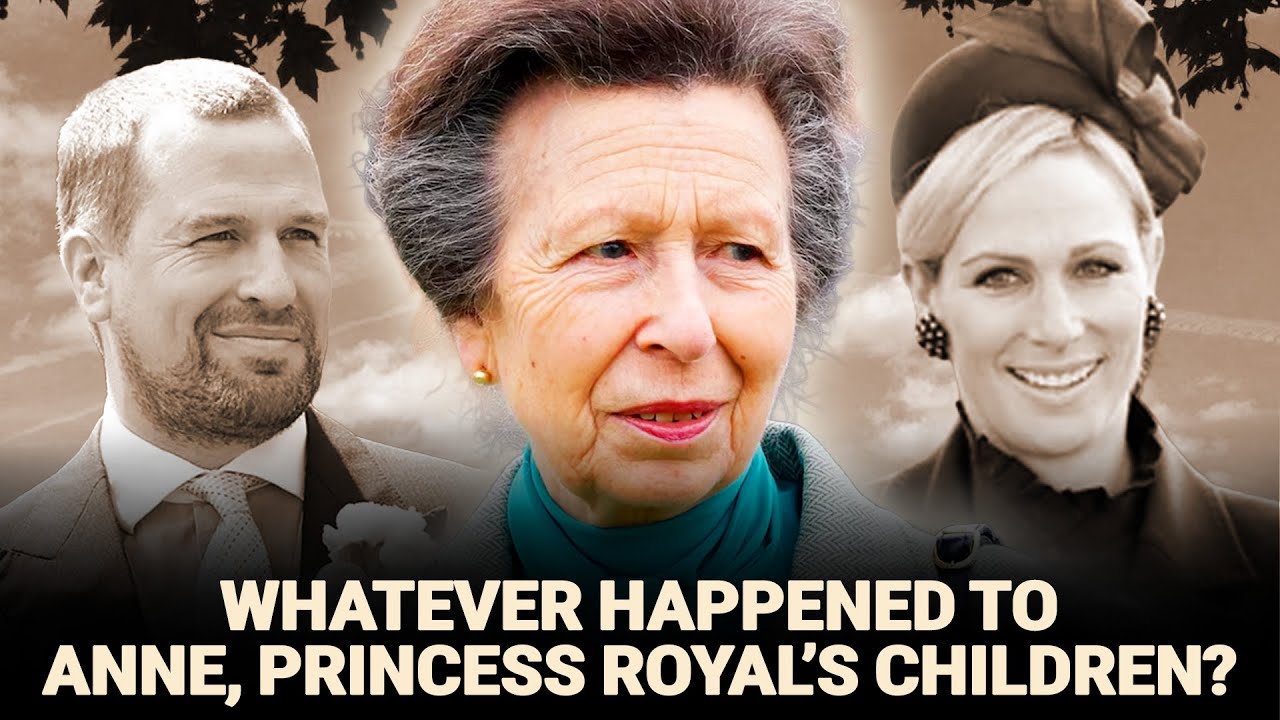
He was simply Master Peter Phillips. No title. No courtesy rank. No place within the formal machinery of royal life.
That decision was deliberate. Peter’s father, Captain Mark Phillips, had declined an earldom offered by the Queen. Anne, for her part, chose not to request titles for her children. She later described the choice as giving them greater freedom and flexibility.
In the late 1970s, when the royal family still operated largely within Victorian and Edwardian frameworks of hierarchy, the decision was radical. Anne’s philosophy was simple: her children would grow up on royal estates and attend family gatherings at Windsor and Balmoral, but they would also attend local schools, build their own careers, and live without the constraints of protocol. Peter’s childhood unfolded at Gatcombe Park, the Gloucestershire estate the Queen purchased for Anne in 1976. Life there was deliberately practical.
Horses, dogs, and agricultural land defined the landscape. Anne maintained a demanding schedule of royal duties but was directly involved in her children’s daily lives, a departure from the royal parenting style of previous generations. Peter learned to ride almost as soon as he could walk, participating in local pony club activities and competing in small events. His education followed the family tradition of character-building institutions.
After preparatory school in Dorset, Peter attended Gordonstoun in Scotland, the school founded by Kurt Hahn and attended by Prince Philip and Prince Charles. Where Charles had been famously unhappy, Peter thrived. He served in the school’s fire service, trained in mountain rescue, played rugby, and embraced the school’s emphasis on self-reliance. He went on to study sports science at the University of Exeter, graduating in 2000.
Peter’s entry into the working world tested his mother’s philosophy. Without a title or official position, he would need to build a career on his own merits, even as his family connections inevitably opened doors. His first major position came with Jaguar Racing, the Formula 1 team, where he worked in corporate hospitality and sponsor relations. He later moved to Williams F1 in a similar role.
Throughout this period, Peter was acutely aware that everything he did was assessed through the lens of his relationship to the royal family. He could not simply be another sports marketing professional. Yet without the formal structure of a working royal, he needed to earn a living in the private sector. In 2008, he was criticized for organizing a corporate event at the British Grand Prix that included a photo opportunity with the Queen.
Critics suggested he was commercializing his access to the royal family. The episode highlighted the ongoing tension in Peter’s position. He was not a working royal, so he needed to earn money through private ventures, but those ventures inevitably drew value from his royal connections. Peter’s personal life became a subject of public interest when he began a relationship with Autumn Kelly, a Canadian management consultant he met in 2003 at the Canadian Grand Prix in Montreal.
Their engagement was announced in July 2007 and revealed an important detail: Kelly, raised Roman Catholic, had converted to Anglicanism. The conversion was necessary because the Act of Settlement of 1701 would have removed Peter from the line of succession had he married a Catholic. The law would later be changed in 2013, but at the time it remained in force. Peter and Autumn married on 17 May 2008 at St.
George’s Chapel, Windsor Castle. Unlike working royals, they paid for much of the wedding themselves, though the Queen granted them use of the chapel. The couple had two daughters, Savannah in 2010 and Isla in 2012, both born at Gloucester Royal Hospital. Savannah became the Queen’s first great-grandchild.
Like their father, neither girl received a title. They were raised at the family home in Gloucestershire, close to Gatcombe Park, attending local schools and appearing only occasionally at major royal events. In February 2020, Peter and Autumn announced their separation after twelve years of marriage. The statement emphasized their commitment to co-parenting and described the decision as mutual and amicable.
The divorce was finalized in 2021. Autumn had initially planned to return to Canada with the children, but arrangements were ultimately made for all parties to remain in Britain during the girls’ school years. Zara Anne Elizabeth Phillips was born on 15 May 1981 at the Lindo Wing of St. Mary’s Hospital, joining her brother Peter.
Her name, Zara, of Arabic origin meaning radiance or blooming flower, was said to have been suggested by Prince Charles. It had no precedent in recent royal history. At birth, she stood sixth in line to the throne. Like her brother, she received no title.
Zara’s childhood at Gatcombe Park was defined by an exceptional natural affinity for riding. She was on horseback almost as soon as she could sit up, and by age four she was riding independently around the estate. Princess Anne, who had competed at the 1976 Montreal Olympics in three-day eventing, recognized her daughter’s talent but was careful not to push her. She provided access to excellent horses and training while allowing Zara to develop her own passion.
The approach worked. Zara’s enthusiasm became self-sustaining. After attending Gordonstoun and studying physiotherapy at the University of Exeter, Zara faced a decision: pursue a career in physiotherapy or commit fully to professional riding. She chose the latter, a decision that would define the next fifteen years of her life.
Her breakthrough came with Toy Town, a chestnut gelding with exceptional talent and a difficult temperament. In 2005, they won the individual gold medal at the European Eventing Championships at Blenheim, the same venue where her mother had won the European Championship exactly thirty-four years earlier. The following year, at the 2006 FEI World Equestrian Games in Aachen, Germany, they became world champions. Zara was named BBC Sports Personality of the Year, the first royal to receive the honor, and was appointed MBE in 2007.
Her ultimate ambition was the Olympics. Ahead of the 2008 Beijing Games, Toy Town suffered a tendon injury that ended any hope of participation. At twenty-seven, Zara faced the reality that her horse might never compete at the highest level again. She persevered, developing partnerships with other horses.
As the 2012 London Olympics approached, Zara earned her place on the British eventing team, riding High Kingdom. The team competition took place at Greenwich Park in front of home crowds, with the Queen herself in attendance. Britain finished with the silver medal, behind Germany. The moment when Princess Anne, in her capacity as President of the British Olympic Association, presented the silver medal to her daughter became one of the most memorable images of the Games.
Both women maintained professional composure, but the significance was evident to everyone watching. Zara also developed a parallel career as a brand ambassador. Unlike working royals, she was free to accept sponsorship deals. She became an ambassador for Land Rover and worked with Rolex and other brands aligned with her lifestyle.
These partnerships were carefully chosen to match her authentic activities and values. In 2003, she met Mike Tindall, a professional rugby player who had just helped England win the Rugby World Cup. The relationship developed over several years as both pursued demanding athletic careers. Their engagement was announced in December 2010, just a month after Prince William and Catherine Middleton announced theirs.
They married on 30 July 2011 at Canongate Kirk in Edinburgh. The wedding was notably more low-key than William and Catherine’s, with no televised ceremony or public procession. The Queen and Prince Philip attended, but the event maintained a private, family-focused atmosphere. Zara and Mike’s first child, Mia Grace Tindall, was born in January 2014.
The joy of her arrival was followed by heartbreak. In December 2016, Zara suffered a miscarriage and announced the loss publicly. In 2017, she suffered a second miscarriage, which she also spoke about. Her willingness to discuss these painful experiences was seen as breaking royal taboos around personal suffering.
The couple’s second daughter, Lena Elizabeth Tindall, was born in June 2018. Their third child, Lucas Philip Tindall, arrived on 21 March 2021 in dramatic circumstances. Zara went into labor so quickly there was no time to reach the hospital. Lucas was born at Gatcombe Park, delivered by Mike with the assistance of a midwife who arrived just in time.
His name honored his great-grandfather Prince Philip, who would die less than three weeks later. The Tindall family settled at Aston Farm on the Gatcombe Park estate, giving them immediate proximity to Princess Anne. The Princess Royal became a regular presence in her grandchildren’s lives. Zara and Mike attend royal family gatherings, including the Platinum Jubilee celebrations, the funeral of Queen Elizabeth II in September 2022, and the coronation of King Charles III in May 2023.
Princess Anne’s decision in the late 1970s and early 1980s not to burden her children with royal titles represented a quiet revolution in how the British royal family approached its more distant members. The decision, made when the implications were uncertain and the precedent was thin, has been vindicated by the lives Peter and Zara have built. Both children successfully navigated the unique challenge of being simultaneously royal and common. They attended family gatherings at Buckingham Palace and Windsor Castle but built careers in the private sector.
They stood in the line of succession but earned their own livings. Peter’s path took him through business and sports management, establishing a model for how a royal grandchild might operate in the commercial world without title or official position. Zara’s achievements were more publicly spectacular. Championship titles, Olympic medals, international recognition.
By allowing her daughter to compete without a title, Anne gave Zara the freedom to be judged purely on merit, to accept commercial sponsorships, and to build an identity as an athlete first and a royal second. The descendants of Peter and Zara, Savannah, Isla, Mia, Lena, and Lucas, represent another generation further removed from the throne but still part of the Windsor family story. They are being raised aware of their heritage but not defined by it, present at major family occasions but living fundamentally private lives. As the British monarchy continues to contract its official working membership while expanding its extended family, the Phillips and Tindall children provide a template.
They demonstrate that royal family members can add to the institution’s vitality and public appeal without being funded by taxpayers or given official duties. Princess Anne, in her practical, unsentimental way, gave her children an extraordinary gift: the freedom to define themselves. Peter and Zara have proven worthy of that gift, building lives of genuine accomplishment while maintaining appropriate connection to their royal heritage.
Their story is not one of palace intrigue or ceremonial drama, but of two people who live beside the throne, shaped by it but not imprisoned by it, creating a model of modern royal life at its margins.






