
WASHINGTON D.C. — In the high-stakes theater of American power, there is a ghost that haunts the West Wing, one that no executive order can deport and no pardon can erase. It is the ghost of the Recorded Word.
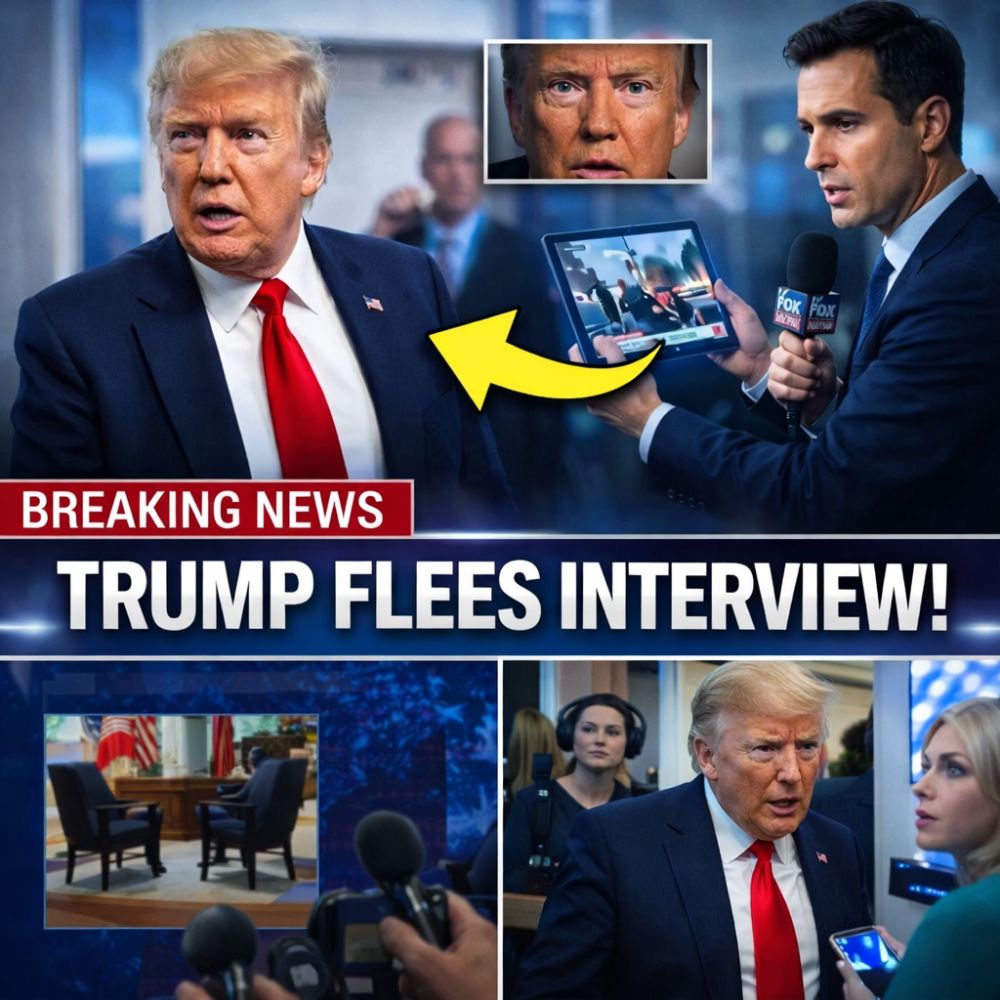
Tonight, as the nation watches a historic collision between President Donald Trump and the federal judiciary, a new and extraordinary chapter has been written. Chief Justice John Roberts has issued a rare, public rebuke of the President, defending the independence of the judiciary after Trump demanded the impeachment of a judge who ruled against his “wartime” deportation powers.
But while the legal battle rages over the definition of “war” in a time of peace, a more profound, psychological battle is playing out. It is a pattern—consistent, documented, and decades-long—that defines Donald Trump’s relationship with reality. It is the pattern of The Footage.
When the President is confronted with his own image or voice documenting conduct he cannot defend, he does not pivot or explain. He engages in a specific, ritualized form of flight. From the gold-leafed boardrooms of 1990s Manhattan to the digital battlegrounds of 2026, the story remains the same: If the camera shows the truth, the camera must be wrong.
I. The Architecture of the Pattern
To understand the current 2026 crisis, one must first map the anatomy of a Trumpian evasion. The pattern functions as a four-stage defense mechanism:
The Ambiguous Artifact: A recording (audio or video) emerges that captures the President in a moment of clear, indefensible conduct.
The Initial Minimization: The conduct is labeled “locker room talk,” a “joke,” or “fake news.”
The Tactical Flight: If the questioning persists, the President physically removes himself (the Walk-Out) or claims a lack of sensory awareness (the “I didn’t see it” defense).
The Erasure Attempt: In the most extreme cases, evidence suggests a move from rhetorical denial to physical destruction.
This isn’t just a communication strategy; it is a worldview. In the world of Donald Trump, documented history is negotiable.
II. The Evolution of the “I Didn’t See It” Defense
The most recent and perhaps most jarring example occurred in February 2026. The President shared a video on social media that concluded with a racist animation depicting Barack and Michelle Obama as apes.
The backlash was immediate. Republican leaders—not just Democrats—called the content “inexcusable.” The President’s response? “I didn’t see that part of the video.”
This defense is a masterpiece of modern political evasion. By claiming he didn’t watch the end of a video he himself clicked “share” on, Trump created a “logical air gap.” He didn’t defend the racism; he simply severed his connection to it.
According to data on social media consumption, the average user views content for less than eight seconds before deciding to share. However, for a head of state, the “I didn’t see it” defense creates a terrifying precedent of Negligent Leadership. If the President isn’t looking at what he’s telling 100 million people to watch, what else is he not looking at?
III. Physical Flight: From CNN 1990 to 60 Minutes 2020
When the “I didn’t see it” defense isn’t available—because the President is currently in the video being questioned—the response shifts to physical flight.
In October 2020, during an interview with Leslie Stall for 60 Minutes, the President reached his breaking point. When pressed on his healthcare plan and the rhetoric of his rallies, he simply said, “I think we have enough,” and walked out.
This wasn’t his first time. Historical archives show a nearly identical scene in 1990. During a CNN interview, a younger Donald Trump, faced with questions about the crumbling finances of his Taj Mahal casino, ripped off his microphone and stormed away.
The Psychology of the Walk-Out:
Behavioral experts note that the “Walk-Out” is the ultimate expression of power in a controlled environment. By leaving, Trump terminates the reality he finds uncomfortable and attempts to create a new one where he is the victor. In 2020, he even posted his own “unedited” footage of the interview to social media, trying to bury the CBS version under a mountain of his own spin.
IV. The Deletion Point: The Mar-a-Lago Security Tapes
The pattern reached its most legally perilous stage with the Mar-a-Lago security footage. Federal prosecutors allege that after the DOJ demanded the return of classified documents, the President asked staff to delete the security camera footage showing boxes being moved in and out of storage.
This is the “Logic of the Deletion.” If you cannot explain the footage, and you cannot walk out of a court of law, you must ensure the footage ceases to exist.
The Escalation Ladder
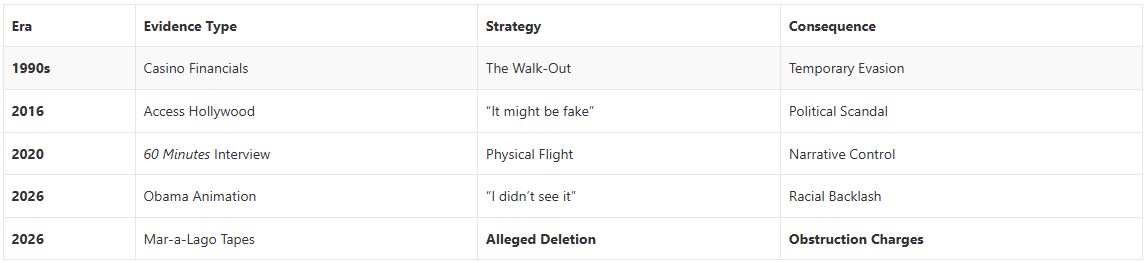
The transition from “The tape is fake” to “Delete the tape” represents the transition from a political crisis to a criminal one. You do not risk an obstruction of justice charge to delete footage of a tidy room.
V. The Bedminster Recording: The Final Proof?
The most damaging piece of footage in the 2026 landscape isn’t actually video—it’s the Bedminster Recording. In this audio, the President is heard rustling papers and telling guests about a “highly confidential” military plan. Crucially, he is heard saying, “As president I could have declassified it. Now I can’t, you know, but this is still a secret.”
This is the “Access Hollywood Tape” of the classified documents case. It is his own voice, in his own words, dismantling his own legal defense.
How did he respond? Following the pattern perfectly, he claimed, “There was no document. I was just talking about news clippings.” He attempted to un-see the very thing the audio proves he was looking at.
VI. The Chief Justice and the Breaking of the Pattern
This brings us to tonight’s extraordinary rebuke by Chief Justice John Roberts.
Trump’s recent attacks on a federal judge—calling for his impeachment because the judge dared to rule against the President’s “wartime” powers—is the pattern applied to the entire third branch of government. Trump is trying to “delete” the judge the way he allegedly tried to delete the Mar-a-Lago tapes.
But Chief Justice Roberts’ statement—”We do not have Obama judges or Trump judges, Bush judges or Clinton judges”—is a signal that the judiciary will not be walked out on. The courts are the one place where “I didn’t see it” is not a valid legal defense.
Conclusion: The Permanent Record
Donald Trump has spent forty years in a war against the camera. He has tried to edit, delete, walk away from, and deny the documented evidence of his own life.
But in 2026, the footage is everywhere. It is in the hands of Special Counsel Jack Smith. It is on the servers of social media companies. It is in the archives of every news network in the world.
The tragedy of the “I didn’t see it” defense is that, eventually, everyone else does see it. And while the President may walk out of an interview, he cannot walk out of history. The tapes are playing, the audio is clear, and for the first time in four decades, the man who tried to delete the truth is finding that the “Record” button is permanently stuck on “Play.”
The series finale of this pattern is not being written on social media. It is being written in the federal courthouses where the footage finally becomes a verdict.