
THE POTASH PIVOT: How Canada’s “Pink Gold” Is Holding American Agriculture Hostage
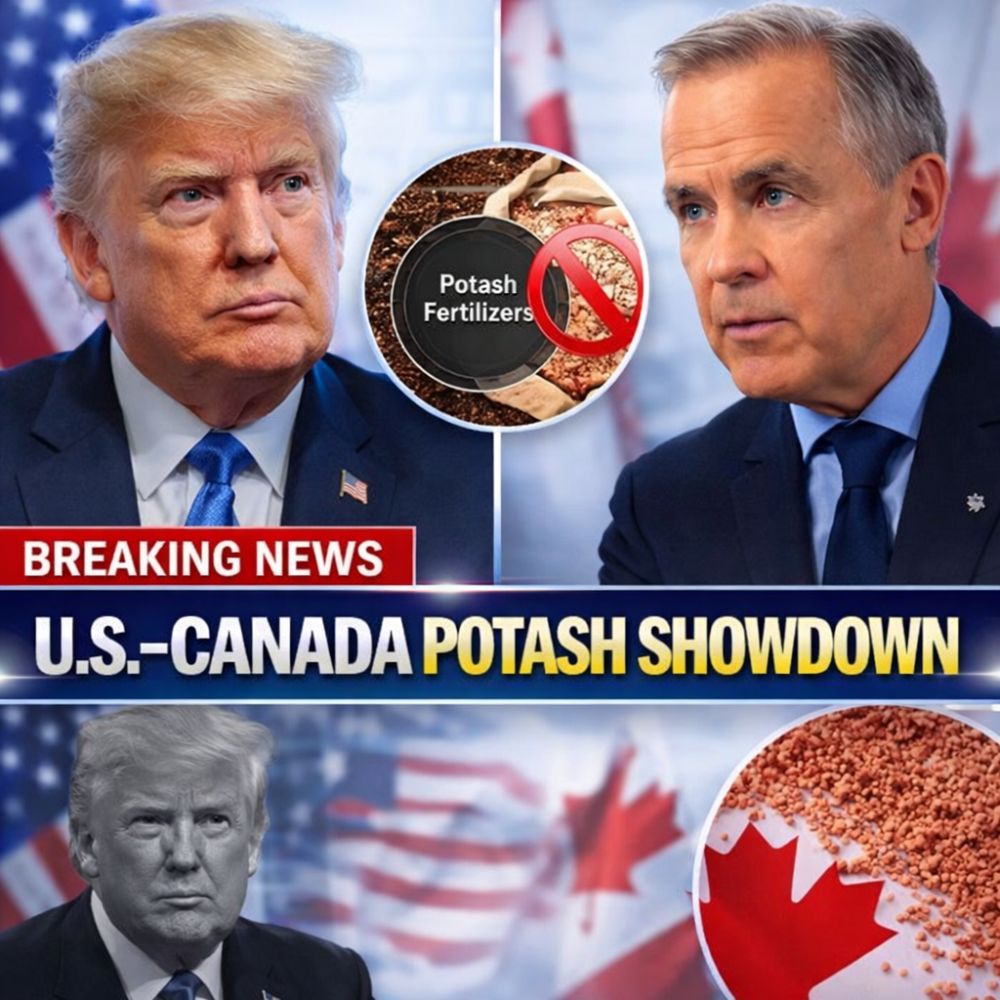
A quiet mineral buried miles beneath the Canadian prairies has suddenly become the most explosive weapon in a North American trade war. As President Donald Trump abruptly reverses course on his trade rhetoric and threatens “severe” new tariffs on Canadian fertilizer, the American heartland is waking up to a terrifying geological reality: America cannot feed itself without Canada.
I. The Geological Trap: Why “Buying American” Isn’t an Option
President Trump’s recent claims that the U.S. can “bolster production here” are facing a harsh rebuke from the U.S. Geological Survey. Unlike steel or aluminum, you cannot simply “build a factory” to create potash. You have to find it in the ground.
The Production Gap (2024-2026 Data)

While the U.S. has minor mines in Michigan, Utah, and New Mexico, they produce lower-quality ore at volumes that cannot meet even a fraction of national demand. Canada’s production is 36 times larger than America’s. With Russia and Belarus—the only other major exporters—largely cut off from Western markets since 2022, Canada doesn’t just dominate the market; it owns it.
II. The Farm Belt “Margin Melt”
For American farmers, the timing of the tariff threat is catastrophic. Fertilizer already accounts for 30% to 45% of the operating costs for corn and soybean producers.
The U.S. Import Price Index for chemical fertilizers has already jumped from 165 in late 2024 to 186.5 in late 2025. A “severe” tariff of 25% would add more than $100 per ton to the price of potash.
“Potash exporters in Canada don’t absorb these costs,” warns Josh Linville of StoneX. “Because there is no domestic alternative, the cost passes straight through to the farmer. The margin has nowhere else to go but down.”
In states like Illinois, Indiana, and Ohio, farm income has already seen three straight years of depressed prices. Industry groups like The Fertilizer Institute and the American Farm Bureau have issued emergency warnings to the White House, calling a potash tariff a “self-inflicted wound” that would deliver a final blow to the rural economy.
III. The Carney Counter-Move: Diversification Over Surrender
While Washington plays a game of tariff threats, Prime Minister Mark Carney has been quietly redrawing Canada’s export map.
Rather than waiting for an exemption, the Carney government has used the last year to forge a “Strategic Partnership” with the People’s Republic of China. This deal, focused on energy and agri-food, ensures that if the U.S. market becomes too expensive due to Trump’s tariffs, Canada has a massive, 1.4-billion-person safety net waiting to buy its minerals and canola.
The “Carney Strategy” is built on three pillars:
Investment Optionality: Using resource strengths in oil and minerals as geopolitical leverage.
Trade De-Risking: Moving away from 95% dependency on the U.S. market.
The “Green” Credential: Marketing Canadian potash as the most sustainably mined fertilizer in the world to reach European markets.
IV. The “Wag the Dog” Theory: Is Fertilizer a Smokescreen?
Critics in Washington argue that the sudden focus on fertilizer tariffs is a tactical move by the Trump administration to distract from the roiling scandals surrounding Kash Patel and the Epstein Files. By picking a fight over a “boring” mineral like potash, the President can project “toughness” on trade to his base, even if the move ultimately raises the price of their milk and bread. However, unlike other trade disputes, the agricultural calendar does not wait for policy shifts. Farmers are making their purchase decisions for the 2026 planting season right now.
Conclusion: The Grocery Bill of a Trade War
The bottom line is simple: There is no American mine ready to replace Saskatchewan. If President Trump pulls the trigger on “severe” fertilizer tariffs, he won’t be taxing Canada—he’ll be taxing the American dinner table.
As the U.S. import price of Canadian goods continues to rise, and as Mark Carney continues to build “roads around” Washington, the leverage is shifting. Canada’s “Pink Gold” is no longer just a commodity; it is a strategic asset.
The ships are rerouting, the prices are up, and the American farmer is standing in the middle of a geological reality that no executive order can change.
Are you concerned about rising food prices? How would a 25% increase in fertilizer costs affect your local community? Share your thoughts below.