In the middle years of the 1840s, American farmers had an enemy that shaped their entire existence: mud. Outside the biggest cities, the roads of the United States were simply cleared tracks of dirt, and dirt roads in a country with real winters and real rain became rivers of bottomless muck. A wagon could sink to its axles. Horses foundered and strained in the suction.
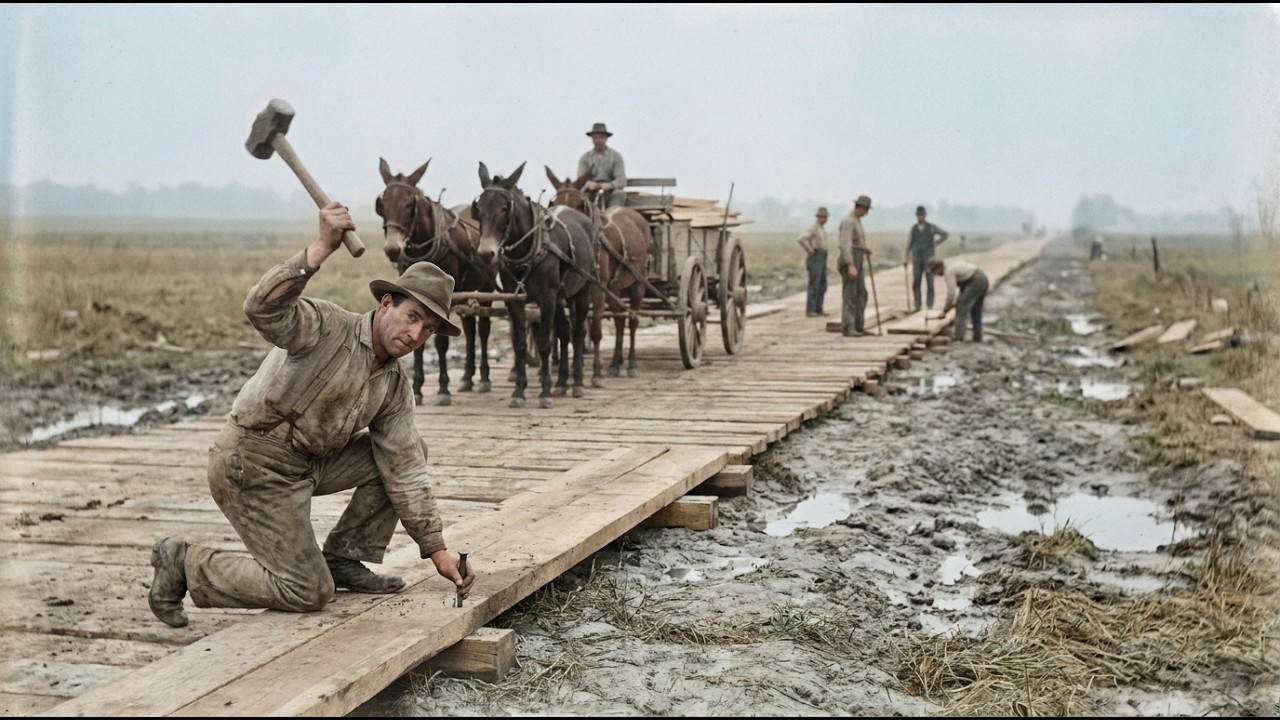
A trip to town that took two hours on a summer road could take all day in the spring thaw or autumn rains, or become impossible altogether. Because the wet seasons were exactly when crops had to reach market, the mud kept farmers poor, isolating them from buyers and trapping their produce in the barn. For generations, this was simply the way life worked. Then came the plank road.
It was not an American invention. The idea had been developed in Russia, where they had the same mud and the same abundance of timber, and from Russia it had reached Canada, where roads of this kind were built around Toronto in the early 1840s. A Syracuse engineer and farmer named George Geddes saw them there and came home convinced they were the future. In 1846, a plank road was laid from Syracuse north toward Central Square to haul salt from the great salt works of central New York.
It was a specific solution to a specific hauling problem, and it worked so well and made money so fast that Geddes wrote it all up and championed the idea. The country caught fire. A plank road was built by grading the earth into a smooth bed with a slight crown so rain would run off, then laying long timber stringers lengthwise down the bed as a foundation. Across these, crews laid thick planks, usually eight feet long, three or four inches thick, laid crosswise board against board to form a continuous wooden floor.
The surface was usually only wide enough for a single lane of plank, about eight feet, with a strip of graded dirt beside it. The rule was that a loaded wagon had the right to the planks, and lighter vehicles were expected to pull off onto the dirt to let it pass. At intervals there were turnouts where vehicles could pass each other. The result, when new, was close to miraculous.
Horses could pull heavy loads across a smooth, hard, quiet surface in any weather while the dirt road beside it was impassable. Farmers who had spent their lives fighting the muck rolled onto the boards and felt the whole miserable friction of the journey simply vanish. At the tollgate they paid a cent and a half a mile for a two-horse wagon, half a cent for a horse and rider, while people on foot walked free. Travelers who resented the toll would take rough side lanes to dodge the gate, a practice that earned its own name: shunpike, a road you took to shun the turnpike.
The word survives as a place name to this day. The boom began in earnest when New York passed a general law making it easy for anyone to form a plank road company. Between 1847 and 1854, more than 340 plank road companies were incorporated in that state alone. Every town wanted one, and every group of local investors wanted the connection to market and the toll revenue it promised.
The economics looked wonderful on paper. Tolls multiplied by steady traffic promised handsome returns. One well-placed road, sixteen and a half miles long, built for around $23,000 out of thick hemlock planks, became a great financial success and convinced everyone that a plank road was a road to riches. The state of New York alone laid something like 3,500 miles of these roads, enough to reach from Manhattan to California.
Across the country, the total ran to more than 10,000 miles. The roads reached into New Jersey, south, and out across Ohio, Michigan, and Wisconsin. They called it the farmers railroad, because for a farmer stuck in the mud, a good all-weather road promised almost as much as a railroad did, and it seemed like something a community could actually afford to build for itself. You did not need stone quarries or a canal engineer or a railroad corporation.
You needed trees, a sawmill, and the will to organize and lay the boards. The investment arithmetic depended entirely on one number: how long the planks would last. Promoters promised seven, ten, even twelve years of steady tolls before the surface needed replacing. That was the whole financial foundation of the boom, and it was wrong.
A plank road was made of wood laid flat on wet ground, exposed to rain and snow and the freeze-thaw cycle of a northern winter. Wood lying on damp earth rots, and the traffic of iron-shod hooves and iron-tired wheels ground and pounded the surface day after day, wearing the planks thin and cracking the ones the rot had already weakened. Damp from below, weather from above, and iron hammering the surface meant the boards began to fail in three or four years, not seven or twelve. They went soft and splintered, breaking under the wheels until the beautiful smooth road became a hazard that could lame a horse or break a wheel.
This single fact broke the arithmetic completely. A company had counted on a decade or more of toll income before rebuilding. Now it had to relay the entire road at enormous cost after only a few years, long before the tolls had paid off the original construction. Rebuild that often, and the maintenance ate every cent the tolls brought in and more.
Let it rot, and the broken surface became worse to drive on than the dirt road it had replaced, and the traffic and tolls dried up. Either way, the company was doomed. There was no clever management that could escape it, because the problem was not in the running of the roads but in the physical lifespan of their material. No amount of belief could make wood last longer than wood lasts.
Some companies tried relaying the planks and never got ahead. Others experimented with ways to make the wood last, but nothing cheap enough was available at the required scale. Many simply let the boards go and folded. Millions of dollars evaporated almost overnight.
The money was gone from communities that did not have much to spare, a quiet, widespread financial wound spread across rural America in the 1850s, carried by farmers, shopkeepers, and small-town boosters who had put their own savings into the dream. The boom was over within a decade of its peak. The great plank road craze vanished so completely that today most people have never heard of it. Some roads were topped with gravel and kept on as ordinary toll roads, quietly abandoning the thing that had made them special.
Most simply decayed, the planks rotting away or being pulled up until the road was dirt again, back to the mud it had been built to escape. The real long-term answer was already arriving from another direction: the hard, durable, well-drained roads of broken stone that Scottish engineer John McAdam had taught road builders to make, roads that did not rot. In the following decades, macadam and gravel, and eventually in the twentieth century concrete and asphalt, permanently solved the mud the plank roads had only briefly and imperfectly promised. But the plank roads left more than their names behind.
Their brief life proved that rural America desperately wanted and needed good all-weather roads, and that wood was not the way to get them. When the bicycle and then the automobile created a new demand for smooth roads, that old hunger came roaring back and fed the Good Roads movement that finally paved rural America for good. In that sense, even the failure was useful, a rough first draft of the paved nation taken for granted today. The men who built the roads are the most forgotten part of a mostly forgotten story.
Ten thousand miles of plank road is an astonishing amount of physical labor, and almost none of it came from machines. An enormous number of trees were felled, hauled to sawmills, and cut into boards by sawyers feeding logs to the blades, losing fingers and hands to the machinery. Crews of laborers graded the beds by hand with picks and shovels and horse-drawn scrapers, dug the drainage ditches, hauled and placed the heavy stringers, and laid down board after board after board mile after mile in the sun and rain. They were the same kind of anonymous heavy workers who built the canals and railroads.
We have the name of George Geddes, the engineer with the idea. We do not have the sawyer who cut the plank or the laborer who laid it. They built 10,000 miles of road with their hands, watched much of it rot, moved on to whatever came next, and the country forgot them entirely. Yet the routes themselves very often survived.
Because a road that connects two useful places tends to stay a road even when its surface changes completely, all over the Eastern United States and the Midwest there are streets and roads today paved in modern asphalt named simply Plank Road. Most of the people driving on them have no idea why. But a Plank Road, nine times out of ten, is exactly what it says: the ghost of a real plank road from the boom of the 1840s and 1850s, a route once floored with wooden boards laid by hand by forgotten men, keeping the old name long after the last plank rotted away. The roads were real while they lasted, and the effort was real, and the relief they brought, however briefly, was real.
The planks are long gone, but under the name, if you know to look for it, is the memory of the forgotten men who once floored America with wood.






