In the winter of 1933, the coal mining town of Lynch, Kentucky, became the center of a case that local newspapers would later call the Hollow Incident. On the morning of January 23rd, Dr. William Thornton, the town’s only physician for over fifteen years, failed to appear at his clinic. Three miners had been injured in a cave-in the previous night, and the doctor was expected to check on their condition.
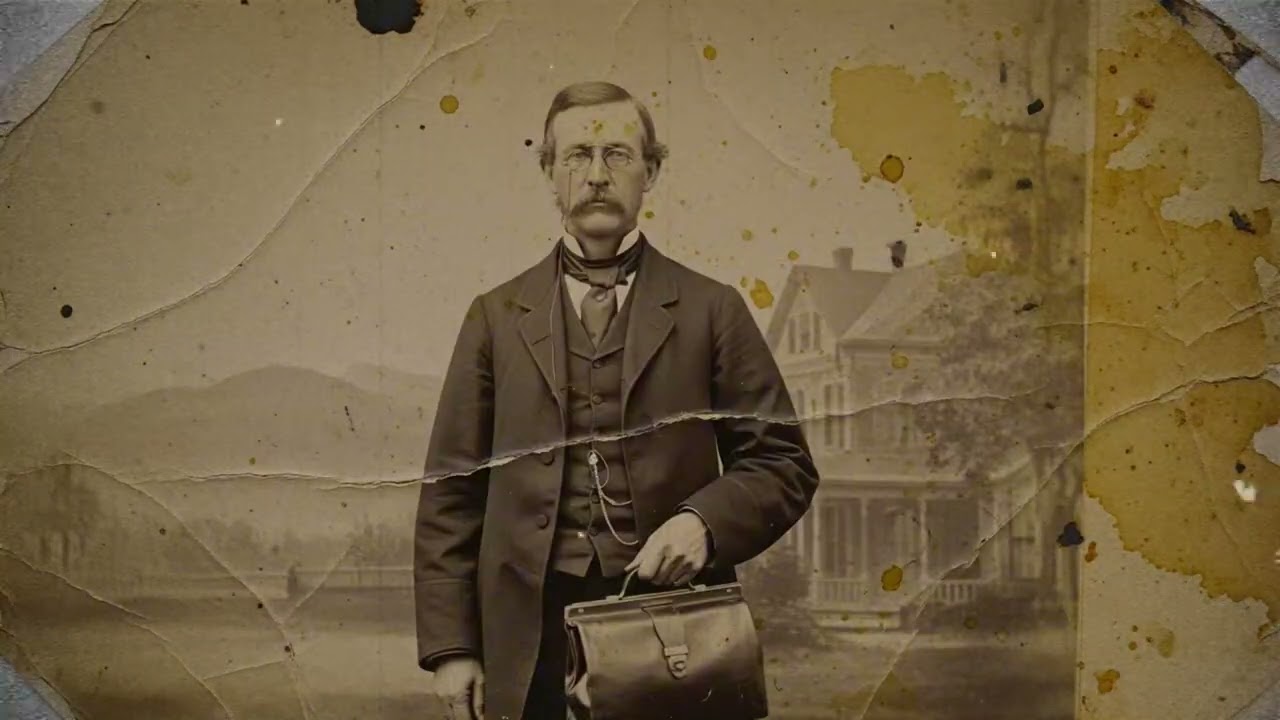
Sheriff James Mallister opened an investigation, but what struck him was not the disappearance itself—it was the silence that surrounded it. Not a single resident seemed concerned. Mrs. Thornton, the doctor’s wife, appeared relieved rather than worried.
Lynch was a town built entirely around the mine, established in 1917 by U. S. Coal and Coke, a subsidiary of U. S.
Steel. At its peak, nearly 10,000 people lived in rows of identical company houses, all within walking distance of the mine entrance. The company controlled every aspect of life, from the church to the company store where miners were obligated to shop. By the early 1930s, the Great Depression had tightened the company’s grip, and safety measures were being reduced to cut costs.
Dr. Thornton lived with his wife, Eleanor, and their housekeeper, Martha Sullivan, in a large two-story Victorian home at 17 Looney Ridge Road, isolated from the main town by dense forest and a small creek called Whisper Stream. Official records stated that Thornton was studying respiratory conditions common among coal miners. But entries in Eleanor Thornton’s diary, recovered years later during a renovation, told a different story.
She wrote that her husband rarely came to bed anymore, that sounds came from the basement through the night. She described a delivery of a metal container with government markings and overheard him on the telephone saying, “The reaction is more pronounced than we anticipated. We may need to adjust the dosage. ”
Martha Sullivan recalled finding a letter from the mining company’s head office in Pittsburgh that mentioned “continuing financial support for your valuable work” and “maintaining absolute discretion about the experimental procedures.
” When the doctor caught her with the paper, he dismissed her for a week without pay. Sullivan also described changes in the doctor over the years. He became distant, his eyes would focus on something that wasn’t there, and sometimes she would hear him talking to himself in a voice that sounded deeper, with an odd rhythm to it. In the week before his disappearance, five large wooden crates arrived from Johns Hopkins University, addressed to the doctor.
The station master noted that Thornton insisted on transporting them himself. One crate had been damaged in transit, and the station master claimed he could see glass containers filled with a black liquid that seemed to move on its own. Mrs. Thornton purchased an unusual amount of lye, formaldehyde, and salt—enough to preserve several large specimens.
The shopkeeper’s granddaughter recalled that Mrs. Thornton was shaking that day and whispered, “He’s changing them, and I think he’s changing, too. ”
The town’s telephone operator reported that the doctor received calls from the same number in Pittsburgh at precisely 9:15 each evening for three days before he vanished. She later confided that she had overheard him talking about “successful integration at the cellular level” and “unexpected cognitive side effects.
” When the person on the other end asked if he could control these effects, the doctor laughed in a way that made her blood run cold. On January 20th, a night watchman reported that the lights at the doctor’s house remained on all night, and sharp, high-pitched sounds came from the basement until dawn. When he approached the house, he saw a silhouette in the window that he described as taller than any man should be, with a head that seemed the wrong shape. Sheriff Mallister’s investigation was cursory.
His three-page report concluded that Thornton had likely left town voluntarily, possibly due to financial troubles or personal matters. No search parties were organized, and the case was effectively closed within 48 hours. Then, in March, a group of hunters found a doctor’s bag torn up and stained black near Whisper Stream. Inside were glass vials containing unidentified powders, a water-damaged notebook, and a pocket watch inscribed with the initials W.
T. The sheriff confiscated the items, and no mention of them ever appeared in an official report. One of the hunters later claimed the notebook contained formulas and diagrams of human organs with strange modifications, and that the vials held tissue samples suspended in dark liquid—one looked like a piece of lung, but it was too dark and had strange fibers running through it that looked almost metallic. Eleanor Thornton remained in the house for six months after her husband’s disappearance, keeping the curtains drawn.
A local delivery person who had regular contact with her noted that her hands were always bandaged and that he could hear scratching sounds from inside. When he asked if she had a cat, she replied, “What’s in this house isn’t anything you’d recognize as an animal. ” The Reverend Thomas Walker, who visited her, reported scratch marks on the walls floor to ceiling, as if made by something with claws, and a substance on the floor that looked like coal dust but moved slightly even though there was no draft. In August 1933, Eleanor sold the house to the mining company for a fraction of its value and moved away.
No trace of her was ever found after she left Lynch. The company assigned the house to a new physician, Dr. Alan Richards, who arrived in September 1934. Richards and his wife experienced disturbing phenomena almost immediately.
Doors that were locked were found open in the morning, and there were sounds from the basement—scratching, tapping, whispered conversations—despite repeated confirmations that the space was empty. Richards’s wife described waking one night to find a figure at the foot of the bed, shaped like a man but somehow wrong in its proportions, wearing a doctor’s coat with no face. By November she had returned to Philadelphia, citing health concerns. Richards resigned in December, writing to the company that “no salary is worth what awaits in that house after dark.
” The company demolished the basement, filling it with concrete. Construction workers found strange metal sheeting lining the walls, drains that led nowhere, and a large stone table with straps attached to it, like you might use to restrain someone. Remarkably, in the months following Thornton’s disappearance, coal output at mine number 31 increased by nearly 30 percent despite employing fewer miners. Internal company memos noted that workers were going as long as 36 hours without emerging from the mine and sometimes needed to be ordered to return to the surface.
Miners rarely spoke during shifts, moved in unusual synchronicity, and had no memory of the episodes. A visiting physician from the Kentucky Department of Health wrote that the pulmonary function of Lynch miners “defies medical explanation. ” Men who had worked in coal dust for decades showed lungs clear of expected accumulation. But he also noted elevated body temperatures, unusual pupillary response to light, and a faint rhythmic tremor in the hands.
In a private letter, he expressed reluctance to handle their blood specimens, which were dark, viscous, and contained particles that appeared almost crystalline under the microscope. The mystery might have remained buried if not for a discovery in 1952. During renovations to expand the Lynch Hospital, workers excavating for a new wing discovered a sealed chamber fifteen feet beneath the building’s original foundation, lined with copper sheeting and containing a desk, filing cabinet, and medical equipment. A leather-bound journal found locked in the desk contained entries written in Thornton’s handwriting.
A clerk who read portions of it before it was secured described what the doctor called the “breathable solution”—a compound he was developing to allow miners to work longer hours in dust-filled conditions without respiratory damage. He had been testing early versions on patients without their knowledge and planned to introduce the compound into the town’s water supply. The final entries took on an erratic tone. Thornton wrote that the compound was creating a kind of collective consciousness among test subjects.
In the final entry, dated January 22nd, 1933, the day before his disappearance, he wrote, “It is no longer accurate to say that I am administering the compound to the subjects. Something has reversed the relationship. It is communicating through them, and now it is beginning to communicate through me as well. ”
The chamber was filled with concrete, and the journal was supposedly transferred to state archives, but researchers who have tried to locate it have been told no such item exists.
The only firsthand account of what may have happened to Thornton came in 1960, when a retired miner named Samuel Carter, on his deathbed, made a recorded statement. Carter claimed that a small group of miners had discovered that Thornton was using them as unwitting test subjects. They went to his house on the night of January 22nd to demand answers. Thornton confessed that he had found something in the mountain—something in a deep seam that changed when it came into contact with air—and had been refining it and testing it on them through their water.
The confrontation escalated, there was a struggle, and the doctor fell and hit his head. He was still breathing when the miners left. When they returned the next day, the doctor was gone, along with all his papers and equipment. Mrs.
Thornton was sitting in the kitchen staring at the wall, and told them, “They came for him in the night. They’ll come for all of us eventually. ” Carter described the same disturbing changes: shared dreams, an ability to communicate without speaking, and a growing awareness that the mountain itself had become aware of them. A 1975 Freedom of Information Act request yielded a heavily redacted file from the Department of Energy confirming that Thornton had been involved in a classified research project related to mining efficiency and worker performance.
A federal mining inspector’s memo from 1934 noted, “The situation in Lynch has been contained for now, but continued monitoring is essential. Whatever Dr. Thornton introduced into the ecosystem appears to be self-perpetuating and adaptive. ”
The Lynch mine continued operating until 1971, when U.
S. Steel closed it due to declining profitability. The town’s water supply was completely overhauled in 1980, and a contractor involved reported that federal specialists in modified hazmat suits treated sections of the old pipes with chemicals they wouldn’t identify, telling him only, “Containment, not detection. ”
Today, Lynch has fewer than 600 residents.
The Thornton house is gone, replaced by an empty lot overgrown with brambles. Among the older residents, there remains a reluctance to discuss certain subjects. The last person with a direct connection to the case, the daughter of the Thornton housekeeper, recalled that her mother once said the doctor had found something he called “mountain breath,” something that lived deep in the earth and changed when it touched air. She said he became part of his own experiment in the end, that the mountain took him back.
What is known is that something unusual occurred in Lynch in the early 1930s. A doctor disappeared. A community changed. Men who should have suffered from breathing coal dust for decades somehow did not.
And throughout it all, a conspiracy of silence has obscured whatever truth might exist. Occasionally, hikers in the area around Looney Ridge report hearing sounds that shouldn’t be there—whispered conversations with no visible source, the rhythmic tapping of metal on stone coming from solid rock, and sometimes a solitary figure in early twentieth-century clothing carrying a doctor’s bag, moving purposefully toward the sealed entrances of mine number 31. By the time they reach the spot where the figure was seen, there is never anyone there.






