At a little table in the back room of the Piedmont Historical Society in Roanoke, in the autumn of 1938, Endicott Marshmount found something that should not have been there. He was forty-three years old, a tall man who unconsciously stooped when he rose from his chair, thin in the way a man becomes thin when he forgets to eat because his mind is elsewhere. He had iron-gray hair, cut carefully around the ears, and small round spectacles that he pushed up his nose whenever he lied, and he did not know that he did this. His hands were long and pale and steady, and the skin on the sides of his thumbs was shiny from years of lifting photographs one after another toward the light.
He worked at the Society as a cataloguer of photographs. He had come there after the war, though he never spoke about that period. By the time of this story, no one in three counties knew more about the photographic cards of Virginia than he did. He could identify a studio from the shape of the painted ferns on the backdrop.
He could place a year within the decade by the height of a woman’s collar. When estate donations arrived, boxes upon boxes of glass negatives and albumen prints tied with brown string, Endicott was the one who sat with them, one by one, to give the dead back their names. He was not sentimental about the work. When asked, he would say he did it because if he did not, no one else would, and because it seemed a simple and logical duty toward a group of people who had once stood still before a camera hoping that someone would remember them.
On the ninth of October, 1938, a plain wooden box arrived from a law office in Christiansburg. The lawyer’s letter said only that the box had been found among the possessions of one Ambrose Kettering, who had died that summer, a bachelor of ninety-two who had lived alone in a boarding house since about 1910. Ambrose Kettering left no will and no living family. The state claimed the money.
The papers were given to the Society. Endicott opened the box on the eleventh. Inside, wrapped in wool and packed in pine shavings, were forty-two glass plate negatives and about two hundred photographic prints. Cabinet cards, tintypes, and a few of the old salted paper prints that rarely survived moisture.
There was no record and no labels, only the photographs and a small leather notebook that turned out to be a rent receipt ledger for a hardware store, useless to anyone now. He went through them slowly, as he always did. It took two or three days for a box of this size, sometimes a week. He wrote a card for each photograph and attached it gently to the frame with a needle so it could be removed without leaving a mark.
He recorded the names if they were written, the dates if the photograph revealed them, and the locations from the studio stamp on the back, or from the clothing, or from the trees in the yard. Most of the Kettering photographs were ordinary and unremarkable. Wedding portraits of strangers, a row of railway workers standing in front of a locomotive, a grocer holding a fish, a group of women in hats seated on a long bench before a white church, a grim couple in front of a country store, the wife holding a bolt of cloth. Endicott had seen ten thousand photographs like these and would see ten thousand more, and he loved them the way one loves a garden one did not plant himself.
On the third day, in the afternoon, he reached that photograph. He had been working since just before eight. He had eaten nothing since breakfast except a small dried apple someone had left on the shelf above the little sink. He was in the relaxed and elastic state of attention that comes over a person who has been staring at the same thing all day and has stopped trying to really see it, and it is in that state, in his line of work, that the strange thing often appears.
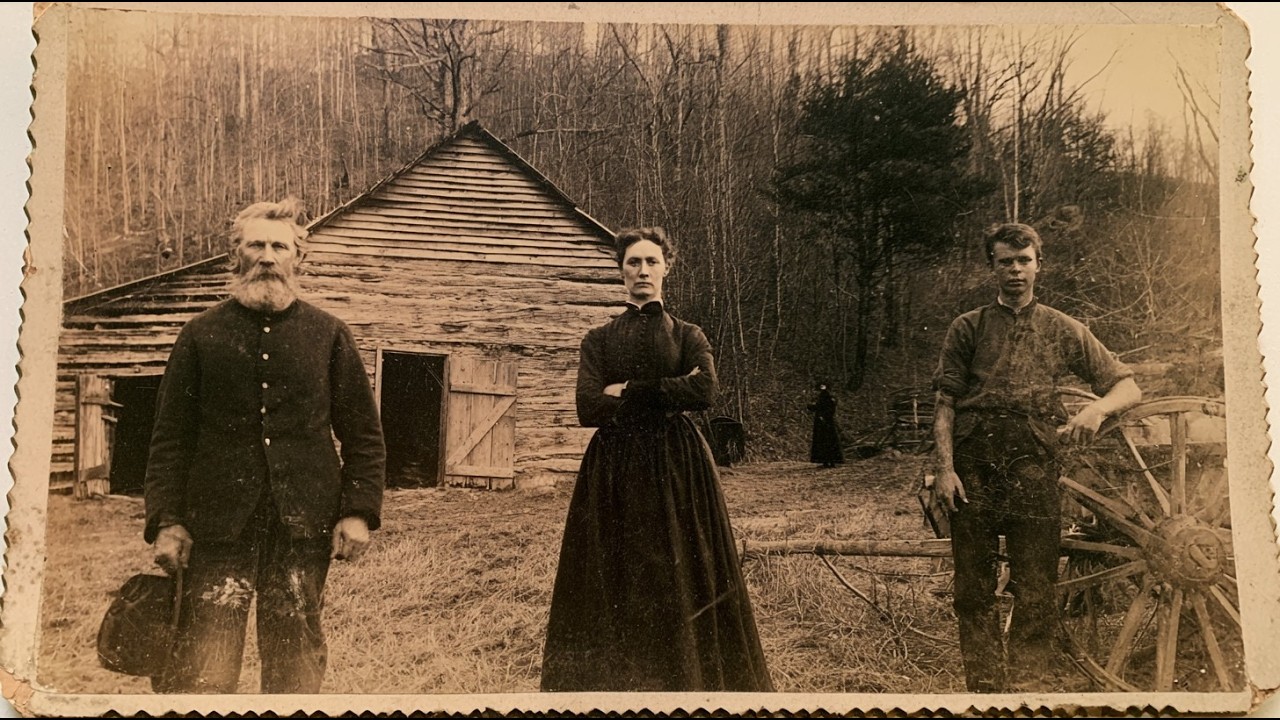
The photograph was a print on a stiff cabinet card, four and a quarter by six and a half inches, mounted on gray cardstock with wavy edges. On the reverse, in small brown copperplate handwriting, someone had written: “Pruitt house, Wicker Hall Hollow, spring 1871. ” Below that, in a different, more tremulous hand: “I don’t keep this photograph in a frame for a reason. ”
Endicott turned the card over.
The photograph showed three adults standing in the yard of a log cabin about twenty feet from the camera. Behind them and slightly to the left stood a barn built in the old way, from crossed planks. One door was open, one door was closed. Behind the barn the ground rose to the tree line, where the hardwoods were bare of branches with a few pines among them.
It was afternoon light, judging by the shadow of the porch post, and late March or early April, judging by the condition of the woods. The three people were arranged in the manner of that era. A man on the left, holding his hat in his hand, his coat buttoned, his feet set firmly apart. A woman in the middle, her hands crossed over her waist, wearing a dark dress buttoned to the neck, her hair simply arranged.
A younger man on the right, hatless, sleeves rolled to the elbow, one hand resting on the rim of a wagon wheel. None of them was smiling. None of them was expected to. Photographs in 1871 resembled funerals, and people knew it.
Endicott studied the composition for about forty seconds. Then he wrote his card: “Three unidentified adults, log cabin, plank barn, hardwood hills, spring light, rural Virginia. ” The mount and processing were consistent with an itinerant photographer, perhaps one of several who worked the mountain counties in the early seventies with a wagon and a portable darkroom. He set the card aside.
He should have moved on to the next photograph. On any other afternoon, he would have. But something in the photograph held him and would not let go, the way a thread caught on a nail stops you from moving forward. After a moment he sat down again and reached for the magnifying glass.
The magnifying glass was a heavy brass piece that had belonged to a botanist. He laid the photograph flat on the desk and moved the glass slowly over it, top to bottom, left to right, the way he had taught himself. He looked at each of the three faces. The man on the left had a heavy brow and close-set eyes and a mouth drawn in a straight line fixed by long habit, not by momentary effort.
The woman in the middle had a face that, by its simple placidity, could have been the face of any of five thousand women in that part of the state. But there was a slight tic at the corner of her mouth that Endicott saw at magnification and noted on a scrap of paper. The younger man on the right resembled the woman around the eyes, was younger than both of them, and stood with his shoulders drawn up as if he were holding his breath, which most sitters of that period were doing anyway because of the length of the exposure. He looked at the shoe.
He looked at the porch. He looked at the horse equipment lying over the wagon. Then he looked at the barn, at the two doors of the barn, one closed and one open. In the open doorway, of course, there was only darkness.
That was to be expected. What was not expected was that, if he moved the magnifying glass along the roofline and then down at the far corner of the barn to the ground behind it, there was a shape between the barn and the tree line that did not look like a barn, and did not look like a tree, and did not look like a shadow, and did not look like any of the things a shape of that size and that light was supposed to look like. It was standing. It was tall.
It was, as far as he could make out at that magnification, standing perfectly still. Endicott set the magnifying glass aside. He rubbed his eyes. He got up and walked to the window and looked across the street at the courthouse until his eyes regained the ability to see distances.
Then he returned to the desk and looked again. The shape was still there. He did what a careful man does. He lit a second lamp.
He turned the photograph a quarter turn, then another, then another. He held it up to the window with the late sun coming through the paper from behind, and he saw nothing on the other side. No crease, no thumbprint, no chemical fog that might explain it. He returned the photograph to the desk and moved the magnifying glass over it a second time, then a third.
The shape was still there. He was not afraid at that moment. He was interested. He had worked in the profession long enough to know that ninety-nine times out of a hundred, the shape behind the barn is a wheelbarrow, or a pile of feed sacks, or a hired hand who wandered into the frame and never knew he was in it.
One time in a hundred, it is something the plate itself made. An emulsion defect, a flaw in the glass, or a spray of fixer at the wrong moment inside a portable darkroom set up on a rainy spring afternoon in 1871. That was the prevailing theory for the rest of that day and most of the next. He could have settled for that theory, filed the photograph, and moved on.
But he had another habit, and it was the habit that undid him. When something in a photograph resisted his understanding, he liked to find out who the person in it was and what became of them. Sometimes there was a granddaughter still alive who could identify the figure and say it was her uncle in his good coat. Sometimes the granddaughter would say she had never heard of the man in the photograph and would ask him to please stop calling.
So Endicott went looking for the Pruitt family. It did not take long to find the name. There was a bound volume in the Society’s reading room, a collection of county histories written in the 1880s by a schoolteacher named Alvin Course. Endicott had used it so often that the second volume fell open in his hands at the correct page by itself.
Cassian Pruitt, born 1837 in the eastern part of the county, son of a small holder who worked sixty acres and a small orchard, died of influenza in the year Cassian turned nineteen. Married Verline Ash of the same area in 1864 on his way back from what the record called his military leave, and settled on a farm at the head of Wicker Hall Hollow in 1866, on land her father had owned since 1830. The 1870 census listed him as a farmer, his wife Verline, and his brother-in-law Usher Ash, twenty-six, single, living in the household. The 1880 census listed the dwelling as vacant.
Between those two lines lay all the truth Endicott had come seeking. He read on. The schoolteacher Alvin Course had allowed himself only one paragraph. It read as follows, and Endicott copied it into his notebook that evening in his small, neat hand.
The Pruitt house in Wicker Hall Hollow stood empty from the spring of 1872 onward. Neighbors who came to check on Cassian, who had not appeared at the mill on the second of April with the barrels he had promised, found the cabin door open and the animals still tied in the barn. The mare had thrown a shoe in the stall and stood on it long enough to go lame. In the house, a table was laid for three.
Nothing had been eaten from it. Nothing had been taken from the shelves. Mrs. Pruitt’s shawl lay over the back of a chair.
Her husband’s pipe was on the mantel, packed with tobacco but unlit. Usher Ash’s boots stood by the door. There was no note. There was no sign of violence.
Extensive searches of the surrounding country were conducted over the following weeks. No trace of any of the three was ever found. It is worth noting in this connection the earlier disappearance in the same hollow, mentioned in volume one, page 149. Endicott turned to the earlier volume.
Page 149 contained a shorter paragraph. Two brothers named Kettering, who had camped temporarily at the head of Wicker Hall Hollow in 1854 for the purpose of cutting timber, were found to have left their camp between one visit of the supply wagon and the next, a period estimated at eleven days. Their tools were left where they had last been used. Their bedding lay inside the tent, and one of their two horses was still tied by its halter.
The second horse, in the meantime, had worked its tether loose and made its own way home, sixteen miles down the hollow, arriving alone, riderless, and in a state of great agitation. On its arrival the animal bore a long wound along its left side that no one in the district could explain. No trace of the two brothers was ever found. For years afterward, no one lived at the head of the hollow until the Pruitts arrived twelve years later.
Endicott closed the book. He sat for a long time with his hand on the cover. Two disappearances, in the same hollow. Eighteen years between the Ketterings and the Pruitts.
And Ambrose Kettering, whose box now sat open on his desk, had been a young man in 1854. Likely a cousin, or maybe a nephew. Someone, in any case, close enough to those two lost brothers to keep a photograph of the second family that had vanished from the same place. And to write on the back, in a trembling hand, seventy years after the event, that he did not put it in a frame for a reason.
The first thing Endicott did next was write a letter. Two letters, actually. The first went to a photographer in Richmond named Wolston Halvorsen, who owned the only enlarger in that part of the state capable of producing a clean twenty-inch print from a cabinet-card negative. Endicott did not possess the negative, of course.
He possessed only the print. But he wrote to ask whether it might be possible to re-photograph the print onto a new glass plate and then enlarge from that. Halvorsen’s reply came within a week, saying that such a re-photograph would add an extra generation of grain, and that this grain would swallow the fine detail, and that if Endicott wanted to see something the size of a cabinet card, which was already at the edge of what the eye could distinguish, he had better bring the print himself and allow the enlargement to be made under supervision, with several different exposures. The second letter went to the current postmaster of Wicker Hall, hoping that someone in that country might remember whether the Pruitt cabin still stood, and perhaps be persuaded to say who owned the land now, and what the road to the hollow was like in October.
While he waited for the two replies, he did the other thing a careful man does. He returned to the box. He had assumed that the Pruitt photograph was unique, that Ambrose Kettering had somehow come by it and kept it aside, and that nothing else in the box had any relation to it. That assumption was wrong.
On his second pass through the box, working slowly and comparing corners, mounts, and cardstock cuts, Endicott found three other photographs taken by the same itinerant photographer who had taken the Pruitt picture. Two were ordinary. A wedding before a country church, and a group of men standing beside a mill wheel. The third was a photograph of the same log cabin as in the Pruitt picture, from nearly the same angle, but with different people in front of it, and the trees behind it noticeably smaller.
He turned it over. The writing on the back was old, faded almost to brown. It was in a hand Endicott did not yet know, but would come to know later that autumn: “Ash place, Wicker Hall Hollow, summer 1866. ” In the foreground stood a bearded man in his sixties, a woman perhaps ten years younger, clearly his wife, and to the side a young man in a coat a size too large, whom Endicott, comparing the faces under the glass, identified as Usher Ash in his younger years.
So these were the wife’s father, the wife’s mother, and the wife’s brother, on the same land the Pruitts would inhabit in the same year the photograph was taken. The younger woman in the 1871 photograph, the wife, was not in this one. Perhaps she was away, already married by then, or perhaps she was inside making tea. Endicott set the two photographs side by side on his desk.
Cabin here, cabin there, same porch post, same barn behind, same hill behind the barn. He picked up the magnifying glass. He looked at the hill in the 1866 picture. He looked at the tree line.
He looked at the space between the corner of the barn and the trees. In that space, in the same posture, in the same location, at the same height, stood the figure. This time he did not tell himself it was a defect in the photographic plate. It was a different plate.
Made by a different exposure at a different hour of a different year, five years before the Pruitts crossed that gate. Five years before the Pruitts unpacked their china and set it on the wooden shelves and drove nails in the wall to hang Verline’s shawl. The figure had been there in 1866. The figure had been there in 1871.
The Pruitts had lived in that cabin for six years, and in all likelihood, at every dusk, that thing had stood between the far corner of their barn and the edge of the woods. And none of them, so far as any surviving record showed, had spoken a single word about it out loud. Or maybe they had. Maybe that was why the parents had left the land to their married daughter and moved down the hollow.
Maybe that was why the father-in-law in the 1866 photograph was not looking at the camera but slightly past it, toward the barn, with a face that Endicott could now see at magnification was not dignified in the way the faces of that period usually were. It was the face of a man trying hard to think of something else. There was an additional piece of this matter that Endicott discovered in the following week. Among the papers that came in the Kettering box was a letter, folded once and placed inside a small brown envelope with nothing written on the outside.
It was written in a hand Endicott did not recognize at first. It was addressed to a woman only as “my sister,” with no name given. It was signed at the bottom, in a small and careful hand, with the name Verline. The letter was dated the sixth of March, 1872.
The writer said the winter had been long, arriving early and leaving slowly. She said Cassian was well but tired. She said Usher had become silent in a way that was not usual even for his usual silence, and that he had taken to sitting on the porch in the evening after supper with his rifle across his knees, and when she asked him what he was watching for, he said only that he did not know, but he would know it when he saw it. And in the last paragraph she said there was something on the hill behind the barn.
She said she had first seen it in the second week of February, at dusk. She said she had seen it every dusk since. She said Cassian told her it was just a tree stump with a trick of the light and her nerves on edge. She said she had gone up there one morning with the dog to prove to herself he was right.
And when she reached the top of the hill, the dog would not accompany her for the last twenty yards. It planted its forelegs and pulled the rope backward until she carried it in her arms and came back down. She said the dog would not eat that night. She said she would write again in April.
There was no letter dated in April. Endicott read it three times. He put it back in the envelope. He turned the envelope over in his hands and noticed, for the first time, that it had in fact never been mailed.
There was no stamp. There was no postmark. The letter had been written and folded and placed in an envelope, and so far as the evidence suggested, it had never left the cabin in which it was written. How it came to be in the hands of Ambrose Kettering, and how it came to be among his possessions at his death seventy years later in a boarding house in Christiansburg, was a question Endicott turned over in his mind all evening without finding an answer.
Wolston Halvorsen’s reply arrived by the second week of October. He would be free on Saturday and Sunday, he wrote, and Endicott should bring the photograph personally, along with any other photographs he wanted re-photographed for comparison. And Halvorsen, in his own words, was curious to know what had moved Endicott to bother writing at all. Endicott took the train on the eighteenth.
He had wrapped the two photographs, the 1871 print and the 1866 print, in three separate layers of tissue and cardboard, and carried them in a small leather bag on his lap the whole way. He opened the bag only once, briefly, in the train’s washroom, to make sure the photographs had not been damaged by the vibration. Halvorsen’s studio was on the third floor of a commercial building near the tobacco warehouses in Richmond. It smelled of sodium thiosulfate and sweat and the particular acidity of a room where hot lamps burn all day.
Halvorsen himself was a short man with a wide mustache and reddened knuckles, the hands of a man who had spent his life in cold rinse water. He shook Endicott’s hand and led him straight into the enlarging room without preamble. By mid-afternoon they had produced a re-photographed glass plate of the 1871 print, and by evening they had begun enlarging it. At about ten times enlargement, the shape behind the barn was nothing more than a vertical blotch of tone, slightly darker than the trees and slightly lighter than the barn.
Halvorsen said first that it might be a fence post at the corner of a cattle pen. Endicott said no, because in the older 1866 photograph there was no cattle pen. Halvorsen said it might be a scarecrow. Endicott said no, because it was too tall.
Halvorsen said it might be a man who had walked into the frame during the exposure and not held still. Endicott said no, because in that case the figure would be blurred, and the figure was not blurred. And it was in the same position and posture in a photograph taken five years earlier. At that, Halvorsen said nothing for a while, and drew his chair a little closer to the enlarger and adjusted the lamp.
At fifteen times enlargement, the vertical blotch acquired shoulders. At its top was a shape that could be a head. And hanging from the shoulders was something that could be a long dark coat, or the folds of shadow the figure cast on the trees behind it. Halvorsen stopped talking and adjusted the lamp and made a second exposure, longer than the first.
At twenty times enlargement, they stopped making exposures for a while. The head had a face. The face was turned toward the camera. The head was tilted slightly, as if the thing behind the barn had heard the click of the shutter and turned its face toward the sound.
The shoulders were narrow. The coat, if it was a coat, reached almost to the ground. The hands, if there were hands, were not visible. The shape as a whole stood in a shallow patch of what might have been last winter’s leaves, and around the shoe, if there was a shoe, nothing was crushed or pressed down, and nothing suggested that this shape was standing on the ground the way human beings stand on the ground.
The leaves beneath it were flat and undisturbed. The leaves ten feet to either side were flat and undisturbed. If you had walked through that patch of ground on the afternoon of that spring in 1871 and looked down, you would have seen nothing you would walk around, and nothing you would step over. And yet you would have felt in your body, the way animals feel, that you should not walk on that particular patch of ground, and you would have taken the long way around it, and gone on with your day.
Above the face, where the hair should have been, there was hair, dark and long. It hung down the sides of the head and gave the shape, if one could say such a thing, the features of a middle-aged man of medium height, wearing an old coat of the kind a farm hand or a country doctor of that era might own. But the face. The face had no eyes.
Endicott did not mean the face had its eyes closed. He did not mean the face had its eyes turned away. He meant that where the eye sockets should have been, there were, at that enlargement, simply two long black smears running downward, as if the eye sockets were holes drilled straight through the head to the trees behind. And the afternoon light of that spring in 1871 had failed to enter them and had also failed to come out the other side.
Halvorsen cleared his throat. He said quietly that he had once, as a young man, seen a photograph of a soldier from the war years where the eyes appeared that way because the plate had caught movement, the man having turned his head at the last moment. He said, “That might be the reason. ” He said it very carefully.
He said it the way a man says something he does not believe himself, but hopes the other man in the room will accept, so they can both go home and have dinner and not think about it anymore. Endicott did not answer him. He looked at the large print on the easel for another long moment, and tilted his head slightly to one side, the way one does when not sure whether one has heard a noise, and looked at the figure from a small angle, and the figure did not change, and did not become a fence post, and did not become a scarecrow, and did not become a young man in a coat a size too large. And without saying anything, Endicott took a soft lead pencil from his breast pocket, and on a spare sheet Halvorsen had set out for notes, he drew a small precise circle around the figure’s face and wrote beside it, in his neat and clear hand, two words: “No eyes.
”
They then enlarged the 1866 photograph. It took them two more hours. When they had a twenty-times enlargement, they did not speak. The face was the same face.
The posture was the same posture. The coat was the same coat. At the end of that second enlargement, Halvorsen went to the sink and washed his hands for a long time in very cold water until his knuckles were white. Then he wrapped the two large prints in wrapping paper and handed them to Endicott without looking him in the eye, saying only that he would send the bill in the usual course.
That evening, on the train back to Roanoke, Endicott thought about it a great deal. The reply from the postmaster of Wicker Hall arrived the following week. It was written on the back of a business invoice, in pencil, in an unpracticed hand. The postmaster said the Pruitt cabin was still standing, more or less.
The roof was holding, sort of, and the barn had collapsed under the snow a few winters back, and the land now belonged to a widow named Lucinda Merryweather who lived down the hollow and used the hollow only for grazing a few head of cattle in the summer, and she would not mind a man carrying a letter from the Society wandering around the place, provided he closed the gate behind him. And the postmaster added, in smaller writing at the bottom, that most people in Wicker Hall did not care to go up to that hollow after the light was gone, and asked that if Endicott meant to visit the place, he do it in the morning. And below that, in smaller writing still, as if the postmaster had hesitated to add it and then decided to write it anyway, there was a short note saying that his grandfather, who died in 1912 at the age of eighty-six, had once told him that a man had come out of that hollow in the autumn of 1872, walking on the road toward town, refusing to speak to any of the men who offered him a ride, and when someone finally stopped him and looked into his face, he walked straight on through the gathering and kept going out of the district and was never seen again, and the men who saw him said afterwards that he reminded them of the younger of the two Pruitt men, but older somehow, and thinner somehow, and with an expression on his face that made a full-grown strong man take his hat off and put it back on again because there was nothing else to do with his hands. The postmaster closed by saying he did not know whether any of it was true.
Endicott intended to go anyway. He left Roanoke on the third of November on the early train, with two photographs in his leather bag, a third empty bag for the glass plates, and a small folding camera he had borrowed from Halvorsen for the purpose. He changed trains once in Christiansburg. He hired a horse from the nearest post station to the hollow and rode up in mid-morning while the sun was still low enough to cast long shadows across the bare hardwoods on either side of the road.
The road rose, the hollow narrowed, the road became a track, and the track became a path through the woods that a man on horseback could follow only if he knew what he was looking for. The last mile the horse would not travel faster than a walk, and twice at turns in the path where the light coming through the bare trees fell in a certain slanting pattern on the leaves, the animal stopped completely and refused to go on until Endicott dismounted and walked ahead a few steps, leading it by the bridle. He had a rough sketch the postmaster had drawn on the back of a business invoice, and he reached the Pruitt place in the hollow a little after eleven. The yard was exactly as he had expected, overgrown with bergamot and juniper, and nothing remained but the old cabin and the collapsed barn to show that anyone had ever cut the trees there.
A vine had grown up the east wall of the cabin and reached the eaves, and over past winters had pulled loose a corner of the cedar shingles. A small walnut tree grew where the yard should have been, straight and slender and as tall as a man, standing almost exactly where Cassian Pruitt had once stood holding his hat in his hand for the 1871 photograph. Endicott, passing it, noticed this and did not stop to think about it. The cabin door hung on a single hinge, and the porch was gone.
Inside, where the wooden shelves had been, only the marks of the nails remained, and where the fireplace had been, a hearthstone that had split in two during some winter and would never be repaired. On the mantel above the hearthstone, in dust deep enough to write your name in, stood a small tin cup with a broken handle. Endicott did not touch it. He walked around the cabin first, then around the barn.
The barn, as the postmaster had said, had collapsed under the weight of snow. Nothing remained but the low outside walls and the great timbers that had once carried the roof, lying now on the ground in a rough square like the ribs of an animal that had died so long ago it had lost its shape. He walked around the barn. He walked to the far corner.
He turned as the photographer of 1871 had turned and looked back toward the cabin. From here one could see the porch clearly. One could see, if one closed one eye, the place where the three had stood. One could imagine the photographer under his black cloth with the camera on its tripod, the shutter ready and the light in exactly the right position.
One could imagine Cassian Pruitt with his hat in his hand, and Verline with her fingers laced over her waist, and Usher with his hand on the wheel of a wagon that no longer existed. Endicott turned again. He realized he was now standing on the very patch of ground where the figure had stood. He had come here to stand on this ground.
He had known on the train that he would end up doing this. He had brought Halvorsen’s little folding camera specifically for this purpose. And now that he was here, he realized two things at once. He realized first that the light in the hollow at eleven o’clock on a bright November morning was the friendliest light this land would ever give a human being.
And he realized second, that this place was not friendly, and had not been a friendly place for a very long time. The air where he stood was several degrees colder than the air ten steps away on the path he had come by. There was no wind. There were no birds.
He realized he had not heard a bird since he had turned off the road. He took a breath. He set up the camera on the small tripod. He composed the shot to include the ruins of the barn in the foreground and the cabin in the middle distance, so that anyone looking at the photograph later would see the same scene that anyone standing at the far corner of the barn would have seen in 1871.
He set the exposure. He stepped back. He pressed the shutter. He heard the click.
And in the same moment, from the hill above him and behind him somewhere, he heard the sound of a footstep placed carefully on last year’s leaves. Endicott did not turn around. He rotated the plate. He pressed the shutter a second time.
He heard the sound a second time. Farther to his left now. Closer. He rotated the plate.
He pressed the shutter a third time. This time he heard nothing, and the silence was worse than the sound that had been. He folded the camera. He walked to the horse, which was standing tied to a walnut tree at the edge of the clearing, its ears pinned flat back against its skull, its eyes ringed with visible white.
He mounted. He rode out. He did not look back until he had gone three miles down the hollow and the sun was overhead and the road had widened enough for two men to pass. And when he finally turned, there was nothing on the road behind him and nothing on the hills on either side.
And the horse, which had been trembling under him the whole way, began to walk more quietly. He returned to Roanoke on the fifth. He was very tired by then. He did not develop the plates that night.
He put them in the safe behind his room at the boarding house, ate a bowl of soup in the kitchen, and went to bed. He slept badly. He dreamed he was walking down the middle of his own hallway carrying a lamp, and there was a shape at the end of the hallway standing at the door of his sitting room. And the shape had no eyes.
He woke in the dark and lay looking at the ceiling for a while. Then he got up and went to the safe and took out the plates and carried them across the yard to the Society’s building, where the darkroom was. And he developed them at four in the morning of the sixth of November, alone, with the door bolted from the inside. The first plate showed the ruins of the barn in the foreground, the cabin in the middle distance, and in the far background at the edge of the trees where the hill began to rise, a figure.
The figure was slightly larger than it had been in the 1871 photograph. Not much, but slightly larger. It stood in the same posture. It was turned toward the camera.
Its head was tilted slightly. The dark hair, the long dark coat, the face without eyes. The second plate showed the same scene except that the figure had moved. It was now about four or five yards closer to the collapsed barn.
It was still turned toward the camera. Its head was still tilted slightly. If Endicott had not known, he would have said that this was another man in a similar coat who had walked into the frame between the two exposures and stopped out of politeness to turn toward the photographer, and happened to have his eyes closed in a strange way. Endicott knew.
The third plate, the one from the exposure after which he had heard nothing at all, showed the ruins of the barn in the foreground and the cabin in the middle distance, and in the space between the ruined barn and the camera, no figure of any kind appeared. Only the leaves, only the hollow, only the bright November morning light. He sat at the drying rack in the dark for a very long time with the red safety light falling on his hands, and he looked at that third plate more than the other two, because that third plate was the one whose exposure had contained no photographic subject to explain what it recorded, and because the emptiness of the plate, in Endicott’s experience, was not ordinarily a thing to be afraid of. And yet this emptiness was frightening, and he sat with that fact until his hands began to shake from the cold, and for a little longer than that.
Endicott returned the three plates to their sleeve. He put the sleeve in the safe. He locked the safe. He went back to his room as the sky was beginning to turn gray, and lay down on his bed fully dressed, and drew the quilt up to his chin, and did not sleep.
From that morning on, he kept every lamp in his room lit throughout the night. He asked the landlady for a second lock on his door and paid for the locksmith himself when she refused. He took the 1871 photograph and the 1866 photograph and the three plates from the hollow and Verline’s letter, wrapped them together in waxed cloth, put them in a metal box, put the metal box in the deepest drawer of the deepest cabinet in the Society’s records room, and wrote on the front of the drawer, in his own hand, one word: “Sealed. ”
He kept working.
He kept cataloguing. He wrote an account of the disappearance of the Pruitt family for a small Virginia history journal in the spring of 1939, and he did not mention the figure in the article at all. He said the family had vanished in April 1872. He said the meal was on the table.
He said the pipe had been taken from the mouth. He said in the end the case was never solved, and the people in the region only said that the hollow was a place where strange things happened. He did not mention the photograph. He did not mention the enlargement of it.
And he did not mention, in any letter to any friend, the sound of a footstep touching leaves. He lived in his rooms in Roanoke for another eleven years. He kept the lamps burning. He never again traveled to Wicker Hall Hollow, nor to any of the neighboring counties.
He twice refused offers of promotion within the Society that would have required him to inventory records in that part of the state, and both times he gave a reason involving his eyes. He aged during those eleven years more than any man of forty-three should age in eleven years. His hair grayed at the temples. His stoop grew worse.
He stopped taking his supper at the common table in the boarding house and had it brought to his room. He kept on the wall opposite his bed a small round mirror in a plain wooden frame, and the landlady said afterwards that in the last two years of his life he turned that mirror to face the wall, and asked her, when she came to change the sheets, not to turn it back. She did as she was asked. She did not ask why.
In the spring of 1949, he died in his sleep at the age of fifty-four, and the doctor who signed the death certificate wrote that the cause was cardiac arrest, which is the polite phrase the law uses when a man’s heart stops in the night and there is no one to say why. The landlady who found him said only that all his lamps were burning when she came in, and his eyes were open, and that he was looking, when she found him, at the wall opposite the foot of the bed, and there was nothing on that wall for anyone to look at, and she drew the curtain over him before she went for the doctor because she did not want the doctor to have to look at him too. The metal box was found behind him in the sealed drawer at the Society, and according to the note attached to its front, the box was not opened for another twenty years. When it was opened in 1969, and the plates were held up to the light, the three exposures from November 1938 were still there.
But the figure in each of them had moved. In the first plate, which Endicott had developed showing the figure at the tree line, the figure now stood on the near side of the collapsed barn. In the second plate, in which the figure had been four or five yards closer, the figure now stood in the middle distance between the ruined barn and the cabin, its head tilted slightly, its face turned toward the camera. In the third plate, the one in which Endicott Marshmount in 1938 had seen no figure at all, the figure now stood in the immediate foreground, filling the frame from the waist up, its face turned toward the camera, its eyes nothing but two long black smears running downward, where the light had failed to enter and failed to leave.
The assistant who opened the box was a young woman named Odalis Vessey, and she was not a naive person. And when she saw what she saw, she did not tell anyone at the Society what she had seen. She put the plates back in the metal box. She put the box back in the drawer.
She put the drawer back in the cabinet. And on the front of the drawer, beneath the word Endicott had written there thirty years before, she wrote a second word in her own hand: “Still. ” She stayed at the Society for another six years. She never opened the drawer again.
When she left in the spring of 1975, she left a note attached to the front, and an additional note in her own personnel file, saying that the box in the deepest drawer should not be opened by any member of the staff without written approval from the director, and that the director concerned should think about it for a night or two before granting that approval, and that if the director granted it, the box should be looked at in the morning in a well-lit room, and not alone. The box is still, as far as anyone knows, in that drawer in that cabinet in that records room in that quiet building on that quiet street in Roanoke. The cabin in Wicker Hall Hollow is still, as far as anyone knows, standing. And whatever that thing is that has stood behind the barn since sometime before 1866, since sometime before anyone in this story was born, it is still standing there too.
Closer now than it was when the Pruitt family stood for their photograph on that spring afternoon. Closer now than it was when Endicott Marshmount stood on its ground and heard the leaves rustle. Closer, in all likelihood, this evening than any of us would like.






