On December 15th, 1942, outside Stalingrad, a German platoon moved through the ruins. There were 32 men, battle-hardened, veterans of months of continuous fighting. The morning was quiet, too quiet. Snow covered everything.
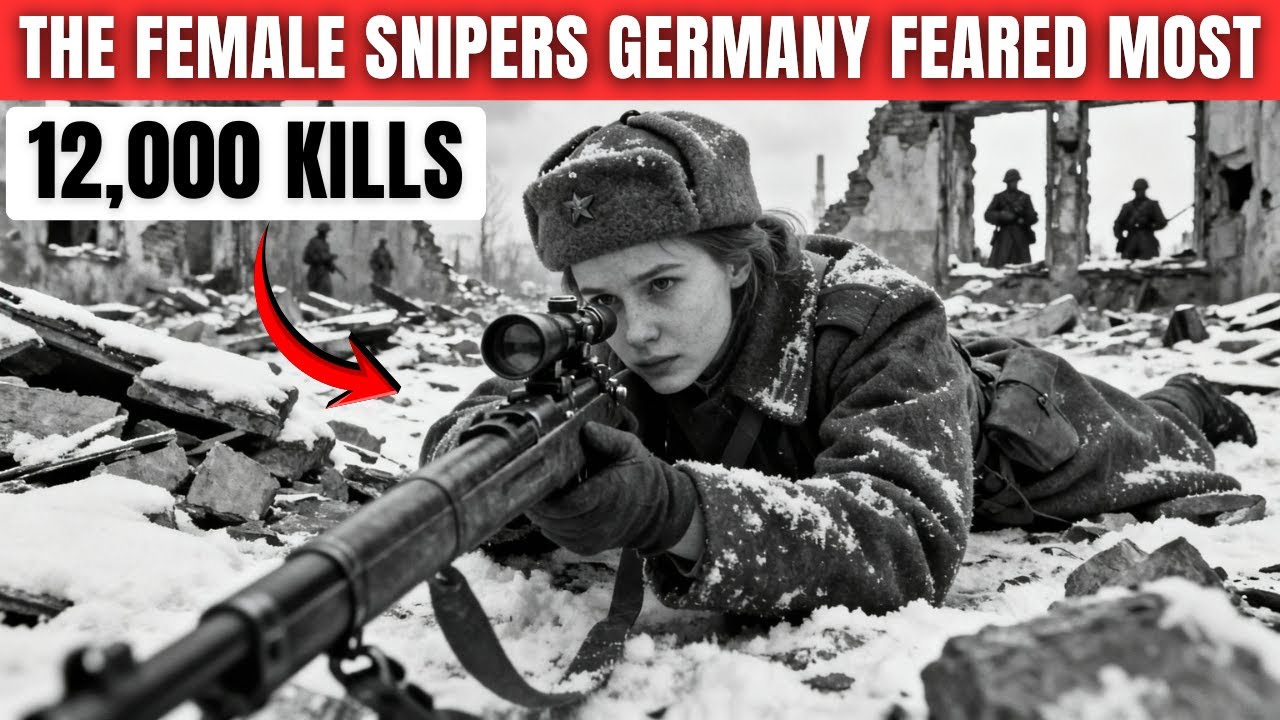
Then the shooting started—not from the front, but from above, from the sides, from nowhere and everywhere at once. Three men dropped in the first five seconds. The Germans dove for cover, but there was no cover, just rubble and bodies. More shots.
More men falling. The survivors screamed, confused, terrified. They couldn’t see the enemy. They couldn’t tell where the shots came from, only the crack of rifles and the screams.
In ninety seconds, 21 Germans were dead or dying. The 11 survivors ran. One of them, a sergeant named Klaus Fischer, wrote in his diary that night. He’d fought in Poland, in France, and in Russia for six months, but he’d never been so scared, because he never saw who was shooting.
Fischer had every reason to be confident before that day. The Wehrmacht was the best army in the world, and everyone knew it. They’d crushed Poland in weeks. France fell in six weeks.
The Soviets were supposed to be next. German soldiers were better trained, better led, better equipped. They had the best tactics, the best officers, the best of everything. And Russian soldiers?
The Germans laughed at them. Poorly trained, badly led, weak. The German High Command told their men that Russia would fall in three months, four at most. When Operation Barbarossa started in June 1941, it looked like they were right.
The Germans pushed hundreds of miles into Soviet territory. They captured millions of Soviet soldiers. They destroyed thousands of tanks and planes. By December 1941, German soldiers thought they’d won.
Moscow was almost in their hands. Victory was days away. They’d be home for Christmas. Then winter came, and everything changed.
The Soviets didn’t quit. They didn’t surrender. They just kept fighting. And that’s when the Germans started noticing something strange, something that made no sense to them.
Soviet snipers were killing their men—a lot of their men. But these weren’t the snipers they expected. These snipers were different: quieter, more patient, more deadly. German soldiers started whispering about ghosts in the rubble, about invisible death, about shots that came from nowhere.
Officers thought their men were cracking under pressure, making excuses, seeing things that weren’t there. But the bodies kept piling up. One shot, one kill, over and over. Company commanders started filing reports.
Something was happening. Their men were dying in ways that made no sense. Sentries with perfect cover, officers standing with their troops, machine gunners in protected positions—all dead from single shots to the head. It took months before the Germans figured it out.
The Soviet snipers killing their best men weren’t the hardened male soldiers they expected. They were women—young women, some barely 20 years old. Farm girls, factory workers, teachers, students. And they were better than almost any sniper the Germans had.
The Wehrmacht had faced snipers before, good ones, but nothing like this, because these women had something the German soldiers didn’t expect, something that made them more dangerous than any male sniper: patience, focus, and a burning hatred for the invaders who destroyed their homes and killed their families. The Germans called them Nachthexen—night witches. They feared them more than tanks, more than artillery, more than air raids, because you could see a tank coming. You could hear artillery.
But these women—you never saw them. You never heard them. You just died. The Soviet Union did something no other country in World War II did.
They put women on the front lines, not as nurses or clerks or support staff, but as combat soldiers, as snipers. And it wasn’t a small experiment. It was massive. Over 2,000 women trained as snipers.
By the end of the war, Soviet female snipers had killed over 12,000 German soldiers—confirmed kills, more than some entire divisions accomplished. The top Soviet female sniper, a woman named Lyudmila Pavlichenko, killed 309 Germans, more than almost any male sniper in history. The second best, Nina Lobkovskaya, killed 89. Dozens of others killed 50, 60, 80 Germans each, one shot at a time.
Here’s what the Germans couldn’t understand. These women weren’t supposed to be good at this. Women weren’t supposed to be soldiers. That’s what German commanders believed.
That’s what their culture told them. Women were weak, emotional. They couldn’t handle combat. They’d panic under fire.
They’d fail when it mattered. The Germans were so sure of this that they didn’t even bother training female snipers. It never occurred to them. But the Soviets saw it differently.
They were desperate. The Germans had killed millions of Soviet soldiers. They’d captured millions more. They’d pushed deep into Soviet territory.
The Soviet Union needed every person who could hold a rifle, man or woman. And when they started training women as snipers, they discovered something: women were often better at it than men. Not because they were stronger, not because they could shoot better, but because sniping isn’t about strength. It’s about patience, discipline, focus, the ability to stay perfectly still for hours, to wait for the perfect shot, to control your breathing, your heartbeat, your emotions.
And women were very good at that. The first major battle where German soldiers encountered Soviet female snipers in large numbers was Stalingrad, August 1942. The Germans were pushing into the city. They expected to take it in days, maybe a week.
The city was already half destroyed. Soviet forces were falling back. It looked like another easy German victory. Then urban warfare started, and everything got strange.
German soldiers started dying in ways that made no sense. A lieutenant would be talking to his men. Crack. Dead.
Head shot from 400 meters. A machine gun team would be set up in a building. Perfect position. Good cover.
Crack. The gunner’s dead. His replacement takes over. Crack.
He’s dead too. Three gunners died in five minutes; the rest abandoned the position. An entire squad moving through a street. Crack.
Crack. Crack. Three men down. The others scatter, but there’s nowhere to go.
More shots. More bodies. The survivors hide, terrified. They can’t see the shooter.
They can’t figure out where the shots are coming from. They just know that if they move, they die. One German corporal, Heinrich Zimmer, wrote a letter home in October 1942. He said Stalingrad was hell, not because of the fighting, not because of the artillery or the tanks, but because of the snipers.
He wrote that you could never relax, never rest, never feel safe, even in buildings that seemed secure, even behind good cover. The snipers found you. They always found you. He wrote that his company lost 43 men to snipers in two weeks.
That was almost half the company. None of them saw the sniper who killed them, not once. Zimmer survived Stalingrad, barely. He was wounded three times, but he said the wounds didn’t scare him.
What scared him was knowing that somewhere out there, a Soviet sniper had him in her crosshairs, and he’d never know until the bullet hit. The Germans tried everything to stop the female snipers. They sent their own snipers to hunt them. Most of those German snipers died.
They used mortars to blast buildings where they thought the snipers were hiding. The snipers moved. They tried using dogs to sniff them out. The snipers shot the dogs.
They tried mannequins and dummies to draw fire. The snipers didn’t fall for it. They waited for real targets. The Germans started moving only at night, but the Soviet women had learned to shoot in the dark.
They memorized distances. They knew the sound of German boots. They knew how German soldiers moved. They knew everything.
And they were always watching. The Soviet command knew they had something special, so they built an entire training system around these women. The Central Women Sniper School opened in 1943. It trained over 1,300 female snipers.
The course was brutal: six months of constant training. The women learned to shoot at distances up to 800 meters. They learned to calculate wind, temperature, humidity. They learned to camouflage themselves so well that you could walk within feet of them and never see them.
They learned to stay motionless for eight, ten, twelve hours—no food, no water, no bathroom breaks, just watching, waiting. They learned to control their breathing so their rifle wouldn’t move when they shot. They learned to slow their heartbeat before pulling the trigger. They learned to shoot between heartbeats, that half second when the body is completely still.
And they learned something else, something darker. They learned to hate. Most of these women had lost everything to the Germans. Their homes burned.
Their families killed. Their cities destroyed. They’d seen things no one should see: mothers shot in front of their children, children shot in front of their mothers, entire villages wiped out. So when they looked through their scopes at German soldiers, they didn’t see people.
They saw invaders, murderers, targets. And that made them ruthless. No hesitation, no mercy, no second thoughts. Just aim, breathe, shoot.
Next target. A male sniper might feel guilt, might think about the person he just killed, wonder if that German soldier had a family, children, a wife. The women didn’t think about that. They didn’t care.
Every German they killed was one less invader in their country, one less threat to their people, one step closer to pushing the fascists out. The numbers stunned the Germans when they finally figured out what was happening. Soviet female snipers weren’t killing ten or twenty Germans each. They were killing dozens, hundreds.
In one eight-month period, Pavlichenko killed 309 confirmed targets—more than one kill per day, every single day, for eight months straight. And she wasn’t alone. Nina Lobkovskaya killed 89. Aliya Moldagulova killed 92 before she was killed in action at age 20.
Roza Shanina killed 59 confirmed targets and was known for double-tapping: two targets, two shots, two kills in under three seconds. Nataliya Kovshova and Mariya Polivanova operated as a sniper pair. Together they killed over 300 Germans. When they were finally surrounded by German troops, they fought until they ran out of ammunition, then blew themselves up with grenades rather than surrender.
The Germans found their bodies surrounded by dead Wehrmacht soldiers; estimates say they killed another 20 Germans in that final fight. But the most feared Soviet female sniper wasn’t the one with the highest kill count. It was a woman named Nina Petrova. She didn’t just kill Germans.
She hunted German snipers. She studied their patterns, figured out where they liked to hide, how they operated. Then she set traps. She’d wait for them, sometimes for days, and when they finally appeared, she killed them.
German snipers started refusing missions in sectors where Petrova operated. They’d rather face a court-martial than face her. One German sniper, a veteran with over 100 kills, wrote in his diary that he’d been hunting Petrova for three weeks. He thought he had her position figured out and set up to take the shot, then realized too late that she’d been watching him the whole time.
She let him get comfortable, let him think he was safe, then killed him. His body was found with a note pinned to his chest. In German, it said: “You were too slow. ” Petrova survived the war with 73 confirmed kills, 50 of them enemy snipers.
The German military tried to downplay what was happening. They told their soldiers that Soviet female snipers weren’t real—it was propaganda, lies. The women were probably just spotters. The real snipers were men, and the women were taking credit.
But the soldiers knew better, because they kept dying. Orders came down from German High Command: any Soviet female sniper captured alive was to be executed immediately—not sent to POW camps, not interrogated, just executed on the spot. The Germans claimed it was because these women were partisans, illegal combatants. But the real reason was fear.
These women had killed too many Germans, caused too much terror, made the Wehrmacht look weak. They had to be stopped. And if they couldn’t be stopped, they had to be eliminated. But here’s what the Germans never understood.
You can’t stop someone who’s already lost everything, someone fighting for their home, their family, their country, someone willing to die to take you with them. The Soviet female snipers knew they probably wouldn’t survive the war. Most of them didn’t. Of the 2,000 women trained as snipers, only about 500 survived.
The rest died in combat, captured and executed, killed in artillery strikes, died from wounds. But every single one of them, even knowing they’d probably die, kept fighting, kept shooting, kept killing Germans. That’s what they signed up for—not for glory, not for medals, but to stop the invasion, to protect what was left of their country, to make the Germans pay for every meter of Soviet soil they’d taken. American industrial power was massive in World War II; America built more planes, more tanks, more ships than anyone else.
But the Soviet female snipers proved something different. You don’t need a massive industry to win battles. Sometimes you just need determination, skill, and the will to fight. These women fought with basic Mosin-Nagant rifles, simple bolt-action weapons that had been around since 1891.
Nothing special, nothing high-tech, just iron sights and good training. Meanwhile, German snipers had the best scopes, the best rifles, better equipment in every way. But it didn’t matter, because the Soviet women were better. Not because of their gear, but because of their training, their patience, their absolute refusal to quit.
The legacy of the Soviet female snipers is complicated. After the war, Stalin didn’t want to talk about them much. It didn’t fit the Soviet narrative. Women were supposed to be building the nation, having children, being mothers, not killing Germans by the hundreds.
So their stories were downplayed, hidden. Many received medals but not the recognition they deserved. Lyudmila Pavlichenko became a hero—she toured America, met Eleanor Roosevelt, gave speeches. But most of the other women faded into history.
They went back to their normal lives, became teachers, doctors, factory workers. They didn’t talk about what they’d done, and their country didn’t ask. It took decades before historians started really studying what these women accomplished, how effective they were, how much terror they caused among German troops. The numbers are staggering: over 12,000 confirmed kills.
12,000 German soldiers who never made it home, killed by women the Germans didn’t think could fight. Klaus Fischer survived the war. The German sergeant who’d been so terrified outside Stalingrad surrendered to American forces in 1945. Years later, he gave an interview to a German newspaper.
They asked him what the worst part of the war was. He didn’t say the cold, or hunger, or the wounds. He said it was the Soviet female snipers. He said they weren’t human.
They were ghosts, death itself. You could face a tank, you could face a machine gun nest, you could face artillery, because you could see those things coming. You could fight back. But the snipers?
You never saw them, never heard them. You just died. And knowing that some of those snipers were women made it worse somehow—not because women weren’t capable, but because it meant the Soviets were so desperate, so determined, that they’d send everyone to fight. Man, woman—it didn’t matter.
Everyone. And that’s when Fischer said he knew Germany would lose. Not in 1945 when they surrendered, but in 1943 when he encountered those female snipers. Because any country that committed like that, that put every single person into the fight, couldn’t be beaten.
They’d die before they quit. The Soviet female snipers proved that war isn’t just about who has the most tanks or planes or ships. It’s about will, determination, the refusal to surrender no matter how bad things get. The Germans had better equipment, better training at the start, better tactics.
But they didn’t have what the Soviets had. They didn’t have people willing to die to defend every meter of their homeland. The German soldiers fought for conquest, for their Führer, for an empire. The Soviet soldiers, including those 2,000 women with rifles, fought for survival, for their homes, for their families.
And that made all the difference. By the end of the war, over 12,000 German soldiers had been killed by Soviet female snipers—more than the entire population of some towns. And those are just confirmed kills. The real number is probably much higher, because in the chaos of war, not every kill gets recorded, not every shot gets counted.
But 12,000 confirmed means 12,000 times a Soviet woman looked through a scope, found a German soldier, and pulled the trigger. 12,000 families in Germany who never saw their son or husband or father again, killed by women the Germans said couldn’t fight.






