He was born at the height of Europe’s power, an archduke of the House of Habsburg, a grand admiral of the fleet, and a man who was openly offered a crown. Yet he turned his back on his imperial dynasty, refused the throne, and chose to die an ordinary citizen in a country that had been erased from the map. His name was Archduke Charles Stephen. How did a man born to rule the Austrian Empire end up committing what the Nazis later called racial treason?
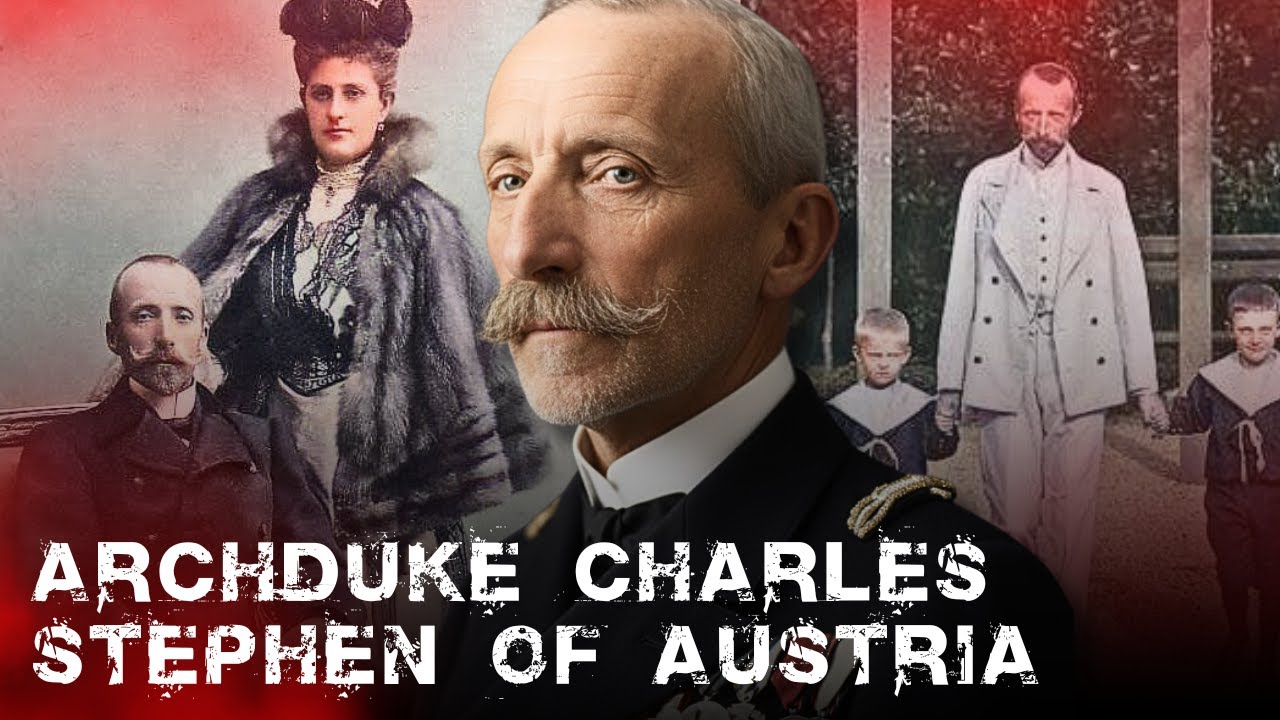
And why did his refusal to wear the crown lead his family not to a palace, but to a Gestapo torture cell? That tragedy was inevitable. Charles Stephen was crushed between two worlds that could never be reconciled: the rigid imperial past he was born to govern, and the chaotic nationalist future he was forced to navigate. But given the tragedy and greatness of his life, we cannot begin at the end.
We cannot begin with the silence of the garden in 1932. We must travel back across the chasm of the Great War, back to before the invention of the airplane, before the telephone, before the electric light bulb. We must return to the height of Habsburg monarchy, to a time when the fate of millions was decided in whispered conversations inside Vienna’s velvet salons. We must return to the autumn of 1860.
That year was a turning point in human history. In America, a lawyer named Abraham Lincoln was campaigning for the presidency, and the clouds of civil war were gathering on the horizon. In Italy, the revolutionary Garibaldi was leading his Red Shirts through the south, tearing apart the old maps of the peninsula. And in central Europe, the Austrian Empire was holding its breath.
It was an ancient, sprawling creature, an empire that encompassed what is today Austria, Hungary, the Czech Republic, Slovakia, Croatia, Slovenia, Bosnia, and parts of Italy, Romania, Poland, and Ukraine. It was a kaleidoscope of languages, religions, and cultures, bound together by only one thing: the House of Habsburg. For 600 years, the Habsburgs had married, conquered, and maneuvered their way to dominance. They believed with religious fervor that they were chosen by God to rule.
Their jawlines were famous, their etiquette suffocating, their authority absolute. But by 1860, cracks were beginning to show in the marble. The young Emperor Franz Joseph I, the man who would become a symbol of the nineteenth century, had sat on the throne for twelve years. He was a man of severe discipline, a bureaucratic monarch who slept on a soldier’s bed and rose at four in the morning every day to sign papers.
He was trying desperately to freeze time, to hold back the waves of nationalism and democracy sweeping across Europe. He believed that if he worked hard enough, if the army remained loyal enough, the empire would endure forever. And into this world of golden restraints and ancient duties, Charles Stephen was born. The location was Groß Seelowitz, a magnificent castle in Moravia, in what is now the Czech Republic.
The date was the fifth of September, 1860. It was a Tuesday. In the crisp air of the early harvest season, the cries of a newborn echoed through the castle, announcing the arrival of a new archduke. But Charles Stephen was not born into the main line of the family.
He was not destined for the Viennese throne. He was born into the Teschen branch of the Habsburg dynasty. And that distinction is crucial. The Teschen line was different.
They were the soldiers. They were the practical Habsburgs. While the main line in Vienna concerned itself with court protocol and the divine right of kings, the Teschen branch concerned itself with maps, fortifications, and artillery. They were enormously wealthy, perhaps the richest branch of the entire family, thanks to their vast landholdings and industrial investments in Silesia.
But their identity was forged in war. Charles Stephen’s grandfather was the legendary Archduke Charles, Duke of Teschen, the man who did the impossible: he defeated Napoleon Bonaparte on the battlefield at Aspern-Essling in 1809. That legacy, the legacy of the warrior hero who saved the dynasty, hung over the family like a heavy tapestry. Charles Stephen’s father was Archduke Karl Ferdinand.
He was the second son of the great hero, a cavalry general who lived his life to the rhythm of the bugle call. Karl Ferdinand was an old-fashioned man, blunt and simple in his tastes, utterly devoted to the army. He was not an intellectual. He did not spend his evenings discussing philosophy or contemplating the stars.
For him, the world was ordered and clear. There was the Emperor. There was the army. And there was God in that system.
He looked at his newborn son, Charles Stephen, and saw what every Habsburg father saw: a future officer. A man who would learn to ride before he learned to read, who would wear the white uniform of the infantry, who would marry a German princess and keep the dynasty going. But biology is a strange thing. And inheritance is never a straight line.
Because Charles Stephen was also his mother’s son. Archduchess Elisabeth Franziska was a woman of immense complexity. She was Habsburg by birth, but her soul was Hungarian. Her father had been the Palatine of Hungary, the viceroy who ruled Budapest.
She grew up listening to the loud, emotional music of the Hungarian plains, surrounded by a culture that valued passion, poetry, and rebellion. Tragedy had already touched her life before she married Karl Ferdinand. She was a young widow, her first husband, a cousin from the Este line, having died at an early age, leaving her with a daughter and a broken heart. When she married Karl Ferdinand, it was a practical marriage, a dynastic arrangement to consolidate family wealth.
But she brought something utterly foreign into the stern military household of Teschen. She brought imagination. She brought a sensitivity to the cultures of the empire that her husband lacked. While Karl Ferdinand saw the empire as a map of garrisons and fortresses, Elisabeth Franziska saw it as a tapestry of peoples.
She understood that Hungarians, Czechs, and Poles were not merely subjects to be commanded. They were peoples with souls. That was the genetic mixture that created Charles Stephen. On one side, the iron-willed, rigid discipline of the Austro-German military machine.
On the other, the romantic, adaptable, culturally sensitive spirit of the Hungarian aristocracy. From the moment he took his first breath, a war was being waged inside his DNA. A war between the past and the future, between the rigid order of the parade ground and the fluid chaos of the real world. His early years at Groß Seelowitz were a textbook lesson in isolation.
A Habsburg childhood in the 1860s was not filled with playdates or fun. It was a job. From the age of four or five, Charles Stephen and his brothers Friedrich and Eugen were placed under the care of tutors and governesses. Their day was divided into precise time blocks.
6 a. m. : wake, wash in cold water, pray, breakfast. 7 a.
m. : Latin. 8 a. m.
: French. 9 a. m. : mathematics.
10 a. m. : fencing. The education was designed to produce a ruler, not a thinker.
They learned history, but it was a specific kind of history: the history of Habsburg glory. They learned that their family was the center of Europe, the unbreachable fortress against chaos. They learned to speak German, of course, the language of command, but they also learned the other languages of the empire, though often mechanically, simply as tools for issuing orders to subordinates. And yet, even in his boyhood, Charles Stephen was quiet.
He was observant. While his older brother Friedrich, who would one day become Supreme Commander of the Austro-Hungarian army, was naturally inclined to the rowdy games of military play, waving a wooden sword and barking orders at servants, Charles Stephen was often found in the library. He was fascinated by globes. He would spin the large globe in his father’s study, his finger tracing the blue expanses of the oceans.
For a Habsburg, an interest in the sea was like a lion showing an interest in flying. It was not merely unusual; it was considered almost eccentric. But Charles Stephen saw something in those maps that his tutors never explained. He saw that the world was connected by water.
He read stories about the British Empire, how a small island nation dominated the world through naval power. He read about the American Civil War, specifically the naval blockade strangling the Confederacy. He began to understand, with a precocious clarity, that the future belonged to those who mastered technology and trade, not merely those who mastered marching in straight lines. As he entered adolescence, the contrast between him and his surroundings grew sharper.
The 1870s were a difficult time for his family. His father, Archduke Karl Ferdinand, died in 1874 when Charles Stephen was only fourteen. The loss was sudden. That towering symbol of authority, the link to the glories of the Napoleonic era, was gone.
The young archduke became an orphan, pushed further into the stern expectations of the dynasty. His older brother Friedrich was immediately prepared to assume the role of soldier-prince, heir to the Teschen military legacy. Friedrich replaced their father both literally and figuratively. Charles Stephen was the spare son.
And in the vacuum left by his father’s death, he made a decision that shocked the Viennese court. Usually, a second son was given a cavalry regiment. He was given a handsome uniform, a meaningless title, and a life of leisure in the capital. But Charles Stephen refused that.
He went to his guardian, his uncle Archduke Albrecht, the stern, ultra-conservative head of the family, and asked permission to join the navy. Not as an honorary admiral sitting in an office. He wanted to join as an officer cadet. He wanted to go to sea.
You have to imagine the scale of the shock. The navy. That was a place for commoners, for technicians, for men who stained their hands with coal and grease. It was not a place for imperial blood.
But the Habsburgs had a rule: every male must serve. And if the boy was stubborn enough to want the sea, perhaps it would cure him. Perhaps a few months of seasickness and harsh deck discipline would send him running back to the comfort of the cavalry. So permission was granted, but it was granted with a sneer.
Let the boy play with his boats. He would be back. They were wrong. In 1879, at the age of nineteen, Archduke Charles Stephen boarded the SMS Seeda.
He was assigned as an officer with the rank of Seefähnrich, the lowest officer rank. He shed the velvet and silk he had grown up with and donned the coarse wool of the naval uniform. He did not request private quarters. He did not demand a retinue of servants to wipe his brow.
He wanted to learn the trade literally from the bottom up. And there, on the swaying decks of a wooden cruiser, surrounded by the smell of salt spray and tar, Charles Stephen found his first freedom. For the first time in his life, he was not merely a Habsburg artifact for people to admire. He was a junior officer with a job to do.
He had to learn navigation. He had to understand the physics of wind and sail. He had to learn how to manage men, not as subjects, but as a crew. His first major voyage was not a pleasure cruise.
It was a transatlantic journey to Brazil and North America. Think of the psychological impact. While his brother Friedrich was inspecting barracks in dusty provincial towns in Hungary, Charles Stephen was crossing the equator. He was seeing the rainforests of Brazil.
He was visiting the bustling, chaotic, rapidly industrializing cities of the United States. He saw New York. He saw the energy of the New World. He returned to Europe changed.
He had seen the size of the real world. He realized how small, isolated, and fragile the Austro-Hungarian Empire actually was. He saw that while Vienna was obsessed with the past, the rest of the world was racing toward the future. He saw that the empire was a landlocked dinosaur in a world of sharks.
But he also learned something else on board those ships. Something that would define his political future. On board an Austrian ship, the crew was a miniature model of the empire. You had Italians from Dalmatia working the ropes, Croatian gunners, Austrian officers, Hungarian engineers, Czech stokers.
On land, these groups often bickered and fought over language rights and borders. But on a ship in the middle of a storm, none of that mattered. If the Croatian didn’t pull the rope at the same time as the Italian, the ship would sink. They had to work together.
The ship imposed cooperation. It imposed a kind of artificial unity that the empire sorely lacked. Charles Stephen looked at his crew and saw a vision of what Austria-Hungary could be. He saw “United Danube States,” a federation where loyalty to the whole was paramount over the petty nationalisms of the parts.
He fell in love not just with the sea, but with the idea of the navy as a unifying force. Yet as he rose through the ranks, lieutenant in 1881, captain shortly after, he began to realize that his vision was not shared by the men in Vienna. To the court, he was still just the eccentric cousin. But Charles Stephen was growing up.
He was becoming a man of substance. And he realized that if he wanted to make a real impact, he could not just be a sailor. He needed a base of operations. He needed a partner.
And he needed to carve his own destiny, away from the suffocating hierarchy of the Viennese court. In the mid-1880s, he met the woman who would become his partner in fate: Archduchess Maria Theresa of Austria-Tuscany. She was not a shy, retiring woman. She was from the Tuscan branch of the family, another secondary line, another group of outsiders.
She was intelligent, devout, and fiercely ambitious for her family. When they married in Vienna in February 1886, it was a grand event, celebrating the union of two branches of Europe’s most powerful family. But for Charles Stephen and Maria Theresa, it was the beginning of a project. They did not want to live in the Emperor’s shadow.
They did not want to be a decorative royal couple attending the opera and trading gossip. They wanted a purpose. And shortly after his marriage, Charles Stephen began looking at the map of the empire again. This time, he turned his gaze away from the sea and toward the land.
But he did not look at Austria. He did not look at Hungary. He looked north. He looked at a region known for its poverty, its rough roads, and its rebellious, unmanageable inhabitants.
He looked at Galicia. Galicia was the Austrian part of partitioned Poland. It was a land of vast forests, rolling hills, and deeply tragic history. The Polish aristocracy there was proud, resentful of German rule, and fiercely attached to its culture.
Most Habsburgs avoided Galicia if they could. It was viewed as a semi-civilized frontier region. But Charles Stephen saw an opportunity. He had inherited the estate of Saybusch, or as the Poles called it, Żywiec.
It was a massive property, tens of thousands of hectares of forest and farmland, with an old castle that needed restoration. In the early 1890s, Charles Stephen made a decision that sealed his fate. He packed up his household. He took his young wife and their growing number of children.
And he left Vienna. He moved to Żywiec. He was not just moving to a new home. He was crossing a cultural bridge with no return.
He was entering the den of Polish nationalism. Not with a whip, but with an outstretched hand of peace. He was about to begin one of the most extraordinary social experiments in royal history. He was about to attempt to transform a Habsburg archduke into a Polish prince.
As the train carried him and his family north through the mountain passes into the mist-covered valleys of Galicia, Charles Stephen had no way of knowing he was heading toward a phantom crown. He had no way of knowing he was placing himself at the epicenter of an impending earthquake. He only knew that he had found a home and a mission. The sailor-prince had found his harbor.
But the storm was just beginning. When Charles Stephen and his family arrived at Żywiec in the mid-1890s, they were not entering a fairy tale. They were entering a fortress in a land of ghosts. For more than a century, the Polish people here had lived under Austrian rule.
They had witnessed their kingdom erased from the map, their uprisings crushed, their culture marginalized. For the locals, the farmers tilling the fields, the proud and impoverished Polish nobles in their crumbling manor houses, the arrival of a Habsburg archduke to live among them was not cause for celebration. It was cause for suspicion. Was he a spy sent by Vienna?
Was he a jailer come to tighten the chains? The locals watched the castle with wary eyes. They expected arrogance. They expected the click of military boots and the sharp tone of German command.
What they got instead was silence, followed by a shock that shook the entire province. Charles Stephen did not treat Żywiec as a summer home or a colonial outpost. He treated it as a miniature kingdom. He applied the same rigor to managing the estate that he had applied to commanding a warship.
He woke before dawn. He pored over the accounts. He walked the forest not just to hunt, but to understand the management of the land. But the real revolution was happening within the castle walls, in the nursery, in the sitting rooms.
Charles Stephen and Maria Theresa made a decision that was, in the context of nineteenth-century Habsburg royalty, positively radical. They decided that their children would not just live in Poland; they would be Polish. In Vienna, the Imperial court was a German-speaking bubble. But at Żywiec, Charles Stephen hired Polish tutors.
He brought in Polish governesses. He insisted that the language of the home, the language of play and prayer, be Polish. Imagine the confusion of a visiting Austrian official. He arrives at the castle expecting to be received with the stiff formality of the Viennese court.
Instead, he finds the archduke’s children running through the halls, shouting at each other in the Slavic tongue of the locals. And he finds the archduke himself sitting in his library reading the poems of Adam Mickiewicz, the great Polish romantic nationalist whose works were practically anthems of rebellion. This was not a hobby. This was a radical transformation.
Charles Stephen was engaging in a project of self-implantation. He understood something the rigid men in Vienna did not: you cannot rule a people you do not respect. If the Habsburg Empire were to survive in this modern age of nationalism, it had to stop being a prison of nations and become their homeland. He was building a prototype of a new kind of monarch.
A kind that merged with the peoples. The castle at Żywiec began to change. It ceased to be a grim fortress and became a cultural salon. Charles Stephen opened its doors to the Polish intellectual elite.
Painters from the Academy of Fine Arts in Kraków, professors from the Jagiellonian University, writers, poets, historians, they all began receiving invitations to Żywiec. At first, they came out of curiosity. Why would an imperial cousin want to talk to them? But they stayed because of his sincerity.
They found a man who listened more than he spoke, a man who asked real questions about Polish history, who commissioned Polish artists to paint, who donated to Polish charities without fanfare. He became a patron of the arts, a benefactor of the Kraków Academy of Sciences. Gradually, the ice began to melt. In the cafés of Kraków and Lwów, the nickname started to circulate.
They no longer called him the Austrian. They began to whisper about the Polish Archduke. But Charles Stephen was living a double life. While he was transforming into a Polish patriarch in the mountains, he was still an inspector of the navy on the coast.
He was commuting between two worlds. And just as he was updating his identity in Galicia, he was fighting to modernize the empire’s fleet in the Adriatic. The turn of the century witnessed a naval arms race exploding across the world. Britain and Germany were building massive dreadnoughts, floating steel fortresses with guns that could bombard over the horizon.
Charles Stephen realized that Austria-Hungary was falling behind. The old wooden ships he had sailed on in his youth were obsolete. He lobbied, he argued, he rallied support for steel, for turbines, for torpedoes. He was a voice for technological progress in an empire suspicious of machines.
There is a profound paradox here. Charles Stephen was trying to save the empire in two different ways, in two different places at the same time. In the south, he was building a steel fleet to defend the empire’s body. In the north, he was building a bridge of culture to defend the empire’s soul.
He was the hardest-working man in the dynasty. But his most dangerous gamble was yet to come. As his daughters came of age, the question of marriage arose. In the Habsburg family, marriage was not a personal choice.
It was a matter of national security. You had to marry your equals. You had to marry from royal families: Bourbons, Wittelsbachs, Savoys. Marrying below your station, even to high-ranking nobles, was considered a morganatic marriage.
It meant your children would lose their rights of succession. It was a kind of dynastic suicide. By 1910, Charles Stephen’s daughters had reached marriageable age. They were beautiful, wealthy, and highly educated.
Any prince in Germany or Italy would have been eager to marry them. The Emperor in Vienna, old Franz Joseph, expected traditional marriages. Charles Stephen went to the Emperor with a different proposal. He asked permission to marry his daughters to Poles.
Not to the Polish royal family, because the Kingdom of Poland did not exist, so there were no kings. He wanted to marry them to Polish nobles. The Radziwiłł and Czartoryski princely families. These were ancient families, older and richer than many royal houses, but in the rigid hierarchy of the Habsburg court, they were considered subjects.
It was unheard of for an archduchess to marry a subject. It broke centuries of protocol. But Charles Stephen made his case with the precision of a naval tactician. He told the Emperor: “If we want to keep the loyalty of Galicia, we must bind ourselves to them by blood.
We must prove to them that we are not occupiers but partners. ” The weary Emperor, worried by the rising tide of Polish nationalism, relented. He granted permission. He recognized these marriages as equal.
In January 1909, Archduchess Renata married Prince Hieronim Radziwiłł. Later, her sister Mechthild married Prince Olgierd Czartoryski. The weddings were political earthquakes. When a daughter of an imperial archduke said “I do” to a Polish prince, it sent a shockwave across Eastern Europe.
The Polish press was ecstatic. For the first time since the partitions of the eighteenth century, a major European power was treating them as equals. They no longer saw Charles Stephen merely as a friend. They saw him as a candidate.
If the Habsburgs were willing to marry Poles, were they willing to be ruled by one? The whispers began to coalesce into a concrete plan: the Trialist solution. The idea was to transform the dual monarchy of Austria-Hungary into a triple monarchy of Austria-Hungary-Poland. And who would sit on that third throne?
Who else but the man who lived in Żywiec, spoke the language, and was the father-in-law of the Radziwiłłs. Charles Stephen sat at the center of this network, watching and waiting. He never campaigned openly. He was too disciplined, too loyal to the Emperor to appear as a usurper.
But he prepared. He groomed his sons, Karl Albrecht and Wilhelm, to be soldiers for this new future. But even as he built this dream, a crack was opening within his own house. A crack that mirrored the tragic fault lines of the region.
His youngest son, Wilhelm, was the wild card. While the rest of the family was becoming Polish, Wilhelm was looking further east. He was fascinated by the other great oppressed nationalism of the region: the Ukrainians. The Poles and Ukrainians in Galicia were bitter rivals.
Both claimed the same land. Both wanted independence. And while Charles Stephen was becoming the champion of the Poles, his son Wilhelm was secretly falling in love with the romantic nationalism of Ukraine. He learned the language.
He traveled to the Hutsul villages in the Carpathian Mountains. He began dreaming of his own crown, a Ukrainian crown. The father was building a Polish kingdom. The son was dreaming of a Ukrainian kingdom.
Under the roof of Żywiec Castle, the future civil war of Eastern Europe was being rehearsed at the dinner table. But for now, they were still a family, united by the quiet authority of the admiral. By the spring of 1914, Charles Stephen was fifty-three years old. He was at the height of his powers.
He had succeeded in integrating his family with the Polish nation. He was a respected admiral. The fleet was being modernized. The Emperor was old, but the empire seemed stable enough.
Sunday, June 28, 1914, was a hot day. Charles Stephen was likely at Żywiec, perhaps enjoying the shade of the garden, or discussing crop yields with his sons-in-law. Far away, in the city of Sarajevo, a young student named Gavrilo Princip was standing on a street corner with a pistol in his pocket. He was waiting for the carriage carrying Charles Stephen’s cousin, the heir to the throne, Archduke Franz Ferdinand.
The bullets that killed Franz Ferdinand did not just kill a man. They killed the nineteenth century. They shattered the delicate stained-glass window that Charles Stephen had spent twenty years building. The telegram reached Żywiec that evening.
The air was still and ominous. War was coming. Charles Stephen must have looked at his sons, Karl Albrecht and Leo Wilhelm. He must have looked at his Polish sons-in-law.
With the instinct of a strategist, he knew the gaming table had just been overturned. The careful diplomacy, the slow cultural integration, the peaceful marriages, all of it was about to be tested by fire. He set aside his garden shears. He put on his admiral’s uniform.
He took the train to Vienna. The admiral was reporting for duty. But he was not sailing the Adriatic. He was sailing toward a hurricane that would sweep away crowns, borders, and empires.
The Polish experiment was no longer a theory. It was about to become a desperate gamble for survival in a world tearing itself apart. The summer of 1914 died quickly. It did not fade quietly into autumn.
It was assassinated. When the war telegrams went out in late July and early August, the mood in Vienna, and indeed in Berlin, Paris, and St. Petersburg, was one of wild, drunken optimism. They called it the “Spirit of 1914.
” Crowds gathered on the Ringstrasse, throwing flowers at the columns of marching soldiers. Officers in their crisp uniforms toasted with champagne to a new and joyful war. They believed, with naivety that is heartbreaking in retrospect, that they would be home by Christmas. But in Żywiec Castle, Charles Stephen was not drinking champagne.
He was looking at a map. And what he saw was a nightmare. While the world’s attention was fixed on the Western Front, on the German invasion of Belgium and the race to Paris, a catastrophe of mythical proportions was unfolding in the East. Galicia, Charles Stephen’s adopted homeland, was not just a backdrop to the war.
It was the battlefield. The Russian Empire, that mighty machine, had mobilized faster than anyone expected. Millions of Russian soldiers were pouring across the border, flooding the Austrian part of Poland. For Charles Stephen, the war was not an abstract geopolitical conflict.
It was happening in his backyard. It was happening to his tenants, to his neighbors, and most terrifyingly, to his children. The archduke’s sons, raised in the dual-identity, dual-language world of Żywiec, were now officers in the Imperial army. Karl Albrecht, the heir, took up his duties with the stern sense of duty his father had instilled in him.
Leo joined the cavalry, ready to charge with sabers in an age of machine guns. And Wilhelm, the romantic Ukrainian dreamer, went to command Ukrainian troops, viewing the war as a first step toward his secret ambitions. They were Habsburgs, yes, but they were fighting on land they considered home, leading men who spoke their languages. This was not a colonial campaign.
It was a defense of their very existence. But the defense failed. By September 1914, the Austro-Hungarian army was collapsing. The Russians broke the lines.
The fortress city of Lemberg, Lwów, fell. The Imperial army retreated in muddy, chaotic defeat, leaving thousands of dead in the foothills of the Carpathians. The war reached the gates of Żywiec. The Russian advance was relentless.
Panic swept through the aristocracy. Most Polish nobles packed up their silver, their jewelry, and their furs, fleeing west to the safety of Vienna. They left their estates to be looted by Cossacks. Charles Stephen faced a choice: flee or stay.
Protocol dictated that no member of the Imperial family should be captured. That would be humiliation. So, with a heavy heart, the family temporarily evacuated Żywiec, moving to the safety of Vienna. But this was not a retreat to a life of luxury.
For Charles Stephen, Vienna in 1914 was a place of torment. He was an admiral with no fleet under his command in the north, watching the army generals destroy the army his family had built for centuries. He saw the refugees flooding into the capital. He saw the hospitals filling with faceless men, men whose bodies had been torn apart by modern artillery.
And he saw something else. He saw the empire’s cracks widening. Czech soldiers were surrendering to the Russians. Italian subjects were restless.
But the Poles, the Poles were fighting. Under a socialist revolutionary named Józef Piłsudski, the Polish Legions were fighting for Austria against Russia. Not because they loved the Habsburgs, they hated them, but they hated the Russians more. Piłsudski’s strategy was simple: use the war to destroy the powers that had partitioned the country.
Fight with Austria to defeat Russia, then fight Austria for independence. Charles Stephen watched Piłsudski from afar. He respected the man’s fervor. He realized that the Polish question could no longer be solved with half-measures.
You couldn’t just give the Poles better roads or a few seats in parliament. They had tasted blood. They wanted a homeland. And as 1915 arrived and the German and Austrian armies launched a massive counteroffensive, the Gorlice-Tarnów offensive, to drive the Russians out of Poland, the question shifted from how to defend Galicia to what to do with the conquered territory.
The Central Powers had occupied the Russian part of Poland. They now controlled Warsaw. They controlled millions of Poles. And they had a problem.
They needed more soldiers. The war was turning into a furnace, devouring men by the hundreds of thousands. Germany and Austria needed fresh bodies to throw into the trenches. The German military dictators Hindenburg and Ludendorff had a cynical idea.
If we promise the Poles a kingdom, they will give us an army. They didn’t care about Polish independence. They wanted a buffer state, a puppet kingdom to shield Germany from Russia, and a recruiting ground for cannon fodder. But a kingdom needs a king.
The search for a king of Poland began in earnest in 1916. It was a bizarre political beauty pageant held amidst a slaughterhouse. The Germans proposed a German prince. The Austrians shouted no, a German on the Polish throne would completely encircle Austria.
The Austrians proposed that the Emperor himself become King of Poland. The Germans said no, that would make Austria too powerful. They needed a compromise. They needed someone Austrian enough to please Vienna, independent enough to please the Poles, and connected enough to please the Germans.
Every finger on the map pointed to Żywiec. Archduke Charles Stephen was the only logical choice. The pieces were falling into place. Charles Stephen was approached.
He was cautious. He was not a vain man. He told the diplomats: “I will not accept a crown that is merely a hollow prop. If I am to be king, I must have a real government, a real army, and real borders.
” He began drafting a constitution. He met with Polish leaders. He prepared his sons. Karl Albrecht was to be Poland’s crown prince.
They were ready. But history rarely moves in a straight line. It is a series of colliding trains. On November 5, 1916, the manifesto of the two emperors was issued.
Germany and Austria-Hungary officially proclaimed the creation of an independent Kingdom of Poland. It was a historic moment. For the first time in 121 years, the name Poland had returned to the political map of Europe. But there was a catch.
The proclamation did not define the borders. And it did not name a king. It was a kingdom without a king. A blank check signed by two empires that were slowly going bankrupt.
The Poles were not stupid. They saw the hidden terms. Piłsudski, the commander of the Legions, famously said: “Not a drop of Polish blood for German interests. ” He refused to recruit soldiers for this phantom kingdom until a real government was formed.
Charles Stephen watched this botched launch with frustration. He knew you couldn’t fool the Poles. You had to lead them. He was ready to step in and fill the void, to be the king who turned the paper promise into reality.
And then, eighteen days later, the world changed again. Emperor Franz Joseph I died. He had reigned for 68 years. He was the only emperor most people had ever known.
He was the glue holding the empire’s crazy mosaic together. When he died, the psychological anchor of the monarchy faded. The funeral was the last great parade of the old world. A black funeral carriage drawn by black horses.
The streets lined with soldiers in gray, the air filled with incense and foreboding. Charles Stephen marched in the procession, his face grim. He was not just mourning his cousin. He was mourning the stability of the world he knew.
The new Emperor was Charles I. He was young, only twenty-nine. He was decent, pious, and desperate for peace. He looked up to his uncle Charles Stephen with admiration.
But he also feared him. Why? Because Charles Stephen was popular in a crumbling empire, and popularity is a dangerous thing. The young Emperor Karl had a problem.
If Charles Stephen became King of Poland, he might become more powerful than the Emperor of Austria. A Habsburg Poland led by the dynamic, Polish Charles Stephen might overshadow the faltering Habsburg Austria. Jealousy is a slow-working poison. Karl did not say no to Charles Stephen immediately.
He just hesitated. He stalled. He said: “Let us wait until we win the war. ”
But the war was not heading toward victory.
1917 was the year of disintegration. The Russian Revolution broke out in the east, taking Russia out of the war, but releasing the virus of Bolshevism. The United States entered the war in the west, bringing an industrial power the Central Powers could not match. At Żywiec, Charles Stephen was in a strange state of limbo.
He was the designated king, receiving delegations, drawing up plans for a Polish navy, designing Polish currency. But he held no power. He was an actor waiting in the wings while the theater burned. And the script was being complicated by his own blood.
We must return to Archduke Wilhelm, the Red Prince, the Ukrainian dreamer. While Charles Stephen prepared to wear the Polish crown, Wilhelm was moving toward the Ukrainian crown. The collapse of Russia created a vacuum in Ukraine, just as it had in Poland. The Ukrainians wanted their own state.
Wilhelm saw his destiny. He positioned himself as a champion of Ukrainian independence, often against Polish interests. Imagine the dinner table conversations at Żywiec in 1917. The father, Charles Stephen, was the candidate for the Polish throne.
The son, Wilhelm, was the candidate for the Ukrainian throne. The Poles and Ukrainians were waging a fierce border war over who owned the city of Lwów. It was a Greek tragedy played with a German accent. The House of Habsburg-Teschen was winning the game of thrones, but they were playing on two different chessboards that were colliding with each other.
Charles Stephen tried to rein in his son. He was a disciplined naval officer. Wilhelm was a reckless romantic. But the chaos of 1917 allowed him to run wild.
He was negotiating with Ukrainian warlords, wearing embroidered shirts, earning the hatred of the Poles his father was trying to woo. Then came the Oath Crisis. Józef Piłsudski played his trump card. He refused to allow the Polish Legions to swear an oath of loyalty to the German Kaiser and the Austrian Emperor.
He said their loyalty was to Poland alone. The Germans, furious, arrested Piłsudski and threw him into Magdeburg prison. This was a disaster for Charles Stephen’s candidacy. Piłsudski was the only man with the moral authority to unite the Poles.
With Piłsudski in prison, the Kingdom of Poland was a sham in the eyes of the people. Charles Stephen had bet on being a constitutional monarch working with leaders like Piłsudski. Now he was being asked to be a puppet for the Germans who had imprisoned the Polish national hero. He refused.
He sent word to Vienna and Berlin: “I will not accept the crown under these circumstances. I will not be a king imposed by bayonets. ” It was a moment of absolute integrity. He could have had the title.
He could have donned the velvet robes and placed the golden crown on his head. But he knew it would be a lie. He chose honor over power. But the vacancy remained.
The throne was empty. The wind whistled through the Royal Palace in Warsaw. And as 1917 turned into 1918, the mood shifted from political maneuvering to pure survival. While the Polish dream faltered, the nightmare returned to the sea.
Charles Stephen was still an admiral, and the fleet he loved, the fleet he had modernized, was starving. The blockade was taking its toll. Sailors were eating worm-infested biscuits. They hadn’t seen their families in years.
They had heard about the Russian Revolution, about sailors who took over ships, shot their officers, and declared freedom. In February 1918, what was inevitable happened: the Cattaro Mutiny. The red flag was raised over the flagship Sankt Georg. The sailors turned their guns toward the officers’ quarters.
They demanded peace and bread. The Empire panicked. If the navy fell, the army would follow. They needed a man who commanded respect.
They needed an elder of the sea. Emperor Karl sent a telegram to Żywiec: go to Cattaro, fix this. Charles Stephen put on his admiral’s uniform again. He looked at himself in the mirror, older, grayer, the phantom Polish crown weighing heavily on his forehead.
He was leaving the wreckage of his political ambition to try to save the wreckage of his military career. He took the train south, leaving the misty forests of Poland for the sunny, rebellious coast. He was walking toward a mutiny armed only with his reputation. He did not know it yet, but this would be his last great command.
The admiral was about to face the current of history. And for the first time, he would find that the current was stronger than the ship. In February 1918, the Bay of Cattaro was arguably the most beautiful prison in the world. It was a natural fjord, a deep-water harbor protected by towering limestone mountains that blocked the sun early in the afternoon.
For three years, the pride of the Austro-Hungarian navy had been rotting here. The great battleships, the Sankt Georg and the Kaiser Karl VI, were floating steel fortresses, but they were paralyzed. Blockaded by the British and French fleets in the Adriatic, there were no great battles to fight. There was only boredom, the damp cold on the iron decks, and the deadly emptiness of hunger.
The sailors were starving. The Empire had run out of food. The daily ration had shrunk to a few ounces of bread made from flour mixed with sawdust. Clothing was ragged.
And while the sailors shivered, the officers drank wine in the wardrooms and slept in warm cabins. On February 1, 1918, the tension reached its breaking point. It did not begin with a speech. It began with a sound.
A gunshot rang out aboard the flagship, followed by cheers. Then, slowly, horrifyingly, red flags began to rise on the masts. Not the Emperor’s eagle, but the red flag of revolution. By the time the Archduke’s train was racing south through the Balkans, the Cattaro Mutiny involved 6,000 sailors and 40 ships.
This was the nightmare scenario. If the ships turned their guns on the shore fortifications, or sailed to defect to the Italians, the war would be over. When Charles Stephen arrived, the physical mutiny had already been crushed by loyal ships that had sailed from Pola. But the psychological wound was deep.
The authorities were preparing a bloodbath. They wanted to execute hundreds of sailors to restore honor. Charles Stephen stepped onto the pier at Cattaro not as an executioner, but as a judge. He was the senior admiral, the old man, and he had authority the loud politicians in Vienna lacked.
He walked through the prison cells. He looked into the faces of the mutineers. They were men he had trained. They were Croats, Slovenes, Hungarians, and Italians.
He realized instantly this was not mere treason. It was despair. He wrote a scathing report to the Emperor. He did not blame the sailors.
He blamed the system. He blamed the gulf between the aristocratic officers and the multi-ethnic crews. He blamed the sheer idleness of the command. He recommended clemency.
While four of the mutiny’s leaders were executed by firing squad before he could stop it, he saved the lives of hundreds of others. He stopped the campaign of collective punishment. But he did something else. Something that would echo through history in ways he never intended.
He realized the navy needed new blood. The old admirals with their titles were useless. He searched for a man who was tough, aggressive, modern. He found a captain of forty-nine named Miklós Horthy.
Horthy was Hungarian, a pioneer of naval aviation, a man of iron discipline. Charles Stephen recommended Horthy be promoted over dozens of senior admirals to become Commander-in-Chief of the Fleet. The irony is astonishing. In promoting Horthy, Charles Stephen saved the navy for a few more months, but he also launched the career of the man who would later become Regent of Hungary, a right-wing dictator who would ally with Hitler in World War II.
In trying to plug a leak in 1918, Charles Stephen unwittingly helped shape the fascism of the 1930s. But at that moment, standing on the deck at Cattaro, Charles Stephen felt he had done his duty. He had stabilized the fleet. He had prevented a civil war aboard the ships.
He took the train back north, to his beloved Poland, thinking the worst was over. He was wrong. While he was saving the ships, the diplomats were busy sinking his kingdom. To understand what happened next, you have to understand the concept of the Bread Peace.
By the spring of 1918, the people of Vienna were subsisting on dog and horse meat. The Empire was starving to death. They needed grain. The only place to get grain was Ukraine, Europe’s breadbasket.
The new Ukrainian People’s Republic knew this. They made an offer to the Central Powers: we will give you millions of tons of grain, but in return, you must cede us the region of Chełm. Chełm was historically Polish. Its population was mixed, but the Poles considered it sacred ground.
On February 9, 1918, in the town of Brest-Litovsk, the Austrian and German diplomats signed the treaty. They sold Chełm to Ukraine for bread. They did not consult the Poles. They did not consult Charles Stephen.
They simply traded away a piece of Poland to feed the bellies of Vienna. When the news reached Żywiec, it was like a bomb exploding inside the archduke’s study. For twenty years, Charles Stephen had told the Poles: “Trust me. Trust the Habsburgs.
We are your friends. ” With one stroke of a pen, Vienna had made him a liar. The reaction in Poland was volcanic. The Polish Archduke suddenly became just an ordinary archduke again.
How could he claim to be King of Poland while his family was carving up the country like a Thanksgiving turkey? Crowds in Kraków tore down the imperial eagle emblems. Polish officers in the Austrian army tore the badges from their caps and stomped them into the mud. The Regency Council in Warsaw, the provisional government, resigned in protest.
Charles Stephen felt destroyed. He sent furious telegrams to Emperor Karl: “You have destroyed everything I built. You have made my position impossible. ” But the tragedy included a painful personal sting.
Do you remember his son, Archduke Wilhelm, the Red Prince who loved Ukraine? Wilhelm supported the treaty. Wilhelm was overjoyed. His beloved Ukraine was getting new territory.
He was leading the Ukrainian Sich Riflemen, marching alongside the Austrian army into Ukraine to secure the grain. Father and son were now effectively on opposite sides of a war. Charles Stephen was the candidate for a Poland that felt betrayed. Wilhelm was the hero of a Ukraine that was perpetrating that betrayal.
The Habsburg family, once a symbol of unity, was now a mirror reflecting the ethnic hatreds tearing the region apart. Spring turned to summer. The grain from Ukraine never arrived as hoped. The railways were in total chaos.
The sacrifice of Polish trust had been in vain. Charles Stephen retreated into a deep, melancholy silence at Żywiec. The crown dream was fading. The diplomats in Vienna and Berlin were still arguing, proposing new candidates, making ridiculous plans.
But Charles Stephen knew the truth. The window of opportunity had closed for good. The Poles no longer wanted a Habsburg king. They wanted independence.
They wanted out. As the summer of 1918 wore on, a strange, feverish mood settled over the Empire. It was the summer of illusions. The German army launched a final, massive offensive in France, the Kaiserschlacht.
For a few weeks, it looked like they might win. The maps showed German gains. But at Żywiec, Charles Stephen saw the reality. He read letters from the front.
Soldiers were deserting in droves. They were hiding in the forests of Galicia. They were called the “Green Cadres. ” Bandits, deserters, and revolutionaries.
The countryside was becoming dangerous. And a new silent killer was moving through the train stations and barracks: the Spanish flu began reaping what the bullets had left behind, adding a layer of grisly horror to the atmosphere. In August 1918, Emperor Karl made one final, desperate visit to see Charles Stephen. It was a meeting of ghosts: the young failed Emperor and the old never-quite-king.
Most likely they met at the spa town of Baden near Vienna. Karl was frantic. He was looking for a way out of the war. He asked Charles Stephen: “Can we still save Poland?
Will you still accept the crown? ” Charles Stephen looked at the young man with pity. He reportedly said: “It is too late, Your Majesty. ” You cannot offer a crown you no longer possess.
He returned to Żywiec to wait for the end. October 1918 was the month every foundation collapsed. On October 7, the Polish Regency Council in Warsaw proclaimed Poland’s independence. They did not mention a king.
They did not mention Austria. They proclaimed a free and united Poland. On October 16, Emperor Karl issued a manifesto. He offered to transform the Austrian Empire into a union of free states: “Austria shall become a federal state.
” It was a noble idea. It was exactly what Charles Stephen had proposed thirty years earlier. But in 1918, it was a joke. The peoples of the Empire did not want a federation.
They wanted secession. The response to the Emperor’s manifesto was derision and secession. The Czechs declared independence. The South Slavs declared independence.
The Hungarians declared the union at an end. At Żywiec, the ground was shaking beneath Charles Stephen’s feet. He was no longer a powerful archduke in his own domains. He was a stranger in a strange land.
The Polish Liquidation Commission, the new local government, sent representatives to the castle. These were men who would have bowed to him a few years earlier. Now they stood with their hats on, looking him in the eye. They demanded to know his loyalty.
Are you an Austrian archduke? they asked. Or are you a Polish citizen? This was the moment of truth.
The moment every immigrant, every exile, every person caught between two worlds fears. He had to choose. If he said Austrian, he would be expelled. His property would be confiscated.
He would become a refugee, an old man wandering through Europe’s train stations with a suitcase. If he said Polish, he would betray his blood. He would renounce the dynasty that had ruled for 600 years. He would commit treason against the Emperor to whom he had sworn allegiance.
He looked at his wife, Maria Theresa. He looked at the portraits of his ancestors on the walls: the Duke of Teschen, the victor of Aspern. He took a deep breath. He did not sign as an Archduke.
He did not sign as an Imperial Highness. He began drafting the declaration that would sever him from his past forever. But before the ink was dry, chaos erupted outside the gates. The war did not end with a whistle.
It ended with a thunderous collapse. The Austrian army collapsed on the Italian front. The front lines dissolved. Hundreds of thousands of soldiers were returning home, angry, armed, and hungry.
They were walking straight through Galicia. Żywiec was no longer a safe haven. It was a target. When we think of November 1918, we often think of the armistice on the Western Front.
We think of the silence that fell over the trenches in France at the eleventh hour of the eleventh day. We think of crowds cheering in London and Paris. We think of peace. But in Galicia, there was no peace.
There was only a terrifying vacuum. The Austrian Empire hadn’t just surrendered. It had evaporated. The police disappeared.
The judges disappeared. The army dissolved into mobs of armed, hungry, angry men returning home. And in the forests surrounding the Żywiec estate, a new horror emerged: the Green Cadres. These were gangs of deserters, radicalized peasants, and criminals who had taken to the woods.
They were heavily armed with stolen military rifles. They were starving, and they were looking for targets. To them, the castle on the hill was not the home of a Polish patriot. It was a symbol of centuries of oppression.
And a storehouse of food and silver. For Charles Stephen, the nights of November 1918 were a siege. The man who had commanded battleships was now commanding a handful of loyal gamekeepers and servants, boarding up windows and watching the treeline for any movement. Every shadow could be a killer.
Every sound of a broken branch could be the start of a Bolshevik-style revolution. We must remember the context. Just four months earlier, in July 1918, the Russian Tsar Nicholas II and his entire family, Charles Stephen’s cousins, had been butchered in a basement in Yekaterinburg. The Habsburgs knew this.
They knew that when empires fall, the blood of kings is often the ink used to write the next chapter. Most of the Austrian aristocracy fled. They packed their bags and escaped to Switzerland. But Charles Stephen stayed.
Was it courage? Or was it a paralysis of decision? Or a calculated gamble that his Polish experiment would save him? And on a cold morning in late 1918, the test came.
A delegation from the new Polish authorities arrived at the gates of Żywiec. They were not deferential aristocrats as in the old days. They were officials of the Polish Liquidation Commission. Their mission was to erase the Austrian presence from Polish soil.
They put Charles Stephen to a choice that felt like a gun to his head. The ultimatum was clear: the House of Habsburg is an enemy of the Polish people. If you are a Habsburg, you are an enemy. And if you are an enemy, your lands will be confiscated, and you must leave or face arrest.
Yet they knew who he was. They knew about his daughters. They knew about his support for the Academy of Sciences. So they offered him a legal loophole.
If you want to stay, they effectively told him, you must stop being who you are. You must become a citizen of the Republic of Poland. To us today, this seems like just a change of paperwork. But for a man born in 1860, who believed in the sanctity of his dynasty, this was a spiritual death.
It meant renouncing the privileges of the House of Habsburg. It meant bowing to a republic. It meant accepting being equal to his gardener. Charles Stephen did not hesitate.
He looked at the officials and spoke in fluent Polish. He told them he had considered himself a Pole by choice for years. In 1919, the paperwork was completed. The Archduke was gone.
In his place stood Pan Karol Stefan Habsburg, Citizen Charles Stephen Habsburg. He was allowed to keep his estates. He was allowed to stay alive. But the price was his legacy.
He was now a private landowner in a country struggling to be born. And Poland’s birth pangs were violent. The end of World War I was just the beginning of the Little Wars, the brutal border conflicts between the new states. The greatest threat was coming from the east: from the Bolsheviks.
Lenin’s Red Army was marching west, intent on exporting communist revolution to Berlin and Paris over the corpse of Poland. This was the Polish-Soviet War. And here, the family of Charles Stephen paid the blood price for their new citizenship. His son, Archduke Karl Albrecht, now just “Pan Karol,” did not hide in the castle.
He joined the Polish army. Imagine the symbolism. A prince of Habsburg fighting for the Polish Republic against the Russian communists. Karl Albrecht fought with bravery and honor.
He led troops on the front. He proved under fire that the “Polonization” of the family was not a ruse. It was a fact. But while one son was a hero, the other was becoming a ghost.
We have to return to Wilhelm, the Red Prince, the dreamer of Ukraine. While Karl Albrecht fought for Poland, Wilhelm fought against it. He had placed his bet with the Ukrainian People’s Republic. He was a colonel in the Ukrainian army.
And who was the Ukrainian army fighting? They were fighting the Poles for control of Galicia, specifically the city of Lwów. It is almost impossible to write a tragedy this perfectly: two brothers, one father, two opposing armies. Charles Stephen, sitting at Żywiec, was watching his sons fight a proxy war against each other.
The Polish press discovered Wilhelm’s activities. They were furious. They labeled him a traitor. They called him “the Habsburg who kills Poles.
” This cast a dark shadow over Charles Stephen. How could the Polish government trust Citizen Habsburg when his youngest son was leading Ukrainian forces against Warsaw? Charles Stephen had to make the hardest decision a father can make. He effectively disowned Wilhelm.
He cut him off. He had to publicly distance himself from his beloved eccentric son to save the rest of the family. Wilhelm became a wanderer, an exile, moving through the nightclubs of Europe, a prince without a country, dreaming of a Ukraine that would never exist. He was never welcome at Żywiec again.
The family was shattered. In August 1920, the Red Army was at the gates of Warsaw. The fate of Europe hung in the balance. If Warsaw fell, communism would sweep over Germany.
At Żywiec, Charles Stephen packed his bags. The Bolsheviks would surely execute him if they arrived. The Red Army commissars had a special hatred for the Habsburgs. But the miracle happened.
Piłsudski, the man Charles Stephen once hoped to rule, engineered a brilliant counterattack. The Red Army was crushed. Poland was saved. The immediate danger passed.
But the world that emerged from the smoke was gray and dour. The 1920s were a period of slow decline for Charles Stephen. He was safe, yes. He was a citizen, yes.
But he was also forgotten. He was a man who almost became a king. Now he worried about taxes. The new Polish state was strapped for cash.
They levied heavy taxes on the nobility. The agricultural reform laws stripped parts of the great estates. Charles Stephen, once one of the richest men in Europe, found himself land-rich but cash-poor. He spent his days managing the brewery.
The Żywiec Brewery was the family’s lifeline. The admiral of the fleet became a master brewer. He became obsessed with the quality of barley and hops. He marketed beer fiercely.
It was a strange retirement. The man who discussed naval strategy with emperors was now reading beer sales reports from Kraków. But there was a quiet dignity to it. He never complained.
He never gave interviews lamenting his lost crown. He accepted his fate. He would walk through the streets of the town of Żywiec, tipping his hat to the shopkeepers, a familiar figure, the gentleman from the castle. But inside the castle, the silence grew deeper.
His wife, Maria Theresa, was aging. His sons were scattered or struggling in their hard lives within a republic that didn’t quite know what to do with them. And Charles Stephen began to feel the weight of his own declining health. The body that had weathered Atlantic storms and the pressures of the Great War was finally beginning to fail.
But history was not done with him yet. It had one final, cruel twist. A reminder that in the twentieth century, you are never safe. In 1926, Józef Piłsudski staged a coup and took control of Poland.
He became a dictator in all but name. Piłsudski was a socialist, but he was also a romantic. He remembered 1916. He remembered that Charles Stephen had refused to accept the crown from the Germans.
He remembered the Archduke’s honor. One account, possibly apocryphal, possibly true, claims that Piłsudski briefly considered restoring the monarchy, believing Poland needed a king to stabilize the parliamentary chaos. And who did he think of? He thought of the old man at Żywiec.
But it was a fantasy, a whisper in the wind. The age of kings was over. The dawn of the age of dictators had begun. Charles Stephen watched from his window as the world darkened again.
He saw Mussolini’s rise in Italy. He saw the rise of a loud agitator in Germany named Adolf Hitler. He knew what these men represented. They were the antithesis of everything he believed in.
He had championed a traditional, Catholic, multi-national order. They championed racial purity, pagan strength, and total destruction. He must have realized, with the foresight of a man who had seen empires fall, that another storm was coming. A storm that would make World War I look like a skirmish.
By the early 1930s, Charles Stephen was confined to the castle. Illness had taken hold of him. He spent his days in prayer and memory. He had outlived his time.
He was a Victorian man trapped in the frightening modernity of the 1930s. He had one final task to perform: to die before the world ended again. On April 7, 1933, just two months after Hitler became Chancellor of Germany, Archduke Charles Stephen passed away. He was 72 years old.
He died as he had lived, quietly and with dignity, inside the home he had chosen for himself. His funeral was a strange event. It was not an official state funeral. No representatives from the Austrian court attended, for there was no longer a court.
But the people of Żywiec came. Polish peasants, factory workers, old soldiers. They lined the streets. They were not mourning a Habsburg archduke.
They were mourning a kind neighbor. They mourned “Pan Habsburg. ” He was buried in the crypt of the family church. His wife, Maria Theresa, followed him just one month later.
It was as if she could not bear to face the coming darkness without him. But while Charles Stephen found peace in the crypt, he left his children above ground to face the inferno. The chapter of his life was over. But the epilogue, the story of his children, was a horror film.
Charles Stephen died believing he had secured his family’s future by becoming Polish. He thought his sacrifice of his title had bought them safety. He was wrong. The Nazis were coming.
And they did not care about Citizen Habsburg. What they cared about was blood. They looked at Charles Stephen’s son, Karl Albrecht. And they did not see a Polish patriot.
They saw a German traitor who had refused to be German. And they were coming to punish him. When Adolf Hitler looked at a map of Europe, he did not see states. He saw races.
And when he looked at the Habsburg family in Żywiec, he saw a provocation. A family of pure German blood, the finest blood in the German sphere, daring to call themselves Polish. To Nazi ideology, this was not just a political choice. It was a biological crime.
It was racial treason, Rassenschande. When the Wehrmacht occupied Żywiec in the first days of September 1939, the Gestapo arrived with a specific mission. They were not there to arrest random civilians. They were there to correct the Habsburg situation.
They brought a document called the Volksliste. The deal was simple. If Karl Albrecht, Charles Stephen’s son, signed the paper declaring himself German, everything would be restored. They would be honored as royalty in the Third Reich.
Their property would be returned. They would be safe. All he had to do was say: “I am German. ” Karl Albrecht stood in the same library where his father had taught him Polish history.
He looked at the Gestapo officer. He was a colonel in the Polish army. He had fought the Bolsheviks. He said: “I do not recognize any German nationality.
I am a Polish officer. ”
The consequences were immediate and brutal. The Nazis were not used to hearing no, especially from royalty. They arrested Karl Albrecht.
They did not treat him as a prisoner of war. They treated him as a traitor. He was thrown into a prison in Cieszyn, then transferred to a darker, more terrifying facility. The torture began.
We do not know the precise details of every interrogation, but we know the outcome. They beat him. They kept him in solitary confinement in total darkness and bitter cold. They broke his body trying to break his spirit.
They wanted the propaganda victory of a Habsburg submitting to Hitler. He never broke. But he paid a terrible price. When he was released years later, he was nearly blind, partially paralyzed, and his health was destroyed forever.
He was a martyr who survived, which is sometimes harder than dying. But while the Nazis thought they had crushed the family’s spirit by breaking Karl Albrecht, they vastly underestimated the Habsburg women. Karl Albrecht’s wife, Alice, was Swedish-born but Polish in conviction. While her husband rotted in a Gestapo cell, she did not hide.
She joined the Home Army, the Polish underground resistance. Think of that image. An Archduchess of Habsburg living in the servants’ quarters of her confiscated estate, passing information to the resistance to kill the Nazi occupiers. She had turned her family’s legacy of service into a weapon of war.
Eventually, the Nazis caught her. She was sent to a forced labor camp. The children were scattered. The estate was turned into a vacation resort for the Hitler Youth and the Luftwaffe.
The castle where Charles Stephen dreamed of a kingdom now echoed with Nazi chants. And as the tragedy unfolded at Żywiec, a parallel nightmare was consuming another branch of the family. What about Wilhelm, the rebellious son, the Ukrainian dreamer? His story is the tragic subplot running parallel to the horror at Żywiec.
Wilhelm spent the interwar years in Paris as a playboy and spy, still dreaming of Ukraine. When the war began, he walked a tightrope. He despised the Nazis, but he hated the Soviets more. He stayed in Vienna during the war, working as a spy for the Western Allies, passing information about the German army to the British and French.
But his enemy was not Hitler. His enemy was Stalin. After the war ended, Wilhelm thought he was safe in the British zone of Vienna. But Soviet SMERSH agents, the “Death to Spies” unit, kidnapped him in broad daylight.
They took him east to Kyiv, the city he had briefly ruled as a young prince in 1918. Not as a king. He returned as a prisoner with the number 291. He was interrogated for months.
They wanted him to confess to being a Western agent. He died in the Lukyanivka prison hospital in Kyiv in 1948. His body was thrown into an unmarked grave. The man who wanted to be King of Ukraine became part of its soil, but in the cruelest possible way.
Back at Żywiec, the liberation of 1945 did not bring freedom. It simply brought a change of guards. The Nazis fled, and the Soviets arrived. Karl Albrecht, broken and blind, had survived the Nazi torture.
He returned to his family. But the new communist government of Poland had no use for Citizen Habsburg either. To the communists, he was a class enemy. He was a landowner.
He was a parasite. The agrarian reform decree was issued. The entire Żywiec estate was nationalized: the castle, the forest, the brewery, the farms. They were given only hours to pack.
They could not take the furniture. They could not take the artwork. They were allowed to take only personal belongings. Karl Albrecht, the man who refused to be German to save his property, lost it anyway.
He had sacrificed his health and his estate for Poland. And Poland, on Soviet orders, expelled him. They moved to a small apartment in Kraków. They lived in abject poverty.
The neighbors knew who they were, the royal family, and would sometimes leave food at their door, a silent tribute to their sacrifices. Alice, the fierce resistance fighter, was finally able to use her Swedish connections to get the family out. In 1951, they were allowed to leave communist Poland for Sweden. Karl Albrecht never saw Poland again.
He died in Sweden in 1951, shortly after arriving. He died an exile. The castle in Żywiec became a technical school. The gardens became public.
The brewery became a state-owned enterprise. For forty years, behind the Iron Curtain, the Habsburg name was whispered but officially erased. Charles Stephen’s experiment, the dream of a Polish dynasty, was buried under concrete and ideology. But Charles Stephen’s life was over.
His truth was just beginning to emerge. If you look at a spreadsheet of his existence, the accomplishment column looks tragically empty. He built a modern navy for an empire that vanished. He built a Polish identity for a family that was exiled.
He prepared for a throne that never existed. By the cold calculations of power, he was a failure. But history is not a spreadsheet. Its meaning is not written in laws or borders.
It is written in the survival of a radical idea: that culture is a choice, not a prison. In an age of ferocious nationalism, when people were slaughtering each other over language and blood, Charles Stephen dared to prove that you can love a country not because you were born there, but because you believe in it. He was a German-speaking Archduke who chose to be a Polish citizen. He proved that identity is not a matter of DNA, but of heart.
Think of the courage that required. When the world demanded he be one thing, an oppressor Habsburg, he chose to be a partner. And when the Nazis later demanded his son be a German master, his son chose to be a Polish victim. That choice resonates.
It resonates in the fact that democratic Poland today remembers the Habsburgs of Żywiec not as enemies, but as patriots. And there is the haunting question: what if? What if Vienna had listened? What if Charles Stephen had been crowned king in 1916?
Imagine a stable Polish constitutional monarchy acting as a shield between Hitler and Stalin. Could the catastrophe of the twentieth century have been avoided? We will never know. It is the ghost history that runs parallel to our own.
A timeline where the admiral sailed the ship to safety instead of watching it sink. Charles Stephen the Austrian was the king who never was. But in his failure, he revealed a dignity greater than that of many successful rulers. He teaches us that loyalty is not found in blindly following orders.
It is found in serving the people you swore to protect even when the orders stop. He teaches us how to lose. To lose everything, your crown, your fleet, your empire, your wealth, and yet retain the only thing that matters: your soul. He died a simple citizen, Mr.
Karol Habsburg, in a world that had no place for archdukes. But in the hearts of the people of Żywiec, and perhaps now in your heart, he wears a crown that no revolution can take away.