He came toward her on a film location in Portofino, Italy, in the summer of 1960, a twenty-four-year-old singer approaching an actress who was still a child of eight. He told her that one day he would marry her. Her name was Sandra Dee; his was Bobby Darin. She would later say that her first impression of him was not flattering.
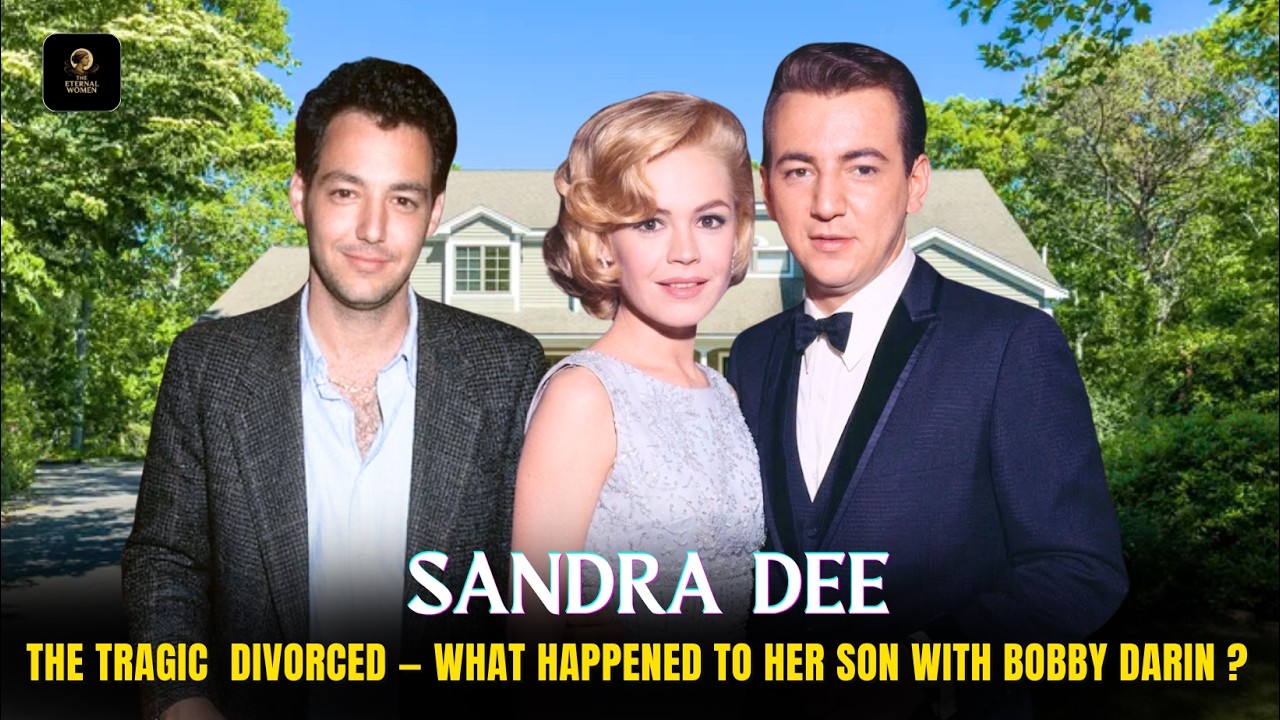
Beyond the fact that he was rude, reckless, and constantly trying to provoke a reaction, she simply did not like him. By December of that same year, they were married. From the outside, it looked like the most dazzling love story Hollywood had produced in years. America decided they were the perfect couple.
Their son, Dodd, would later put it plainly: their story looked glamorous. It looked ideal from the outside, but it was far from that. What the public never saw was a secret Sandra had carried since childhood, a secret her husband learned only after their divorce, a secret that made him weep when she finally told him. What the outside never saw was the boy who became the most honest witness to a story Hollywood always preferred to keep pretty.
This is Sandra Dee’s story. She was born Alexandra Zuck on April 23, 1942, in Bayonne, New Jersey, the only daughter of John Zuck and Mary Douvan Zuck. Her parents divorced when she was very young, still an infant in fact, and she was raised by her mother, Mary, under the conditions of single motherhood in 1940s New Jersey. Mary made her way through life after a failed marriage with a daughter who was, from an early age, exceptionally beautiful.
She was not a stage mother in the exploitative sense of the word. But she was a mother who recognized something in her daughter and made decisions based on that recognition, decisions Sandra could not fully assess at the age they were made. Sandra began modeling at twelve, not because she had ambitions toward it, but because her mother arranged it. Mary understood that beauty in mid-century America was an asset that could be converted into income and opportunity, and that the window for that conversion was finite.
Mary had also remarried. Her second husband was Eugene Douvan, the man whose name Sandra carried professionally as Sandra Dee, since the “Dee” was a softened, Americanized version of “Douvan. ” The name she became famous under was the name of the man who abused her. Sandra Dee’s son, Dodd, revealed this publicly after his mother’s death.
Sandra had never spoken about it with full clarity during her lifetime. She had hinted at it. She described psychological damage in ways that pointed to it, but she never named Eugene Douvan the way Dodd did after she was gone. The sexual abuse began when Sandra was about eight years old and continued for years.
She was a child model. She was being abused by her stepfather. She was being managed by her mother, and she was developing in response to the specific circumstances of her life: coping mechanisms, psychological and physical, that would define her existence as an adult. Eating disorders that began in adolescence and that she struggled with for the rest of her life.
The difficulty with intimacy that made her marriage to Bobby Darin far harder than it looked from the outside. The emotional detachment and numbness that are among the most documented responses of children abused by adults in positions of trust. She carried all of this before she ever set foot on a Hollywood soundstage, before she turned sixteen, before she played Gidget, before Bobby Darin walked toward her on a film set in Italy and told her she would become his wife. The public version of Sandra Dee—the girl next door, the perfect sweetheart, the untouchable good girl of 1950s Hollywood—was built on top of a private reality that was the exact opposite of that image.
That perfect good girl was a child abused by the man whose name she carried. That untouchable image was a response to having been touched in ways she had neither the power to prevent nor the language to name. When Grease immortalized her as an exaggerated symbol of purity—”Look at me, I’m Sandra Dee, lousy with virginity”—the joke landed hardest on the person least able to find it funny. By the late 1950s, Sandra Dee was one of the most famous young actresses in Hollywood.
She moved from modeling to acting with the efficiency of someone steered toward a specific destination rather than steering herself toward it. And the destination, by 1957 and 1958, was genuine stardom at a major studio. Four films in 1959 cemented her place at the heart of a particular American cultural moment. The Wild and the Innocent in 1959.
A Summer Place in 1959, a drama directed by Delmer Daves that was a major commercial success and introduced her to audiences as a romantic lead rather than merely a pretty face in a supporting role. Imitation of Life in 1959, directed by Douglas Sirk, in which she appeared alongside Lana Turner, now regarded as one of the most important melodramas of its era. And Gidget in 1959, Columbia Pictures’ adaptation of Frederick Kohner’s novel about a teenage girl learning to surf, which turned Sandra Dee into a cultural phenomenon of a particular and unique kind. Gidget was not, by the standards of the other films she made that year, the most artistically significant of her 1959 credits.
But it was the one that stuck. It created a public identity for Sandra Dee that was simultaneously her greatest achievement and the thing that constrained the rest of her career and public image more than anything else. Gidget was vivacious, sweet, innocent, and simple. Gidget was exactly the girl-next-door archetype that mid-century America was hungry to celebrate.
And Sandra Dee, who was seventeen during filming, who carried inside her the specific and painful weight of what her stepfather had done to her, played the role so convincingly that audiences accepted it as the complete truth about her. She was seventeen. She was a major Hollywood star. She was managed by her mother and by Universal Pictures.
She had never completed a normal education. She had never lived a normal adolescence. She had been working professionally since age twelve, and she had been carrying her stepfather’s secret since she was about eight. And now she was the face of innocent American teenage optimism.
The gap between public Sandra Dee and private Alexandra Zuck was not a small one. It was the distance between what the industry wanted her to be and what she actually was. And that distance, sustained over years of public performance and private suffering, exacts a toll that eventually becomes visible to everyone, usually after it has passed beyond the control of the person paying it. To understand why the marriage between Sandra Dee and Bobby Darin was always going to be difficult, you have to understand who Bobby Darin actually was.
He was not merely a charming singer who happened to marry the wrong woman. He was a specific and complicated human being with his own secrets, his own wounds, and his own peculiar relationship with time that shaped everything he did. He was born Walden Robert Cassotto on May 14, 1936, in the Bronx, New York. He grew up in a household where women were the primary engines of his life: his mother, Nina, whom he adored, and his grandmother, Vivian, who for many years represented the stability in his family life.
His biological father was not present in his life. He grew up believing Nina was his mother and Vivian was his grandmother. He discovered the truth later: that Vivian was actually his biological mother, that Nina was his older sister, and that the father he never knew was not Nina’s husband but a man who had left before Bobby was born. The revelation was profoundly affecting.
His understanding of his origins had been built on a fictional story maintained by the women of his family for years. He contracted rheumatic fever in childhood, a serious condition that left his heart damaged and gave him a deep-rooted awareness, from an early age, that his heart was unreliable and that his life might be shorter than others’. He told people later that he expected to die before turning thirty. He did not die before thirty.
He died at thirty-seven, on December 20, 1973, following open-heart surgery at Cedars-Sinai Medical Center in Los Angeles. The rheumatic fever that damaged his heart in childhood produced its final result twenty-nine years after the initial infection. That sense of limited time, that feeling that the years available to him were finite and that the achievements he wanted had to be accomplished within whatever window remained, defined his entire career. He was impulsive, tireless, and his impatience was of the kind that marks a man who believes he is racing a deadline others cannot see.
He won the Grammy for Record of the Year in 1960 for “Mack the Knife. ” He was nominated for an Academy Award for Best Supporting Actor for Captain Newman, M. D. in 1964.
He was inducted into the Rock and Roll Hall of Fame in 1990 and the Songwriters Hall of Fame in 1999. By any reasonable measure, he was one of the most gifted and versatile artists of his generation. He was also, by the testimony of those who knew him, a genuinely difficult person to live with as a husband. He was obsessively focused on his career in a way that distinguished someone who considered professional success an existential matter rather than merely a job.
He was pathologically jealous, suspicious of Sandra’s relationships with her co-stars in a way that led to confrontations and separations throughout their marriage. He was capable of warmth and genuine affection, with a particular intensity of a man who loved deeply and expressed his love in ways that were both sincere and suffocating. And he was fundamentally unequipped to deal with what Sandra was carrying. Not because he was a bad person, but because the burdens she carried—abuse, eating disorders, addiction—required a particular kind of sustained therapeutic care that Bobby Darin, racing against time and consumed by his own ambition, was not able to provide.
When they met on the set of Come September in Portofino in the summer of 1960, he sent her eighteen yellow roses every day during their courtship. He proposed with a flawless seven-carat diamond ring. He told her on the day they first met that he would marry her one day. He was confident, charming, and entirely himself, while she was nineteen years old and had never felt entirely safe.
She would later say that on the first morning she woke up as his wife, she felt safer than she had ever felt in her life. That safety, that specific feeling, was what marriage was supposed to provide, and it was ultimately what the marriage failed to sustain. They married in the early hours of December 1, 1960. Sandra was nineteen.
Bobby was twenty-four. They entered the marriage with what seemed an almost even mixture of genuine love and real incompatibility. It took seven years to answer the question of which would prevail. Their son, Dodd Mitchell Darin, was born on December 16, 1961, exactly one year and fifteen days after the wedding.
He was their only child. His arrival, by the accounts of both parents in later years, was a genuine source of joy. Bobby adored him, Sandra loved him, and for a time, the child provided a shared focus that held the marriage together in ways the two adults were unable to provide for each other. But the structural problems in the marriage were not going to be solved by a child.
In some ways, the child made them worse. After Dodd’s birth, Sandra’s doctor prescribed amphetamines, a common practice in early 1960s Hollywood, where weight control was a professional requirement for actresses and where the medical profession had not yet identified the addictive and destructive properties of amphetamine use with the clarity that emerged later. Sandra was already suffering from anorexia nervosa since adolescence, a response to the abuse and control that had been exercised over her body since childhood. The amphetamines added a pharmaceutical dependency to an already deeply rooted troubled relationship with food and her body.
Bobby’s response to Sandra’s difficulties was not empathy. It was impatience, and ultimately, suspicion. He was a man who knew what he wanted and pursued it with a specific intensity, as someone who believed time was short. He did not know the full story of what Sandra was suffering and coping with.
She never told him about her stepfather, about the abuse, about the specific origins of the damage he saw her trying to manage with alcohol and pills. He saw the symptoms without knowing the causes: symptoms like drinking, erratic behavior, difficulty with emotional closeness. He interpreted them through the lens of his own insecurity and jealousy rather than through what they were actually experiencing. In 1963, Bobby left.
He accused Sandra of having an affair with Peter Fonda, her co-star in Tammy and the Doctor. Sandra’s account of the situation was that the accusation had no basis, that Peter Fonda was merely a friend and colleague, nothing more. They reconciled. The marriage continued, but the reconciliation was built on the same foundation as before: Sandra’s untreated trauma, Bobby’s impatience and jealousy, and the fundamental incompatibility between two people who genuinely loved each other but could not give each other what the other needed.
The final separation came in 1966, after Bobby saw Sandra talking with Warren Beatty at a party. She described the incident later with precise and rather heartbreaking clarity. She said it meant nothing at all. But it was the first time Bobby had seen her with a handsome man with a Hollywood reputation, and that was enough.
Bobby filed for divorce in 1967. Sandra spent the marriage trying to be Bobby Darin’s wife: attending his Las Vegas performances, organizing her life around his schedule, subordinating her career to the demands of his. She said in an interview that her son Dodd later discussed: “I didn’t have a life, and we didn’t have a life together. ” That sentence is both an indictment of the specific structure of the marriage and a description of something more fundamental: a woman who was never allowed to develop her own identity.
First because her mother managed her, then because the industry shaped her image, then because her marriage required her to be merely a support pillar for someone else. She would discover that when the marriage ended, she was not sure who she was without it. Here is the detail in Sandra Dee’s story that is rarely discussed and most important to understanding it. After the divorce, after the marriage was over, after Bobby Darin and Sandra Dee had ceased to be husband and wife, Sandra finally told Bobby what her stepfather had done to her.
She told him after the divorce was finalized, after seven years of marriage, after the jealousy and accusations and amphetamine use and drinking and the final argument over the party with Warren Beatty, after all of that had led to the legal dissolution of their union. She told him. Bobby cried. This detail, documented in multiple accounts including that of their son Dodd, is the axis around which the entire story turns.
It explains things the public version of their marriage never explained. It explains why Sandra was the way she was: the difficulty with intimacy, the eating disorder, the drinking, the emotional capacity that was never quite what it should have been. It explains why a woman who said she felt safer with Bobby than she had ever felt in her life could not give him the marriage that safety might have produced. It explains why the symptoms Bobby interpreted as infidelity and dysfunction were in fact the expressions of a child who had been abused by an adult and had never received the support to process that abuse and move forward.
This raises the most painful question in the story: what would have happened to the marriage if she had told him during it? The honest answer is that we do not know. Bobby’s jealousy and professional obsession were not merely products of his misunderstanding of Sandra’s trauma. They were also products of his own wounds, his sense of limited time, his own personality.
It is not certain that knowing Sandra’s history would have solved the other structural problems of the marriage. But it is at least possible, and perhaps likely, that Bobby’s response to Sandra’s behavior would have been substantially different had he known what he was dealing with: that the woman he accused of affairs and of being unreasonably erratic was a woman managing the long-term consequences of childhood sexual abuse without any support or acknowledgment from the man she married. That the drinking and the pills were not moral failures but survival mechanisms of a person who had never received the therapeutic support to get through it any other way. He cried when she told him.
That means the jealous, impatient, career-obsessed man who filed for divorce possessed, deep down, the capacity for that particular grief that arrives when you realize, too late, what someone you loved was carrying and you never knew. The divorce became, paradoxically, the beginning of the closest period of their relationship. Outside the structure of marriage and the specific expectations it generated, Bobby and Sandra developed a friendship that was, by her account and by Dodd’s, more honest and genuinely supportive than most of what the marriage had been. When Bobby’s health began to decline in the early 1970s, as the problems with his damaged heart worsened and the countdown he had always known about approached its end, he sought Sandra out.
He wanted her near him. The woman he had divorced was the person he wanted when he realized that the time he had always known was short had become shorter. Bobby Darin died on December 20, 1973, at Cedars-Sinai Medical Center in Los Angeles, after open-heart surgery. He was thirty-seven.
Dodd was twelve. Sandra Dee was thirty-one when Bobby Darin died. She had been divorced from him for six years. She had spent those six years dealing with the same struggles that had marked her marriage: anorexia, amphetamine dependence, alcohol, all without the structure of marriage and without the career that had previously provided some external support for her life.
The Hollywood that had made her a star had moved past her. Sandra Dee found herself divorced in 1967 just as the Hollywood film landscape was changing. Audiences were no longer lining up for the sugary romances that had made her a star in the early 1960s. The transition from the sweetness of Gidget to the harsher, more realistic American cinema of the late 1960s and early 1970s was a transition her specific image could not keep up with.
She had been presented as something the culture was in the process of rejecting. The perfect, innocent, untouchable girl next door belonged to an earlier America, one that the social upheavals of the mid-1960s had largely dismantled. She appeared in the horror film Dunwich in 1970. She made guest appearances on television shows like Night Gallery, Love, American Style, and Fantasy Island.
She appeared in the film Lost in 1983, her final screen credit. The work that had come steadily during the late 1950s and early 1960s slowed until it faded and then stopped. She became reclusive in the 1980s after her retirement. Her depression worsened after her mother’s death in 1987, a relationship that had been troubled over the years.
Mary Douvan had been the central adult figure in Sandra’s entire life: she had managed her career, she had married the man who abused her, she had pushed and protected and exploited and loved her in the complicated, contradictory way of a mother who never fully realized the dimensions of what was happening to the child in her care. Her death left Sandra without the complicated anchor Mary had always represented. Whatever price Sandra paid in that relationship, Mary’s presence had been constant since birth. After 1987, it was not.
Sandra never remarried. She never entered another serious public relationship. She lived largely alone in Los Angeles, managing her health, her dependencies, and the ongoing consequences of decades of anorexia on her body. She was a person who achieved fame before she was old enough to vote, and she spent the last decades of her life largely invisible to the industry and the public that had consumed her image entirely.
The anorexia that began in adolescence had never received the sustained professional treatment the condition requires. Anorexia is the psychiatric disorder with the highest mortality rate, and it cumulatively damages the body’s systems over the years in ways that eventually become irreversible. Decades of the eating disorder led to the kidney disease that ultimately killed her. In her final years, her son Dodd was her most constant and reliable support.
He helped her on her path toward recovery. He was present in ways that the distances and complications of earlier years had not always allowed. In those final years, he became not just her son but her advocate: the person who fully understood the truth of her life and who was already thinking about how to ensure that understanding became part of the legacy she left behind. On February 20, 2005, Sandra Dee died at Los Robles Hospital and Medical Center in Thousand Oaks, California.
She was sixty-two. The cause of death was kidney disease complicated by decades of anorexia. She was buried at Pierce Brothers Westwood Village Memorial Park in Los Angeles, the cemetery where Marilyn Monroe, Natalie Wood, and Dean Martin are also buried. A neighborhood of Hollywood’s most significant figures.
A fitting location for a woman who was, for a specific and important period of American cultural history, one of the most famous faces in the country. She died without telling her full story to the public. Her son told it for her. Dodd Mitchell Darin was born December 16, 1961, the only son of Sandra Dee and Bobby Darin.
Born into one of the most visible marriages in American entertainment history, he grew up under the shadow of the private reality of what that marriage actually was. He was twelve when his father died on December 20, 1973. He was forty-three when his mother died on February 20, 2005. Between those two losses, he built a career as a music producer and entertainment industry professional, maintained the privacy of his personal life, and wrote the most complete public account of his parents’ lives.
In 1994, Dodd Darin published Dream Lovers: The Magnificent Shattered Lives of Bobby Darin and Sandra Dee. The title is accurate and honest. The word “magnificent” was earned by both of them, and the word “shattered” was earned by both of them equally. The book drew on Dodd’s first-hand knowledge of his parents’ private lives, on interviews with people who knew them, and on Sandra’s own accounts of the marriage and what followed.
At the time of its publication, the book was the most complete public account of what the marriage had actually been. Not the glamorous story the photographs suggested, but the complex, painful, and sometimes beautiful reality the photographs had always concealed. The book made clear, as Sandra had never publicly done herself, the dimensions of what her stepfather, Eugene Douvan, had done to her and the impact that abuse had left. Dodd named Douvan directly by name.
He described the sexual abuse in terms that made clear its severity and duration. He traced the anorexia, the addictions, and the difficulties with intimacy that marked his mother’s adult life to the specific context of what was done to her in her childhood. This was an act of great courage and great love. It was the act of a son who understood that his mother’s story had been told incompletely, that the public version of Sandra Dee had always lacked the information that would make her choices and struggles comprehensible rather than merely puzzling or disappointing.
He gave her the context she herself was never able to provide publicly, and he did it in a way that honored her rather than exploited her. He also told his own story honestly, in the book and in later interviews. He described growing up with a father who loved him and whom he lost at twelve. He described growing up with a mother whose struggles were evident to him, whose roots he only gradually came to understand.
He described the specific experience of being the child of two famous people whose public images were so manufactured that the gap between image and reality was something he always had to navigate, knowing the truth about his parents while the world fell in love with who they appeared to be. After the book, he helped support his mother on her road to recovery from addiction, a commitment that reflected his love for her and the particular role children sometimes play in the recovery of parents who have suffered from addiction for decades. He was by her side in the years before her death in ways that public records do not fully document, but his statements about her make clear. Bobby Darin has been celebrated and memorialized.
The Rock and Roll Hall of Fame in 1990, the Songwriters Hall of Fame in 1999, and the 2004 film Beyond the Sea in which Kevin Spacey played him. Bobby Darin’s story has been told, celebrated, and given the full Hollywood treatment. Sandra Dee was reduced—famously—to a joke in a song in the film Grease. “Lousy with virginity.
” The joke targets a woman whose private truth was the exact opposite of the image the song was mocking: a woman whose virginity was taken from her by her stepfather before she even understood what was being taken. A woman who carried that secret for decades and died at sixty-two from the physical consequences of never receiving adequate support for what had been done to her. Dodd Darin has been the most steadfast and honest advocate for his mother. In an entertainment industry that always preferred the beautiful version of the story to the true one, he has quietly and insistently insisted on the truth.
He is now sixty-three. He is the only surviving member of the family his parents created. He is the son of two people whose public images were magnificent but whose private lives were shattered, and he has spent three decades insisting that both things must be understood simultaneously: that the magnificence was real, and the shattering was real, and that any story that acknowledges only one of them is not the complete story. His mother deserved better than a joke in a film like Grease.
His father deserved better than the shortened life his damaged heart imposed. And Dodd Darin, the son who carried them both, has spent his adult life making sure that their truth—with all its complexity, talent, brokenness, and capacity for genuine love, limited by the damage their histories left behind—was at least partially visible to the world they left behind.






