The case had not ended when the newspapers said it ended. It ended nine days after the county road supervisor, Coburn Ash, walked out of his kitchen at four-thirty in the morning and did not come back. And even after that, it kept ending quietly every summer, as long as there was anyone left who cared about the integrity of the records in Garren County. What the divers pulled from Rose Cut quarry in July of 1927 sits in the courthouse files at Belcher, Kentucky, under a red thread in a cabinet no one is permitted to take out.
I have seen it. I have held one of the pieces in my hands, and I still cannot tell you what was really at the bottom of that water. Only what floated to the surface. Coburn Ash was fifty-two years old in the summer he went missing.
He had the wide chest of a man who had spent thirty years swinging a nine-pound hammer for the county road commission. His face had been burned by the sun so many times it had the color of tobacco. His hands did not want to be touched during an argument. He owned a farm on the east side of Truman Hollow, six acres of poor rocky ground he no longer worked, and a small barn he kept up.
His wife, Virba Ash, raised chickens and put up her own preserves, and their two grown daughters lived elsewhere by then, one in Louisville, the other married to a railroad man in Indiana. It was a big house, and Coburn Ash was its head. Not the sort of man who wandered off alone. He went to bed on the night of June 28, according to Virba, at his usual time, just after nine.
She woke at three in the morning to a dog barking in the yard and could not get back to sleep. When she reached across the bed at four-thirty, the bed beside her was empty and the covers cold. His work boots were gone from the porch. His coat was not on its peg.
Coburn Ash’s lunch pail sat on the kitchen table, packed for that morning, untouched. That last detail was what enraged Virba. Coburn Ash would not go out for the day without his pail. He had not missed a single lunch pail in twenty-nine years of working for the county.
The sheriff of Belcher was a man named Sherwin Bragg, forty-eight years old, thin as a matchstick, with a pale face as though it had been soaked and dried. He had been sheriff of Garren County for eleven years by then, and he had known Coburn Ash since they were boys running through the hills. When Bragg got the call from Virba at six-thirty in the morning, he did not send a deputy. He drove his own truck, a can of coffee between his knees.
By ten o’clock he had covered the eastern half of Truman Hollow, climbed the hill above Coburn’s barn, and come back around through the low fields. He talked to the two nearest neighbors and the man at the crossroads store. No one had seen Coburn Ash. No truck had passed east that morning.
His truck sat in the barn, key still on the seat. His fishing rod hung on its pegs. Whatever he had gone into, he had gone into it on foot. And he had gone into it in the dark.
At eleven-thirty, Sherwin Bragg stood on Coburn’s porch drinking coffee that Virba had made, looking east across the pasture toward the treeline. Truman Hollow ran another mile in that direction before the ground began to rise toward the foothills. Beyond that lay four hundred acres of regrown forest, some old wagon roads turned to briars, and in the middle of it, the sunken limestone shell of the Rose Cut quarry. Coburn Ash had grown up half a mile from that quarry.
He had drunk from its creek as a boy. According to Virba, he had stood on its edge only three times in the past twenty years, and he had spoken of it in only about six sentences in all that time. Always the same sentences, always ending with the same phrase: “That place isn’t right. Better to leave it alone.
”
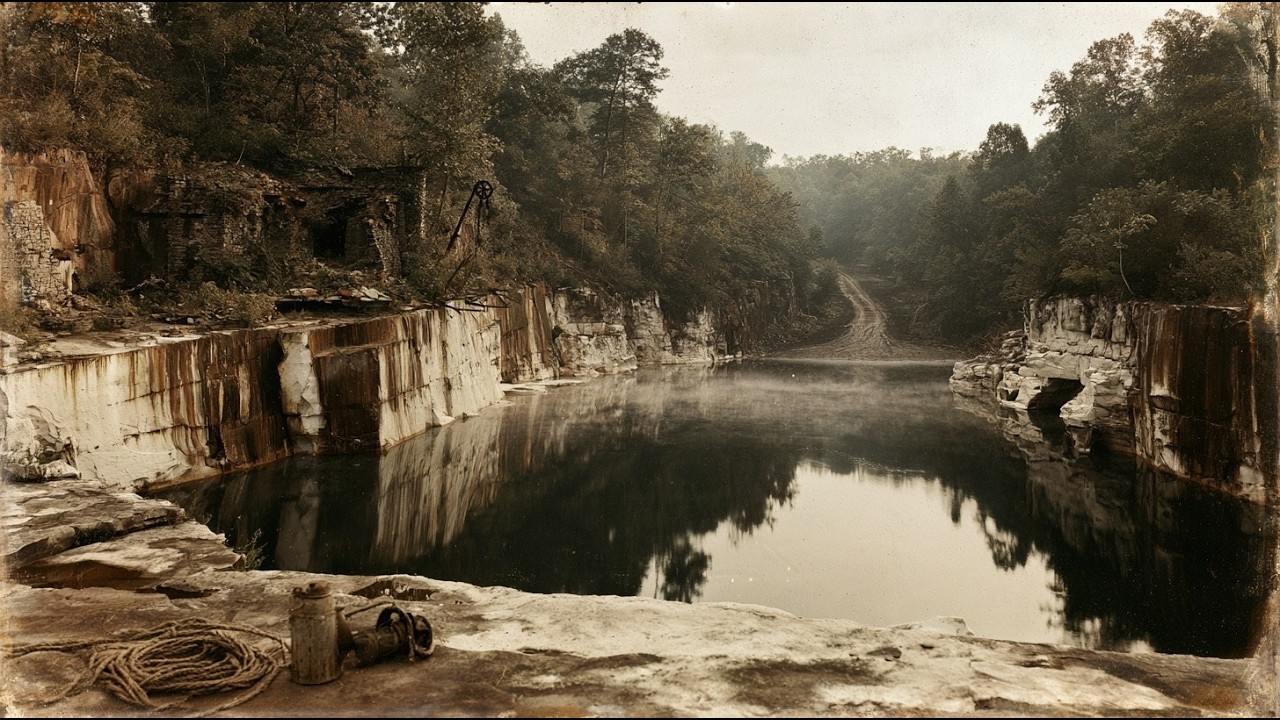
At three in the afternoon of June 29, Sherwin Bragg stood on the north rim of Rose Cut, looking down at water so still it did not look like water at all. It looked like a mirror someone had laid on the ground and forgotten. He had a bad feeling in his stomach. He would tell me later that the feeling had a specific shape.
It was not general unease. It was a particular unease, the kind a man feels when he looks at a room that has been cleaned too well. The Rose Cut mine had been flooded in 1911. It had taken about twelve years to dig, by a company out of Louisville that bought the mineral rights from the Rowe family cheap in 1899.
At the height of the work, forty-two men a day went down into it. They pulled clean building limestone and shipped it north by rail. The mine itself, while in operation, was roughly oval, the size of a small church, cut into the hill from the south face, with a series of dry stepped benches along the walls and a work floor below that, in its final year, lay sixty-eight feet under the rim. There were holes drilled in the floor.
There were crane anchors on the east bench. I was told there was a small stone shed on the west bench where the foreman kept his ledgers and where a man could get out of the rain. In October of 1911, a crew was cutting a seam of clean limestone underground, running under the north wall, following it farther than the company men in Louisville had expected. On one afternoon, around three o’clock, a wall gave way between that seam and an old spring.
Three men had gone down into the quarry that morning. Two came out. The third, a man named Uriah Renfrow, forty years old, the husband of a woman named Ona who lived in the hollow, was never found. The company closed the quarry within a month, pulled out what was left of their equipment, and let the water take the rest.
By 1912 the quarry had filled to within eight feet of the rim. And there it stayed for sixteen years. Poplars grew up along the edge. Deer came down at dusk to drink.
Boys threw stones from the high hills just to hear them hit. Nobody went into the quarry in all that time, because there were no divers in Garren County. There were no divers in the next county either. Sherwin Bragg made three phone calls on the morning of June 30.
One to Frankfort, one to a man he had known during the war, and a third to a river salvage company in Cincinnati that a friend in the state highway office had told him about. By evening he had a promise. A two-man team with their equipment would take train number 805 to Corbin the next morning. From Corbin they would drive the last forty miles by truck.
The lead diver was a man named Winton Mayberry. Forty-four years old, medium height and heavier than he looked, with the strong arms of a man who had spent ten years pulling himself along a line hand over hand. His hair had gone gray early. His eyes were pale gray-green and seemed not to blink as often as they should.
He had started his career on sunken steamboat salvage on the Ohio River out of Cincinnati, and by 1927 he had spent about sixteen years working the muddy bottoms of southern rivers, cutting cables off sunken barges, lifting safes out of wreckage. Once, he had brought a woman up out of the water so her people could bury her. He wore a simple wool sweater under his rig, chewed on a small unlit cigar, and spoke, when he spoke, very slowly, choosing his words with care. His tender was a younger man, Merle Vestal, twenty-four, thin, with a face that suggested bad luck, high cheekbones and hooded eyes.
He did not talk much either, but for a different reason. Merle Vestal had been around water work since he was fourteen. He held the lines. He ran the pump.
He watched the surface. He was the one who noticed things. They reached Belcher at ten-thirty on the morning of July 1. Sherwin Bragg met them at the station and drove them straight to the quarry road without stopping to talk.
Winton Mayberry sat with his knees against the dashboard, watching the hills out the window without a word. When they reached the rim of Rose Cut, he got out, walked to the edge, put his hands in his back pockets, and stood there for a long minute. Then he turned and asked Sherwin Bragg what he had not yet been told. Bragg said he did not understand.
Mayberry said, “You called me instead of a closer man. You paid freight charges in advance. You never asked my fee. You never asked my time.
There is something you have not told me about this water. ”
Bragg took off his hat. He turned it over in his hands and said, “My missing man never spoke of this quarry in twenty years except to say it wasn’t a proper place, and he never said what he meant by it. And I have been sheriff here eleven years, and in those years three other men have disappeared, last seen in the hollow that leads to this cut, and none of them was ever found.
Their records all end with the same phrase: presumed drowned. I don’t know if my man is in this water, Mr. Mayberry, but I want a man down there who isn’t afraid of it. ”
Winton Mayberry looked at the quarry, took the cigar from between his teeth, and put it back.
“We go in at first light,” he said. “And if we find something that’s been down there a long time, we’ll bring that up too. ” Bragg nodded once. That was the agreement.
That night, at Virba Ash’s kitchen table, Sherwin Bragg wrote out in a small brown notebook the names of the other three missing men. Elroy Fisk, born 1921, age thirty-eight, had gone up the hollow with a hunting rifle to shoot crows and never come back. His rifle was found leaning against a birch tree fifty yards from the water. Old Man Chapel Munsey, born 1916, age sixty-one, had gone up to check on a still he was rumored to keep, and had not come home.
His still was there. He was not. And a railroad surveyor named Idus Coye, born 1908, age twenty-nine, sent to map a line over the top of the hill, whose transit was found precisely set on its tripod at the hollow’s edge, still level, still aimed at the far wall, as though he had stepped away from it for a moment and then never come back. Add Coburn Ash, and that made four.
When Sherwin Bragg told Winton Mayberry this at six-thirty the next morning on the rim of Rose Cut, the diver listened without interrupting. Then he asked a single question. “Was there a fifth? ” Bragg said, “Not that I know of.
” Mayberry said, “That will change. ”
He put the mouthpiece between his teeth, and Merle Vestal lowered him into the water at 6:07 on the morning of July 2, 1927. On the first day they found nothing. That is not quite true.
Winton Mayberry came up at nine o’clock, again at two in the afternoon, and a third time at four-thirty. Each time he had a small thing to report and a small thing to hand to Merle. In the morning, a piece of quarry chain, thick as a man’s wrist, still bolted to a rusted piece of what had once been a crane. In the afternoon, a mule shoe, still nailed to a scrap of hoof, that had been down there so long the iron was thin as piecrust and crumbled between the fingers.
On the last dive of the day, a brown whiskey bottle, sealed with a cork, holding dark water and something else not yet examined. “We mark the place and go back down,” he said. What he told Sherwin Bragg that first evening, sitting on the shelf rock with his boots off and his hair still wet, was that the shape of Rose Cut was not the shape of a flooded quarry. A working quarry, he said, when the water takes it, tends to keep its shape through the early years.
The benches are still there. The floor is still there. The tool marks on the walls are still there, readable as handwriting to a man who knows how to read them. This quarry, he said, was not like that.
The east benches were in place, the crane bolts still set where the company left them in 1911. But the north wall, he said, was wrong. The north wall was too straight in places and too rough in others. The tool marks were at the wrong depth.
There were places where the stone had been cut with precision and places where it looked bitten. And along the base of the north wall, at about fifty feet, there was a shelf that was, in his judgment, neither natural nor quarry-made. It looked planned. Sherwin Bragg wrote in his notebook on the night of July 2 that Winton Mayberry had told him the water in Rose Cut was not ordinary flooded quarry water.
It was colder than it should have been at that depth. There was a current in it, though there was no visible flow. And the visibility, once below about twenty feet, was nothing at all. Not the cloudy nothing of stirred silt, but a black black like ink.
He said he had worked muddy river bottoms his whole life and had never been in water this black. He said the lamp on his helmet at fifty feet gave him about eighteen inches of light and then stopped. The beam did not fade the way a light beam is supposed to fade in dark water. It stopped suddenly.
As if there were a wall of black air beyond his hand where the water should have remained water. On the second day they found the first of the cans. It came up at 11:00 on the morning of July 3. Merle Vestal pulled it over the rim and set it on the flat rock they were using as a work table.
It was an old-style milk can, the tall twenty-inch kind, dented on one side, stamped along its lower edge with the name of a creamery in Danville, Kentucky. It was heavy. When Merle tilted the can, Sherwin Bragg heard something move inside that was not the movement of milk or water. There was a rope wound three times around the can’s neck and knotted at the handle.
At the other end of the rope, ten feet long, was a lump of limestone about the size of a man’s head, drilled and weathered. Someone had anchored this can to the bottom of the quarry on purpose. Winton Mayberry arrived at that moment. He had been circling the place Merle had marked.
He came out of the water, unlatched his helmet, and set it aside. He looked at the can for half a minute before he touched it. Then he said, “Sheriff, do you want to open it here, or at the courthouse? ” Sherwin Bragg said, “Open it here.
”
They cut the rope. They pried off the lid with a screwdriver. It came open with a sound like a mouth being opened. Inside the can was a folded square of oilcloth, black with age, wrapped tightly around something small.
Mayberry took it out. Unwrapped it slowly. Laid its contents on the rock. There was a man’s pocketknife, closed.
There was a leather bootlace, coiled. There was a small tin matchbox with a name scratched into its lid. And there was a single brass button, of the kind used to close a station agent’s coat. The name on the matchbox was Idus Coye.
Sherwin Bragg had already written that name in his notebook. He turned the notebook to the page. He read it aloud. Then, very carefully, he sat down on the rock and put his head between his knees, because his ears had begun to ring and his hands to shake and he did not want anyone to see.
Idus Coye had gone up that hollow nineteen years before and never walked out. His transit was found where he set it. His body was never found. And here, in Sherwin Bragg’s hand on July 3, 1927, was a matchbox scratched with his name, placed inside a milk can, weighted with a stone, and thrown into water that had been thirty feet deep on the day Idus Coye reached it.
Winton Mayberry did not sit down. He looked at the can. He looked at the water. Then he looked at Sherwin Bragg and said, “Sheriff, that can wasn’t put down there when Idus Coye got here.
” Bragg said, “What do you mean? ” Mayberry said, “That rope on the can’s neck is new. Five years old, no more. Six at the outside.
Whoever put that can there did it after 1921. ” Bragg said, “And the name on the can? ” Mayberry said, “Older. Much older.
The scratches are dark all the way through. The metal has eaten around them. ”
They stood in the white hot sun on the flat white rock. Somewhere in the trees above the cut, a crow began to call and did not stop.
They came back with the dawn on the fourth. There was a light mist over the water when they reached the rim that morning, a thin white mist that lay on the surface without touching it, rising from among the trees along the east edge, and it did not move even when a light breeze came and moved the branches. Merle Vestal would tell his nephew, years later, that the mist over the water at Rose Cut in the morning did not behave like ordinary mist. It stayed still.
It waited. It kept its shape. Winton wanted to sweep the area east of the marked point. Merle laid out a grid line across the shelf where the first can had come up.
He counted the knots on the line as Winton went down and paid it out. Sherwin Bragg stood on the rim and had not slept well the night before and would not sleep well on any night of that week. The second can came up at ten o’clock on the morning of July 4, Independence Day, and no one at the quarry noted the holiday. It was smaller, ten inches.
The kind a farm wife sends up to the crossroads store for cream. The rope was the same, with the same knot, the same stone weight, the same ten-foot length. Inside the second can was another folded square of oilcloth. Inside the oilcloth were three things.
A briar pipe, the bowl chewed almost through. A pair of wire-rimmed spectacles, one lens cracked in a spiderweb pattern. And a sheet of folded paper so brittle it had to be handled with the point of a knife, written on in faded ink with the name Chapel Munsey and the date August 7, 1916. Sherwin Bragg read the paper.
He did not sit down this time. He only said, “That was his hand. I saw it on the bill of sale for his mule. ”
The third can came up in the afternoon of the fifth.
This one was full-size, twenty inches long and heavy. When they set it on the rock, water was already seeping from a small hole in its bottom. Winton opened it quickly. Inside were four things wrapped in oilcloth.
A hunting knife, still sharp, with the letters E. F. scratched into the wood of its handle. A shotgun shell, twelve gauge, brass base, never fired.
A silver pocket watch on a broken chain, stopped at 2:18. And a small square of paper with the name Elroy Fisk and the date October 9, 1921. Sherwin Bragg looked at the watch a long time. He turned it over.
Scratched on the back were the words: “To Elroy from his father. ” He had seen that watch on Elroy Fisk’s wrist dozens of times before Elroy went up the hollow with his rifle and did not come back. He set the watch on the rock and said, “Gentlemen, there is something wrong here. ” Winton Mayberry said, “We haven’t found your foreman yet, Sheriff.
” Bragg said, “I… I… ” He stopped. That night, at the county hotel in Belcher, Winton Mayberry sat on the edge of the porch and told Sherwin Bragg something he had been thinking about all afternoon.
He had taken off his boots and put his feet up on the rail, a small cigar between his teeth, unlit. A moth was working at the porch light. A piano was being badly played somewhere down the street by someone who had had two drinks too many. And Winton Mayberry, who had not said much all week, said this: “I’ve been down in this water three days now, and I have not seen the bottom once.
” Bragg said, “But you found the shelf. ” Mayberry said, “I found a shelf. It’s at fifty-two feet. It’s about the width of two barns, and I don’t know how far it runs back under the north wall.
That’s where the cans are, Sheriff. On that shelf. In a row. ” Bragg said, “A row.
” Mayberry said, “A row. Evenly spaced. Like fence posts. ”
Bragg looked at him.
Mayberry said, “Whatever is down there goes deeper than that shelf, Sheriff. There’s a slope behind the shelf and I haven’t measured it. I’ve gone past a hundred feet and felt no bottom, and the sounding line comes back without any silt on it. ” Bragg said, “What do you mean, whatever is down there?
” Mayberry looked at his cigar and did not answer for a while. Then he said, “Sheriff, the cans on that shelf were placed there over the years. I can tell you that from the rope alone. Some of that rope is fifteen years old, some of it five.
Someone comes to this quarry and puts a can on that shelf, now and again, for a long time. And every can we’ve opened so far carries a name. And every name we’ve opened so far belongs to a missing man of this county. So I would ask you, Sheriff, to consider that whoever put those cans there may still be doing it.
”
Bragg did not answer. He went to his room and sat by the window and watched the moon come up over the hill and did not sleep. On the morning of July 6, Winton Mayberry did something he had not done in eleven years of water work. He asked Sherwin Bragg to bring another man to the rim.
He said, “Sheriff, I want someone here who knows this ground well, someone who was here before the flood, old enough to tell the truth without caring who hears it. ” Bragg thought for a moment, then said, “That’s Loyal Bedgood. ”
Loyal Bedgood was seventy-eight years old. He had been the county surveyor from 1878 until 1914, when his eyesight failed.
He lived alone in a white house on the edge of Belcher, reading newspapers through a magnifying glass, and spoke to almost no one. But Sherwin Bragg had known him for thirty years, and when Bragg drove up to Loyal Bedgood’s front porch that evening and told him what they had brought out of Rose Cut, Loyal Bedgood did not need to hear it twice. He said, “I want to come up there. ”
He was at the rim of Rose Cut by four in the afternoon, seated in a folding chair that Merle Vestal brought him, a water gourd in one hand and his old brass level in the other, though there was nothing to level.
He looked at the three opened cans on the rock. He looked at the pipe, the spectacles, the pocketknife, the watch, the matchbox, the bootlace. Then he said, “Boys, I have to tell you something I have never told anyone in this county before, because there was never a good reason for it. ”
He said, “In 1893, a mining engineer came through here from a company in Louisville.
He was going to survey the Rose Cut ground for an expansion. His name was Ulysses Astor, and he was thirty-one years old, and he boarded in my house four nights because there was no nearer hotel. He was a quiet, courteous man, no drink, no tobacco. And he sat at my kitchen table every evening after supper, drawing in a leather-bound notebook by oil lamp light.
On the third of his four nights, he told me at supper that he had gone down into the cut earlier that day in the dry season, when they were still working the dry seam, and that he had seen something in the wall of the cut he did not know how to describe. He said there was a borehole cut into the north wall of the quarry, small, barely wide enough for a man to crawl into, and old, much older than the quarry itself. He said the tool marks on it were not the tool marks of any tool he knew. They were not pick marks.
They were not drill marks. They were not the kind left by wedge and hammer. He said the stone around the mouth of the borehole was polished, as though something had gone in and out of it many times over many years, and he said that when he reached it and put his lamp inside, he saw that it did not stop. It went back.
As far as his lamp reached, it went back. It was level. It was straight. It did not slope up or down.
He said it was cut with a hand and a purpose. He said he came out of there and never went back in and never told the foreman. “Ulysses Astor left this county on August 7, 1893. I saw him onto the wagon myself.
Six weeks later, the company in Louisville wrote to ask if I knew what had become of him. He never reached Louisville. ”
Bragg said, “Lord. ” Bedgood said, “If the flood came in 1911, that borehole is under the water now.
” Winton Mayberry said, “On the north wall. ” Bedgood said, “Yes. ” Mayberry said, “Sheriff, the shelf is on the north wall. ” Bragg said, “Lord.
”
Bedgood looked at him and said, “Sherwin, I have kept that story to myself since I was forty-four years old, and I have never told it because the name of a man who was never named should not be named. But you have four men now, one of them a road man for thirty years. Ulysses Astor makes five. And if what you say is true, that there are cans down there with names on them, I will bet you a month of my pension that if you find another can, his name will be on it.
”
Sherwin Bragg did not answer. He walked to the water’s edge and looked down. That evening they pulled the fourth can. It came up at 7:06 on the evening of July 6.
A small ten-inch can, a stone weight, a ten-foot rope, the same knot. Inside, on a square of oilcloth so brittle it flaked when Winton opened it, were four things. A brass compass, badly corroded, scratched on its lid: U. Astor, Louisville, 91.
A pen nib. A brass button. And a piece of paper with the name Ulysses Astor and the date August 9, 1893. Loyal Bedgood was still sitting in his folding chair on the rim.
He looked at the compass. He looked at the paper. He looked at the button. He nodded once, slowly, like a man confirming a diagnosis he had already made in his head.
Then he took off his hat. And he wept. Silently, the way an old man weeps who has carried a heavy thing for thirty-four years. He put his hat back on and asked Merle Vestal to drive him home.
He never returned to Rose Cut. He lived six more years in the white house on the edge of Belcher and never spoke Ulysses Astor’s name to another human being. When he died in the winter of 1933, Sherwin Bragg found among his things a leather-bound notebook, written in a small clear hand. On its last page, in ink still soft, was a single sentence: “I should have told him not to go back in.
That was the 6th. ”
On the seventh, they found nothing new. Winton Mayberry went down at dawn, came up at nine, went down again at ten, came up at noon. He said the shelf ran back farther than he had first thought.
He said the row of cans extended in both directions from their first point of entry. The deeper he went, he said, the older the ropes on the cans became, and the closer to the edge, the newer. Whoever was placing them had started at the back of the shelf, nearest the borehole in the wall, and had moved outward year by year over decades. He said there was a new can on the far edge of the row, its rope newer than any other rope, its sinker stone newer, set a little apart from the rest.
He said, “That one is for your foreman, Sheriff. ” Bragg said, “Bring it up. ” Winton Mayberry said, “Tomorrow. ” Bragg said, “Why not now?
” Winton Mayberry said, “Because I want daylight for the one after it. ”
That was the afternoon of July 7. Sherwin Bragg went back to town and sat at the drugstore table on Main Street and drank three cups of coffee without eating. Then he came back to the hotel at nine-thirty and sat on the porch with Winton Mayberry, and they did not talk for a long time.
Then he said, “Mr. Mayberry, I have a question. If I understand you correctly, whoever has been putting those cans down there has been doing it for at least thirty-four years, from 1893 until now. That is longer than one man’s lifetime.
So there is more than one of them, isn’t there. There must be. ” Winton Mayberry did not answer at once. He took the cigar from between his teeth, looked at it, put it back, and said, “Sheriff, in my trade you learn early that water has abilities you would not believe.
It keeps things, hides them, moves them from their place when no one is looking. I have known rivers that gave me back a horseshoe on a Tuesday and the same horseshoe on a Friday, three miles apart, with the current standing still. I have recovered a lantern in Cincinnati that was still warm. I have brought up a woman from a drowned silo in Indiana whose hands were folded over a Bible that her father’s family had owned since 1840.
That Bible could not have come to her hands under thirty feet of still water, and no one in that town could tell me how. In Rose Cut I have been six days, and I will tell you what I can say honestly. The ropes on those cans are not all the same age, according to their place on the shelf. Some of the newer ropes are farther back than they should be, and some of the older ropes are farther out.
And there is a place near the borehole in the wall where the rope is so new I could have bought it at the general store this morning, and I did not bring it up. ”
Bragg said, “Why not? ” Winton Mayberry said, “Because I did not want to know the name on it yet. ” Bragg said, “Whose do you think it is?
” Winton Mayberry did not answer. Bragg said, “Mr. Mayberry. ” Winton Mayberry looked at him and said, “Sheriff, I have been diving for twenty-two years.
I have never once had to talk myself into going back into any place in the water. I have had to talk myself into it four times this week. Tomorrow at first light we bring up the fresh can from the far edge. That one is your foreman.
And if the sheriff and the divers and old Loyal Bedgood agree, we bring up the fresh can from near the borehole after that. And after that, if anything remains, we decide what to do. ” Bragg said, “Agreed. ”
Winton Mayberry stood up and went into the hotel.
He did not sleep either. July 8, 1927, was the hottest day of that summer in Garren County. By ten in the morning the water of Rose Cut gave off a smell of metal, a smell that had not been there on any other day. The black mosquitoes came up out of the ferns in such clouds that Merle Vestal had to tie a wet bandana over his nose and mouth.
Winton Mayberry went into the water at 6:17. He stayed under for forty-one minutes. He came up slowly, too slowly for Bragg’s taste, but he had told them from the start that this water did not like speed. When he broke the surface he had a rope in his hand and was pulling something behind him.
He brought it to the rock. Merle helped him lift it. It was a milk can, twenty inches long. The rope around its neck was so new the cut ends were still bright.
They cut the rope. Winton opened the lid. Inside was a folded square of oilcloth, thick as a saddle blanket, heavy for its size. Winton laid it on the rock and opened it.
Inside were four things. A small closed pocketknife, with the letters C and a period scratched into its wooden handle with a nail. A key ring with two keys, the smaller of which fit the lock of Coburn Ash’s barn door. A metal star, of the kind a man might carry as a luck charm, with no marking on it.
And a folded square of paper, written in faded ink with the name Coburn Ash and the date June 29, 1927. Sherwin Bragg sat down on the rock. He had known this would happen since Winton Mayberry said it the night before. He had known since Loyal Bedgood said it two days before.
But he had told himself, all the way from Belcher that morning, that he might be wrong. And now he was not wrong. He sat on the rock and did not speak. Winton Mayberry gave him a minute.
Then he said, “Sheriff? ” Bragg said, “Yes? ” Mayberry said, “The ink on this paper is dry. ” Bragg said, “Of course it is.
” Mayberry said, “No, Sheriff. Look. It is not just dry. It is old.
This ink was put on this paper years before this one. Look how it has soaked into the paper. Look at the color. ”
Bragg looked.
The ink had faded to a light brown. The edges of the paper were yellowed the way a page yellows when it has lain in a dresser drawer for several winters. The name Coburn Ash and the date of his disappearance had been written on that paper before he disappeared. Bragg said, “Mr.
Mayberry? ” Mayberry said, “Sheriff? ” Bragg said, “Mr. Mayberry, this is not possible.
” Mayberry said, “No, sir. It is not possible. ”
They stood on the rim of Rose Cut in the hot metallic air, the black mosquitoes crawling on the backs of their necks. And Winton Mayberry, who had been diving for twenty-two years, who had never, he said, had to talk himself into going back into any place in the water, turned to Sherwin Bragg and said, “Sheriff, with your permission, I would like to go down again this afternoon.
” Bragg said, “You said tomorrow. ” Mayberry said, “Yes. ” Bragg said, “And now? ” Mayberry said, “And now I have changed my mind.
I want to bring up the fresh can from near the borehole. And then I want to leave this water. ” Bragg said, “Go. ”
Merle Vestal lowered Winton Mayberry into the water of Rose Cut at 1:02 on the afternoon of July 8, 1927.
He stayed under for fifty-three minutes. Then he came up with a rope in his hand. At the end of the rope was a small milk can, ten inches long, weighted with a stone. The rope around its neck was new, and so was the stone.
The lid of the can was sealed shut, its edge sealed with a black wax that Winton said was not tar and not pitch and smelled like neither. Winton brought the can to the rock, but he refused to touch it further. He said, “Sheriff, this is your decision. I have brought up six cans from that water in seven days, and every one of them had a name on it I did not want to read.
I will not be the one to open this one. ” Bragg said, “All right. ”
Bragg took the screwdriver from Merle. He worked at the wax, and it came off in one long dark curl.
Then he opened the lid and set it aside. Inside the can was a folded square of oilcloth. Bragg lifted it out and spread it on the rock. There was nothing wrapped in it but a folded square of paper in the middle of the cloth.
A sheet of bright white paper, not yellowed. He picked it up. He opened it. On it was a date: July 23, 1927.
There was no name on it. Sherwin Bragg stared at the paper for a long time. Winton Mayberry looked at Sherwin Bragg. Merle Vestal, sitting on the rock with the wet bandana tied over his nose and mouth, looked at the water.
It was July 8, a Friday. July 23 was two weeks and one day away. Bragg folded the paper again. He put it in his shirt pocket.
He said, “Mr. Mayberry. ” Mayberry said, “Sheriff? ” Bragg said, “I want you and Mr.
Vestal to go home tonight. I want you on train 805 out of Corbin in the morning. I will pay your fares both ways, and half your fee for your silence. And I want your word that if anyone ever asks you what happened at Rose Cut, you will say only that a search was made and the supervisor was not found.
” Mayberry said, “Sheriff, are you sure? ” Bragg said, “Yes. ” Mayberry said, “And the newspaper? ” Bragg said, “That is my affair.
”
Mayberry looked at him a long time. Then he took the cigar from between his teeth, put it in his shirt pocket, shook Sherwin Bragg’s hand, and did not say another word. Merle Vestal loaded their gear onto the truck. Sherwin Bragg drove them to Belcher and paid them out of the county strongbox.
They were on the train by eight o’clock the next morning. Winton Mayberry never returned to Garren County. I was told that Merle Vestal left the diving trade in 1931 and moved to Oregon, where he worked the rest of his life in a sawmill, and spoke of what he had seen in the Kentucky water only once, near the end of his life, to a nephew who wrote it down in a private notebook I was not allowed to read. On the ninth day, July 9, 1927, Sherwin Bragg went back to Rose Cut alone.
He did not go into the water, for he had no means to do so. He stood on the rim for an hour in the bright morning light, holding his notebook and a can of coffee between his boots. Then he drove back to town and did three things. The first was that he filed with the Belcher court a report in his own handwriting stating that a search of Rose Cut had been made for the missing road supervisor, Coburn Ash, over a period of nine days, that the search had produced nothing, and that Coburn Ash was presumed drowned.
That report is now in the records of Garren County. It is the report that was shown to Virba Ash three months later when she came to the sheriff to ask what he could tell her, and it is the only report the state of Kentucky ever received on the matter. The second was that he went to the drugstore on Main Street and bought a small brown envelope. At the drugstore, on a folded sheet of paper, he wrote out the following words: “To whoever finds this in 1950 or after.
On July 8, 1927, at Rose Cut, Garren County, Kentucky, a can was found containing a paper dated July 23, 1927, with no name. I will watch the county on that date. I will record what happens. ” The paper was signed Sherwin Bragg, Sheriff.
He put that paper and the paper that had been inside the can into the small brown envelope. He sealed it. He wrote on its face: “To be opened in 1950 or after. ”
He returned to the courthouse.
He placed the items in the red-thread cabinet, inside the box labeled “Ash. ” Then he drove to the rim of Rose Cut with the six cans, the fresh can, the pipe, the pocketknife, the compass, the shotgun shell, the watch, the spectacles, the bootlace, all the small heavy things they had pulled from the water, now wrapped in a clean cloth. He walked to the water’s edge and threw the whole bundle in. He told Loyal Bedgood later that he had thought about that decision all his life.
He said he did not know if it was the right one. He said he could not decide whether he was returning the things to the water to satisfy whatever had kept them there, or whether he wanted the evidence of what had been in those cans to stay in a place no living soul would ever see again. On July 23, 1927, in Garren County, Kentucky, nothing happened at all. Nothing.
The sheriff’s record for that day, in Sherwin Bragg’s own hand, reads: “Quiet day, no incidents, clear weather. ” He wrote in his personal notebook that night that he had sat in his truck at the mouth of Truman Hollow from six in the morning until nine in the evening, and had seen no one walk into the hollow or out of it that day. On July 24, 1927, Virba Ash did not wake up. She was found in her bed at nine-thirty in the morning by her sister, who had come from Louisville to visit.
She had not been ill. She had gone to bed the night before at her usual time. Her doctor came over from Belcher and said her heart had stopped during her sleep. A woman of fifty-one whose husband had disappeared under strange circumstances is a woman whose heart carries a great weight, he said, and these things happen, and there was no reason to look further.
She was buried on the twenty-sixth in the family cemetery beside a headstone that bore the name Coburn Ash, so that at least his name would be somewhere in the ground of the county where he had spent his life. The date the sheriff had kept in his shirt pocket was the twenty-third. Virba Ash died on the twenty-fourth. He thought about that for the rest of his life.
He told Loyal Bedgood three years later that he did not know whether the paper had been off by a day, or whether he was meant to understand that what was counted was not always a man walking into a hollow. Sometimes it was a woman in her bed. And perhaps the water had been counting different things all along. Sherwin Bragg remained sheriff of Garren County until 1939.
In those remaining twelve years, three more men were lost, their last known walks in Truman Hollow. Merritt Cullins, a saw-filer, in 1931, age forty-six, had gone up the hollow to look at a fallen poplar and had not come back. Otway Krebs, a veterinarian from near the Tennessee line, in 1934, age fifty-one, had gone up the hollow with a rifle and a blanket to hunt turkey and had not come back. And a man about whom I was asked to give no details, a man of sixty-three, beloved and respected, who stepped out of a country dance at ten o’clock to smoke on the porch and did not come back inside.
Sherwin Bragg did not return to Rose Cut for any of these cases. He filed each report the same way, presumption of drowning. He wrote no further notes on them, and added no further envelopes to the red-thread cabinet. He died in 1952 at his sister’s house in Frankfort, of a stroke, at the age of seventy-three.
According to his sister, he spent the last three weeks of his life sitting on her porch looking east toward the mountains, and spoke of only one thing in a low voice: “I should have gone back up there. ” On his last night, he said it again. The red-thread envelope was opened in the Belcher courthouse in 1954, when a new county clerk was taking inventory of the sealed materials. She found the paper, read it, and showed it to the then-sheriff, a man named Barlen Toll, thirty-eight years old, who had never heard the name Coburn Ash.
She later showed it to the county historian, the man who ultimately told me the story, and who gave me, from his personal collection, a folded piece of yellowed paper written in faint brown ink with the date July 23, 1927, and no name. I keep that paper in my desk drawer as I record this. I have looked at it under good light more times than I should. I took it to a friend at the university, who told me the ink was of a kind used in this country from about the 1860s to about the 1920s, and that the paper was rag paper of about the same period.
And the handwriting… it does not belong to anyone careful, whatever the age. There is nothing impossible on that paper. Only what surrounds it.
I have not returned to Garren County. I have not gone to Rose Cut. A man who fishes in that part of Kentucky told me the quarry is still there, still flooded, and that a fence was put around it sometime around 1960, placed by the state as a general precaution, for no other reason, as anyone will tell you. He told me the boys in the county still pass it around among themselves that there is something at the bottom of it that has been keeping count of the county for a long time.
He told me that when he was a boy in the 1940s, he threw a stone from the hill above and heard it hit the water, and waited, and never heard it hit the bottom. He said, “That water is deep. ”
He told me one other thing, and I will pass it on to you for you to decide what to make of it. He said that every now and again, about once every seven or eight years, a person disappears in Garren County in a way that makes no sense.
Not a runaway, not a witnessed drowning. A person goes to bed at the usual time, or steps out to check the barn, or goes down to the crossroads store for a pound of coffee, and does not come back. He said the sheriff’s office, whoever is in charge that year, files the case the way every sheriff’s office in the county files it: presumed drowned. He said, “Even when the person was nowhere near water.
” He said, “It doesn’t always happen in Truman Hollow anymore. But it always happens. ”
And you, listening to me now, what do you think?
Is this a case that ended when the newspaper said it ended, or is it the kind that only ends when whoever does the counting decides it does?






