A 15-year-old boy sat alone in a small room in a mountain farmstead in the Austrian Alps, reading a newspaper by the light of an oil lamp. The year was 1946, and the name he was living under was not his own. It could not be his own. The boy was Martin Adolf Bormann, eldest son of Martin Bormann, Adolf Hitler’s private secretary and one of the most powerful men in the collapsed Third Reich.
The newspaper told him his mother was dead. Gerta Bormann had died in an Allied prison hospital in Italy at the age of 36, of uterine cancer, after months of interrogation and isolation. No relative had told her son. No priest had broken the news gently.
A stray article had done it, read alone, in a borrowed bed, far from everything he had known. He cried through the night, hiding his face, unable to explain even to himself the shame that came wrapped around the grief. Decades later, an old man, he would stand before rooms full of schoolchildren in Germany and Austria and tell them what it had been like. He would describe a childhood inside the sealed mountain compound of the Obersalzberg.
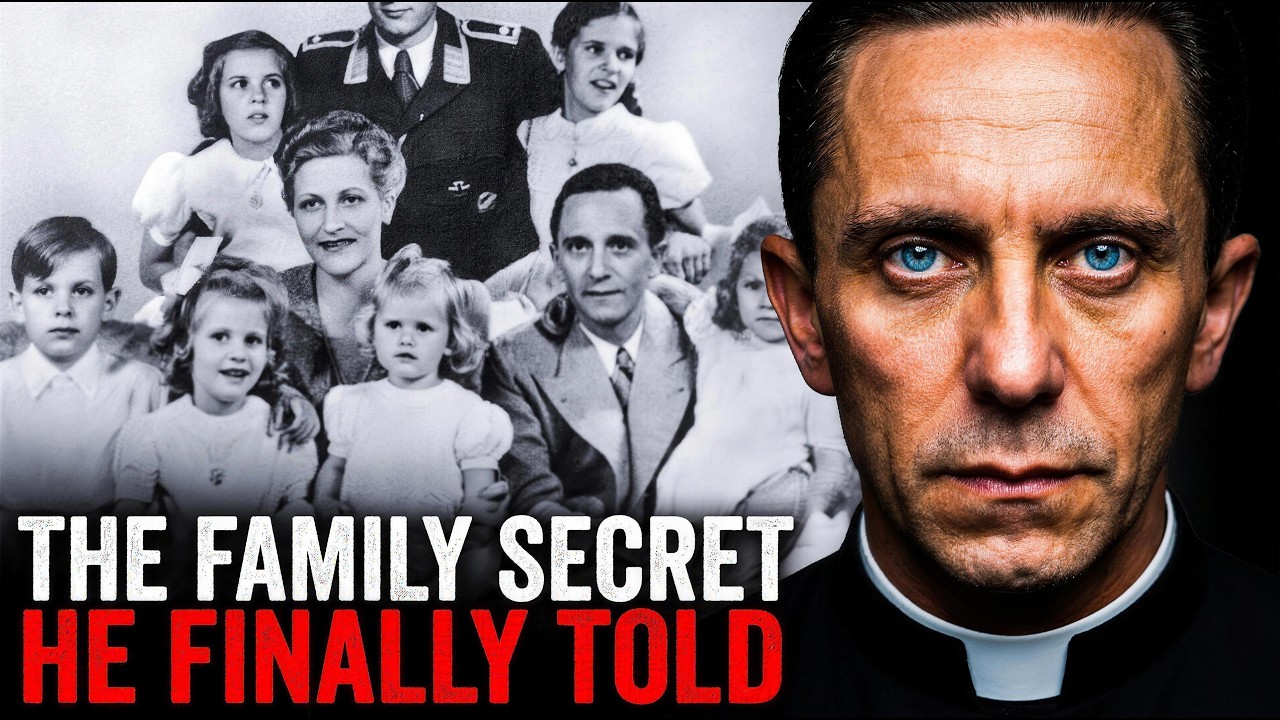
A father who was strict and remote yet wrote embarrassingly tender love letters. A mother who bore ten children for the glory of the Reich and quietly approved of her husband’s mistress. A family life so entangled with the machinery of the Nazi state that even birthdays and baptisms became instruments of political theater. What did Gerta Bormann’s son actually reveal about that household?
By the early 1940s, Martin Bormann senior had maneuvered himself into position as arguably the second most powerful man in Nazi Germany. He controlled access to Hitler, managed the Party Chancellery, and quietly accumulated authority over almost every domestic decision that crossed the Führer’s desk. Contemporaries called him the brown eminence, a man who worked in shadows while others claimed the spotlight. He was coarse, ruthlessly ambitious, and utterly without sentiment toward political rivals.
Yet inside his own household, a different and stranger dynamic took hold, one built on ten children, an isolated mountain estate, and a wife raised from childhood to believe that everything the Nazi movement demanded of her was natural and holy. Martin Adolf Bormann was born on April 14, 1930, in Grünwald near Munich. His mother Gerta was barely twenty. Born Gerda Buch on October 23, 1909, in Konstanz on the shores of Lake Constance, she was the eldest of four children of Major Walter Buch, a decorated First World War officer who had joined the Nazi Party as early as 1922 and eventually rose to become chairman of the party’s own internal court.
Growing up in the Buch household meant growing up steeped in National Socialist ideology from the earliest possible age. Gerda was exposed to anti-Semitic rhetoric and radical nationalist politics from around the age of eleven, absorbing it the way other children absorb nursery rhymes, without ever encountering a competing worldview. As a teenager, she watched a steady parade of young, ambitious Nazi men pass through her father’s household. Among them was Martin Bormann, nine years her senior, already a rising figure within the party apparatus.
Whether the match was genuine romantic attraction or a marriage brokered between an ambitious subordinate and his patron’s daughter remains a matter of historical debate. The practical effect was clear: Bormann’s marriage into the Buch family in September 1929 gave him a direct line into the party’s inner sanctum. Adolf Hitler and Rudolf Hess stood as witnesses at the wedding. For a young woman taught since childhood that a woman’s highest calling was devotion to husband, children, and Führer, having Hitler himself at her wedding must have felt like the ultimate validation of everything she had been raised to believe.
Seven months later, Martin Adolf Bormann arrived. The child’s very name signaled what kind of household he would grow up in. He was baptized in the German Evangelical Church with Adolf Hitler standing as godfather. The honor followed him for the rest of his life in the form of a nickname whispered around the Nazi elite: Krönzi, a mocking, affectionate shortening of Kronprinz, crown prince.
Within the closed social circle of the Obersalzberg, the joke carried a real edge of truth. As the eldest son of Hitler’s most trusted administrator and the Führer’s own godson, young Martin occupied a position no other child in the Third Reich, apart perhaps from the offspring of Joseph and Magda Goebbels, could claim to rival. Over the following thirteen years, Gerta Bormann gave birth to nine more children. There was Ilse, born in 1931, whose name was later changed to Eike after Rudolf Hess’s flight to Scotland in 1941 made the family reluctant to keep naming children after a man now branded a traitor.
There was Irmgard, born in 1933. There was Rudolf Gerhard, born in 1934 and later renamed Helmuth for the same reason his sister had been renamed. There was Heinrich Hugo, born in 1936 and nicknamed Heiner, named for his godfather Heinrich Himmler, the Reichsführer SS himself. There was Eva Ute.
There was a second Gerda, born in 1940, named for her mother. There was Fritz Hartmut, born in 1942. And finally Volker, born in 1943, who would not survive childhood. For bearing this staggering number of children, Gerta Bormann was awarded the Gold Cross of Honor of the German Mother, the highest tier of a medal instituted by the regime in 1938 to celebrate women who produced eight or more children for the Reich.
She had, in the coldly biological language of Nazi ideology, outproduced even Magda Goebbels, the woman Hitler publicly styled as the Mother of the Nation. In the summer of 1936, when Martin Jr. was six, the family relocated to the Obersalzberg, the mountain retreat above Berchtesgaden where Hitler had built his alpine residence, the Berghof. The move placed the Bormann children inside what was effectively a walled political fortress, a restricted area known as the Führersperrgebiet, sealed off from the outside world by guards, checkpoints, and barbed wire, populated almost exclusively by the families of the Nazi elite and the army of staff required to service them.
Martin Jr. and his siblings grew up playing alongside the children of Albert Speer, Hitler’s architect and later armaments minister, within sight of the mountain panorama that postcards and propaganda films had turned into a symbol of German natural grandeur. They were present, at least in the background of family photographs, at New Year celebrations hosted by Hitler himself, where Eva Braun’s private albums captured images of the Bormann and Speer children mingling with the Führer’s inner circle as though it were the most ordinary thing in the world. In later life, Martin Jr.
would describe this period with a mixture of irony and genuine unease as a kind of paradise. A childhood spent carefree and sheltered on a mountainside while unspeakable crimes were being organized in offices not so very far away. He described his father as a man characterized above all by severity. Martin Bormann senior was a stern disciplinarian who demanded absolute obedience and showed little of the warmth a child might crave.
Yet he was also dutiful in a way many of his fellow Nazi leaders were not. Whatever his political demands, he made a point of visiting his wife and children whenever his schedule allowed, insisting on close oversight of their schooling and moral formation. Martin Jr. would later draw a careful distinction, one that reveals just how complicated the process of reckoning with a monstrous parent can be.
He separated the father he had personally known as a child, a man who was strict but whom he nonetheless loved, from the political figure whose crimes he came to understand only much later and whose actions he unreservedly condemned. That distinction between the private father and the public criminal became the central tension running through everything he eventually revealed. His mother presented a softer though no less ideologically committed presence. Gerta Bormann took on the role of the nurturing parent within a household where discipline was considered the father’s domain.
She sang to her children, drew pictures with them, and read them stories. She was by every measure available to historians a committed and unapologetic anti-Semite. A woman whose worldview had been formed in a household devoted to National Socialism from before she could walk, and who never once in any surviving letter or record expressed doubt about the rightness of the cause. She was, in the words of one historian who has studied the wives of the Nazi leadership, the very incarnation of what the regime demanded of German womanhood: modestly dressed, endlessly fertile, and unwaveringly loyal to a husband she treated as her natural superior.
One detail surfaces again and again in accounts of the household. Visitors to the Obersalzberg were reportedly left uncomfortable by the sight of the supposedly cultured Reichsleiter whistling through his fingers to call his wife to his side the way one might call a dog. Gerda would comply immediately, without hesitation or visible resentment. In private, however, the same gruff, domineering man turned out to be a startlingly sentimental correspondent.
Martin Bormann’s surviving letters to Gerda, later published as a historical record, are filled with clumsy, almost childlike tenderness that stands in jarring contrast to his public reputation. In one letter, he asked in a tone of near worship who was everything to him, who was his highest happiness, who was his greatest wealth, who was his most beautiful treasure, before answering his own question: Mommy. This was the same man, his son would later note with resigned bitterness, who could shout at his children and kick out at them in anger within the same household where he penned those lines. Perhaps no single detail captures the strangeness of the household quite like the story of his father’s mistress.
Around 1940, Martin Bormann senior met a Dresden-born stage actress named Manja Behrens at a film festival and eventually established her as his long-term lover, a relationship he made no serious effort to hide from his wife. What followed was not the confrontation one might expect. Gerda did not merely tolerate the affair. She appeared to actively endorse it, framing the arrangement as the natural fulfillment of duty for what she considered an honest National Socialist household.
In one letter that has since become notorious among historians, Gerda instructed her husband on how to manage his double life with chilling practicality, telling him to arrange things so that Behrens bore a child one year and Gerda herself bore one the next, ensuring, in her words, that he would always have a wife who remained serviceable to him. She went further, suggesting in correspondence that a law should be passed after the war, modeled on precedents she believed existed after the devastation of the Thirty Years’ War three centuries earlier, permitting healthy and capable German men to take a second wife in order to help repopulate a nation that had lost so many of its young men in combat. For the children growing up inside that household, the presence of their father’s mistress was simply another fact of life, absorbed the way children absorb whatever arrangement the adults around them present as normal. The rhythms of daily life for Martin Jr.
and his siblings followed a pattern designed to produce loyal, disciplined future servants of the Reich. Ideology was woven into the ordinary fabric of the household. Several of Gerda’s children were never baptized at all, a direct reflection of both parents’ open hostility toward organized Christianity. Martin Jr.
himself, baptized in 1930 before his parents had fully hardened their anti-religious stance, would later be one of the only children in the family to have received any formal religious rite at all. A detail that takes on considerable irony given the path his life would eventually take. On May 10, 1940, just ten years old, Martin Jr. was sent away from the Obersalzberg to begin his formal schooling at the Reichsschule der NSDAP in Feldafing, an elite Nazi Party academy on the shores of Lake Starnberg, designed to mold the sons of the party’s leadership into the next generation of functionaries.
At Feldafing, the curriculum emphasized not only conventional academic subjects but also physical training, ideological instruction, and an aggressively anti-religious nationalist worldview. He would later describe this education as having conditioned him to interpret Hitler’s death and Germany’s final collapse in 1945 not as liberation but as an apocalyptic ending. The end, full stop, of the only world he had ever known. Letters exchanged between Martin Bormann senior and Gerda throughout the war years reveal a household attempting to maintain an appearance of domestic normalcy even as the military situation deteriorated.
In one letter from October 1944, Gerda wrote to her husband about listening to an opera broadcast on the radio, interrupted repeatedly by reports on enemy air activity overhead, and passed along gossip about the wives of other Nazi officials evacuated from Berchtesgaden ahead of Allied bombing raids. The tone is almost eerily domestic. Part of what makes Martin Jr. ’s later testimony so valuable to historians is the window it opens onto his nine younger siblings, most of whom lived almost entirely outside the public record until their eldest brother began speaking and writing about them decades later.
His sister Ilse, renamed Eike, would grow into adulthood only to die relatively young in 1957 or 1958, her adult life largely shielded from public scrutiny. Irmgard and Helmuth both grew up navigating a surname that after 1945 became one of the most notorious in Germany. Heinrich Hugo, nicknamed Heiner and named in honor of his godfather Heinrich Himmler, carried perhaps the heaviest symbolic burden of all, tied by his very name to the architect of the Holocaust’s administrative machinery. Eva Ute, the second Gerda, Fritz Hartmut, and the youngest Volker, who did not survive childhood, rounded out a family whose sheer size meant its wartime and postwar experiences varied enormously from child to child.
As the war ground into its final phase, the fragile bubble began to shatter with terrifying speed. By early 1945, with Allied and Soviet forces closing in from both directions, the once-secure Obersalzberg compound became a target rather than a sanctuary. Fifteen-year-old Martin Jr. , still enrolled at his party academy, now relocated to Mauterndorf in the Tyrol region as Allied bombing made the Feldafing campus untenable, found himself increasingly cut off from reliable information about his parents and younger siblings.
On April 15, 1945, with Allied forces pressing deeper into Austria, the academy closed its doors for good. A party functionary in Munich advised the fifteen-year-old to make his way toward his mother, who had by then fled the Obersalzberg with eight of her children and taken refuge in the still German-occupied hamlet of Völlan in the Val Gardena valley of the South Tyrol. Martin Jr. never managed to reach her.
Instead, he found himself stranded in Salzburg, a fifteen-year-old boy alone in a city convulsed by the final agony of a regime his entire family had helped build. In Salzburg, a Gauleiter, one of the very officials whose careers had depended on loyalty to men like Martin Bormann senior, recognized the danger the boy was in and provided him with false identity papers, understanding that the name Bormann had almost overnight become one of the most notorious surnames in Europe. Carrying this false identity, young Martin made his way into the Salzburg Alps and found hospitality with a Catholic farming family headed by a man named Nikolaus Hohenwarter at a mountain homestead called the Kotalm, situated halfway up a remote slope. The family took the boy in and treated him as one of their own, feeding him, sheltering him, and asking few questions.
For a boy raised inside a fortress reserved for the families of Nazi power, this was his first genuine encounter with a family whose kindness had nothing to do with political calculation or ideological obligation. Meanwhile, his mother’s fate was unfolding along a far darker trajectory. After Germany’s surrender in May 1945, Gerda Bormann, still sheltering with eight of her ten children in Völlan, was located by Allied authorities and subjected to intense interrogation by officers of the CIC, the joint American-British intelligence body tasked with tracking down high-ranking Nazi officials and their families. She was held in the prison at Völlan, denied visitors, and denied the ability to correspond with her scattered children.
In the autumn of 1945, prison authorities transferred her to a hospital in the Italian city of Merano after she began showing signs of serious illness. Doctors soon discovered uterine cancer, almost certainly present and untreated for some time. Some accounts suggest that treatments administered during this period, including mercury-based compounds then still sometimes used in cancer care, may have hastened rather than slowed her decline. Gerda Bormann died in the prison hospital at Merano on either March 23 or April 23, 1946, depending on which historical source one consults, at the age of thirty-six, having outlived her husband by less than a year.
She was buried without ceremony in a military cemetery in a grave she shared with an unrelated German soldier before her remains were later exhumed, cremated, and scattered at sea. Her sixteen-year-old son did not learn of her death through any official notification. He learned it by reading about it in a newspaper article in the Salzburger Nachrichten, alone in his small room at the farmhouse where he had been sheltering under a false name, an oil lamp providing the only light. He would later describe crying through the night, hiding his face out of a shame he could not entirely explain.
It was only after learning of his mother’s death that Martin Jr. finally confessed his true identity to Hohenwarter. The farmer in turn reported the boy’s identity to the local priest serving the parish of Weißbach bei Lofer, who then referred the matter up the chain to the rector of the church of Maria Kirchtal, a pilgrimage church nestled deep in the Austrian Alps. Rather than turning the boy away, the rector took him into the church’s care.
It was there that Martin Bormann Jr. began the process that would define the rest of his life: conversion to a faith his parents had actively despised, immersion in a community built on precisely the kind of unconditional Christian charity that his family’s entire worldview had dismissed as weakness. While serving as an altar boy at Maria Kirchtal, still a teenager processing grief and the collapse of everything he had once believed, Martin Jr. was arrested by American intelligence officers who held him for several days of interrogation at Zell am See before ultimately releasing him and returning him to his parish, apparently satisfied that a sixteen-year-old altar boy posed no meaningful threat.
Gradually, Martin Jr. was able to reestablish contact with his scattered siblings, several of whom had also been taken in by sympathetic families or religious institutions. Remarkably, given how thoroughly their childhood had been structured around an ideology fiercely hostile to organized religion, nearly all of the surviving Bormann children eventually found their way into the Catholic Church in the years after the war, much as their eldest brother had. Only one sister among the group did not.
Martin Jr. remained with the parish at Maria Kirchtal for several years before making the decision to join the religious congregation of the Missionaries of the Sacred Heart based in Ingolstadt. On July 26, 1958, at the age of twenty-eight, he was ordained a Catholic priest. The godson of Adolf Hitler now stood at an altar, having formally dedicated his life to the faith his parents had scorned.
In 1961, he was dispatched to the newly independent Republic of the Congo to serve as a missionary in a region convulsed by the chaos of decolonization. He labored in conditions of genuine hardship, ministering to communities devastated by poverty and political violence. His time in the Congo was cut brutally short in 1964 when the Simba rebellion erupted across the eastern regions of the country, a violent uprising that saw missionaries, foreign nationals, and perceived government sympathizers targeted for kidnapping, torture, and execution. Martin Jr.
was forced to flee along with dozens of other missionaries and foreign workers, a narrow escape noted by the New York Times, which reported his return along with twenty-five others. Undeterred, he returned to the Congo in 1966 for a further year of missionary service. Several years after his final return from Africa in 1969, Martin Jr. suffered a near-fatal injury, the precise circumstances of which remain somewhat obscure.
During his long convalescence, he was nursed back to health by a Catholic nun named Cordula. In the early 1970s, both made the momentous decision to leave their respective religious vocations, and in 1971, the former priest and former nun were married. The couple would remain together for decades, though they never had children of their own. Leaving the priesthood did not mean leaving his vocation behind entirely.
Martin Jr. transitioned into a career as a teacher of theology, a role he would continue until his retirement in 1992. For most of these teaching years, he remained a relatively private figure. The question of what had become of his father remained maddeningly unresolved for decades.
Martin Bormann senior had last been reliably seen in Berlin on May 1 or 2, 1945, attempting to escape the ruins of the city alongside a small group that included Hitler’s personal physician. What happened after that point remained a genuine mystery, fueling endless speculation that he had escaped to South America. Bormann was tried in absentia at the Nuremberg trials in 1946, convicted of crimes against humanity and war crimes, and sentenced to death by hanging. For Martin Jr.
and his siblings, this meant living for decades under the shadow of genuine ambiguity, with sensational and almost certainly false sightings reported from South America and hidden compounds well into the 1960s and 1970s. The mystery was finally resolved in December 1972 when construction workers excavating near the Lehrter Bridge in Berlin uncovered a skeleton that forensic examiners subsequently identified through dental records and later, in the 1990s, through DNA analysis as the remains of Martin Bormann senior. The evidence strongly suggested he had died on the night of May 1 to May 2, 1945, most likely by suicide via a cyanide capsule after encountering Soviet troops while attempting to cross the Spree River. For Martin Jr.
, the discovery brought a strange, belated closure. To fully appreciate how unusual Martin Bormann Jr. ’s eventual openness actually was, it helps to consider how differently most other children of the Nazi leadership chose to handle their family inheritance. Gudrun Himmler, the only child of Heinrich Himmler, took the opposite path entirely, spending her long life as a staunch and unrepentant defender of her father’s memory, joining the secretive organization Stille Hilfe to provide support to fugitive and imprisoned former SS members, and never once expressing the kind of moral reckoning that came to define her exact contemporary Martin Bormann Jr.
Edda Göring, the only daughter of Hermann Göring, took a starkly different path as well, living in relative seclusion while remaining fiercely loyal to her father’s memory. Wolf Rüdiger Hess, the only son of Rudolf Hess, spent much of his adult life campaigning tirelessly for his father’s release from Spandau Prison and framing Hess’s 1941 flight to Scotland as a genuine peace mission. The contrast between these responses and Martin Jr. ’s decades of public reckoning illustrates just how differently the children of history’s worst perpetrators process the same fundamental inheritance of guilt by association.
Martin Jr. ’s own memoir, Leben gegen Schatten, meaning life against shadows, appeared in German in 1996 and would later be translated and published in other languages, including Czech. Beginning around 2001, already past his seventieth birthday, he began touring schools across Germany and Austria, standing before rooms full of teenagers to speak at length, often for two hours at a stretch, about his childhood. Students, parents, and invited guests who attended these talks, including one memorable session at Munich’s Edith-Stein-Gymnasium that drew roughly two hundred attendees, would later describe the experience as both fascinating and deeply unsettling.
After the formal lecture concluded, he would remain to answer questions directly from students. His willingness to speak did not stop at the borders of German-speaking Europe. Martin Bormann Jr. traveled to Israel to meet directly with Holocaust survivors, a journey that placed the godson of Adolf Hitler face to face with people whose lives and families had been shattered by the very regime his father had helped administer.
In late December 2010 and into January 2011, a story broke in the Austrian press that cast a deeply troubling shadow over the carefully constructed narrative of contrition Martin Jr. had spent decades building. A man who had been a twelve-year-old pupil at an elite Catholic boarding school in Salzburg in the early 1960s, run by the Missionaries of the Sacred Heart, came forward with an allegation that Bormann, who had worked at the school as a priest and schoolmaster during that period, had raped him. Other former pupils from the same institution and era came forward as well, describing a pattern of severe physical violence inflicted on boys under Bormann’s supervision, painting a picture of a post-war disciplinary regime hidden behind monastery walls in which children were subjected to constant religious discipline, physical brutality, and military-style drilling.
Bormann himself was described by former students as physically fit, secretive, vain, and prone to explosive, brutal fits of temper. By the time the accusations became public, Martin Bormann Jr. , then in his eighties, was already suffering from dementia, a condition that left him unable to respond to the specific charges. No criminal legal proceedings followed.
Instead, the matter was referred to the independent Klagsverband Commission, a body established to investigate and address cases of abuse committed by members of the Catholic Church across Austria. After reviewing the case, the commission determined that the accuser’s claims merited compensation, and he was awarded a settlement, a form of institutional acknowledgement that the allegations carried genuine credibility. The school where the allegations centered operated, according to multiple former pupils, under a regime of constant religious discipline combined with military-style drilling, an atmosphere in which physical punishment was treated as an unremarkable feature of daily education. One former pupil told journalists that the pain remained sharp enough that he wept while recounting it even after years of psychotherapy.
The last years of Martin Bormann Jr. ’s life were clouded by these allegations. He died on March 11, 2013, in the town of Herne in North Rhine-Westphalia at the age of eighty-two, having outlived both of his parents by more than six decades. His death drew relatively modest press coverage compared to the intense media attention the abuse allegations had generated just two years earlier.
Those who had attended his school lectures generally described the news with a complicated mixture of sadness and unresolved moral discomfort. There is no single word that adequately captures a life this contradictory. Martin Bormann Jr. revealed a father who was simultaneously a ruthless political operator, a strict and often frightening disciplinarian, and in his private correspondence an almost embarrassingly sentimental husband who wrote his wife letters filled with childlike declarations of love, even as he publicly summoned her with a whistle like a servant.
He revealed a mother who could sing songs and draw pictures with her children in one breath and calmly discuss the practical logistics of her husband’s mistress bearing him additional children in the next. He revealed a household of ten children raised inside a sealed mountain fortress, taught from infancy to regard extraordinary privilege and proximity to totalitarian power as simply the ordinary texture of everyday life. Most of his siblings would spend the rest of their lives either defending that inheritance or quietly burying it. In the singular case of Martin Bormann Jr.
himself, he spent decades trying to drag it into the light and examine it honestly. However incomplete and however compromised that examination ultimately proved to be.






