On the morning of July 14, 1933, a diver stood at the bottom of a pneumatic caisson in the Mississippi River at Waggaman, Louisiana, surrounded by air compressed to about 28 pounds per square inch above atmospheric pressure. He was 75 feet below the surface of the river. The water was above him. Around him was the compressed air that surface compressors forced through an airlock to keep that water out.
Beneath him lay the silt deposited by the Mississippi at that spot over 10,000 years: gray clay, fine sand, and decomposed organic material extending another 30 feet down, before the soil engineers who had run their studies the previous year confirmed a firm foundation capable of supporting construction. His job was to excavate the material beneath the cutting edge of the caisson. He did this with a water jet and a shovel. The jet broke up the sediment.
He then moved the loosened material to the center of the caisson floor, where it fell into a muck chamber, a sealed compartment through which excavated material could be removed to the surface without leaking the compressed air that kept the river out of the working chamber. The caisson above him was a steel cylinder about 40 feet in diameter. As excavation and removal continued beneath the cutting edge, the weight of the concrete poured above drove the structure down into the riverbed. Each foot of downward progress required more digging beneath the cutting edge and more concrete above it.
The cylinder extended downward while the pier rose upward. He was one of about 40 men working in compressed air that morning. They worked shifts of limited duration because the compressed air that kept out the water also affected the nitrogen in their blood in ways doctors did not fully understand, though they had been studying the problem since the 1870s. The workers understood it differently: some men who surfaced too quickly after working in compressed air became severely ill, and some died.
The condition was called caisson disease. The men called it the bends. This is the story of how Louisiana built the southernmost fixed crossing of the Mississippi River at a site where the river is nearly a mile wide at flood stage, where the current runs 3 miles per hour at normal flow and faster when the basin is draining. The navigation channel exceeds 100 feet in depth at the main crossing, and the sediment beneath the riverbed extends another 50 feet before reaching material capable of supporting foundations designed to carry the weight of a loaded freight train at speed.
It is the story of a project that Louisiana was told for 30 years was too expensive to fund, too geologically uncertain to build, and, in the opinion of some engineers, simply too far south on the river to be founded safely on competent material. Yet it was built in 3 years and 4 months by a man who did not believe that the things others said could not be done were truly impossible, and who built roads and bridges with the same conviction he applied to everything else he touched: that the people of Louisiana had been told for too long they could not have what people in other states had, and he was determined to prove they could. That man was shot to death 3 months before the bridge opened. The bridge was named for him.
The men who built it exist in the payroll records of the contractors who employed them, in whatever form those records survived. To understand why the Mississippi south of Memphis had no fixed crossing at all in 1930, and why this remained true throughout the industrial age, one must understand what the Lower Mississippi is and what it does to structures that try to stand in it. The Mississippi at New Orleans is not the same river that enters Minnesota from Canada. It is the same water, in the sense that water draining the northern basin eventually passes through Louisiana; but by the time it reaches New Orleans, the river has gathered the drainage of 31 states and two Canadian provinces, and it carries that water through a channel it has cut, abandoned, and rebuilt across the alluvial plain of the lower valley since the last glacial retreat.
The river does not hold a fixed position. Over centuries it has occupied multiple channels across the width of the alluvial Mississippi Valley, leaving a record of its former positions in the form of oxbow lakes, cypress swamps, and ridge lines in the delta topography. The river faced by bridge engineers at New Orleans in the early twentieth century ran through a channel chosen relatively recently in geological terms, on a foundation of its own deposits. Beneath the riverbed, soft material extends 200 feet before anything resembling stable bearing capacity is found.
The river’s width at the Waggaman crossing varies with river stage. At low water, the main channel is about 2,000 feet wide. At flood, the river spreads across its banks to nearly a mile. The main navigation channel at the crossing reaches 100 feet or more in the scour holes the current has carved into the sediment at the bend.
Surface current in the navigation channel reaches 3 miles per hour under normal conditions. In the spring flood season, when snowmelt from the upper basin and rainfall from the Ohio Valley push the river to its highest stages, surface speed in the main channel reaches 5 miles per hour or more. A steel caisson lowered through 75 feet of river water to reach bearing material beneath the bed must hold its position in that current while men work inside it. Engineers calculated the lateral loads the current would impose.
The river imposed them on its own schedule. Below Memphis, no fixed bridge crossed the river until 1892, when the Memphis Bridge opened: the first crossing between St. Louis and the Gulf of Mexico that a locomotive could use without a ferry. Below Memphis, the river crosses Mississippi, Arkansas, Tennessee, and Louisiana through a valley that is flat, extremely wide, and composed entirely of the river’s own deposits, making the challenge of anchoring a pier in it without bedrock at any reachable depth the same challenge at every site, and greater the deeper and wider the river grows toward the Gulf.
The commercial importance of the lower river made any fixed crossing as much a matter of political negotiation as engineering. The river was the economic artery of the south-central region. Towboats and barges moved coal, grain, and petroleum products north and south on schedules set by commodity markets, weather, and river stage, not by the wishes of any bridge authority. Any bridge at New Orleans had to allow passage of the tallest ships on the river, had to allow their passage without disrupting commercial navigation during construction, and had to do all this on a foundation of mud while an unceasing current pushed against every structure placed in it.
The first engineering proposals for crossing the Mississippi at New Orleans appeared in the 1890s, when the Southern Pacific Railroad commissioned preliminary studies for a railroad bridge above the city at a site where the river was slightly narrower. The studies came back identical from every firm that examined the problem. The crossing was technically possible. The crossing was extremely expensive.
The foundations would have to reach depths exceeding anything the profession had achieved at any crossing above that point. The required navigation clearance would push the main spans to lengths at the edge of what the technology of the era could economically achieve. The return on investment from rail traffic alone, at the traffic volumes of the 1890s and the first two decades of the twentieth century, was unsatisfactory. Southern Pacific continued to use ferries.
It had been moving its cars across the Mississippi at New Orleans since its lines reached the city. The ferry operation moved cars one at a time on a schedule limited by vessel capacity, river conditions, and the fog that settled on the Lower Mississippi in the fall and winter months, when the water temperature remained warm from the heat stored in the river’s mass during summer while the air above it cooled as the season advanced. Freight cars lined up at the ferry landing waiting for fog to lift meant shipments stopped moving on a schedule the shipper had been promised would not stop. During the 1920s, automobiles changed the economics of bridge building across most American rivers, but not for the Mississippi at New Orleans.
The width was greater than any automobile bridge of the 1920s had been asked to span. The depth was greater. The foundation problem was more complex. The required navigation clearance was higher.
Together these factors produced cost estimates that no projected toll revenue from 1920s traffic was expected to cover. Engineers came, studied the problem, and reported what engineers studying the Lower Mississippi always determined. Politicians read the reports, and those reports were not wrong. What changed in Louisiana in 1928 was not the river.
It was not the engineering. It was not any new technology for founding piers in deep alluvial sediment. What changed was the election of Huey Long. Huey Pierce Long became governor of Louisiana in 1928 at age 35.
He came from Winn Parish in the pine hills of central north Louisiana, an origin that did not connect him to the established political class of New Orleans. He was elected on a program of roads, bridges, and schools funded by taxes on the oil companies and corporate landowners who had controlled Louisiana’s resources for decades without managing them for the benefit of the people who lived above those resources. He meant what he said. Between 1928 and 1932, Louisiana added more miles of paved roads than it had built in the previous decade.
The highway system connecting rural parishes in northern and central Louisiana to the cities of the south was built in those years, or committed to, by a governor who understood that a road you could drive to town was not an abstraction. It was a classroom your children could attend, a crop you could get to market, a doctor you could reach before disease killed you. He built the infrastructure of a state that had been allowed to fall behind by an administration more interested in managing what passed through Louisiana than in building what Louisiana needed. The Mississippi River bridge was a project of a different order entirely from the highway projects.
It was the largest single public works project the state had ever attempted. It required the cooperation of the Southern Pacific Railroad, which needed the crossing for its own operational reasons and possessed the engineering capacity and construction management experience that a bridge of this complexity demanded. It required a financing mechanism the bond market would accept, which toll revenues, railroad operating fees, and highway charges could support. It required engineers who had worked on the Lower Mississippi and understood that river’s nature.
Long got all of it. The project was authorized. Financing was arranged through a combination of state bond issues and railroad investment. Southern Pacific would build and operate the railroad portion.
Louisiana would build the highway component, two narrow lanes mounted on either side of the railroad truss structure, and would operate the highway crossing. The engineering was assigned to Modjeski & Masters, the firm whose principal, Ralph Modjeski, had designed more major American bridges than any other engineer of his generation, including bridges over the Ohio, the Missouri, and the Upper Mississippi, where the sediment problem existed but was less severe than at Waggaman. Modjeski’s firm came to the Lower Mississippi and did what engineers must do before designing anything that must stay in one place. They characterized the site.
They measured the river’s depth along the proposed crossing alignment. They drilled soil samples through the riverbed and sent the samples to a laboratory to determine the bearing capacity of the material at various depths below the bed. They measured current velocities at the proposed pier locations under different river stages. They surveyed commercial vessel traffic and determined the navigation clearances required by river traffic for the foreseeable future of the commerce the river carried.
Their conclusion was that the main spans over the navigation channel required a clearance of 135 feet above the highest navigable water stage to accommodate the vessels that river traffic was generating and would generate as barge technology continued to develop. The 135-foot clearance over a 2,000-foot navigation channel at that stage of the river required main spans of a length that the cantilever truss configuration could achieve at a cost the financing structure could support. This was something the suspension bridge configuration could not achieve at a cost the bond market would accept. The design called for a continuous cantilever truss bridge.
The main span was set at 790 feet. Approach spans carried the structure across the full width of the river and its slopes on both banks. Total length of the crossing, including approaches, was about 4. 4 miles.
The pier foundations required pneumatic caissons. There was no alternative engineers could identify with confidence. The depth of the river at the main pier locations, the depth of soft sediment below the riverbed, and the force of the current against any open cofferdam structure made the pneumatic method the only approach with a proven record on similar foundations. The caissons would be sunk through the riverbed to the bearing material identified by the borings, and concrete would be poured through a water seal to fill the caisson shell and form the foundation on which the pier would be built.
The pneumatic caisson foundation is an effective method, but it kills people. The physics behind it is direct and simple. A hollow cylinder is set on the riverbed with its cutting edge in the sediment. Compressed air is pumped into the working chamber at the bottom, displacing the water that would otherwise fill it.
Men enter the working chamber through an airlock, excavate material below the cutting edge, and the caisson sinks under its own weight and the weight of the concrete added above. When the cutting edge reaches the bearing material identified by the engineers, excavation stops. The chamber is filled with concrete through underwater placement. The caisson becomes the foundation.
The compressed air required to keep out water at 70 feet is about 30 pounds per square inch above surface atmospheric pressure. At that pressure, the nitrogen in the compressed air dissolves into the blood and tissues of the men working in the chamber at a rate proportional to the pressure and the duration of exposure. If a man decompressed slowly, passing through gradual pressure reductions over an appropriate period, he allowed the nitrogen to come out of solution gradually through the lungs. He then left the caisson safely.
If he decompressed too quickly, the nitrogen came out of solution as bubbles. The bubbles formed in joints, in muscles, in the spinal cord, and in the brain. The pain they caused ranged from severe joint aches to paralysis. Cases reaching the spinal cord or brain could be fatal.
The decompression schedules developed during the 1910s and 1920s on bridge projects using pneumatic caissons were known to the engineers of the Huey P. Long Bridge project. They had already been established. Men working at 28 to 30 pounds per square inch required roughly 75 to 90 minutes of staged decompression after a standard shift.
The actual working time in the caisson per shift was limited by this requirement, meaning the rate of production per shift was constrained not only by how fast men could excavate sediment, but by how long they could safely remain inside the chamber before beginning the decompression process. The caisson workers at Waggaman received a wage premium above the ordinary labor rate. That premium reflected the nature of the work, something the men who did it understood by the standards available to workers in Louisiana during the Depression year 1933, standards having to do with what the job paid compared to what the alternatives paid. And what the risk was compared to the risk of no job at all.
The alternatives available to a Black worker in Jefferson Parish in 1933 were agricultural labor at low wages in a cotton and sugar economy that had been shrinking since 1927, or domestic work at less than the construction rate, or unemployment. The construction wage at Waggaman, including the premium, was more than that. The caisson crew passed through the airlock at the start and end of each shift. The airlock operator managed the pressure differentials and the decompression sequence.
Whether every operator on every shift managed it correctly over the 18 months of work at Waggaman is a question the payroll records of the Walsh Construction Company do not answer, and the payroll records are the principal record that survives. The medical records of the men who suffered caisson disease while working at Waggaman, and the records of the outcomes of those cases, exist in no widely published account of the bridge. Living in the river construction camp at Waggaman in the summer of 1933 meant living in Gulf Coast summer heat on a riverbank that offered no relief from the heat it generated. The surface temperature of the Mississippi at Waggaman in July exceeds 80 degrees Fahrenheit.
Air temperature above that water at that latitude in July ranges from the low to mid-90s. The humidity produced when air touches a river surface at that temperature in that climate is humidity that dew point measurements at the New Orleans weather station consistently recorded above 75 degrees in the morning hours, and that did not drop significantly through the workday. A worker operating a water pump in a compressed air chamber 70 feet below a river surface in these conditions worked in a space where the compressed air itself raised the temperature above surface conditions, where there was no cross-ventilation, no shade, no air movement beyond what the machinery produced, in a chamber lit by electricity and filled with the noise of compressors operating through the walls above him. He left the chamber after his shift and passed through the decompression lock to emerge into July air on the west bank of the Mississippi.
The air on the west bank was only a few degrees cooler than the air in the caisson, not dramatically different. The construction camp provided sleeping quarters and food service facilities. The Mississippi at Waggaman offered no mitigation of the summer heat it generated. Above the caisson foundations came the ironworkers who erected the steel truss from the erection crews of the American Bridge Company, a subsidiary of United States Steel, whose fabrication shops and erection divisions had been installing major bridge steel throughout the country for decades.
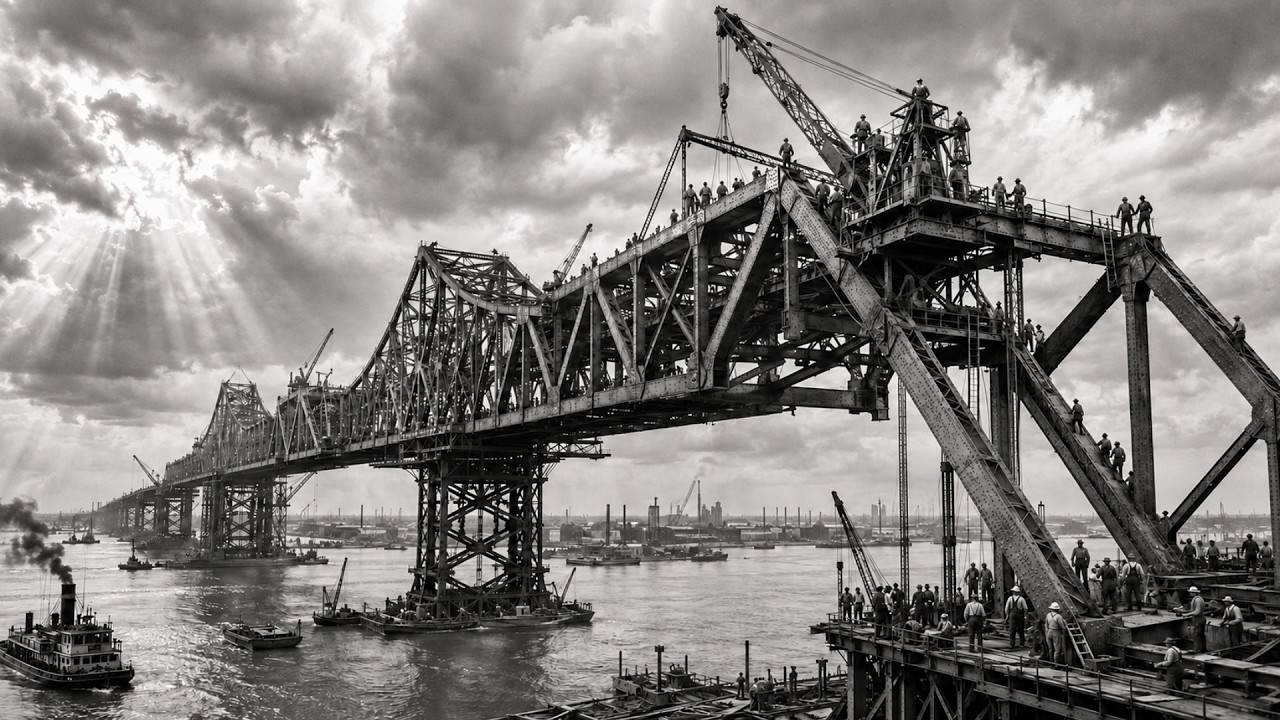
The truss members for the main spans were fabricated in American Bridge shops and shipped by rail to New Orleans, then transferred to barges for delivery to the construction site at Waggaman. The river that made the crossing necessary was the same river that carried the steel to build it. Erecting a cantilever truss over the navigation channel of the Mississippi while commercial traffic continued beneath it required a construction sequence coordinated with the Army Corps of Engineers, which controlled navigation on the river, and with the towboat operators whose barge fleets moved through the crossing alignment on schedules set by commerce rather than construction requirements. The erection sequence extended the cantilever arms of the truss outward from the main piers on both sides of the navigation channel simultaneously, advancing toward a mid-span closure point while the river ran below at whatever stage the basin produced.
The ironworkers who built the truss over the navigation channel worked at heights ranging from 70 feet above low water at the bottom chord to more than 130 feet at the peak of the top chord of the main span. The river beneath them was the Mississippi at whatever stage it happened to be. At 130 feet above the water surface in the fall and winter months, when fog rose from the warm river into the colder air above it and reduced visibility from one end of the span to the other, the men walking the top chord of the truss they could not fully see relied on touch, on the positions of the members they had placed in previous shifts, and on the understanding of the structure that experienced ironworkers acquire through years of working steel at heights. Fog forms on the Lower Mississippi in November and December when the temperature of the river surface, warmed by heat the water stored all summer, meets an air temperature that drops as the season advances.
The resulting condensation can cover the entire river surface within an hour of the early-morning temperature inversion. A construction crew starting its shift in December could find itself unable to see the pier it was working on across the width of the span it was erecting. Navigating those conditions on an incomplete truss above the main channel of the Mississippi required a kind of attention to position and footing that ironworkers acquire only through experience, and that experience does not make the work safe, only less dangerous. One man fell from the top chord of the main span 130 feet into the navigation channel of the Mississippi.
The river at that point moves at 3 miles per hour toward the Gulf of Mexico. A man falling into water moving at 3 miles per hour from a height of 130 feet faced conditions that the safety boats stationed below the work area were positioned to respond to, and the response time was subject to what the river allowed, the boat’s speed, and the distance. The current moved downstream, regardless of where the safety boat was stationed when the man fell. The construction crews understood what the work required and what it risked.
Ironworkers who build high steel structures above running water understand these things before they accept the job. They accept the work for the pay it provides, and because men who have done this work for years have developed a relationship with risk that is professional rather than fatalistic. They know which movements are safe and which are not, and what the difference looks like from a given position on a given member of the structure. That understanding is not infallible.
It was not infallible at Waggaman. The deaths on the Huey P. Long Bridge project were not collected in any widely available public record. Death documentation for construction in Louisiana in the early 1930s fell under state labor laws that were less comprehensive than those enacted in later decades.
The river environment around the crossing added complexities not faced by the records of land-based projects. A man who fell into the Mississippi from a height and whose body was not recovered downstream is a man whose death may not appear in the death records of the construction site in a way a researcher can easily find 90 years later. The circulated accounts record the story of the bridge completed. The uncirculated accounts record the full cost of completing it.
Huey Long was shot on the evening of September 8, 1935, in the corridor of the Louisiana State Capitol in Baton Rouge. He was 42 years old. He had served as a United States senator since 1932, when he moved from the governorship to the Senate while retaining, through his political organization and personal authority over Louisiana politics, a kind of operational influence over the state government that the constitutional separation of those offices would have prevented anyone of a different temperament from maintaining. He had made the enemies that anyone makes who tells people they have been governed for the benefit of others, and that this situation was coming to an end.
His enemies included the oil companies, the New Orleans political elite, and the Franklin Roosevelt administration, with which he disagreed over the pace and goals of the New Deal. Carl Weiss, the doctor who shot him, came from a family that had been in conflict with Long’s political organization over a redistricting matter. The circumstances of the shooting and its aftermath were examined and disputed by historians over the decades that followed. Long died two days after the shooting.
The bridge at Waggaman was nearly complete. He never crossed it. The steel structures had been erected, the roadway finished, painting was underway, and the approach structures on both banks were ready. The bridge that Long had forced into existence against the advice of the bond markets, the inertia of the political class, and the customary professional skepticism of the engineers who had previously studied the Lower Mississippi crossing and concluded it was prohibitively expensive.
That bridge was completed. He was dead. The Louisiana Legislature named it for him. The Huey P.
Long Bridge opened on December 16, 1935, 97 days after his death. Attending the opening ceremony that day were officials of the Louisiana Highway Commission, officers of the Southern Pacific Railroad, elected officials of Jefferson and St. Charles Parishes, and the political figures who inherited Long’s organization and would govern Louisiana in the years after his passing. There were speeches at both ends.
There was a ribbon. Photographs taken that morning show officials, engineers, and railroad officers at the highway entrance on the east bank. The workers who had spent 3 years excavating pneumatic caissons 85 feet below the Mississippi riverbed and erecting steel trusses 130 feet above the navigation channel were not at Waggaman on December 16, 1935. A construction workforce does not remain at a project site after the contract is complete.
The ironworkers from the American Bridge erection crew moved to the next installation job, wherever the company had work. The caisson crews dispersed to whatever work came next, which for ordinary laborers on large construction projects in Louisiana during the Depression might mean another project if one existed, or a return to the agricultural labor market from which many had come. The construction camp on the west bank was cleared. The barges and equipment were towed away.
The officials in the opening photographs exist in the administrative history of the Louisiana Highway Commission and the records of the Southern Pacific Railroad. The engineers whose names appear on the design drawings exist in the technical literature of the profession, where Modjeski & Masters is referenced in connection with every major bridge the firm designed, which is most of the major bridges built in America in the first half of the twentieth century. The governor for whom the bridge was named exists in the political history of the United States, where the debate over what he was and what he meant has continued unresolved since the day he died. The men who ran the caissons 85 feet below the Mississippi in compressed air, and the men who set the steel 130 feet above the navigation channel, exist in the payroll records of the Walsh Construction Company and the American Bridge Company, in whatever form those records survived the years since 1935.
The bridge carried the traffic it was built for from the day it opened. The Southern Pacific Railroad, which had been ferrying its cars across the Mississippi at New Orleans for decades, now crossed in minutes instead of hours. Freight that had waited at the ferry landings through fog, high water, and equipment failure now moved on a fixed structure the river could slow in flood but could not stop. The highway lanes carried traffic in Jefferson, St.
Charles, and St. John Parishes across the river without the vehicle capacity constraints imposed by the ferry schedule. The highway lanes were narrow. The two cantilevered lanes on either side of the railroad truss were designed within the dimensional constraints imposed by truss engineering, and the result was lanes wide enough for the vehicles of 1935 to cross, while the vehicles of later decades crossed with diminishing comfort as vehicle widths increased.
The bridge authority eventually imposed width restrictions that prevented trucks and vehicles wider than 8 feet 6 inches from using the original spans. This restriction was not a design failure in the sense of the structure performing below its specified capacity. It was a dimension set in 1932 applied to a traffic environment that continued to change over the following 80 years. The parallel highway bridge that eventually supplemented the original crossing was not built by a single decision.
Expanding the crossing’s capacity was proposed, studied, and debated over the decades in which traffic volumes on the original bridge made that restriction relevant to the regional economy it served. The new highway bridge opened in stages in the first decade of the 21st century, and with both structures in service, the full crossing carries the automobile and truck traffic the original bridge could not carry, plus the railroad traffic for which the original structure was built, on the same river, above the same caisson foundations, above the same sediment the caisson crews excavated in 1933. The Huey P. Long Bridge is still in service.
Southern Pacific no longer exists as a commercial entity. It was merged into Union Pacific in 1996, but the trains crossing at Waggaman now carry Union Pacific logos on the same steel structure Southern Pacific built in 1935. The freight they carry moves in the same direction commercial freight has always moved along the Lower Mississippi, toward the Gulf or away from it, depending on season, commodity, and market conditions. At mid-span of the main bridge, 135 feet above the Mississippi at normal stage, the river’s current runs at 3 miles per hour in the navigation channel below.
The channel beneath the main span is 90 feet deep in the scour hole. The current has scoured the alluvial sediment since the bridge piers changed the flow geometry of the water in 1935. That same current has worked on the concrete surfaces of the caisson foundations since the construction crews finished them. Inspection teams that dive through the water column on scheduled inspection cycles examine the concrete, measure any deterioration, record what they find, and file a report to the maintenance crew that decides what needs repair and when.
The foundations are still where the caisson crews left them. They were excavated to the depth the 1932 engineers determined was sufficient to reach the bearing layer identified by the soil samples, where men worked in compressed air 85 feet below the riverbed because the river above them allowed no other method. The identified bearing layer has not moved. The foundations set into it have not moved.
The bridge has been in service since December 16, 1935. The men who came out of those caissons after their shifts and passed through 90 minutes of staged decompression before the pressure equalized and the airlock door opened on the west bank of the Mississippi in the summer of 1933 are recorded in the payroll records of the companies that employed them. The men who walked the top chord of the truss bridge in December, through the fog 130 feet above the navigation channel, and set the steel where the drawings indicated, are recorded in those same records. Their names are not on the bridge.
The bridge bears the name of a governor who was killed three months before it opened, who never drove across it, and whose legacy remains disputed in Louisiana 90 years later. The caisson workers are in the payroll records. The ironworkers are in the payroll records. The men who excavated the bed of the Mississippi in compressed air to give the bridge something to stand on are in those records, in whatever form they have survived.
The current moves through the scour hole below the main pier at 3 miles per hour. The fog rises from the river in November when the water is warm and the air is cold. The bearing material lies 85 feet below the riverbed, where the blow counts indicated and where the men who reached it left it.
The bridge is still there.






