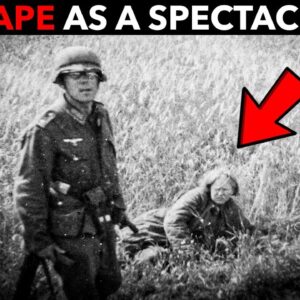
On January 22, 1943, Soviet troops entering the village of Alexeyevka near Stalingrad found a front-line prisoner camp that defied description: more than 1,500 uncollected corpses lying before the…
The warning order came down the line in the second half of 1942, when the Red Army’s counteroffensive at Stalingrad had already begun to turn the war. Every day at five in the morning, the prisoners in the camp at Aleksandrovka were lined up and driven out to work. They dug trenches, gathered grass from … Read more
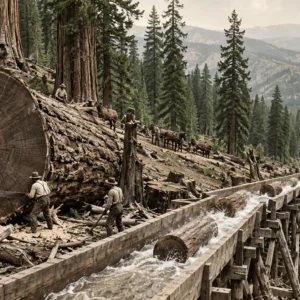
In 1890, a California lumber company finished a 54-mile wooden flume to send giant sequoia logs down a mountain on running water. The trough, a V-shaped channel on trestles, crossed a granite…
The wooden V ran across the canyon toward the horizon, a long trough on stilts, and in front of it stood a sequoia stump so wide that a dozen men could stand on top of it with room to spare. Some of those trees took a crew nearly two weeks to cut through. And when … Read more
In 1936, Los Angeles police dispatched 136 officers to sixteen checkpoints along California’s 700-mile border, ordered to stop anyone entering withoutNaN
In the autumn of 1935, a 1927 Ford Model T, caked in the dust of half a continent, ground west along a cracked ribbon of road. A mattress was lashed to its roof with baling wire, a tin wash tub swung from the running board, and inside, a father gripped the wheel with the sunken … Read more
In 1955, American automakers controlled over 90% of the domestic car market, and a GM line worker could buy a new car every two years, own a home, andNaN
In 1955, American automakers controlled more than 90 percent of the domestic car market. The country was laying down the Interstate Highway System, suburbs were filling with families who needed wheels, and Detroit, the fourth largest city in America, was the engine of it all. A factory job paid enough to buy a house, raise … Read more
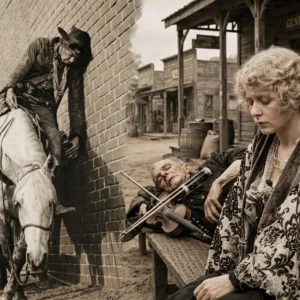
In the 1870s, you could walk into a drugstore in Tombstone and buy opium, morphine, cocaine, and cannabis over the counter, sitting right beside the soap. Laudanum, opium dissolved in alcohol,…
The shot glass slid down the bar, the dusty gunfighter threw back one last drink before the big showdown, and the dark interior of a Tombstone saloon did its best to live up to every movie ever made about the Old West. The whiskey part was never far off from reality. But the bottle in … Read more
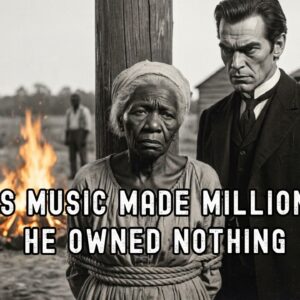
In 1887 Alabama, 63-year-old Elma knelt in the mud while wealthy planter James Thornehill kicked dirt into her face. She didn’t flinch. Her silence only fed his rage. Then a deep, guttural howl…
The whip cracked once, and Elma did not flinch. She knelt in the mud of the Thornhill plantation, a sixty-three-year-old woman whose back was bowed by decades of cotton picking, whose hands were twisted like tree roots, and whose knees shot sharp pain through her body with every breath. The rich plantation owner kicked dirt … Read more
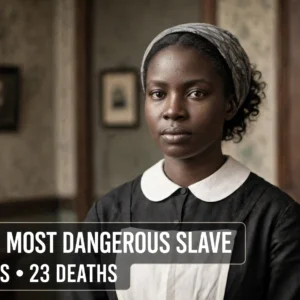
In April 1847, Samuel Rutledge bought an enslaved woman named Rachel at a Mobile estate sale for just $400, far below the usual price for a skilled house servant. The listing noted she was…
On a July night in 1847, a storm split the great oak near the main house at Fairmont plantation down the center, and in the days that followed, a quiet woman named Rachel watched her work take root. She had been in Limestone County, Alabama, for only three weeks, purchased at an estate sale in … Read more

In 1846, a plantation owner locked his pregnant wife inside a decaying barn with 19 enslaved people, not to punish her, but to test a theory: that fear could reshape a human mind more completely…
It was 1846, and the night sky was so black it swallowed the moon. On a sprawling plantation, in a decaying barn at the edge of the property, a man locked his pregnant wife inside. Not with kindness, not with protection, but with nineteen enslaved people. Nineteen lives forced into submission. Nineteen bodies trapped in … Read more
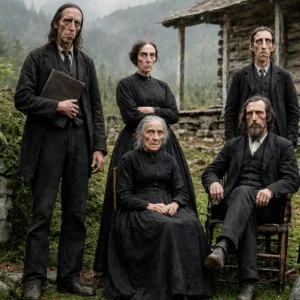
In 1931, four federal surveyors walked into Bleak Water Fork, a sun-starved hollow in the Smokies where black water runs cold even in August. Three days later, only the youngest came back. A boy…
October 1931. Four men walked into a hollow called Bleakwater Fork, deep in the Smoky Mountains of eastern Tennessee. They carried steel chains, a brass transit, and a federal mandate to map every acre of the ridge before the new national park swallowed the land whole. Three days later, only one of them came back … Read more
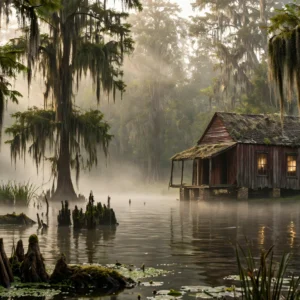
In 1911, surveyor Ovid Sonnier traveled deep into Louisiana’s Bayou Malfeu to measure cypress timber, guided by an old boatman named Onésime Landry. When drought lowered the water, Sonnier…
There are stretches of low country where the water does not flow, but decides its own fate. It keeps what it wants and lets the rest slip toward the gulf, and no one there argues with it. You learn its moods the way you learn the temper of a person you fear. Quiet when it … Read more