
A Government at a Standstill: Political Deadlock, Public Strain, and the Erosion of Trust
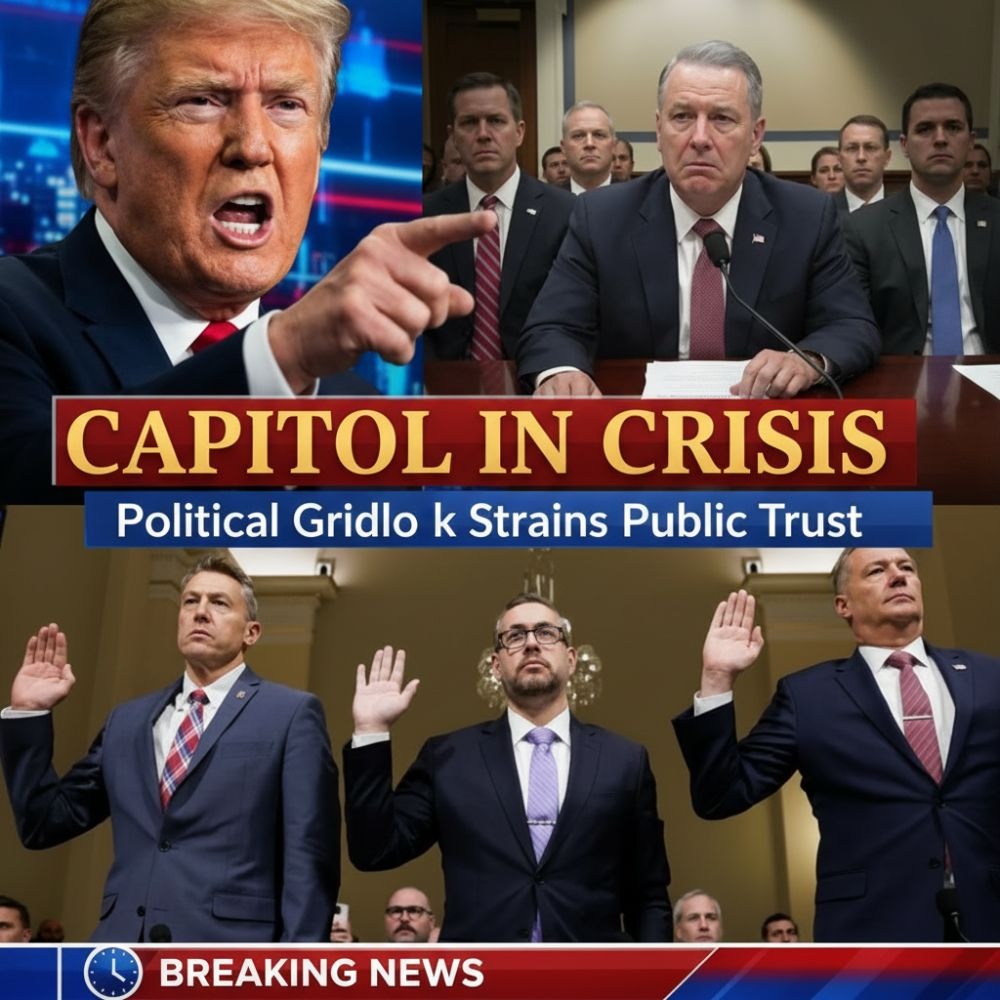
In the thirty-third day of a partial federal government shutdown, the United States finds itself caught in a moment of profound political dysfunction—one that is reverberating far beyond the halls of Washington and into the daily lives of ordinary citizens. What began as a dispute over legislative priorities has evolved into a broader crisis of governance, exposing structural weaknesses, intensifying partisan divides, and raising urgent questions about accountability, leadership, and democratic norms.
At the center of the impasse is a familiar cast of political actors, most notably Donald Trump and a deeply divided Congress. Yet the consequences of their stalemate are being borne not by lawmakers or lobbyists, but by tens of thousands of federal workers, including those tasked with ensuring the safety and efficiency of the nation’s transportation infrastructure.
Airports Under Pressure: The Human Cost of Political Gridlock
Few places illustrate the tangible effects of the shutdown more vividly than America’s airports. The Transportation Security Administration (TSA), responsible for screening millions of passengers daily, has been operating under extraordinary strain. Approximately 50,000 TSA officers have been required to work without pay, a situation that has led to rising absenteeism, declining morale, and a growing number of resignations.
Reports from major travel hubs indicate that as many as 10% of TSA agents have called in sick on certain days, resulting in security lines stretching for hours. In some cases, passengers have missed flights altogether, while others have opted to cancel travel plans entirely. Airport authorities have warned that if staffing shortages continue, partial closures may become unavoidable.
The situation has grown so dire that some airports have resorted to asking travelers to bring food or gift cards for TSA agents—an extraordinary measure that underscores the severity of the crisis. For many workers, the inability to receive a paycheck has meant difficult choices between paying rent, buying groceries, or covering childcare expenses.
“These are not abstract policy debates,” said one aviation analyst. “These are real people, with real lives, being caught in the crossfire of political brinkmanship.”
A Political Stalemate Rooted in Process, Not Policy
What makes the current shutdown particularly striking is the nature of the disagreement itself. According to multiple sources within Congress, the impasse is not primarily about ideological differences or major policy disputes. Instead, it revolves around procedural disagreements—what some lawmakers have described as “paperwork.”
This distinction has fueled frustration among both federal employees and the general public. While political leaders engage in tactical maneuvering, the machinery of government has slowed to a crawl, leaving essential services in limbo.
Democrats have emphasized the need to restore normal operations and ensure that federal workers receive their paychecks. Republicans, meanwhile, have focused on advancing legislative priorities related to immigration enforcement and election security. Neither side has shown a willingness to compromise, resulting in a prolonged standoff with no clear resolution in sight.
The “Save Act” and the Politics of Electoral Control
Complicating matters further is the introduction of controversial legislation known as the Safeguard American Voter Eligibility Act, or “Save Act.” Championed by allies of Donald Trump, the bill is ostensibly aimed at preventing voter fraud. However, critics argue that it represents a broader effort to reshape the electorate in ways that could advantage one party over another.
One of the most contentious provisions would require voters to present documentation that precisely matches their legal name. This has raised concerns about the potential disenfranchisement of married women who have changed their surnames, as well as other individuals whose documentation may not align perfectly.
Voting rights advocates warn that such requirements could create significant barriers to participation, particularly for marginalized communities. “This is not about protecting the integrity of elections,” said one legal expert. “It’s about restricting access to the ballot.”
The debate over the Save Act has intensified partisan tensions, with Democrats accusing Republicans of undermining democratic norms, and Republicans countering that election security is a legitimate and necessary concern.
Energy Policy and Personal Grudges
In an unexpected twist, the administration has also been linked to efforts to halt the development of offshore wind farms along the East Coast. According to reports, officials have considered allocating up to $1 billion in federal funds to block projects led by a French energy company.
These wind farms, particularly those planned for New York and North Carolina, are expected to generate enough electricity to power up to one million homes annually. Proponents argue that they represent a critical step toward reducing reliance on fossil fuels and combating climate change.
However, critics suggest that opposition to the projects may be influenced by longstanding personal grievances. Two decades ago, Donald Trump reportedly opposed a wind farm near a golf course development in Scotland, citing concerns about aesthetics. Although he ultimately lost the legal battle, observers note that his skepticism toward wind energy has persisted.
“This raises serious questions about the role of personal bias in shaping public policy,” said an environmental policy analyst. “When decisions of this magnitude are influenced by individual preferences, it undermines the credibility of the entire system.”
Confirmation Hearings and Questions of Competence
The political drama has extended to the Senate, where confirmation hearings for key प्रशासन appointments have become increasingly contentious. One such hearing involved Markwayne Mullin, a nominee for a senior homeland security role.
During the proceedings, Mullin faced intense scrutiny from lawmakers, including Rand Paul, who questioned his qualifications and judgment. The exchange was particularly heated given Mullin’s previous comments appearing to justify a physical assault on Paul by a neighbor in 2017.
Paul used the hearing to challenge Mullin directly, asking him to explain his remarks and defend his stance. Mullin’s responses were widely viewed as evasive, further fueling concerns about his suitability for the position.
Adding to the controversy were reports of Mullin’s past behavior, including public challenges to physical altercations and references to outdated practices such as dueling. Critics argue that such conduct is incompatible with the responsibilities of overseeing national security.
Intelligence Oversight and Ethical Concerns
Meanwhile, lawmakers have also turned their attention to the intelligence community, questioning senior officials about reports of questionable fundraising practices. In particular, allegations have surfaced that supporters of Donald Trump were offered access to private national security briefings in exchange for donations.
During a congressional hearing, both John Ratcliffe and Tulsi Gabbard were asked to address these claims. Their responses, which included statements of unfamiliarity with the alleged communications, did little to reassure skeptical lawmakers.
Ethics experts have expressed alarm at the implications of such practices, noting that the commodification of sensitive information could pose significant risks to national security. “The idea that classified briefings could be tied to political donations is deeply troubling,” said one former intelligence official. “It blurs the line between governance and campaigning in a way that is fundamentally inappropriate.”
Public Sentiment and the Erosion of Trust
As the shutdown drags on, public frustration has reached a boiling point. Polls indicate declining confidence in both the executive branch and Congress, with many Americans expressing a sense of disillusionment with the political process.
Interviews with voters reveal a growing perception that elected officials are more focused on partisan battles than on addressing the needs of their constituents. Even some longtime supporters of Donald Trump have begun to voice doubts about his leadership.
“I voted for him multiple times,” said one respondent in a recent survey. “But this situation has made me question whether that was the right decision.”
Such sentiments highlight a broader crisis of trust, one that extends beyond any single policy dispute. When citizens lose faith in their leaders, the foundations of democratic governance are weakened.
The Broader Implications
The current shutdown is not merely a temporary disruption; it is a symptom of deeper systemic issues. The increasing polarization of American politics has made compromise more difficult, while the concentration of power in the executive branch has raised concerns about accountability.
At the same time, the reliance on brinkmanship as a negotiating tactic has created a cycle of recurring crises, each with escalating consequences. From delayed paychecks to disrupted travel plans, the costs are being borne by those least able to absorb them.
Experts warn that unless structural reforms are implemented, similar situations are likely to arise in the future. Potential solutions include changes to budgetary procedures, greater protections for federal workers, and mechanisms to ensure continuity of essential services.
Conclusion: A Test of Democratic Resilience
As the United States navigates this period of uncertainty, the stakes could hardly be higher. The ability of its political institutions to function effectively—and to serve the interests of the public—will be tested in the days and weeks ahead.
For now, the lines at airports grow longer, the paychecks remain unpaid, and the debates in Washington continue without resolution. Whether this moment will serve as a catalyst for meaningful change or merely another chapter in an ongoing cycle of dysfunction remains to be seen.
What is clear, however, is that the consequences of inaction are no longer theoretical. They are visible, immediate, and deeply human. And as the shutdown persists, the question facing the nation is not just how to reopen the government, but how to restore faith in the system itself.