The sheriff’s horse refused the last stretch of the Notch Road, and Silas Redcliffe was not a man who argued with livestock. He dismounted, tied the rein to a laurel, and told Deputy Enoch Bledsoe to do the same. They went the rest of the way on foot, the smell of wet April earth thick around them, and when they reached the clearing they found the cabin door closed. That alone was unusual.
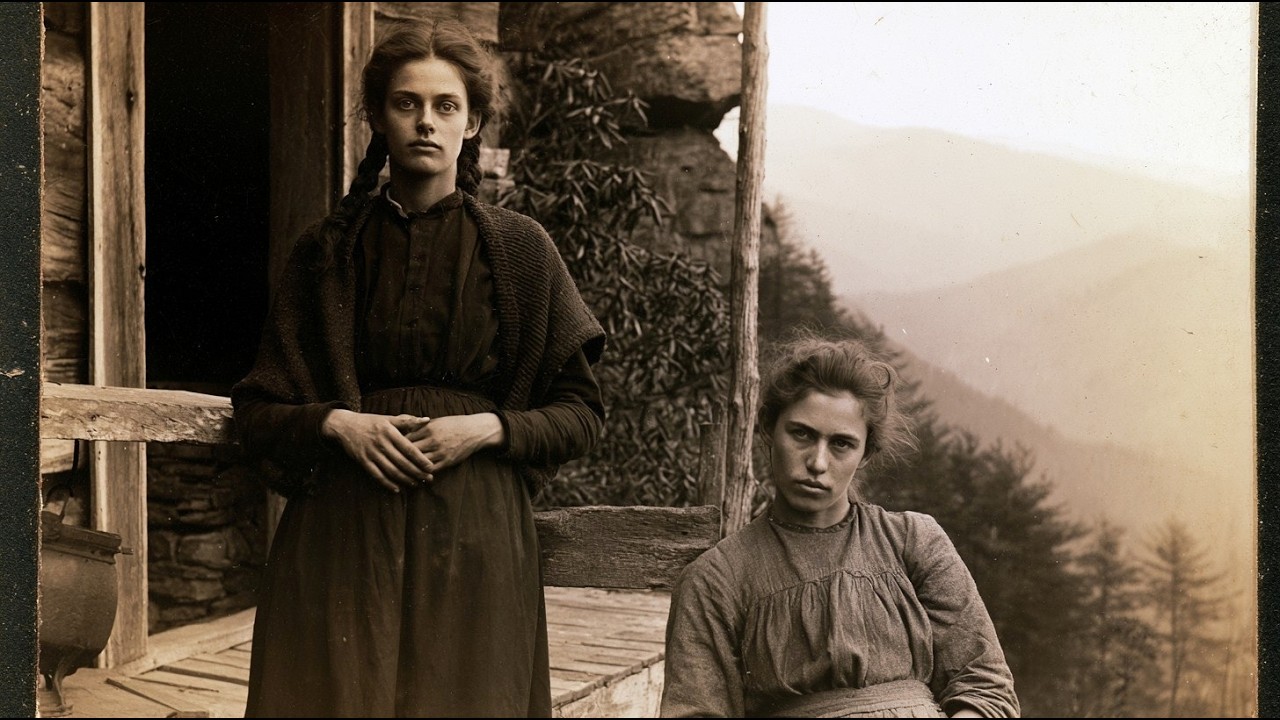
In Letcher County in 1897, nobody locked a door, because there was no reason to. A closed door was a statement, and the statement had been made. Redcliffe knocked. No answer.
He knocked again, called out the names Mercy and Tabitha Otwell. From inside came a single sound that Bledsoe would swear to for the rest of his life: a chair being dragged across a floor. No footsteps. No voice.
The sheriff knocked a third time and said he had not come to make trouble, only to ask about reports he had received concerning their neighbors. The door opened. Mercy Otwell stood in the gap. She looked, Redcliffe noted later in his official report, like a woman who had not slept in a week.
Her hair was down. Her eyes were the same pale cold gray he remembered from a funeral the year before. She did not look at him. She looked over his shoulder, up the road, at something beyond him.
Then she said, and he recorded her words exactly: they had been expecting him, but not so soon. He asked where her sister was. Tabitha, she said, was resting. He asked if he could speak to her.
No, Mercy said, and she was sorry. He asked what was wrong. She looked at him for a long moment, then stepped out onto the porch and pulled the door shut behind her. In a low, careful voice she told him that something had come in.
Redcliffe asked what she meant. She told him that her family had followed a certain way of doing things for a long time. Her mother and grandmother had known it. The land above the spring house was never left unchecked.
Her father, in the last year of his life, had come to believe the care was superstition, so he stopped. He went up the hill in November of 1889 to prove there was nothing to fear. That was why he never came back. Since that month, she and Tabitha had kept the care with twice the precision their mother had taught them.
Their mother had died in 1893, and after that they kept it alone, and it held. The minister’s visit, she said, was not the cause of what was happening. She wanted the sheriff to know that. But the visit had been noticed.
Something had used it as a door. Something had followed him back down the mountain. And after three weeks, it had come back. This time, she said, it had brought a companion.
Redcliffe did not laugh. He had spent eleven years as sheriff of Letcher County, long enough to know that when a woman like Mercy Otwell spoke to you in a low, careful voice on her own porch, you did not laugh. He asked what she wanted him to do. She wanted him to go back down the mountain.
She wanted him to tell the widow Ora Threadegill to burn the sage she had been given, and to keep a lamp burning for the next three nights. She wanted him to tell Uriah Threadegill not to walk his upper line at dusk until mid-June. She wanted him to leave Minister Corrin alone, and to tell him, if it could be done without frightening him, to burn the notebook he had been writing in. She and Tabitha, she said, would handle the rest.
She said it the way a woman spoke of routine work. Redcliffe said he could not simply leave. If there was a problem, he was the man whose job it was to fix it. Mercy Otwell looked at him then and said, very quietly, that this was not his kind of problem, and that his help would only make it worse.
His revolver, she said, was a bell. She had no time to explain what she meant, and she was sorry for that. And then she said the last thing she ever said to him on that porch: if he entered the cabin, he would see something he would carry with him for the rest of his life. She was not asking him as a suspect asked a sheriff.
She was asking him as a neighbor asked a neighbor not to come in. He did not go in. Bledsoe wanted to. Bledsoe was twenty-nine years old and had something to prove.
Redcliffe, who had watched eleven years of twenty-nine-year-olds trying to prove themselves, put a hand on his chest and turned him around. They walked back to the horses. They rode down. When they passed the widow Threadegill’s cabin, Redcliffe dismounted and knocked, and told her about the sage.
She went inside without answering him, came back out with the bundle in a pair of fire tongs, and put it in her stove. When they passed Uriah Threadegill’s yard, the sheriff called out the message. Uriah raised a hand from his porch and did not get up. When they reached the sawmill at last light, Bledsoe reined in and said, in a voice Redcliffe had never heard from him, that he had heard singing on the road behind them for the last mile.
The sheriff said he had heard it too. Bledsoe asked what they were going to do about it. Redcliffe said to keep riding. The road went quiet after that, and stayed quiet.
The story of what happened inside the Otwell cabin does not come from the sheriff, because the sheriff never went in. It comes from two sources. The first is Mercy Otwell’s own account, given three weeks later, sitting at the kitchen table of the widow Ora Threadegill. The second is Minister Elphinstone Corrin’s notebook, which stopped mid-sentence on the ninth day and was never finished.
Mercy described twenty-two days of something being in the house. Twenty-two mornings of waking in a cabin that was no longer entirely theirs. Twenty-two nights of hearing something settle into a chair behind a wall. She did not use the word haunted, not at first.
But when she did, Ora Threadegill wrote it down, crossed it out, and wrote it again, because she wanted the account to be correct. Mercy said the cabin was occupied, the way a country is occupied by a force that was not invited and cannot, at that moment, be removed. In the first week she tried the simple things her mother had left her. She washed the floor with vinegar and salt.
She turned every mirror in the house to the wall. On the third night she buried a piece of iron under the threshold. None of it worked. On the fifth night she sat holding her mother’s old handkerchief, and for the only time in her life she asked her mother aloud what to do.
She heard no answer. What she heard was a sound from the kitchen, exactly the sound of her mother’s shoes on the floorboards. She knew, without checking, that the kitchen was empty. She stayed where she was.
She put the handkerchief back in the drawer, and from that night on she stopped asking. Mercy did what her mother had taught her. She lit a candle in each of the four corners of the front room and sat with them until they burned down. She did this every night of the first week, with Tabitha, and nothing happened, and she began to hope, cautiously, that she had been wrong.
On the eighth night, Tabitha woke her around three in the morning and whispered that someone was sitting in their father’s chair. Mercy looked. The chair was empty. But it was rocking, slowly, in a room with no draft.
Mercy walked to it and put her hand on the armrest, and it stopped. The wood was warm, she said, as if a man had just stood up. Tabitha began to cry, quietly and steadily, in a way that did not sound like Tabitha at all. Mercy put her sister back to bed and sat in the chair herself for the rest of the night.
It did not rock again. But near dawn she felt a hand settle very lightly on her head, and stay there, and then disappear. She did not look up. The next night the ladle moved from the kitchen shelf to the middle of the floor.
The night after that, every door in the cabin opened at once, front and back and both bedrooms, at exactly a quarter past four in the morning. Mercy walked through the house and closed them. Tabitha followed her. On the fourth night, Mercy woke to find Tabitha standing in the yard in her nightgown.
Tabitha did not know how she had gotten there. She said a woman had asked her to come out and look. She could not remember the woman’s face, but the voice had been familiar. Mercy brought her inside and barred the door with a wooden board her father had cut for exactly that purpose, unused since 1889.
She stayed awake in the front room all night with her father’s hunting rifle across her knees, not because she believed the rifle would help, but because holding it made Tabitha, in the next room, believe everything would be all right. Ora Threadegill, testifying to the sheriff a month later, said Mercy told her all of this in a calm, steady voice, and did not cry. She apologized, at one point, for taking up so much of Ora’s afternoon. Ora told her to be quiet and made her another cup of tea.
Then Ora asked the question that mattered. Mercy’s account until that moment had been day-by-day and precise. On the ninth day, Ora noticed, something changed. Mercy looked into her cup for a long moment and said, very quietly, that on the ninth day, the thing in the cabin stopped pretending to be their father.
Ora Threadegill was sixty-eight years old and not easily frightened. That night she banked her stove, barred her door, and sat in a chair by the window with a lit lamp until dawn. She had known Sylvania Otwell. She had known Absalom.
She had held the baby Tabitha the day after her mother died and had not asked what killed her, because in that valley you did not ask, and because she knew the answer would not be the name of a sickness. For forty years Ora had spoken kindly of the family at the top of the hill and had never once thought to fear them. The family at the top of the hill, in Ora’s understanding, was the reason nothing had ever fallen apart. The Otwells were the wall.
And on the ninth day of whatever had entered the cabin, by Mercy’s careful and unafraid accounting, the wall was in trouble. Mercy told Ora what happened on the tenth night. She was in the yard knocking ash from the stove when she saw the treetops along the ridge above the spring house bend, one after another, in a slow line coming down toward the cabin. There was no wind.
She went inside. She barred the door. She woke Tabitha. She lit the four candles in the four corners.
She lit a fifth candle, the one her mother had told her to light only in the worst case, and set it in the center of the table. She and Tabitha sat across from each other, hands clasped over the table, and waited. Mercy would not say what happened that night, not all of it. She said the thing circled the cabin once, on the outside, and stopped at each of the three windows.
At each window it made a sound on the glass, like a fingernail drawn very slowly across it. Tabitha’s hand went cold in hers. Mercy did not look at the windows. The fifth candle went out at the third window, and stayed out.
Mercy said this was important. Then the circling stopped. After a long time, from up the hill, they heard a distant, grieving cry. It was not a scream and not a call.
It was the kind of cry a person makes when they understand something they did not want to understand. Tabitha squeezed her hand and whispered, in a voice she would never use again to anyone but Ora, that the cry had been in their father’s voice. Mercy squeezed back. They did not speak.
The candles burned down. Morning came, and the cabin was theirs again. That day Mercy saddled the old mule and put Tabitha on it and walked her down the mountain herself. She left her sister crying, quietly and steadily, in the front room of the widow Ora Threadegill’s house.
Ora asked where she was going. Mercy said she was coming back. Ora asked when she would come down. Mercy said, in the phrase the sheriff would later record and underline without comment, that she would come down when the care was finished.
And if it was not finished, Ora was to keep Tabitha as her own for as long as Tabitha needed keeping. There was a folded note in the drawer of the small table beside their mother’s chair, telling Tabitha where the little money was. Then Mercy walked out. She went back up the road.
That was the last time anyone saw Mercy Otwell alive in Weetbrock Hollow. That was the seventh of May, 1897. The sheriff returned on the ninth, with Bledsoe again. This time Bledsoe brought a rifle, which Redcliffe allowed, and later said was a fool thing to allow.
The horses would not even reach the flat place. They stopped half a mile short, lathered and trembling as if they had run, and the two men walked the last mile and a half in the rain. When they reached the cabin, the door was open. The front room was perfectly in order.
The four candles stood in the four corners of the hearth, burned down to nubs. The fifth candle on the table had burned completely, and wax had run over the table’s edge to form a pale, smooth pool on the floorboards. The stove was cold, but not long cold. It had been used within the past two days.
There was a kettle on it, and the kettle held water, and the water was clear. Redcliffe walked through the cabin. Both beds were made. Mercy’s Bible lay on the small table beside her bed, open to the ninetieth Psalm.
Tabitha’s copper hairbrush was in her drawer. Their mother’s shawl was folded at the foot of the other bed. Nothing had been taken. Nothing had been broken.
Bledsoe, who had hunted all his life, went out the back door and walked a hundred yards up the hill behind the cabin. He came back twenty minutes later and said, in a voice the sheriff recorded without commentary, that he had found the spring house open and empty. Behind it he had found a place in the woods where the leaves were turned face down in a circle about the width of a wagon wheel. There was nothing in the center of the circle.
The ground there had been swept clean. He was ready to go back whenever the sheriff was. They went back down. Two men on exhausted horses in the last of a spring afternoon, the younger carrying a rifle he had not fired and now understood he never would, the older riding silent ahead.
Bledsoe wrote in his journal, which he kept for the rest of his life and left to his wife, that the ride down that day changed him in a way he could not describe. He wrote that he rode the narrow road understanding that the world was wider than the county, and the county was wider than the courthouse, and that there were things in the woods above the sawmill the courthouse had no papers to deal with. He wrote that at the sawmill, when Silas Redcliffe stopped his horse and told him to keep riding, he understood for the first time in his life what a sheriff was for. A sheriff’s job, he wrote, was not chiefly to arrest thieves.
It was to stand between the people of the county and the things they could not handle, and to make the small decisions in time, the decisions that kept the county from ever learning what those things were. He wrote that Silas Redcliffe made the right decision that day, and that he, Bledsoe, at twenty-nine, had not been brave enough to make it, and was glad the sheriff had been in front of him. Redcliffe filed a report. He wrote that the two women were missing.
He did not use the word vanished. He did not use the word abduction. He wrote, in his own hand, that Mercy and Tabitha Otwell, sisters of Weetbrock Hollow, had not been seen since the seventh and ninth of May respectively; that the search of the cabin found no evidence of a struggle; that the cabin and outbuildings were left in good condition; that the spring house was empty; and that the road above the sawmill had been closed, on his instruction, to traffic until its condition improved. That last line, which seems strange at first glance, is what the county kept.
The road was never reopened. In 1922, when the state surveyed a new route connecting farms to markets, a young engineer came to Letcher County to review the pass. He met with the sheriff, a different man by then, Silas Redcliffe’s nephew, who had taken office in 1916. The engineer went home.
The road was rerouted. On modern maps the Notch Road is drawn as a dotted line and marked private. No private owner is registered. Ora Threadegill kept Tabitha in her home for the rest of her life.
Tabitha did not speak from the day her sister left her at Ora’s door, except once. She helped in the garden. She sat by the fire in the evenings. Sometimes she sang, very softly, a tune Ora did not know and did not ask about.
She lived quietly in Ora’s spare room until Ora died in 1911, and then in the same room in the house of Ora’s niece, who took her in as family and asked no questions. Tabitha died in 1934 of an old woman’s cough, at sixty-five, in a bed turned to face the east because she had asked, in a written note, that it be turned. That note is the only piece of writing she left in the thirty-seven years between the day her sister walked away from Ora’s door and the day she died. It read, in an old, precise hand: please turn the bed toward the east so I can see her when she comes down.
The one time she spoke in those thirty-seven years was in 1902. She was thirty-three. Ora came into her room one morning and found her sitting up in bed, awake, eyes on the window. Ora asked if she was all right.
Tabitha answered, without turning her head, in a steady voice as if she had been speaking every day of her life, that Mercy had finished her care. Ora asked what Mercy had done. Tabitha said Mercy had finished her care and was still up there, and did not want to come down, and that Ora should not send anyone up. Ora asked how she knew.
Tabitha said she had woken up knowing. That was all. She lay back down. She did not speak again for thirty-two years.
Minister Elphinstone Corrin left Letcher County in June of 1897. He wrote to his friend in Cincinnati that he could not continue with a clear conscience. He did not say why. He took a small parish in central Illinois and died there in 1914 of pneumonia, at fifty-eight.
His notebook, which stopped at the ninth day, went to a nephew, who gave it to a historical society in the 1940s. It is now kept in a file in an archive in Chicago. The last complete entry, from the eighth day, records that he had seen a woman at the head of the gap. He knew she was a woman.
He knew she was not the older sister, and not the younger. He knew she was looking at him, and that she was smiling, and that she was standing where no woman could stand, because the ground behind her did not exist. The mountain, behind her, simply ended. Then the notebook stops.
The ninth day is a single line: God help me. Then a blot. Then nothing. Silas Redcliffe was sheriff of Letcher County until 1915.
He never spoke publicly of what happened at Weetbrock Hollow. In a private letter to his wife four years before his death, he wrote that he thought of the Otwell porch at least once a week. He wrote that in his life he had done many things he was proud of, and a few he was not, and that the thing he was most certain of was that not entering the cabin when Mercy asked him not to was the best decision he had made in his career. He wrote that he did not know what Mercy was about to do that day, but that standing on the porch looking at her face, he understood she was about to do something on behalf of all of them.
Not on his behalf. Not on her sister’s. On behalf of the whole valley. And his job that day, he wrote, was to get out of her way.
The road above the sawmill was never reopened. The cabin, as far as anyone knows, still stands. Hunters in Letcher County say they have gone up during deer season and seen it. Other hunters say they have not.
Both may be telling the truth. Those who say they have seen it say it looks maintained. They say the paint on the front door is new. They say the porch is swept.
They say the remains of four candles are still on the four corners of the hearth, and a fifth is still on the table, and the wax is still on the floor, a pale, smooth pool shaped like a palm. They also say, and these are the hunters who do not go back a second time, that the back door of the cabin, the one that leads toward the spring house, is always open. And if you are quiet at the right hour and the wind is right, coming down from the hill, you can hear from somewhere above the spring house a low, steady humming. A tune nobody quite knows, but everybody thinks they have heard before.
An old hunter named Raven Coulter, in the 1940s, sitting in the sawmill store with enough drink in him to talk, said he heard the humming and knew, without knowing how, that Mercy Otwell had been humming it since the seventh of May, 1897, and would keep humming it at the head of that gap until the thing she had gone up to meet grew tired of being held. He said he did not think it would tire. He said he thought Mercy had agreed to that, in her own quiet, careful way. Asked why she would do such a thing, he said that a woman who has tended something her whole life knows it better than anyone else.
And when the tending gets hard, the one who tends well is the one who knows the price of letting go. Mercy Otwell, he said, understood on the seventh of May what the letting go would cost the whole valley. And she, a woman who had spent her life making tea for the dying, had set the price. The county buried Tabitha Otwell in 1934, in the church cemetery below the hollow.
The minister, Dewitt Marshbanks, wrote her name in the register. He wrote it in ink, and he did not tear the page. At the graveside, in a sermon recorded in the church minutes for that Sunday, he said that a woman who had waited thirty-two years for her sister to come down from the mountain had earned a place in the record, and that whatever names had been struck from the previous minister’s register in the 1890s, he did not intend to know or to correct, but Tabitha Otwell’s name would be written in his book and would stay there. There is a small, plain stone in the churchyard.
It reads: Tabitha Otwell, 1869 to 1934, sister. That is all. No mother. No father.
Only sister. The county records go quiet after 1955, the last recorded incident, when a deputy stopped a car full of hunters trying to walk the closed road. He found them badly shaken and asked for them to be brought to the county seat and interviewed there instead of on the road, which he said he did not personally care to remain on any longer than necessary. That interview never happened, as far as anyone knows.
The deputy drove them down. He filed a brief report. He requested a transfer to another county the following week, and the request was granted. The hunters gave three separate accounts of what they had seen on the closed road.
None of the accounts matched. One said he saw a woman walking. One said he saw a light in the window of a cabin where there was no cabin. The third said nothing at all, refused to confirm or deny anything, and repeated only that the road above the sawmill was of a strange nature, that he could not describe that nature in greater detail, and that he wished to go home.
That last man, Elwood Cassinberry, forty-eight, left Letcher County that same month and never came back. He was, according to the records, the last person to attempt the Notch Road. The road does not appear on any county map printed after 1962. The land it crosses is listed in the state assessor’s office as unbuildable.
There is a note in the margin of the assessor’s book, in an old hand nobody has bothered to identify, which reads plainly: no survey. That note has been copied, word for word, into every edition of the book since 1922, and nobody in the county offices can say who first wrote it. Ora Threadegill wrote, in the last page of her small journal, which she kept and left to her niece, that she had come to believe there were two kinds of people in the world. There were those who tended things, and there were those who benefited from the tending.
She wrote that most of us live our lives as the second kind without knowing it, and die grateful for a quiet valley, never asking once who stands above us in the dark, keeping watch. That journal is still in the family. The page is not torn.






